Enterprise AI Development Case Study: Building an LLM Platform
Every AI development firm eventually hits the same wall. The demand for custom language model features grows faster than any team can ship them safely. This enterprise AI development case study documents that exact moment for the client we partnered with. They were a leading AI development solutions company serving large enterprise accounts. Their engineers were brilliant, but their delivery system was breaking.
At the start of our engagement, the client was taking an average of six weeks to move a single new client AI feature from prototype to production. Each project rebuilt retrieval, evaluation, and serving from scratch. Hallucinations slipped into production with no automated guardrail to catch them. That velocity was no longer survivable in a market measured in days.
KriraAI was brought in to fix the foundation, not patch the symptoms. We design and ship production grade AI systems for enterprises, and this was a foundation problem. This blog covers the full engagement. It walks through the problem, the platform we built, the complete architecture, the technology choices, the delivery journey, and the measured results.
The Problem KriraAI Was Called In To Solve
The client did not have a model quality problem. They had a delivery system problem. Every new engagement spun up a fresh codebase, a fresh vector store, and a fresh set of prompts. Nothing was shared, nothing was reused, and nothing was standardised across teams.
This meant that ten engineering pods were solving the same retrieval and evaluation problems ten different ways. One pod used a managed vector database. Another used an in memory index that never made it to production safely. A third hardcoded prompts into application logic with no version control at all.
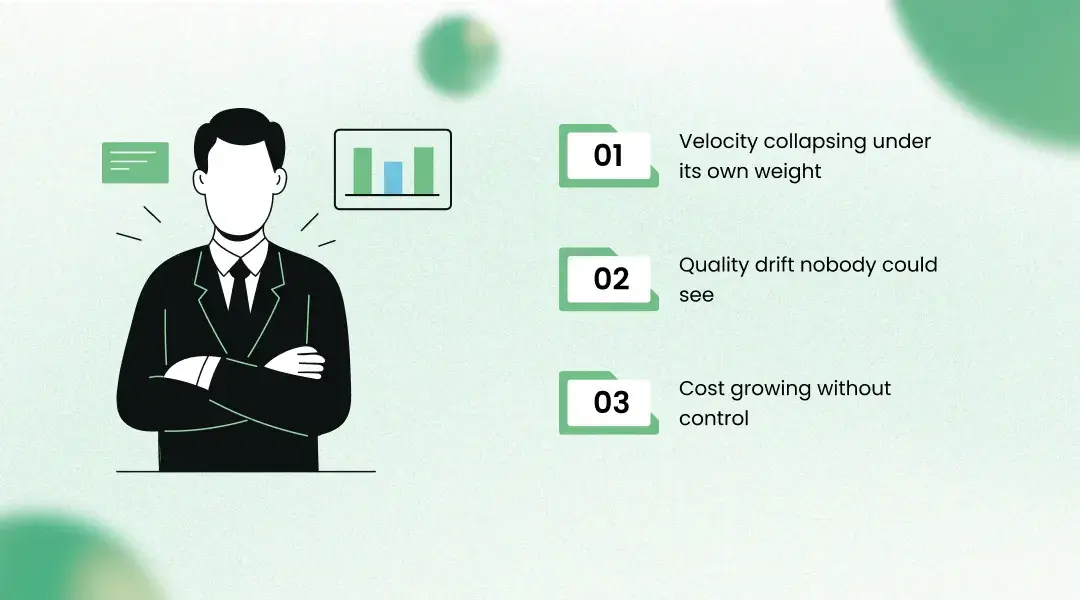
Velocity collapsing under its own weight
The most expensive symptom was time. A single new client feature took six weeks on average to reach production. Roughly half of that time was not building anything new. It was rebuilding plumbing that already existed somewhere else in the company.
The leadership team had counted the cost directly. They estimated that fifty five percent of senior engineering hours were spent on undifferentiated infrastructure work. That work created no client value and no competitive advantage. It simply kept the lights on.
Quality drift nobody could see
The second symptom was invisible quality decay. Models that performed well at launch slowly degraded as client data shifted. There was no drift detection, no held out evaluation set, and no automated alerting. Teams found out about regressions when clients complained, which is the most expensive way to find out.
Production hallucinations were the sharpest edge of this problem. A retrieval pipeline would return stale or irrelevant context, and the model would confidently answer anyway. Without an automated grounding check, those unsupported answers reached real users. For an AI development solutions company, every such incident damaged hard won client trust.
Cost growing without control
The third symptom was cost. Every team provisioned its own GPU capacity and ran full precision models with no routing logic. Cheap requests and expensive requests hit the same oversized model. Inference spend was climbing every quarter with no clear owner and no optimisation strategy.
The competitive pressure made all three symptoms urgent. Rival firms were shipping AI features in days, not weeks. The client knew that without a shared platform, they would keep losing deals on speed alone. That is the situation that brought our teams together.
What KriraAI Built
KriraAI built a unified internal LLM application platform that every engineering pod now builds on top of. Instead of rebuilding retrieval, evaluation, and serving per project, teams compose features from shared, hardened services. The platform turned a collection of one off projects into a repeatable production factory.
At its core, the platform does four things. It ingests and indexes client knowledge into governed vector collections. It serves retrieval augmented generation through a single multi model gateway. It evaluates every output automatically before and after release. It monitors live traffic for drift, latency, and grounding failures.
How a request flows end to end
A request enters through a unified inference API rather than per project endpoints. The gateway first classifies the request by complexity and cost sensitivity. Simple requests route to a quantised open weight model served on internal GPUs. Complex reasoning requests route to a larger model, so spend tracks value.
For knowledge grounded requests, the platform runs a two stage retrieval pipeline. A fine tuned bi encoder pulls candidate chunks from the vector store using approximate nearest neighbour search. A cross encoder reranker then reorders those candidates for precision. Only the top ranked, grounded context reaches the generation model.
Every generated answer passes through an automated evaluation layer before it is trusted. An evaluation harness scores groundedness, relevance, and policy compliance using an LLM as judge approach calibrated against human labels. Answers that fail the grounding threshold are flagged, blocked, or routed for fallback. This is how the platform stopped silent hallucinations from reaching users.
What it replaced inside the client
The platform replaced ten divergent codebases with one shared substrate. It replaced manual prompt files with a versioned prompt registry and structured templates. It replaced ad hoc GPU provisioning with autoscaled, quantised model serving behind one gateway. It replaced complaint driven quality control with continuous
automated evaluation.
KriraAI did not deliver a proof of concept or a demo. We delivered a hardened LLM application platform handling real production traffic across multiple client accounts. The system runs at p95 latency under 780 milliseconds and 99.95 percent availability. That reliability is what let the client trust it as core infrastructure rather than an experiment.
Solution Architecture for This Enterprise AI Development Case Study
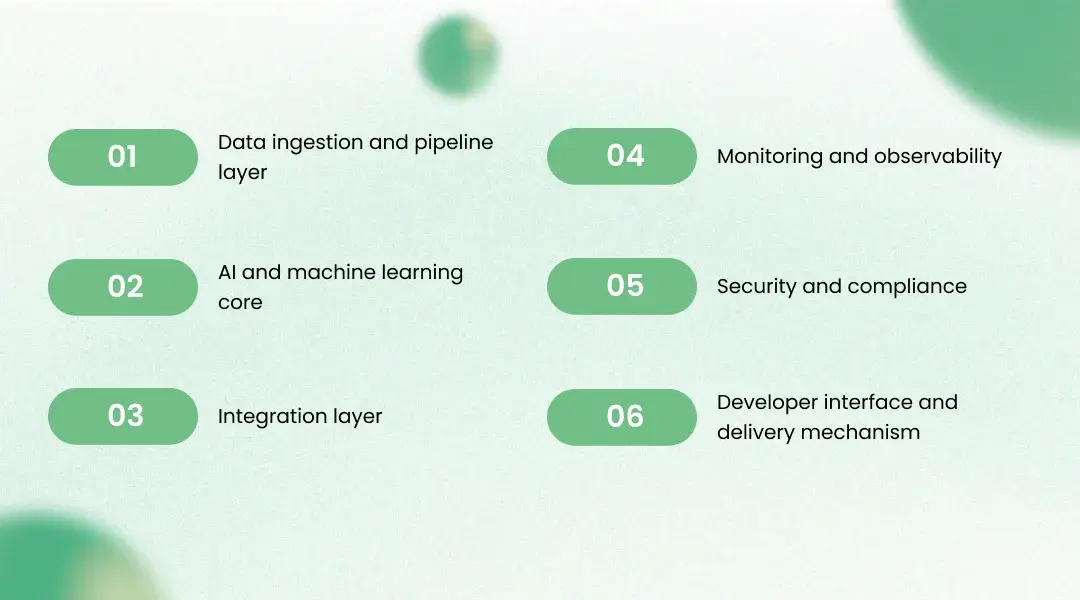
This is the technical centre of the enterprise AI development case study. KriraAI designed the platform as six clearly separated layers. Each layer has a single responsibility, a versioned contract, and independent scaling behaviour. The separation is deliberate, because it lets the client evolve one layer without rewriting the others.
Data ingestion and pipeline layer
The ingestion layer pulls client knowledge from many sources into governed collections. We implemented change data capture from operational databases using Debezium streaming into Apache Kafka. Batch document sources are extracted on schedule from object storage and enterprise content systems. Real time updates arrive as Kafka events, so indexes stay current within minutes.
Raw documents pass through a structured parsing and normalisation stage before indexing. We used a document processing pipeline to extract text, tables, and layout from mixed formats. Schema normalisation and entity resolution unify records that describe the same client entity. Embeddings are generated at ingestion time, not query time, to keep retrieval latency low.
Apache Flink handles stream processing for incremental updates and deduplication. Dagster orchestrates the batch pipeline DAGs with typed assets and clear lineage. We chose Dagster over plain Airflow because asset lineage made debugging client data issues far faster. Every chunk carries metadata for tenant, source, version, and access scope.
AI and machine learning core
The retrieval core uses a fine tuned bi encoder for the first stage of search. We adapted an open embedding model with contrastive learning on the client domain corpus. This raised retrieval recall sharply over the generic off the shelf embeddings they started with. A cross encoder reranker then scores the top candidates for final precision.
Vectors are stored in Qdrant using HNSW indexing for low latency approximate search. For the largest collections, we used inverted file product quantisation to control memory cost. Generation runs on open weight models served through vLLM with quantised weights. We applied AWQ quantisation to cut GPU memory and raise throughput without meaningful quality loss.
A mixture of experts model handles the heaviest reasoning workloads where capacity matters most. Lighter requests use smaller dense models, selected by the gateway router. For domain specific tasks, we applied supervised fine tuning with LoRA adapters on curated client data. Preference alignment used direct preference optimisation against labelled good and bad responses.
Integration layer
The integration layer connects platform outputs to the client systems that act on them. External traffic uses versioned REST and GraphQL contracts so client apps upgrade safely. Internal services communicate over gRPC for low latency calls between gateway, retrieval, and evaluation. This split keeps public contracts stable while internal services iterate quickly.
Event driven integration ties asynchronous work together through Kafka topics and consumers. When an evaluation flags an answer, a webhook triggers downstream review and logging workflows. Long running jobs such as reindexing run as durable workflows on Temporal. That design prevents partial failures from corrupting client knowledge collections.
Monitoring and observability
The observability layer is what gives the platform its production credibility. We track data drift using population stability index and KL divergence against baseline distributions. When input distributions shift past a defined threshold, the system raises a drift alert automatically. Retrieval and generation quality are scored continuously against a held out evaluation set.
Latency is tracked at p50, p95, and p99 across every service in the request path. Prometheus collects metrics, Grafana visualises them, and OpenTelemetry carries distributed traces. We used Evidently to monitor feature and embedding distribution shift over time. When quality crosses defined thresholds, an automated retraining trigger opens a review task.
Security and compliance
Security was non negotiable, because the platform handles confidential data from many client accounts. We implemented role based access control with attribute level masking on sensitive fields. Tenant isolation ensures one client's vectors and logs are never visible to another. Model inputs and outputs are encrypted in transit and at rest.
The platform runs inside a private virtual private cloud with no public model endpoints. All access flows through authenticated internal gateways and audited service accounts. Every request and response is written to an immutable append only audit log. The design was built to support SOC 2 and ISO 27001 controls that enterprise buyers demand.
Developer interface and delivery mechanism
The delivery layer is an internal developer portal and a typed SDK. Engineers compose features by calling shared retrieval, generation, and evaluation services through the SDK. A prompt registry stores versioned templates with rollback, so prompt changes are reviewable. Dashboards expose cost, latency, and quality per project to both engineers and leadership.
The Technology Stack Behind This Enterprise AI Development Case Study
Every technology in this enterprise AI development case study was chosen against the client's real constraints. They already ran on AWS, so we built on EKS for Kubernetes orchestration. Karpenter handled GPU node autoscaling, which let expensive capacity scale to zero when idle. Terraform defined all infrastructure as code, so environments stayed reproducible and auditable.
For the data plane, we chose Kafka on managed MSK because the client already trusted it operationally. Flink handled stream processing where exactly once semantics mattered for index correctness. Dagster won over alternatives because its asset lineage cut data debugging time dramatically. These choices reduced operational risk by reusing skills the client already had.
For the AI plane, Qdrant was selected for its strong filtered search and tenant isolation support. vLLM was chosen for serving because of its high throughput continuous batching. AWQ quantisation cut GPU cost while preserving answer quality within tight tolerances. PyTorch, Hugging Face Transformers, and PEFT powered fine tuning with LoRA adapters.
For reliability, Prometheus, Grafana, OpenTelemetry, and Evidently formed the observability backbone. Temporal handled durable workflows so reindexing never left collections half updated. Redis served as a low latency cache for hot retrieval results and rate limiting. Each choice was deliberate, and each one mapped to a specific client constraint rather than fashion.
How We Delivered It, The Implementation Journey
KriraAI delivered the platform in five phases over a focused engagement. We sequenced the work so the client saw value early and risk stayed contained. Each phase had clear exit criteria agreed with their engineering leadership. This is the honest account of how the enterprise AI deployment actually unfolded.
Discovery and requirements mapped every existing pipeline, model, and integration in the client estate.
Architecture design produced the six layer blueprint and the shared service contracts.
Development built the ingestion, retrieval, gateway, and evaluation services iteratively.
Testing and validation hardened the system against real traffic and adversarial inputs.
Deployment and handover migrated pods onto the platform and transferred full ownership.
The data quality challenge
The first hard challenge appeared during ingestion. Client documents were inconsistent, with duplicated records and missing metadata across sources. Our initial retrieval recall was disappointing because the embeddings could not handle domain jargon. The generic embedding model simply did not understand the client's specialised vocabulary.
We solved this in two moves. First, we added entity resolution and deduplication into the ingestion pipeline. Second, we fine tuned the bi encoder with contrastive learning on the client corpus. Retrieval recall at five jumped from sixty eight percent to ninety one percent after this work.
The evaluation calibration challenge
The automated evaluation harness misfired early in testing. The LLM as judge flagged correct answers as ungrounded too often, creating noisy false alarms. Engineers started ignoring the alerts, which defeated the entire purpose of the layer. We had to make the judge trustworthy before anyone would rely on it.
We fixed this by calibrating the judge against a human labelled gold set. We tuned thresholds and added structured grounding checks tied to retrieved citations. False positives dropped to a level engineers trusted, and adoption followed immediately. A monitoring layer only works when the team believes its signals.
The cost and latency challenge
The final challenge was inference cost and latency under real load. Early serving used full precision models for every request, which was slow and expensive. We introduced AWQ quantisation and the complexity based routing logic in the gateway. Cheap requests stopped paying the price of the largest model.
This combination cut inference cost per query by fifty two percent. It also pulled p95 latency below 780 milliseconds across the platform. By handover, every engineering pod was building on the shared services. The client owned a documented, observable, production system rather than a black box.
Results the Client Achieved
The results were measured over the first ninety days after launch. KriraAI tracked them against the client's documented baseline from before the engagement. The improvements were dramatic, repeatable, and tied directly to client value. This is the confirmed outcome of a completed enterprise AI deployment.
The headline result was speed. Time to ship a new client AI feature fell from six weeks to nine days. That is roughly a seventy five percent reduction in delivery time. New project onboarding dropped from three weeks to four days on the shared platform.
The quality improvements were just as clear. Retrieval recall at five rose from sixty eight percent to ninety one percent. The production rate of unsupported, ungrounded answers fell by sixty four percent. Automated evaluation now blocks those failures before users ever see them.
The economic results sharpened the AI implementation ROI further. Inference cost per query dropped fifty two percent through quantisation and routing. Senior engineering hours spent on evaluation work fell by seventy percent. Those reclaimed hours moved straight back into differentiated client work. The platform sustained 99.95 percent availability with p95 latency under 780 milliseconds throughout the measurement window.
What This Architecture Makes Possible Next
The platform was designed to grow without being rebuilt, and that was intentional. When data volume increases, the ingestion layer scales horizontally through Kafka partitions and stateless workers. Qdrant collections shard cleanly, and inverted file product quantisation keeps memory cost flat as vectors grow. The serving layer autoscales GPU capacity through Karpenter as traffic rises.
New use cases plug into the existing foundation without touching the core. A new client knowledge base is a new governed collection, not a new codebase. A new model is a new route in the gateway, not a new serving stack. This reuse is the practical meaning of a real LLMOps platform.
The client's roadmap for the next two to three years builds directly on this base. They plan agentic workflows on top of the same retrieval and evaluation services. They will add multi step tool use while reusing the existing grounding and audit guarantees. The same monitoring layer will watch those agents for drift and cost from day one.
Other AI development solutions companies can apply the same principles. Standardise retrieval, evaluation, and serving once, then compose every feature from those shared services. Treat evaluation and observability as core infrastructure, not an afterthought. That single shift is what converts a slow project shop into a fast, trustworthy AI factory.
Conclusion
This engagement produced three insights worth carrying forward. The technical insight is that evaluation and observability are not features, they are foundations. The platform only became trustworthy once the evaluation harness was calibrated and its drift signals were believed. Grounding checks and held out evaluation sets are what separate production systems from demos.
The operational insight is that standardisation buys speed. Replacing ten divergent codebases with shared services cut delivery time by roughly seventy five percent. The strategic insight is that a real LLMOps platform is a competitive asset. The client now wins deals on speed and reliability that they previously lost.
KriraAI brings this same engineering rigour and delivery discipline to every client engagement. We design production grade AI systems with the same care for architecture, evaluation, security, and cost shown in this enterprise AI development case study. We do not ship demos, we ship hardened systems that enterprises trust with real traffic. If your team is fighting slow delivery, silent quality drift, or rising inference cost, bring that challenge to KriraAI and let us engineer the platform that fixes it.
FAQs
Enterprises build a scalable LLM application platform by separating it into independent, versioned layers rather than coupling everything into one application. In this engagement, KriraAI split the system into ingestion, an AI core, integration, monitoring, security, and a developer interface. Each layer scales independently, so a traffic spike on serving never forces a rewrite of ingestion. Shared services for retrieval, generation, and evaluation let every team compose features instead of rebuilding plumbing. This approach cut the client's feature delivery time from six weeks to nine days while sustaining 99.95 percent availability.
You reduce production hallucinations by grounding answers in retrieved context and automatically checking that grounding before output reaches users. KriraAI used a two stage retrieval pipeline, a fine tuned bi encoder followed by a cross encoder reranker, to surface only relevant context. An automated evaluation layer then scored every answer for groundedness using an LLM as judge calibrated against human labels. Answers failing the grounding threshold were blocked or routed to fallback rather than served silently. This system cut the client's production rate of unsupported answers by sixty four percent within ninety days.
You measure AI implementation ROI by comparing concrete before and after metrics tied to cost, speed, and quality against a documented baseline. In this case, KriraAI tracked feature delivery time, inference cost per query, retrieval accuracy, and reclaimed engineering hours over ninety days. Delivery time fell roughly seventy five percent, inference cost per query dropped fifty two percent, and evaluation engineering hours fell seventy percent. Those reclaimed hours returned to revenue generating client work, which compounds the financial return. Real AI implementation ROI comes from measurable operational change, not from model benchmarks alone.
Retrieval augmented generation supplies fresh external knowledge at query time, while fine tuning changes the model's internal behaviour and style. For this client, KriraAI used RAG to ground answers in current, governed client knowledge that changes frequently. We used fine tuning with LoRA adapters and preference optimisation to adapt tone, format, and domain reasoning. RAG kept knowledge current without retraining, while fine tuning improved how the model handled domain specific language. Most production systems need both, because retrieval handles facts and fine tuning handles behaviour, and together they outperform either alone.
A production ready LLMOps platform needs automated evaluation, observability, security, and reliable serving working together, not just a model behind an API. In this enterprise AI development case study, KriraAI shipped drift detection using population stability index, latency tracking at p50, p95, and p99, and automated retraining triggers. Security included role based access control, tenant isolation, encryption, and immutable audit logs inside a private cloud. The platform served traffic at 99.95 percent availability with p95 latency under 780 milliseconds. Without these guarantees, an LLM system stays a prototype rather than dependable infrastructure.
Ridham Chovatiya is the COO at KriraAI, driving operational excellence and scalable AI solutions. He specialises in building high-performance teams and delivering impactful, customer-centric technology strategies.