The global deep learning market reached an estimated $48 billion in 2026, growing at a compound annual growth rate exceeding 27%, according to Fortune Business Insights. That figure signals a fundamental shift in how enterprises approach artificial intelligence. are no longer confined to research laboratories or Big Tech experiments. They have become the operational backbone of companies seeking to extract intelligence from unstructured data, automate complex decision making, and build competitive advantages that traditional software cannot deliver. While many organizations spent 2023 and 2024 exploring generative AI through chatbots and content tools, the enterprises pulling ahead in 2026 are those investing in deep learning services that solve specific, high value business problems with measurable returns.
The acceleration is driven by necessity, not curiosity. Industries from healthcare to manufacturing to financial services face mounting pressure to do more with less, process exponentially growing data volumes, and make faster decisions in increasingly complex environments. Enterprise AI adoption now stands at 88% of organizations reporting regular use in at least one business function, according to McKinsey's 2025 State of AI survey. Yet only a fraction have moved beyond surface level implementations into the kind of deep, neural network powered systems that deliver transformational results. This blog examines how deep learning services are reshaping enterprise AI, what measurable outcomes leading companies achieve, how to implement these solutions without costly missteps, and where the market is heading over the next three to five years.
To understand why deep learning services matter, it helps to understand the problems enterprises have been trying to solve with conventional approaches. Most large organizations sit on enormous volumes of unstructured data, including images, audio files, sensor readings, natural language text, and video feeds, that traditional analytics tools cannot process meaningfully. A manufacturing company might have millions of product images captured on production lines, but without computer vision powered by deep neural networks, those images remain storage costs rather than quality assurance assets.
The limitations of rule based systems and classical machine learning have become painfully clear across industries. A financial services firm using traditional fraud detection rules can catch known patterns, but it misses novel fraud schemes that evolve weekly. A healthcare provider relying on manual image analysis for radiology faces throughput bottlenecks and diagnostic inconsistencies that affect patient outcomes. A logistics company using spreadsheet based demand forecasting loses millions annually to inventory imbalances because conventional models cannot capture the nonlinear relationships hidden in purchasing data.
Cost pressures compound these technical limitations. Average enterprise AI spending hit approximately $7 million in 2025 and is projected to jump 65% to $11.6 million in 2026. Organizations are spending more, but many are not spending wisely. The 70% to 85% failure rate for AI projects reflects a fundamental mismatch between ambition and execution. Companies invest in AI tools without the underlying deep learning infrastructure, data pipelines, and domain expertise required to make those tools perform at production scale.
Talent scarcity adds further friction. The global shortage of professionals who understand deep learning architecture, model training, and production deployment means that even well funded enterprises struggle to build capabilities internally. According to industry estimates, the demand for deep learning engineers exceeds supply by a factor of three to one in most major markets. This shortage is precisely why the market for specialized deep learning services, provided by companies like KriraAI that combine domain expertise with technical depth, has grown so rapidly. Enterprises are recognizing that partnering for deep learning capability is often faster and more reliable than building from scratch, particularly when time to market determines competitive positioning.
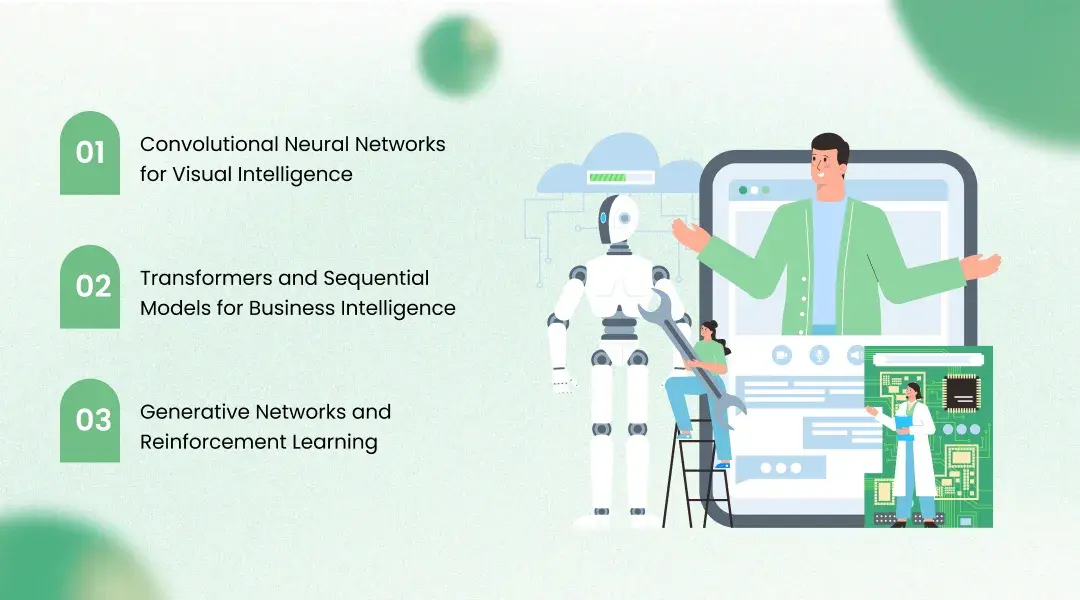
Deep learning is not a single technology but a family of neural network architectures, each suited to different data types and business problems. Understanding which architecture maps to which enterprise challenge is the difference between a successful deployment and an expensive experiment.
Convolutional neural networks (CNNs) remain the foundation of enterprise computer vision. In manufacturing, CNN based inspection systems analyze product images at speeds exceeding 1,000 units per minute, detecting defects invisible to the human eye with accuracy rates above 99%. In healthcare, CNN models trained on medical imaging data identify early stage cancers and retinal diseases with sensitivity matching specialist radiologists. Google's DeepMind Health expanded its retinal scan AI to detect over 50 eye conditions with 94% accuracy by 2025, illustrating what enterprise deep learning solutions can achieve when properly trained and validated.
For retail businesses, CNNs power visual search engines that allow customers to upload a photo and find matching products, increasing conversion rates by 15% to 30% compared to text only search. In agriculture, drone mounted cameras paired with CNN models identify crop diseases and pest infestations across thousands of acres in hours rather than weeks. Each application represents a neural network implementation solving a specific, quantifiable business problem.
Transformer architectures handle sequential and temporal data that enterprises generate continuously. In financial services, transformer based models process transaction sequences to detect fraud patterns that rule based systems miss entirely. These models analyze not just individual transactions but contextual relationships between sequences of activity, catching sophisticated fraud schemes that cost the global economy hundreds of billions annually.
In supply chain management, sequence models forecast demand with 20% to 40% greater accuracy than traditional statistical methods by incorporating hundreds of variables simultaneously. Natural language processing, powered by transformers, enables enterprises to analyze customer feedback, legal documents, and regulatory filings at scales requiring thousands of human analysts. KriraAI builds custom NLP pipelines for enterprises that need to extract structured intelligence from domain specific text, such as medical records or insurance claims, where generic language models fall short.
Generative adversarial networks create realistic synthetic data that supplements limited training datasets. This is particularly valuable in healthcare and finance, where privacy regulations restrict access to real data. A pharmaceutical company can generate synthetic patient records preserving statistical properties of real populations without exposing individual information, enabling model training that would otherwise be impossible.
Reinforcement learning is gaining traction where decisions must be optimized continuously. Data center operators use it to reduce energy consumption by 15% to 40% by dynamically adjusting cooling and power distribution. Logistics companies apply reinforcement learning to vehicle routing and warehouse robotics, achieving cost reductions that compound across millions of daily decisions. These capabilities demonstrate that deep learning for business extends far beyond pattern recognition into simulation, optimization, and autonomous decision making.
The shift from experimental AI to production deep learning is measurable in hard financial terms. Enterprises that have scaled AI model deployment are reporting outcomes that justify investment and accelerate further adoption.
In manufacturing quality assurance, deep learning powered inspection systems have reduced defect escape rates by 60% to 90%. For a mid sized manufacturer producing 500,000 units monthly, this translates directly into millions of dollars in reduced warranty claims and recall costs. In semiconductor manufacturing, CNN based wafer inspection reduced false positive rates by 75%, allowing inspectors to focus exclusively on genuine anomalies.
Financial services organizations deploying deep learning for fraud detection report detection improvements of 30% to 50% while reducing false positives by 60%. When a major payment processor reduces false positives on millions of daily transactions, annual savings easily reach tens of millions of dollars. Enterprise deep learning solutions in credit risk modeling have reduced default prediction errors by 25%, enabling more accurate loan pricing.
Healthcare organizations implementing deep learning diagnostics document 20% reductions in diagnostic turnaround times and 15% improvements in early detection rates for conditions like diabetic retinopathy. A hospital network processing 100,000 radiology scans annually can redirect hundreds of hours of specialist time from routine reads to complex cases by deploying deep learning triage systems.
Companies using deep learning for personalization report revenue increases of 10% to 35% in affected product categories. The per dollar return on AI investment averages $3.70 according to industry surveys, making deep learning one of the highest return technology investments available when implementation follows a disciplined approach.
Implementing deep learning services successfully requires a structured approach. The organizations that avoid the high failure rate follow a disciplined path from assessment through deployment.
Every successful neural network implementation begins with honest evaluation across four dimensions.
Data readiness involves inventorying available datasets, assessing quality and completeness, and estimating preparation costs, which typically consume 60% to 80% of total project effort.
Infrastructure evaluation examines compute resources, cloud capabilities, and networking bandwidth to determine whether the organization can support training and inference workloads.
Talent assessment maps current capabilities against project requirements, identifying whether the organization needs to hire, upskill, or partner externally.
Business case validation ensures the target use case has clear, measurable outcomes tied to revenue, cost reduction, or risk mitigation.
The pilot phase should target a problem narrow enough to deliver results within 8 to 12 weeks but representative enough to validate the approach for broader deployment. Effective pilots use real production data, integrate with existing workflows, and define success metrics before the project begins. Teams should expect to iterate through multiple model architectures and data preprocessing approaches, since what works on academic benchmarks may underperform on real enterprise data. Experienced partners like KriraAI accelerate this cycle by applying patterns from dozens of prior deployments.
Moving from pilot to production introduces new challenges: model serving infrastructure for real time inference, monitoring systems to detect model drift, and automated retraining pipelines. In regulated industries, AI model deployment also requires model versioning, audit trails, and explainability reporting.
The most expensive mistakes are strategic, not technical.
Starting with the wrong problem, selecting use cases based on technical interest rather than business impact, results in impressive demos that never reach production.
Underinvesting in data preparation leads to models trained on noisy datasets that fail unpredictably in production.
Ignoring change management means technically successful deployments face resistance from employees excluded from the design process.
Treating deployment as the finish line leads to model decay, where production models gradually lose accuracy because no one budgeted for monitoring and retraining.
Data quality remains the single largest barrier to successful deployments. Neural networks are fundamentally data dependent, and their performance ceiling is determined by training data quality. Many enterprises discover that data accumulated over years in siloed systems requires substantial cleaning before it becomes useful, often accounting for more project cost than model development itself.
The talent gap continues to constrain adoption. Deep learning engineering requires a rare combination of mathematical foundation, software engineering skill, and domain expertise. Competition for experienced practitioners drives compensation to levels that mid market enterprises cannot match, making external deep learning services the practical option for many organizations.
Regulatory uncertainty adds complexity. The European Union's AI Act, evolving U.S. regulations, and sector specific requirements create a compliance landscape that shifts faster than most organizations can adapt. Deep learning models making decisions affecting individuals must increasingly meet transparency requirements that conflict with the inherently opaque nature of deep neural networks. Research into explainable AI is progressing, but practical tools satisfying regulators while maintaining performance remain limited.
Integration with legacy enterprise systems should not be underestimated. Most large organizations run on technology stacks assembled over decades, with critical systems never designed to interact with modern AI infrastructure. Connecting deep learning inference engines to ERP systems, CRM platforms, and operational technology networks requires middleware and extensive testing that extends deployment timelines significantly.
The next three to five years will separate organizations that treated deep learning as strategic capability from those that treated it as an experiment.
Foundation models are dramatically reducing the time and cost required for enterprise AI model deployment. Rather than training from scratch, organizations will increasingly fine tune powerful pretrained models for their specific domains, reducing data requirements and compute costs that historically made deep learning prohibitively expensive for smaller enterprises.
Edge deployment is moving deep learning from cloud data centers to the devices where data is generated. Manufacturing equipment, medical devices, and agricultural drones will run local inference within three years, eliminating latency and enabling real time decisions where cloud connectivity is unreliable.
Multimodal deep learning, systems processing text, images, audio, and sensor data simultaneously, will unlock use cases that single modality models cannot address. A manufacturing quality system combining visual inspection with acoustic analysis detects failure modes invisible to any single data source. KriraAI is already building multimodal pipelines for enterprise clients, recognizing that the future of deep learning for business lies in combining data sources rather than analyzing them in isolation.
The competitive consequences of delayed adoption will become severe. Organizations that have spent years building deep learning capabilities and accumulating proprietary training data will operate with structural advantages that latecomers cannot quickly replicate. The data flywheel effect, where better models attract more users generating more data that produces even better models, creates compounding returns that make market leadership increasingly difficult to challenge. By 2030, enterprises without embedded deep learning capabilities will find themselves competing against organizations that make faster decisions, serve customers more precisely, and operate at fundamentally lower cost structures.
Three themes emerge consistently from this analysis. First, the technology has matured beyond experimentation into production capability delivering measurable financial returns across industries. Second, successful implementation depends more on organizational readiness, data quality, and disciplined execution than on choosing the newest algorithm. Third, the competitive gap between AI leaders and laggards is widening in ways that become increasingly difficult to close as data flywheel effects compound early mover advantages.
The organizations positioned to win approach deep learning not as a technology project but as a strategic capability requiring sustained investment in data, people, and processes. They start with clearly defined business problems, build incrementally from successful pilots, and partner with specialists who accelerate learning while avoiding costly mistakes.
KriraAI works with enterprises across industries to implement deep learning services that are practical, measurable, and built for scale. From AI readiness assessments through model development, production deployment, and ongoing optimization, KriraAI brings technical depth and domain expertise that turns deep learning potential into business results. If your organization is ready to move beyond experimentation into production systems delivering real competitive advantage, explore how KriraAI's enterprise deep learning solutions can accelerate your journey.
Deep learning services encompass the design, development, training, deployment, and management of neural network based AI systems for enterprise applications. Unlike traditional AI that relies on hand crafted rules or classical machine learning with manually engineered features, deep learning leverages multi layered neural networks that automatically learn hierarchical representations from raw data. This means deep learning models can process unstructured data like images, text, and audio without requiring human experts to define relevant features in advance. Traditional machine learning might need an engineer to specify that a fraud model should consider transaction amount and time, while deep learning discovers these patterns and thousands of additional correlations automatically. Enterprise deep learning solutions are typically offered as end to end services covering data preparation, architecture selection, training, deployment, and monitoring.
Enterprise deep learning implementation costs vary based on scope and complexity, but organizations should expect $150,000 to $2 million for production grade deployment. Costs break down roughly into data preparation at 30% to 40%, model development at 20% to 30%, infrastructure and deployment at 15% to 25%, and ongoing maintenance at 10% to 20% annually. Smaller pilots targeting a single use case with clean data can be executed for $50,000 to $150,000, while enterprise wide deployments may exceed $5 million over two to three years. The per dollar return on AI investment averages $3.70, making deep learning one of the higher return technology investments when implementation follows a disciplined approach prioritizing business outcomes over technical ambition.
Healthcare, financial services, manufacturing, automotive, and retail see the strongest returns from deep learning services in 2026. Healthcare benefits through medical imaging diagnostics and drug discovery, with the sector capturing nearly $1.5 billion in vertical AI spending in 2025. Financial services leverage deep learning for fraud detection and credit risk modeling, with annual AI spending exceeding $20 billion. Manufacturing applies it to visual quality inspection and predictive maintenance, achieving defect reduction rates of 60% to 90%. Retail organizations deploy deep learning for personalization and demand forecasting, reporting revenue increases of 10% to 35% in categories where neural network implementations drive recommendations and pricing decisions.
A typical enterprise deployment takes 4 to 12 months from assessment to production. The assessment and data preparation phase requires 4 to 8 weeks for auditing data and defining success metrics. Model development and piloting takes 8 to 16 weeks covering architecture selection, training, and validation. Production deployment requires another 4 to 12 weeks for infrastructure setup, integration, and gradual rollout. Organizations with mature data infrastructure can compress timelines, while those with poor data quality may need 12 to 18 months. The most common cause of delays is data preparation, where enterprises discover historical data requires far more cleaning than estimated. Working with experienced providers can reduce total deployment time by 30% to 50%.
The five most significant risks are data quality failures, model drift, talent dependency, regulatory noncompliance, and organizational resistance. Data quality failures occur when models trained on biased or incomplete datasets produce unreliable predictions. Model drift happens when production data diverges from training data, degrading accuracy without obvious warnings unless monitoring is in place. Talent dependency creates risk when systems rely on specialists whose departure leaves critical infrastructure unsupported. Regulatory risk is growing as governments implement AI governance frameworks requiring transparency in automated decisions. Organizational resistance manifests when employees perceive deep learning as a threat rather than a tool, leading to active undermining of implementation efforts. Mitigating these risks requires investment in data governance, automated monitoring, team building, and change management programs.
Founder & CEO
Divyang Mandani is the CEO of KriraAI, driving innovative AI and IT solutions with a focus on transformative technology, ethical AI, and impactful digital strategies for businesses worldwide.