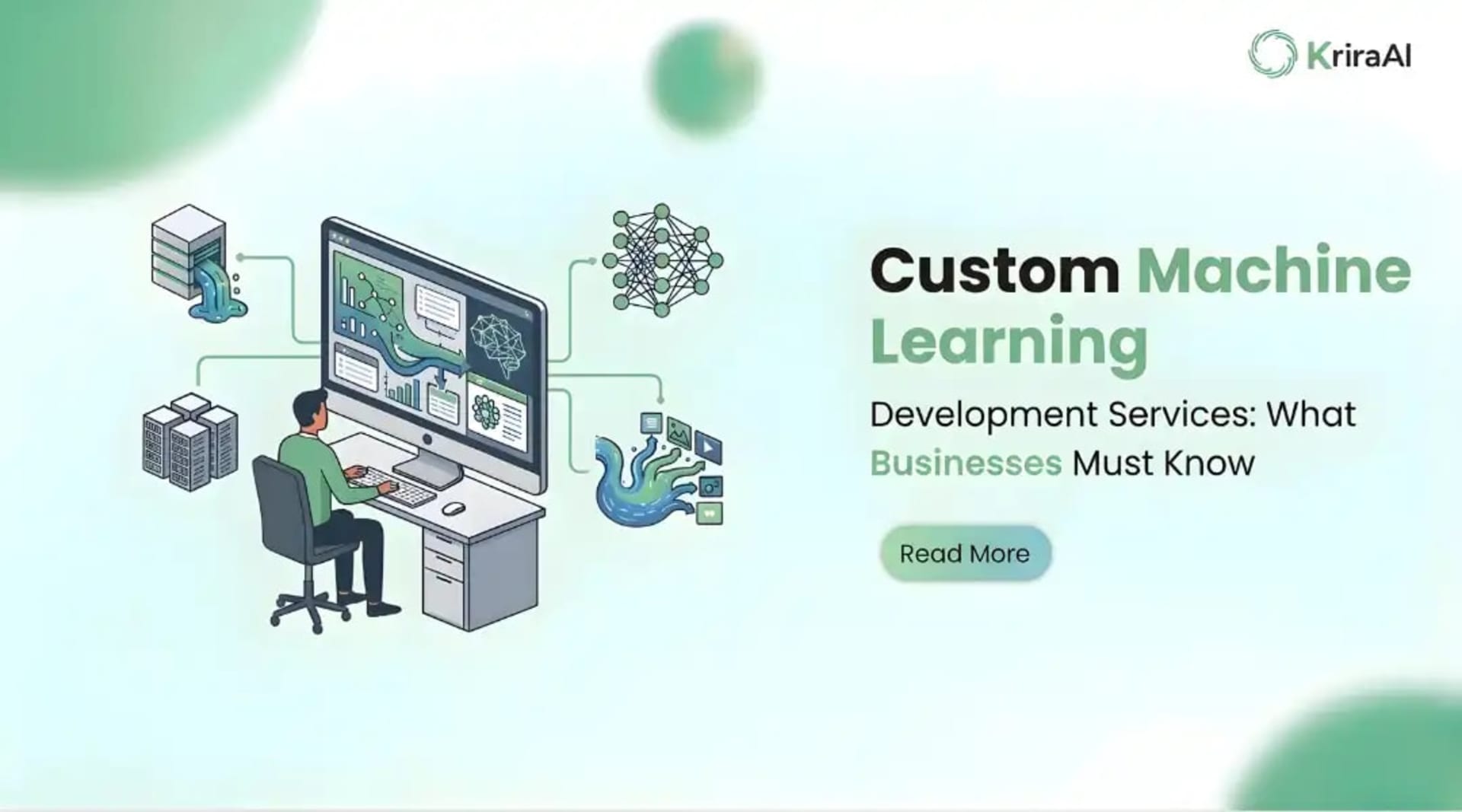
Machine learning has moved from experimental technology to a practical business capability. Organizations now use machine learning to forecast demand, detect fraud, personalize customer experiences, automate decisions, identify anomalies, optimize operations, and turn large datasets into actionable insights.
However, not every business problem can be solved effectively with a generic AI tool or pre-built machine learning API.
Custom machine learning development services are designed for organizations that need models and intelligent systems built around their own data, business rules, workflows, operational constraints, and performance requirements.
A custom ML solution can combine data engineering, model development, application development, APIs, cloud infrastructure, monitoring, and business-system integration into one production-ready system.
This guide explains what custom machine learning development services include, when businesses should consider them, common use cases, development stages, implementation challenges, cost factors, and how to evaluate a machine learning development company.
Custom machine learning development services involve designing, developing, deploying, and maintaining machine learning systems for a specific business requirement.
Instead of adapting a generic tool to a company's processes, a custom solution is designed around factors such as:
Business objectives
Proprietary datasets
Industry requirements
Existing software systems
Operational workflows
Security and compliance needs
Model performance requirements
Scalability expectations
Depending on the use case, a custom machine learning system may include data pipelines, feature engineering, ML models, APIs, dashboards, automated workflows, cloud infrastructure, monitoring, and continuous model improvement.
This approach is particularly relevant when a business has unique data or decision-making requirements that generic software cannot address effectively.
The goal of custom ML development should not be simply to introduce an AI model. It should be to solve a measurable business problem.
Businesses often have valuable historical, transactional, behavioral, operational, or sensor data.
A custom ML system can be designed around that data rather than relying on generic assumptions.
A model built for a specific business context can account for the variables, constraints, and patterns that matter to that organization.
Examples include:
Demand forecasting based on business-specific sales patterns
Fraud detection based on transaction behavior
Customer churn prediction based on product usage
Predictive maintenance based on equipment telemetry
Lead scoring based on CRM and engagement data
Machine learning can be integrated into operational workflows so predictions do not remain isolated inside an analytics dashboard.
For example, a model can trigger a review, prioritize a case, recommend an action, or send information to another business system.
Custom development gives organizations greater control over model architecture, data pipelines, deployment environments, integrations, monitoring, and future enhancements.
A custom system can be extended as new data sources, products, workflows, markets, or business requirements emerge.
The right choice depends on the business problem.
Factor | Pre-Built AI Tool | Custom ML Solution |
Setup | Usually faster | Requires planning and development |
Customization | Limited to available features | Designed around business requirements |
Data | Often standardized | Can use proprietary business data |
Workflow integration | Depends on vendor | Built for required systems |
Control | Vendor-controlled | Greater technical control |
Scalability | Depends on product | Architecture can be designed for growth |
Model customization | Often limited | High |
Best fit | Common, standardized use cases | Unique or complex business problems |
Pre-built tools can be appropriate when the problem is common and the available functionality matches business requirements.
Custom machine learning becomes more relevant when the business needs specialized predictions, proprietary data processing, deep system integration, or greater control over the solution.
A complete ML development engagement typically involves several connected layers.
Machine learning starts with data.
Data may come from:
CRM systems
ERP platforms
Databases
Transaction systems
Applications
Websites
IoT devices
Industrial sensors
Documents
Customer interactions
External data sources
The development team must identify relevant sources and establish reliable data flows.
Raw business data often contains missing values, duplicate records, inconsistent formats, outliers, and other quality problems.
Data preprocessing can involve cleaning, transformation, normalization, labeling, feature creation, and validation before the data is used for training.
Feature engineering converts raw data into representations that help machine learning models identify useful patterns.
The appropriate features vary by use case.
For example:
Transaction frequency for fraud analysis
Purchase history for recommendation systems
Machine vibration characteristics for predictive maintenance
Customer activity patterns for churn prediction
Different business problems require different machine learning approaches.
Depending on the use case, developers may use:
Classification models
Regression models
Clustering
Time-series forecasting
Recommendation algorithms
Anomaly detection
Natural language processing
Computer vision
Deep learning
Model selection should be driven by the problem, available data, performance requirements, and deployment environment.
Models are trained using prepared datasets and evaluated against appropriate validation data.
Important evaluation measures depend on the application.
For example, a fraud detection system may prioritize precision, recall, false-positive rates, or other business-specific metrics rather than relying only on overall accuracy.
A trained model becomes useful only when it can operate inside a production environment.
Deployment may involve:
Cloud infrastructure
APIs
Microservices
Edge environments
Internal applications
Customer-facing software
Data platforms
Business workflows
Machine learning systems require ongoing monitoring.
Production data can change over time, user behavior can shift, and business conditions can evolve.
Monitoring can help detect:
Data quality issues
Model drift
Performance degradation
Unexpected predictions
Infrastructure failures
Changing business patterns
Retraining and optimization can then be performed when required.
A structured development process helps reduce technical and operational risk.
Start with the decision or process the business wants to improve.
Examples:
Predict future demand
Detect fraudulent transactions
Identify customer churn risk
Automate document classification
Forecast equipment failures
Recommend products
Optimize routes
The business objective should be measurable before model development begins.
Assess what data exists, where it is stored, how reliable it is, and whether it is sufficient for the intended use case.
This stage often reveals that the biggest challenge is data readiness rather than model selection.
Define the complete solution architecture, including:
Data sources
Data pipelines
Feature processing
Model layer
APIs
Applications
Infrastructure
Monitoring
Security
A focused proof of concept can help validate technical feasibility and business value before full-scale development.
The objective is not to build every feature immediately. It is to test the core hypothesis using representative data.
Build the selected model, evaluate its performance, and validate results against realistic business scenarios.
Connect the model to the applications and workflows where its predictions or classifications will actually be used.
This could include CRM, ERP, customer-support platforms, manufacturing systems, financial software, logistics platforms, or internal applications.
Production deployment requires appropriate infrastructure, access controls, reliability mechanisms, monitoring, and operational processes.
After launch, track data quality, model performance, business outcomes, and operational feedback.
Machine learning should be treated as a lifecycle rather than a one-time software release.
Custom ML can support many business functions.
Businesses can use historical data to forecast demand, sales, inventory requirements, customer behavior, or other measurable outcomes.
Machine learning can analyze transaction patterns and identify activity that differs from expected behavior.
This is particularly relevant in banking, payments, insurance, eCommerce, and other transaction-heavy environments.
ML models can identify behavioral signals associated with customers who may be at risk of leaving.
This allows businesses to prioritize retention activities.
Recommendation engines can use behavioral, transactional, and contextual data to personalize product, content, or service recommendations.
Manufacturers, retailers, distributors, and other organizations can use machine learning to support demand planning and inventory decisions.
Manufacturing organizations can use machine learning to identify abnormal equipment behavior and support maintenance planning.
For a detailed manufacturing example, see KriraAI's AI predictive maintenance case study.
Natural language processing models can classify documents, route requests, extract relevant information, and automate repetitive text-based processes.
Computer vision can support applications such as visual inspection, object detection, document analysis, quality monitoring, and image classification.
Retail, eCommerce, media, and SaaS businesses can use ML to personalize experiences based on customer behavior and contextual signals.
Logistics and operations teams can use machine learning and optimization techniques to improve planning, routing, forecasting, and resource allocation.
A well-designed ML system can create value in several areas.
Models can be developed around an organization's own data, processes, and requirements.
Machine learning can help teams identify patterns and trends that are difficult to assess manually at scale.
Certain classification, scoring, prediction, and prioritization tasks can be automated or supported by ML models.
ML systems can turn large amounts of business data into structured signals that teams can monitor and act on.
Once the underlying infrastructure is designed appropriately, the solution can expand to additional data sources, business units, markets, or use cases.
Organizations can have more control over the way data, models, infrastructure, and integrations are designed compared with fully packaged solutions.
Machine learning is applicable across industries, although the use cases and data requirements differ.
Potential applications include clinical analytics, medical document processing, patient-risk prediction, operational forecasting, and intelligent workflow support.
Financial organizations can apply ML to fraud detection, risk assessment, forecasting, customer analytics, and transaction monitoring.
Retail businesses can use ML for recommendation systems, demand forecasting, pricing analysis, customer segmentation, and inventory planning.
Manufacturers can use machine learning for predictive maintenance, quality inspection, production optimization, anomaly detection, and forecasting.
Logistics companies can apply ML to demand forecasting, route optimization, ETA prediction, capacity planning, and supply chain analytics.
Software companies can integrate machine learning into products for personalization, customer intelligence, automation, recommendation, forecasting, and intelligent workflows.
Choosing the right development partner requires more than reviewing a technology stack.
Look for experience with problems similar to yours rather than only a broad list of AI technologies.
Case studies can help you understand how a development team approaches data, architecture, deployment, integration, and measurable business objectives.
A capable ML partner should understand data engineering, model development, software engineering, deployment, monitoring, and integration.
Building a model in a notebook is different from operating an ML system in production.
Ask how the partner handles APIs, infrastructure, monitoring, security, scalability, and maintenance.
The partner should be able to explain technical decisions clearly and connect those decisions to business objectives.
Machine learning systems require monitoring and occasional optimization as data and business conditions change.
A development partner should be capable of supporting the solution beyond the initial launch.
For organizations evaluating a machine learning development company, the key consideration should be whether the partner can take the project from business problem and data assessment through production deployment and ongoing optimization.
There is no universal price for a custom machine learning solution.
The total cost depends on the technical and business scope of the project.
Projects involving multiple data sources, large datasets, historical cleanup, labeling, or complex pipelines may require more engineering effort.
A relatively simple classification or forecasting system may require a different development effort from a deep learning or computer vision platform.
Connecting the model to existing CRM, ERP, MES, SaaS, financial, or operational systems can significantly affect the project scope.
Cloud services, GPUs, storage, networking, security, model serving, monitoring, and related infrastructure can contribute to the total cost.
A model used internally by a small team has different requirements from a customer-facing application serving large volumes of requests.
Production ML solutions may require monitoring, retraining, infrastructure maintenance, and future enhancements.
The most useful way to estimate cost is therefore to define the business objective, data requirements, integrations, expected usage, and production scope before estimating development effort.
Custom ML development can deliver strong business value, but several challenges need to be addressed.
Poor-quality or incomplete data can limit model performance.
Some use cases have insufficient labeled examples, particularly where failures or rare events are involved.
Existing systems may use different architectures, protocols, formats, or access controls.
In some applications, stakeholders need to understand why a model produced a particular result.
The relationship between input data and outcomes may change over time, reducing model performance if the system is not monitored.
Sensitive business and customer data must be handled according to the organization's security and compliance requirements.
Even technically capable systems can fail to create value when employees do not trust or use the outputs.
Successful machine learning implementation therefore requires both technical engineering and business-process alignment.
KriraAI develops custom machine learning systems around business requirements rather than forcing every project into the same architecture.
The approach can include:
Business and use-case discovery
Data assessment
ML architecture
Data engineering
Custom model development
Model training and validation
API and application integration
Cloud deployment
Monitoring and optimization
KriraAI's machine learning development services cover custom model development for use cases such as classification, regression, predictive analytics, anomaly detection, recommendation systems, and other business applications.
The broader goal is to connect machine learning with the systems and workflows where the resulting intelligence can create practical business value.
Machine learning is increasingly becoming part of larger intelligent software systems rather than operating as an isolated model.
Several developments are shaping this direction:
More business systems are using machine learning to support decisions and predictions in real time.
For certain industrial and connected-device applications, processing data closer to where it is generated can reduce latency and support local decision-making.
Machine learning models are increasingly being combined with generative AI, AI agents, knowledge systems, and automation workflows.
Modern ML platforms increasingly emphasize automated monitoring, evaluation, retraining workflows, and model lifecycle management.
Organizations are moving toward reusable AI and ML infrastructure that supports multiple business applications instead of building each model as an isolated project.
Custom ML development is worth considering when:
Your problem is specific to your business
You have proprietary data that creates useful differentiation
Existing tools cannot meet your requirements
You need deeper system integration
Predictions or classifications are central to a business workflow
You require greater control over model behavior and infrastructure
The expected business value justifies custom development
A pre-built solution may be more appropriate when the business problem is standardized and an existing product already satisfies the required functionality.
Custom machine learning development services can help businesses turn proprietary data into predictive, analytical, and automated capabilities.
The strongest ML projects begin with a clearly defined business problem rather than a desire to use a particular algorithm. From data preparation and model development to deployment, integration, and monitoring, every stage should support the intended business outcome.
For organizations with unique data, complex workflows, or specialized prediction requirements, custom machine learning can provide a more adaptable foundation than a generic AI product.
The right development partner should be able to bridge the gap between machine learning engineering and business execution, helping move a model from an experiment into a reliable production system.
Explore KriraAI's machine learning development services to discuss a custom ML solution aligned with your data, workflows, and business objectives.
Custom machine learning development services involve designing and building ML systems around a specific organization's data, business requirements, workflows, integrations, and performance goals.
Pre-built AI solutions offer standardized functionality, while custom ML solutions are developed around specific business problems, proprietary data, and integration requirements.
Project timelines vary based on data readiness, model complexity, integrations, infrastructure, and scope. A focused proof of concept may take significantly less time than a production enterprise platform.
Cost depends on factors such as data complexity, model requirements, integrations, infrastructure, user volume, and ongoing maintenance. A reliable estimate requires a defined technical and business scope.
Healthcare, finance, retail, manufacturing, logistics, SaaS, and many other industries use machine learning for forecasting, classification, personalization, anomaly detection, automation, and decision support.
Not necessarily. The amount of data required depends on the use case, model type, data quality, and expected outcome. Some problems can be addressed with limited datasets using appropriate modeling approaches, while others require substantial historical data.
Yes. ML solutions can be connected with existing applications, databases, APIs, CRM systems, ERP platforms, operational software, and other enterprise systems depending on the architecture.
Production models need monitoring for performance, data quality, drift, infrastructure issues, and changing business conditions. Retraining and optimization may be required over time.
The decision depends on the uniqueness of the problem, availability of suitable products, data ownership, integration needs, customization requirements, and expected business value. A standardized problem may be well served by an existing product, while specialized requirements may justify custom development.
Founder & CEO
Divyang Mandani is the CEO of KriraAI, driving innovative AI and IT solutions with a focus on transformative technology, ethical AI, and impactful digital strategies for businesses worldwide.