I’ve sat in too many boardrooms where someone asks, quietly but urgently:
“Are we falling behind on AI?”
The question is rarely about technology. It’s about fear. Fear of making the wrong bet. Fear of buying the wrong tool. Fear of explaining a seven-figure AI experiment that never made it past the pilot.
That’s why Custom AI Model Development keeps coming up in serious enterprise conversations. Not because it’s trendy. But because generic AI tools break the moment real-world complexity walks in.
And enterprise reality? It’s messy. It’s regulated. It’s deeply human.
At its core, Custom AI Model Development for Enterprises means building AI models designed around your data, your workflows, and your risk profile.
Not someone else’s.
Pre-trained tools are built for averages. Enterprises are not average.
Custom AI Model Development allows:
Training on proprietary datasets
Domain-specific reasoning
Tight control over outputs and behavior
Full ownership of models and insights
This is the difference between renting intelligence and actually owning it.
I’ve seen this shift happen after the honeymoon phase ends.
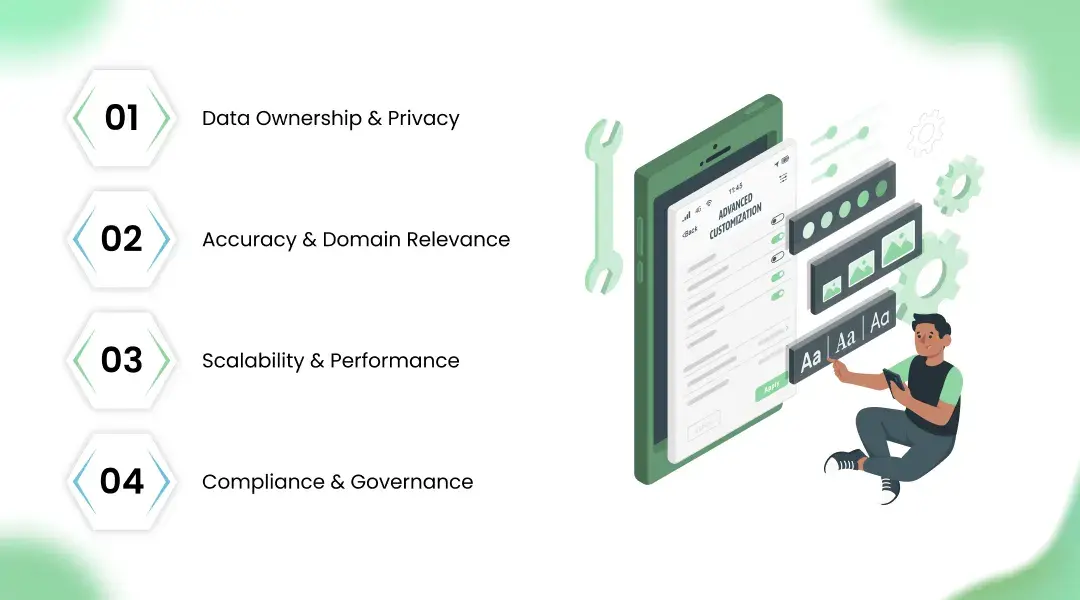
With private AI model development, your data never becomes training fuel for someone else’s roadmap.
Industry-specific AI models outperform general tools because context matters. A lot.
Scalable AI model development isn’t about growth charts, it’s about surviving peak load days without system failure.
Generic tools rarely align cleanly with enterprise AI governance and compliance models. Custom ones can.
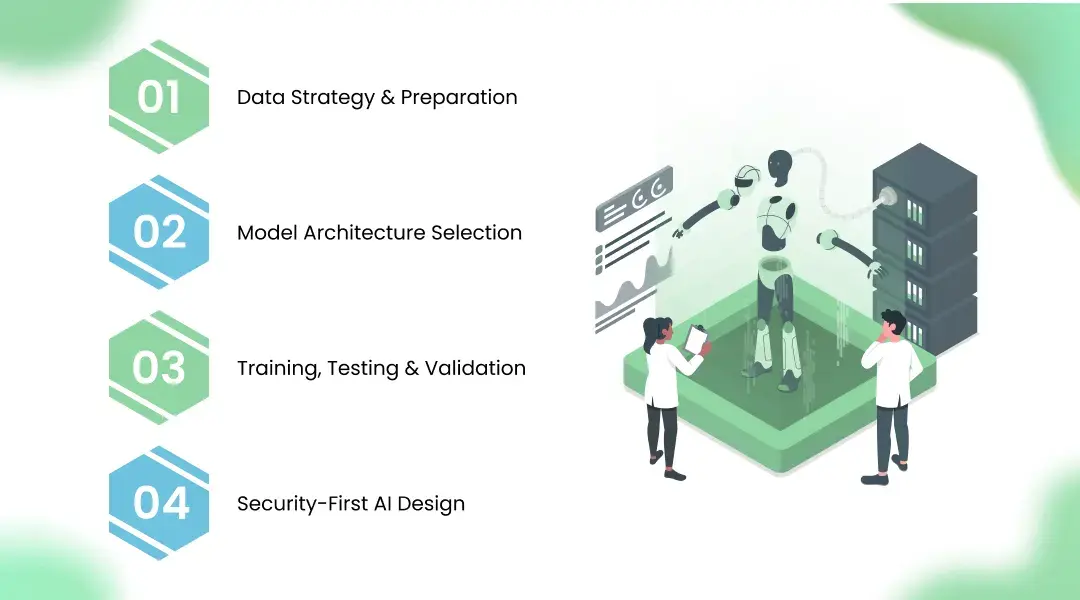
Enterprise-Grade AI Model Development isn’t about clever algorithms. It’s about discipline.
Most AI failures start here. Data quality beats model complexity. Every time.
Choosing between classical ML, deep learning, or custom LLM development for enterprises isn’t philosophical - it’s practical.
AI model training for enterprises must account for edge cases, not just averages.
Secure AI model development is baked in, not added later.
Across Enterprise AI development services, these are the most common:
Custom Machine Learning Model Development
Deep learning models
Computer vision systems
NLP & conversational AI models
Custom LLM development for enterprises
Different problems. Different architectures. Same expectation: reliability.
I’ve seen AI succeed when it replaces friction, not humans.
Intelligent customer support
Predictive analytics & forecasting
Fraud detection & risk analysis
Supply chain optimization
Personalized enterprise automation
This is AI model development for business, not demos.
Solve it with ruthless data prioritization.
Solve it with diverse training sets and continuous audits.
Solve it with phased scaling - not oversized architecture.
Solve it with patience and APIs, not rewrites.
This matters more than the tech.
Look for:
Proven enterprise machine learning solutions
Industry experience
Strong security standards
Long-term support mindset
If a vendor can’t explain trade-offs clearly, walk away. A Best AI development Company will tell you what not to build.
Custom AI solutions for enterprises aren’t about ambition. They’re about responsibility.
When AI touches revenue, customers, and compliance, control matters.
At KriraAI, Custom Artificial Intelligence Development is treated like enterprise architecture, not experimentation. If AI is becoming central to your business, it deserves that level of seriousness.
Yes, when accuracy, data ownership, and compliance matter.
Typically 3–6 months, depending on data readiness and complexity.
With private deployment and governance controls, they’re often more secure than shared platforms.
Yes. Integration planning is part of enterprise AI design.
When designed properly, custom models scale more predictably than generic tools.
Founder & CEO
Divyang Mandani is the CEO of KriraAI, driving innovative AI and IT solutions with a focus on transformative technology, ethical AI, and impactful digital strategies for businesses worldwide.