Most businesses that fail with machine learning do not fail because the technology does not work. They fail because they chose the wrong ML services for their specific context, scale, and operational maturity. A mid-sized logistics company that deploys the same ML infrastructure as a Fortune 500 technology firm is not being ambitious. It is being reckless with its budget and team capacity.
The market for ML services has expanded faster than most companies can evaluate it. From fully managed AutoML platforms to raw compute infrastructure and vertical-specific AI solutions, the range of options in 2025 is both an opportunity and a source of genuine confusion for business leaders. Selecting the right solution requires more than reading product documentation. It requires a structured evaluation framework built around your business goals, your technical readiness, and your long-term scalability needs.
This guide gives you exactly that framework, helping organizations evaluate solutions while understanding how professional Machine Learning Services can accelerate successful AI adoption. Whether you are a small business exploring ML services for the first time or an enterprise team looking to consolidate fragmented AI investments, the sections below will help you evaluate every major decision dimension with clarity and confidence.
What Are ML Services and Why Do They Matter in 2026
ML services refer to the suite of cloud-based, on-premise, or hybrid tools and platforms that allow businesses to build, train, deploy, and monitor machine learning models without necessarily maintaining a full in-house AI research team. These services sit across a wide spectrum. At one end, you have fully managed AutoML platforms that allow non-technical users to train predictive models through a guided interface. At the other end, you have raw ML infrastructure services like GPU compute clusters, data pipeline tools, and MLOps platforms that require significant engineering expertise.
Between those extremes, you find most of the ML services market: pre-built AI APIs for specific tasks like natural language processing, computer vision, or demand forecasting; vertical-specific AI solutions built for healthcare, retail, or financial services; and modular ML platforms that allow businesses to assemble their own stack from standardized components.
The reason ML services matter more in 2025 than they did five years ago has everything to do with competitive pressure and cost structure. According to McKinsey, companies that have adopted AI at scale report a 20 to 30 percent improvement in operational efficiency compared to industry peers. More critically, the cost of not adopting machine learning is rising. Businesses that continue to rely on manual processes for demand forecasting, customer segmentation, fraud detection, or predictive maintenance are now operating at a measurable disadvantage in markets where competitors have already automated these functions.
The challenge is that the wrong ML service choice does not just fail to deliver results. It creates technical debt, organizational frustration, and wasted capital that makes the second attempt at AI adoption significantly harder.
The Business Case for Choosing ML Services Carefully
The financial stakes of ML service selection are higher than most companies realize at the point of decision. A poorly chosen ML platform generates costs across multiple dimensions simultaneously.
Direct infrastructure costs accumulate when a business pays for compute capacity, storage, and tooling that does not align with actual workload patterns. Companies that overprovision for anticipated scale that never materializes routinely waste 40 to 60 percent of their ML infrastructure budget.
Implementation costs grow rapidly when the selected ML service requires more engineering effort than anticipated. A mid-market company that selects a highly customizable but complex ML platform may spend 60 to 90 percent of its first-year ML budget on implementation alone, leaving little capacity for actual model development or business impact.
Opportunity costs are the most expensive and least visible category. Every month a business spends on a misaligned ML service is a month it is not generating predictions, insights, or automation from its data. For businesses in competitive markets, this gap compounds quickly.
On the positive side, a well-matched ML service delivers measurable returns across the business. According to Gartner, organizations with a structured approach to AI platform selection achieve production deployment of their first use case 2.4 times faster than organizations that select tools ad hoc. They also report significantly lower total cost of ownership over three years.
The business case for choosing carefully is straightforward: the selection decision itself is a high-value activity that deserves structured analysis, not just a vendor demo and a price comparison.
The single most common mistake in ML service selection is skipping the readiness assessment. Businesses that evaluate ML tools before understanding their own capabilities consistently select solutions that are either too advanced for their current state or too limited for their medium-term goals.
Machine learning models are only as good as the data they are trained on. Before evaluating any ML service, your organization needs an honest inventory of its data assets.
Start by assessing data volume and quality. Most production ML models require a minimum of several thousand labeled examples for supervised learning tasks and significantly more for complex applications like computer vision or natural language processing. If your business cannot produce a reliable, reasonably clean dataset for your target use case, even the best ML service will not help you.
Next, assess data pipeline maturity. ML services require data to move reliably from source systems into training and inference pipelines. If your business currently manages data manually through spreadsheets or disconnected databases, you will need to invest in data engineering before any ML service can deliver production value.
Finally, evaluate data governance. Regulated industries in particular need to understand where their data lives, who can access it, and what compliance obligations apply before they commit to any ML service that processes sensitive information.
Your team's existing skills directly determine which category of ML services is appropriate for your business. A useful way to structure this assessment is across three capability tiers.
Tier 1 organizations have no data science or ML engineering capability. They may have business analysts and software developers, but no staff with hands-on experience training or deploying ML models. These organizations should focus exclusively on fully managed ML services with minimal configuration requirements.
Tier 2 organizations have at least one or two data scientists or ML engineers, but these individuals are generalists rather than specialists. They can work with ML APIs, pre-built models, and moderately complex platforms, but they do not have the capacity to build custom model architectures from scratch. These organizations have the widest range of ML services available to them and need to be careful not to overreach.
Tier 3 organizations have a dedicated AI or data science team with deep expertise in model development, MLOps, and infrastructure. These organizations can realistically evaluate advanced ML platforms and custom solution development.
Technical readiness is necessary but not sufficient. Machine learning projects consistently fail due to organizational factors rather than technical ones. Before selecting any ML service, assess whether your organization has:
A clear, measurable business problem that ML is expected to solve. Vague objectives like "use AI to improve operations" are not sufficient to drive successful ML adoption.
A designated owner for the ML initiative who has both business authority and technical credibility. ML projects without a clear internal champion rarely reach production.
Stakeholder alignment on what success looks like. If business leadership, IT, and the operational teams affected by ML predictions are not aligned on goals and metrics, the project will face resistance at every stage.
A plan for how ML outputs will be integrated into existing workflows. The model is not the product. The behavior change that results from acting on model predictions is the product.
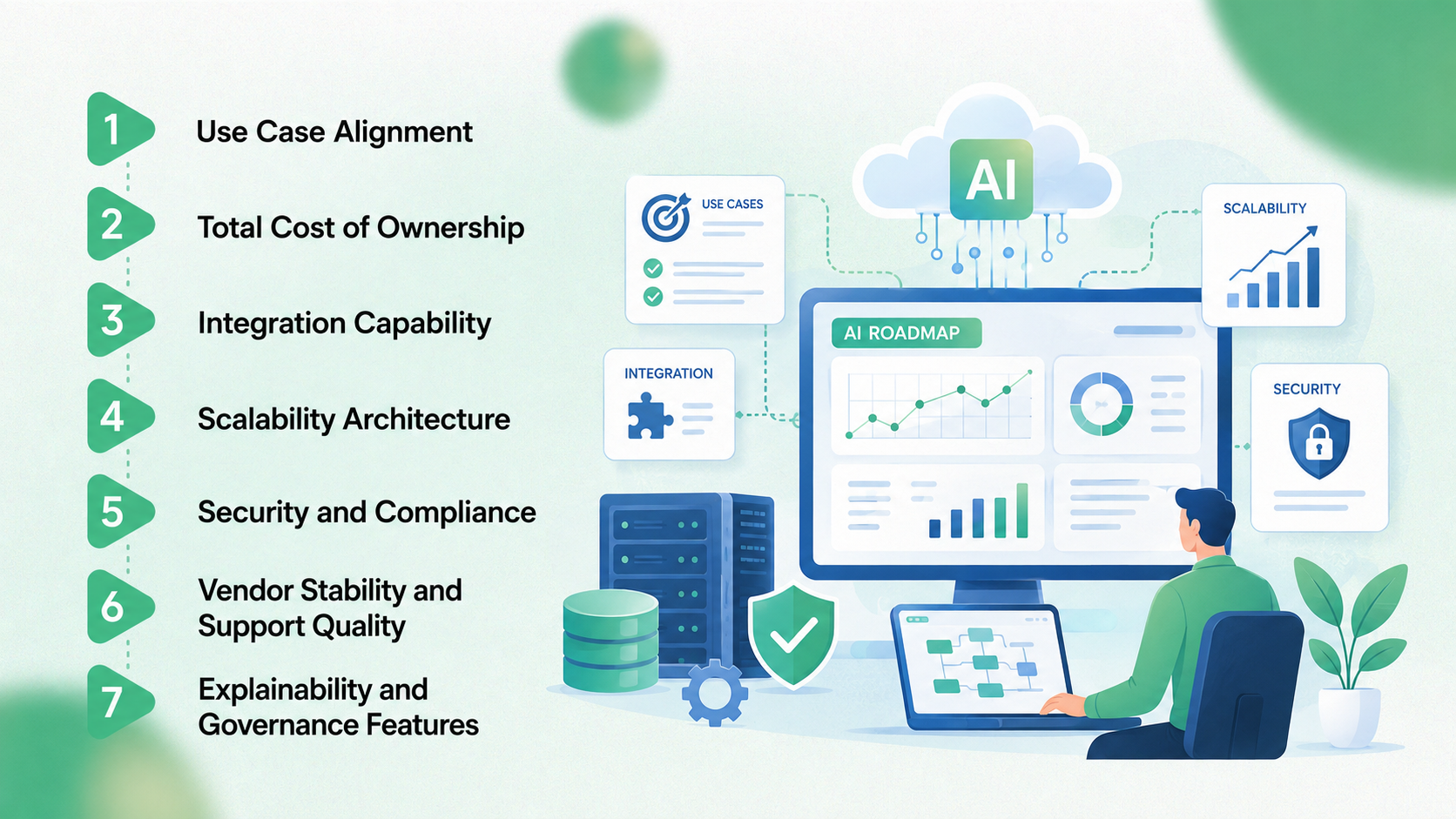
Once your organization has completed a readiness assessment, the next step is applying a structured framework to evaluate ML services systematically. The following framework covers the seven dimensions most predictive of long-term success.
The first evaluation dimension is the fit between the ML service and your specific use case. This seems obvious, but it is frequently overlooked in vendor selection processes that focus on platform breadth rather than specific task performance.
Different ML services are optimized for different task categories. Services built around natural language processing excel at text classification, sentiment analysis, entity extraction, and language generation. Services built for computer vision excel at image classification, object detection, and visual inspection. General-purpose ML platforms may support all of these tasks but may not be optimized for any particular one.
Evaluate each candidate ML service against your specific use case by requesting benchmark data, case studies from comparable businesses, and where possible, a proof of concept engagement before full commitment.
Sticker price is the least useful number in ML service evaluation. Total cost of ownership over a realistic time horizon is the number that matters. TCO analysis for ML services should include:
Licensing and subscription costs across expected usage levels. Pay careful attention to how pricing scales with data volume, API calls, compute hours, or model complexity, since ML workloads frequently exceed initial estimates.
Implementation and integration costs. How much engineering work is required to connect the ML service to your data sources, business systems, and output channels? This is often the largest cost category and the one most consistently underestimated.
Ongoing maintenance and operations costs. Who manages model retraining, performance monitoring, and system updates? For managed services, these costs are often included. For custom solutions, they must be staffed or contracted separately.
Training and change management costs. Your team needs to learn the new system, and the business needs to adapt its processes to act on ML outputs. These costs are real and must be budgeted.
An ML service that cannot connect reliably to your existing systems has limited business value regardless of its model quality. Evaluate integration capability across four dimensions: data source connectors, API accessibility, output delivery mechanisms, and compatibility with your existing software stack.
Cloud-native businesses running on AWS, Google Cloud, or Azure will generally find the best integration options with ML services offered within their existing cloud ecosystem. Businesses with on-premise or hybrid infrastructure need to evaluate carefully whether a cloud-based ML service can access their data with acceptable latency and security controls.
Your business will grow, your data will grow, and your ML use cases will expand. The ML service you select today must be able to grow with you, and the cost of that growth must be predictable and sustainable.
Evaluate scalability across two dimensions. Vertical scalability refers to the ability of the ML service to handle larger models, more training data, and more complex use cases as your capabilities mature. Horizontal scalability refers to the ability to serve more predictions, more users, and more business processes without degradation in performance or cost efficiency.
ML service scalability for growing businesses is a particularly critical evaluation point for companies in the 50 to 500 employee range, where rapid growth can quickly overwhelm a solution selected for current rather than projected scale.
Every ML service that processes business data carries security and compliance obligations. Regulated industries including healthcare, financial services, and education face particularly strict requirements around data residency, access controls, model explainability, and audit trails.
Evaluate each candidate ML service against your specific regulatory context. SOC 2 Type II certification is a baseline expectation. Industry-specific certifications like HIPAA compliance for healthcare or PCI DSS for payment processing represent additional requirements that must be confirmed before selection.
Pay particular attention to data processing agreements and to the question of whether the ML service provider may use your business data to train their shared models. This is a meaningful intellectual property and competitive risk for businesses in proprietary data-intensive industries.
ML service selection is a medium- to long-term commitment. Changing ML vendors mid-project is expensive, disruptive, and technically complex. Evaluate vendor stability by reviewing the provider's financial position, customer retention metrics, product roadmap commitment, and the depth of their enterprise support offering.
Support quality is particularly important for organizations at the earlier stages of ML maturity. The availability of technical account management, implementation support, and training resources can be the difference between a successful first deployment and a frustrating stall.
As ML adoption matures within your organization and as regulatory environments evolve, the ability to explain model predictions becomes increasingly important. This is especially true for decisions that affect customers directly, such as credit decisions, pricing personalization, or risk assessments.
Evaluate whether the ML service provides model explainability features, bias detection tools, and governance dashboards that allow your team to monitor model behavior over time. These features are not just compliance tools. They are essential for building organizational trust in ML outputs and for identifying performance degradation before it affects business outcomes.
The managed machine learning vs custom ML solution decision is one of the most consequential choices in ML service selection, and it is one that many businesses approach with insufficient rigor.
Managed ML services are platforms where the provider handles infrastructure provisioning, model selection, hyperparameter optimization, and in many cases, deployment and monitoring. The business provides data and business logic. The platform handles the technical complexity of producing a working model.
The primary advantage of managed ML services is speed to value. A business with limited technical capacity can often have a working predictive model in production within weeks rather than months. The primary limitation is customization. Managed services make assumptions about model architecture, feature engineering, and optimization that may not perfectly suit every business context.
Managed ML services are the right choice for organizations that have a well-defined, relatively standard use case, limited ML engineering capacity, a preference for predictable costs, and a priority on speed over maximum model performance.
Custom ML solutions involve building models from the ground up using lower-level tools like TensorFlow, PyTorch, or Scikit-learn, running on configurable infrastructure like cloud GPU clusters or on-premises servers. Every aspect of the model pipeline can be controlled and optimized for the specific business context.
The primary advantage of custom ML solutions is flexibility and potential performance ceiling. For highly differentiated use cases where model performance is a direct competitive advantage, custom development can produce results that managed services cannot match. The primary limitations are cost, time, and team requirements. Custom ML development requires experienced data scientists and ML engineers, takes significantly longer to produce initial results, and requires ongoing investment in maintenance and operations.
Custom ML solutions are the right choice for organizations with mature data science teams, use genuinely differentiated cases, and where model performance is a strategic advantage, sufficient budget for longer development timelines, and a requirement for deep integration with proprietary systems or data.
Many organizations find that the right answer is not a binary choice between managed and custom ML. A hybrid approach uses managed services for well-defined, standard use cases while reserving custom development for high-value, differentiated applications. This approach maximizes value delivery speed while maintaining the ability to achieve performance ceilings that matter most to the business.
The optimal ML service for your business is not just a function of your size and technical maturity. It is also shaped by the specific dynamics, data types, and regulatory environment of your industry.
Retail businesses derive the most immediate ML value from demand forecasting, personalization, and pricing optimization. ML services in this context need to handle large transactional datasets, integrate with e-commerce platforms and inventory systems, and produce predictions with low latency for real-time personalization.
Key evaluation criteria for retail ML services include the quality of pre-built retail use case models, the ability to ingest point-of-sale and web behavioral data, and the availability of A/B testing frameworks that allow business teams to validate ML-driven decisions against control groups.
Healthcare ML applications face a unique combination of high-value use cases and stringent regulatory requirements. Predictive clinical decision support, medical image analysis, patient risk stratification, and administrative process automation all represent significant opportunities, but they require ML services with proven HIPAA compliance, audit trail capabilities, and model explainability features.
Healthcare organizations should also prioritize ML services with experience in the specific data modalities relevant to their use case, whether that is structured EHR data, unstructured clinical notes, medical imaging, or genomic data.
Financial services ML applications span credit scoring, fraud detection, algorithmic trading, and many of the practical implementation lessons are covered in AI Implementation in Financial Services: What Actually Works, customer churn prediction, and regulatory compliance monitoring. Each of these use cases has distinct data, latency, and explainability requirements.
Fraud detection, for example, requires ML services capable of near-real-time inference on high-volume transaction streams. Credit scoring models, by contrast, must meet explainability requirements under regulations like ECOA and FCRA in the United States, requiring ML services with strong model interpretability features.
Manufacturing ML applications are typically focused on predictive maintenance, quality control, and supply chain optimization. These use cases often involve sensor data from operational technology systems, which creates integration challenges that many general-purpose ML services are not well-equipped to handle.
Manufacturing businesses should prioritize ML services with strong IoT data connectors, especially organizations implementing AI for Manufacturing initiatives focused on predictive maintenance and smart factory optimization, time-series modeling capabilities, and the ability to deploy models at the edge for low-latency inference in production environments.
Logistics companies use ML services for route optimization, load planning, demand forecasting, and driver behavior analysis. The most impactful ML applications in logistics deal with dynamic, real-time data and require models that can update predictions rapidly as conditions change.
ML services for logistics need strong geospatial data handling, the ability to integrate with telematics and fleet management systems, and support for reinforcement learning approaches that can optimize sequential decision-making in complex operational environments.
Return on investment analysis for ML services is often presented in overly optimistic terms by vendors and in overly conservative terms by skeptical finance teams. The reality is that ML platform ROI is highly variable and highly dependent on use case selection, implementation quality, and organizational commitment to acting on ML outputs.
A useful ML ROI framework begins with quantifying the baseline cost of the problem the ML service is expected to solve. If you are deploying ML for demand forecasting, what is the current annual cost of forecast errors in terms of excess inventory, stockouts, and expedite fees? If you are deploying ML for customer churn prediction, what is the annual revenue impact of customer attrition that could be prevented with earlier intervention?
Once you have a credible baseline cost, you can estimate the improvement that ML is likely to deliver based on published benchmarks and case study data from comparable organizations. Apply a conservative discount to these estimates to account for implementation friction and the learning curve associated with building organizational confidence in ML outputs.
Calculate total investment including platform costs, implementation costs, and ongoing operations costs. Compare this against your discounted benefit estimate over a two- to three-year horizon to produce a realistic ROI projection.
Small businesses with 10 to 50 employees typically achieve the highest ROI from ML services that automate well-defined, repetitive analytical tasks, such as sales forecasting, inventory optimization, or customer segmentation. The investment required is modest, the implementation timeline is short, and even small improvements in decision quality generate significant business value relative to the cost base.
Mid-market companies with 50 to 500 employees often achieve the strongest overall ROI from ML services that address operational scaling challenges, including demand planning, workforce scheduling, and quality control automation. At this scale, the cost of poor decisions grows rapidly with the business, making the value of better predictions correspondingly higher.
The most damaging ROI trap in ML service adoption is investing in a technically sophisticated platform while lacking the organizational capacity to use it effectively. Several companies have reported spending substantial sums on enterprise ML platforms only to find that their teams could not move past the proof-of-concept stage due to a lack of clear business ownership and process integration planning.
A second ROI trap is measuring success too early. ML models improve with more data and more feedback cycles. Organizations that evaluate ROI at three months often capture only a fraction of the value that the same investment produces at twelve to eighteen months.
Scalability is one of the most underweighted criteria in ML service selection and one of the most expensive mistakes to correct after the fact. Migrating an ML system from one platform to another is a significant engineering project that disrupts ongoing operations and delays value delivery during the transition period.
Data scalability refers to the platform's ability to handle growing datasets without degradation in training time or inference performance. This is particularly important for businesses in industries with rapidly growing data volumes, such as IoT-enabled manufacturing, e-commerce, or digital financial services.
Model complexity scalability refers to the ability to move from simple, narrow models to more sophisticated, multi-task models as your ML maturity grows. A platform that is excellent for your first use case may become a limitation when you are ready to tackle more complex applications.
Team scalability refers to the ability of the ML service to support a growing internal team with collaboration features, role-based access controls, model versioning, and experiment tracking. This is especially important for businesses that plan to grow their data science and ML engineering capabilities over time.
Operational scalability refers to the ability to serve a growing volume of predictions across an expanding set of business processes without proportional cost growth. The best ML services achieve significant economies of scale in inference cost as volume grows.
The most effective approach to scalability evaluation is to explicitly define your three-year data, team, and use case growth projections and then evaluate each candidate ML service against those projections rather than against your current state.
Request scalability case studies from each vendor. Ask specifically how their pricing model changes as your usage grows. Understand what migration options are available if you outgrow the platform. These questions are uncomfortable for vendors to answer, but the answers are essential inputs to a sound selection decision.
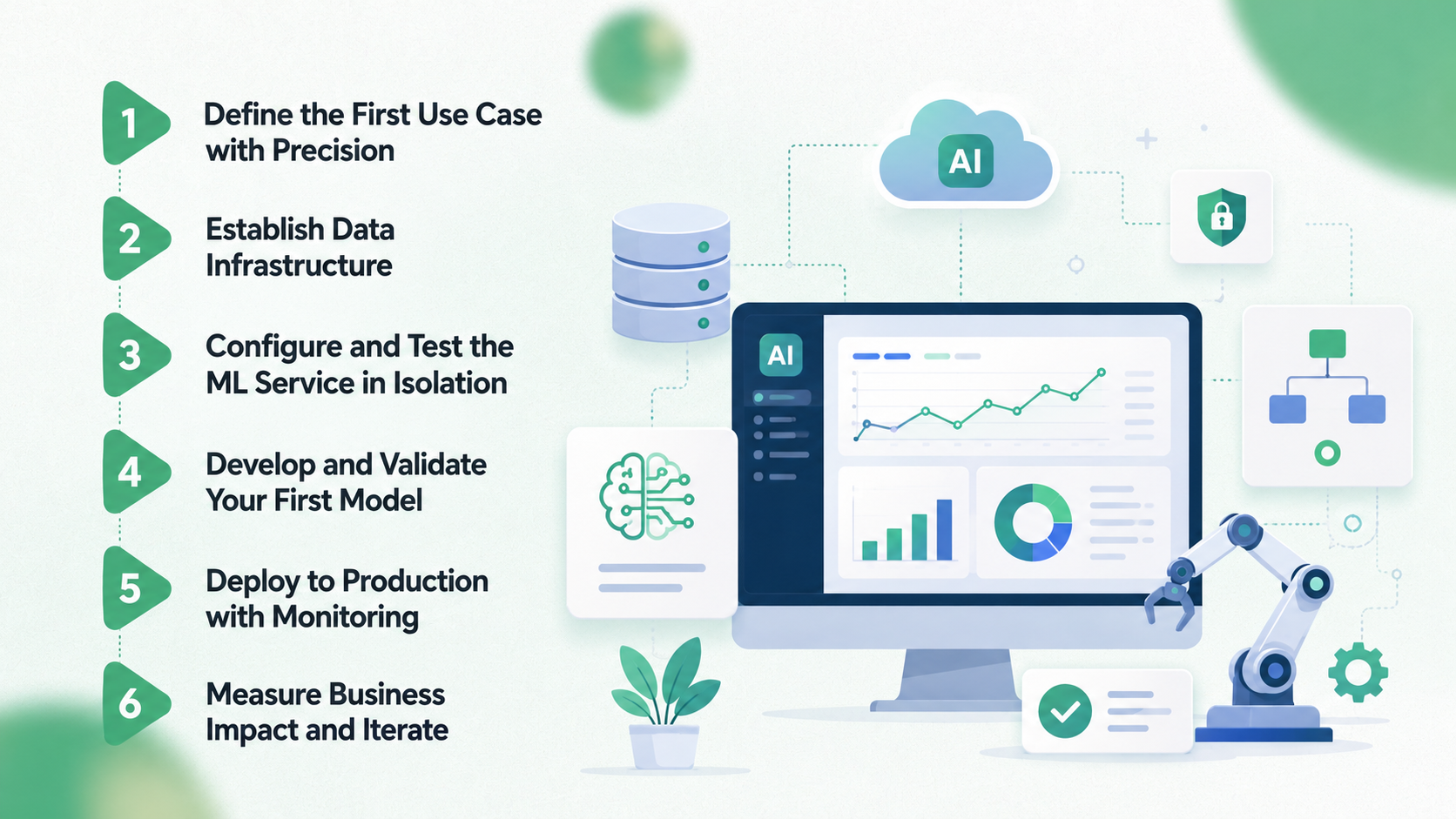
Choosing the right ML service is the beginning of the journey, not the end. Successful adoption requires a structured implementation approach that manages technical, organizational, and process dimensions simultaneously.
Resist the temptation to start with an ambitious, transformative use case. The goal of your first ML deployment is not to revolutionize the business. It is to build organizational confidence in ML outputs, develop internal implementation capability, and generate a documented ROI case that justifies the next investment.
Choose a use case that has a clear, measurable outcome, access to sufficient historical data, a motivated business owner, and a realistic four- to twelve-week path to production deployment.
Before writing a single line of model code or configuring a single ML service parameter, ensure that your data pipeline is reliable and that your training data meets basic quality standards. Data preparation typically consumes 60 to 80 percent of total ML project time. Acknowledging this reality from the start produces more accurate project timelines and more realistic stakeholder expectations.
Set up your selected ML service in a development environment and validate that it can connect to your data sources, produce training runs successfully, and generate inferences in a format compatible with your downstream systems. This validation step catches integration issues early, before they create pressure in a production timeline.
Train your first model on historical data and validate its performance against held-out test data using metrics that are meaningful to the business outcome you are targeting. Do not rely solely on technical model performance metrics like accuracy or AUC. Translate model performance into business impact terms so that stakeholders can evaluate whether the model is good enough to act on.
Production deployment is not the finish line. It is the beginning of the ongoing operations phase. Establish monitoring for model performance, prediction distribution, and data quality from day one of production deployment. Set thresholds that trigger alerts and retraining workflows when model performance degrades.
After four to eight weeks in production, measure the actual business impact of ML-driven decisions against the baseline you established before deployment. Use these results to refine your ROI model, to inform decisions about expanding the current use case or moving to the next one, and to build the internal business case for continued ML investment.
Understanding the most common selection mistakes allows your organization to avoid the patterns that have derailed ML investments for companies in every industry.
Selecting on features rather than fit. The ML service with the most features is not the right choice for most businesses. The right choice is the service whose specific capabilities best match your specific use case, technical context, and organizational maturity.
Underestimating implementation complexity. Vendors present implementation as straightforward because their commercial interest is in getting you to a purchase decision. The reality of connecting an ML service to real business data and real business processes is almost always more complex than the demo suggested.
Skipping the proof of concept. Every serious ML service evaluation should include a time-bounded, objective-defined proof of concept on your actual data before final selection. A service that performs brilliantly in a vendor demo may perform very differently on your specific data and use case.
Ignoring total cost of ownership. Subscription costs are visible and easy to compare. Implementation, integration, maintenance, and retraining costs are invisible until they accumulate. Always build a complete TCO model before selection.
Selecting for current scale rather than projected scale. The ML service that serves your current needs may become a bottleneck as your business grows. Build a three-year scalability assessment into every selection decision.
Neglecting organizational change management. ML models produce predictions. People decide whether to act on them. If your organization has not invested in helping business teams understand, trust, and act on ML outputs, even the best technical implementation will underperform.
Failing to define success metrics upfront. Without clear, pre-defined success metrics, ML projects drift into endless iteration without ever achieving a clear production deployment or measurable business impact.
The ML services market is evolving at a pace that makes today's evaluation criteria somewhat different from those that will dominate in two to three years. Understanding where the market is heading helps you select a platform that will remain relevant and competitive as your needs evolve.
The emergence of large foundation models has created a new category of ML service that abstracts away the model training process almost entirely. Businesses can now access extremely capable models for text, image, and multimodal tasks through simple API calls, with little to no training data required for many applications. This trend will continue to expand the set of use cases accessible to businesses without dedicated ML teams, while also shifting competitive advantage toward data and fine-tuning for businesses in specialized domains.
As ML deployments scale, the operational complexity of managing multiple models across production environments has driven significant investment in MLOps platforms and practices. Future ML service selection will increasingly factor in MLOps capabilities, including automated retraining pipelines, model drift detection, feature stores, and model governance frameworks.
Industries with latency-sensitive ML applications, including manufacturing, autonomous vehicles, and retail, are driving rapid growth in edge ML deployment capabilities. ML services that can train centrally and deploy efficiently to edge devices will become increasingly important for businesses in these sectors.
The global regulatory environment for AI systems is expanding rapidly. The EU AI Act and emerging frameworks in the United States and Asia-Pacific markets will impose new requirements on ML systems used in high-stakes decision contexts. Businesses selecting ML services today should evaluate vendors against anticipated regulatory requirements, not just current compliance obligations.
AutoML capabilities are advancing rapidly, making it feasible for business analysts without formal data science training to build and deploy useful predictive models. This trend will shift ML service evaluation toward usability and business integration capabilities, and away from the raw technical depth that was previously the primary differentiator.
Choosing the right ML services for your business is one of the highest-leverage decisions you can make in your AI adoption journey. Done well, it accelerates your path to business value, reduces wasted investment, and builds organizational capability that compounds over time. Done poorly, it creates technical debt, organizational frustration, and a failed first experience that makes the second attempt significantly harder.
The framework in this guide gives you the structure to approach this decision with the same rigor you would apply to any other major technology investment. Assess your readiness honestly before you evaluate vendors. Apply a multi-dimensional evaluation framework that accounts for use case fit, total cost of ownership, integration capability, scalability, security, vendor stability, and governance. Make a clear-eyed decision on the managed machine learning vs custom ML solution question based on your actual team capabilities and your specific use case requirements.
Most importantly, remember that the ML service selection decision is not the end of the work. It is the beginning. The businesses that generate the most value from ML services are those that invest as seriously in implementation quality, organizational change management, and ongoing model operations as they do in the initial selection decision.
The right ML service, selected thoughtfully and implemented well, is a durable competitive advantage, and KriraAI helps businesses implement scalable AI and machine learning solutions that deliver measurable business value. Start with the right framework, and you give yourself the best possible chance of being among the businesses that achieve it.
Use case fit and total cost of ownership matter most. A small business should look for an ML service that directly addresses a specific, measurable business problem and whose full cost across subscription, implementation, and maintenance falls within a realistic budget.
Assess three areas: data quality, team capability, and organizational readiness. You need reliable historical data, at least basic technical capacity to configure and maintain the system, and a clear business owner who will drive adoption.
Managed services handle model training and infrastructure automatically, offering faster time-to-value with less customization. Custom solutions give you full control but require experienced ML engineers and significantly longer development timelines.
Start by quantifying the cost of the problem ML will solve. Estimate realistic improvement based on comparable case studies, then compare total investment cost against projected benefit over a two to three year period, using conservative assumptions.
Yes. Fully managed AutoML platforms and pre-built AI APIs are designed for businesses without dedicated data science staff. The key is selecting a use case that is well-matched to what these platforms handle well.
Founder & CEO
Divyang Mandani is the CEO of KriraAI, driving innovative AI and IT solutions with a focus on transformative technology, ethical AI, and impactful digital strategies for businesses worldwide.