I remember a conversation with a startup founder two years ago.
He had a brilliant product idea. A growing SaaS platform. And a massive dataset sitting quietly in his servers.
But when he tried to build machine learning features?
Everything stalled.
Hiring ML engineers was expensive. Infrastructure costs kept growing. And the development timeline stretched from weeks… to months.
So he asked me something that I hear almost every week now:
“Is there a smarter way for startups to build ML without building an entire AI department?”
The short answer? Yes.
This is exactly where managed ML services for startups come into the picture.
And in 2026, they’ve become one of the most practical ways for startups to adopt AI without drowning in complexity.
Let me show you why.
At its core, managed machine learning services mean outsourcing the heavy technical work required to build, deploy, and maintain ML models.
Instead of building everything internally, startups rely on machine learning service providers who manage the infrastructure, tools, and model lifecycle.
Think of it like this.
You focus on your product. They handle the ML engine behind it.
Managed ML services are cloud-based or service-based solutions where providers manage:
ML model development
Data pipeline setup
Model training and deployment
Infrastructure management
Performance monitoring
For startups, this removes the biggest barrier to ML adoption: technical complexity.
MLaaS (Machine Learning as a Service) platforms provide pre-built infrastructure and tools for ML development.
These platforms typically include:
Data processing tools
Model training environments
APIs for AI features
Automated model optimization
Which means startups don’t have to spend months building ML pipelines from scratch.
Here’s the brutal truth most startups learn the hard way.
Building an internal ML team sounds impressive. But it’s rarely practical in the early stages.
Why?
Because ML isn’t just about hiring one data scientist.
You need:
Data engineers
ML engineers
Infrastructure experts
DevOps support
Suddenly your “AI experiment” becomes a six-figure investment.
Managed ML services solve that problem.
Let me ask you something.
If your startup has limited funding and a tight roadmap… should you spend two years building ML infrastructure?
Or two months shipping features your customers actually use?
Exactly.
Here’s why machine learning services for startups make sense.
Good ML engineers are rare.
The global demand for AI talent has exploded, and startups often struggle to compete with large tech companies offering huge salaries.
Managed ML providers solve this instantly.
You gain access to experienced ML engineers without hiring them full-time.
Speed matters for startups.
A feature delayed by six months can mean losing market advantage.
Managed AI teams already have frameworks, workflows, and experience. That dramatically reduces development time.
Training ML models requires significant computing power.
GPUs. Data storage. Model monitoring systems.
Managed ML providers already operate this infrastructure, so startups avoid large upfront investments.
Startups grow unpredictably.
One month you have 10,000 users. Six months later you have 500,000.
Managed ML services scale infrastructure automatically as demand increases.
No panic. No emergency server upgrades.
After working with dozens of startups implementing AI, I’ve seen a consistent pattern.
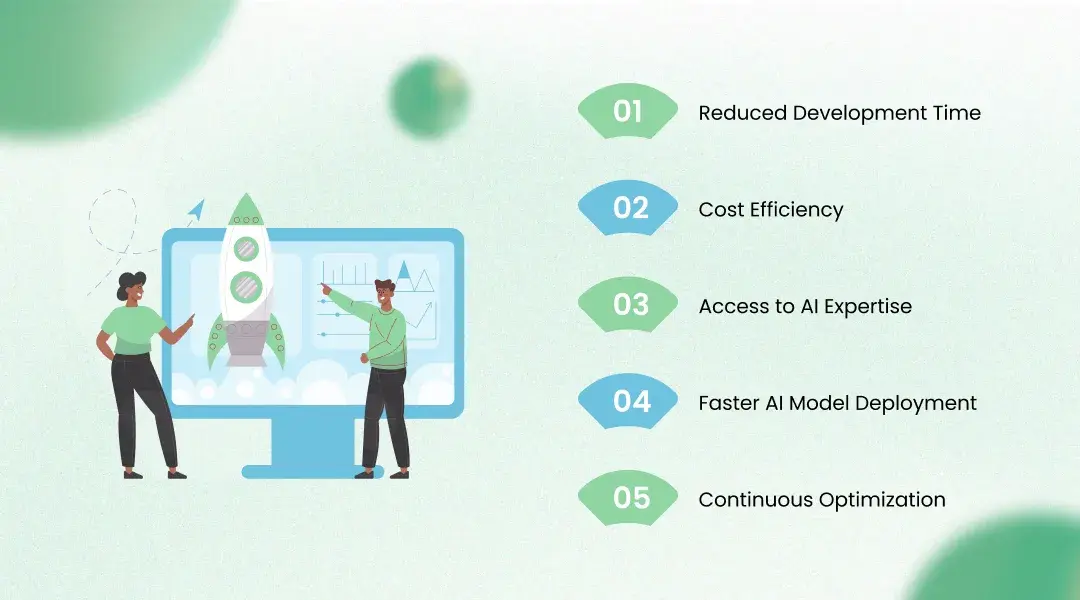
When startups adopt managed AI services for startups, five major benefits appear almost immediately.
Building ML pipelines from scratch can take months.
Managed providers already have established frameworks, which allows startups to deploy models much faster.
Hiring a full ML team can cost hundreds of thousands of dollars annually.
Managed ML services offer predictable monthly costs instead.
For early-stage startups, that matters a lot.
This is underrated.
Machine learning projects fail more often due to poor model design than bad data.
Experienced ML teams know how to avoid those mistakes.
A good ML model means nothing if it never reaches production.
Managed ML platforms simplify deployment using APIs and automated pipelines.
ML models degrade over time as data changes.
Managed providers constantly monitor and retrain models to maintain accuracy.
Let’s talk about the platforms dominating this space.
These represent some of the best managed ML services available today.
Google Vertex AI offers a complete environment for building, training, and deploying ML models.
Key advantages:
Integrated data pipelines
Automated model tuning
Strong AI research foundation
It’s especially popular among startups already using Google Cloud.
Amazon SageMaker is widely used because of its flexibility and massive infrastructure support.
Startups can build ML models quickly using pre-built frameworks and automated training tools.
Azure ML integrates well with enterprise environments and provides strong tools for model lifecycle management.
It’s frequently chosen by startups building enterprise SaaS platforms.
IBM focuses heavily on AI governance, explainable models, and enterprise-level security.
Healthcare and financial startups often prefer Watson because of compliance features.
Now here’s something many founders overlook.
Cloud platforms provide tools.
But tools alone don’t guarantee successful ML implementations.
That’s why startups often partner with experienced AI teams - companies like KriraAI, which specialize in building tailored ML solutions for startups.
Working with a Best AI development Company ensures models are aligned with real business goals, not just technical experiments.
Let’s compare both approaches.
Factor | Managed ML Services | In-House ML Team |
Cost | Lower operational cost | Very high hiring cost |
Expertise | Immediate access to AI specialists | Requires building full team |
Deployment Speed | Fast deployment | Slow setup |
Maintenance | Managed by provider | Internal responsibility |
Scalability | Cloud-based scaling | Infrastructure upgrades required |
For most startups, the decision becomes obvious.
Machine learning is not limited to big tech companies anymore.
Startups across industries are using ML every day.
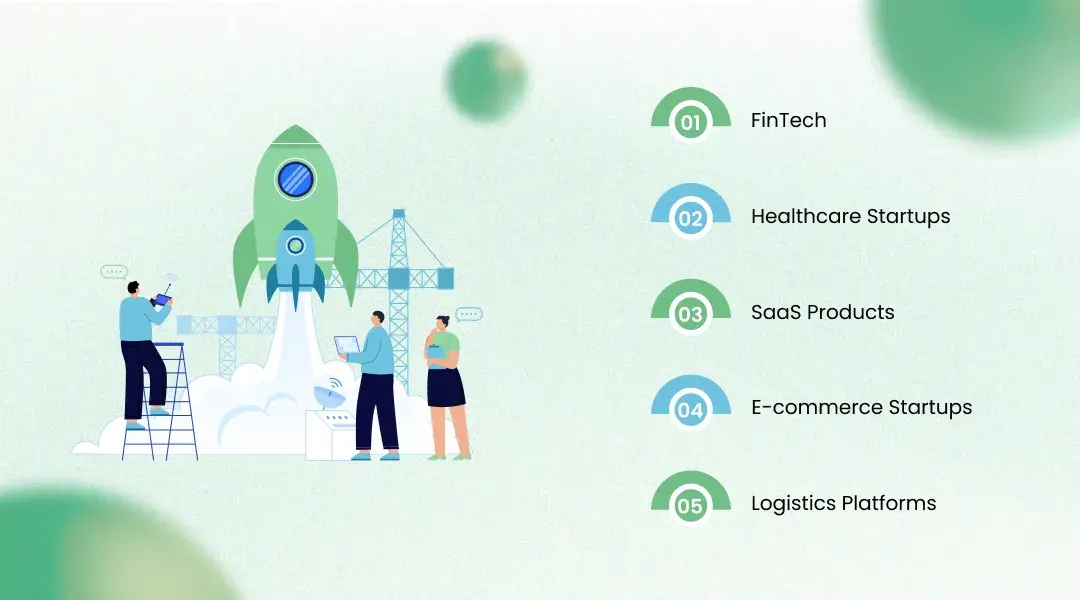
Fraud detection, credit scoring, and risk analysis rely heavily on ML models.
Managed ML services allow fintech startups to deploy these features quickly.
Medical startups use ML for diagnostics, patient data analysis, and predictive health models.
Because healthcare data is complex, managed AI teams often assist with development.
Recommendation engines, predictive analytics, and intelligent automation are common in SaaS platforms.
ML improves user experience and retention.
Product recommendations, demand forecasting, and dynamic pricing all rely on ML.
Many e-commerce founders begin with machine learning services for startups before building internal AI teams.
Delivery route optimization and supply chain predictions use ML extensively.
Managed ML services simplify implementation for logistics startups.
Choosing the wrong provider can delay your product for months.
So I recommend evaluating five things carefully.
Look for providers who have built ML systems before.
Experience matters far more than marketing claims.
Your ML system must integrate with existing infrastructure.
Google Cloud, AWS, or Azure compatibility is essential.
Some providers only offer generic models.
But startups often need custom algorithms designed for their specific datasets.
Startups handling sensitive data must ensure providers follow strict security standards.
ML models require monitoring and optimization.
Make sure your provider supports long-term model maintenance.
At KriraAI, we’ve worked with startups across fintech, SaaS, logistics, and e-commerce.
Our focus is simple.
Build ML solutions that solve real problems.
Not impressive demos.
We design ML models based on startup datasets and product goals.
No templates. No shortcuts.
From predictive analytics to intelligent automation, we help startups integrate AI into everyday operations.
Early-stage startups need practical solutions, not massive infrastructure costs.
Our ML architecture focuses on efficiency and scalability.
As startups grow, their AI systems must scale as well.
We design ML pipelines that grow alongside the product.
Many startups choose experienced partners because working with a Best AI development Company dramatically reduces the risk of failed AI projects.
Machine learning is evolving quickly.
And managed ML services are evolving with it.
Here are trends I’m watching closely.
AI systems are becoming increasingly autonomous, reducing the need for manual model tuning.
Models can now retrain themselves based on new data streams.
Which means systems become smarter over time.
AI agents are starting to manage entire workflows, from data processing to decision-making.
More platforms now allow non-engineers to experiment with ML models using visual tools.
This opens AI adoption to many more startups.
Here’s the reality I tell every founder.
Machine learning is no longer optional for startups building data-driven products.
But building ML infrastructure internally?
That’s rarely the smartest first step.
Managed ML services for startups offer a faster, safer way to experiment with AI, deploy intelligent features, and scale technology as the business grows.
And sometimes, the smartest decision a startup can make… is simply partnering with people who have already solved these problems before.
Managed ML services help startups build, deploy, and maintain machine learning models without creating an internal AI team.
Costs vary depending on model complexity and infrastructure, but they are typically far cheaper than hiring a full ML engineering team.
Yes. Managed ML providers supply experienced AI engineers who build and maintain models for startups.
Major providers include Google, AWS, Microsoft, IBM, and specialized machine learning service providers.
For most early-stage startups, managed ML services offer faster development, lower costs, and easier scalability compared to building internal teams.
Founder & CEO
Divyang Mandani is the CEO of KriraAI, driving innovative AI and IT solutions with a focus on transformative technology, ethical AI, and impactful digital strategies for businesses worldwide.