
How to Choose an AI Development Company: Ask These 12 Questions Before You Sign
Put three AI vendors in front of the same invoice problem, and their pitches will sound almost identical. So learning how to choose an AI development company is really learning which proof to request. Key features of leading AI development companies lists the traits worth looking for.
This guide turns those traits into 12 questions. Each ends with one document, such as a pilot report or exit plan, to collect before signing.
To keep things concrete, we'll follow a fictional buyer called Tidewater Cargo. It is a Mumbai freight forwarder that handles about 4,000 shipping documents a month. Its goal fits in one line: pull invoice and bill-of-lading fields into its ERP without anyone retyping them.
Before you choose an AI development partner, write a one-page brief
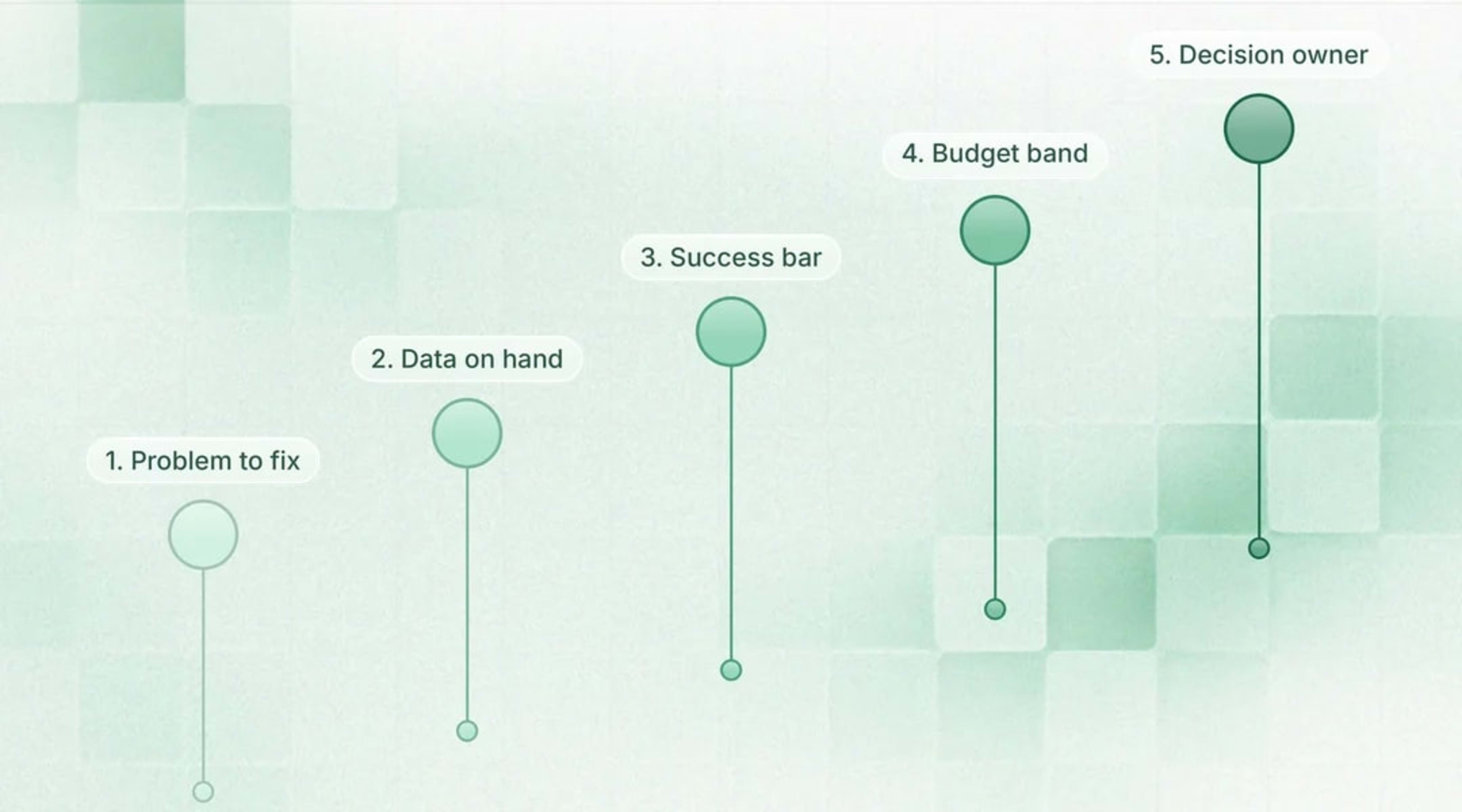
Leave the accuracy target blank, and each vendor fills it with whatever number flatters its proposal. So settle the problem, the data, the success number and the budget band before the first call.
A one-page brief also forces your own team to agree on what winning looks like. Buyers who choose an AI development company without one often end up comparing three different projects.
Here is what Tidewater's brief would contain (all figures are illustrative):
Problem to fix: clerks spend roughly six minutes keying each customs invoice into the ERP by hand.
Data on hand: eighteen months of scanned PDFs, about a third of them phone photos taken on the dock.
Success bar: at least 92% of fields correct on 200 documents the vendor has never seen.
Budget band: ₹30 to 45 lakh to build, plus a ceiling for monthly running costs.
Decision owner: one operations manager who can approve scope changes within two working days.
That page becomes the spine of your RFP later. It also gives every vendor the same starting point, which keeps their answers comparable.
How to choose an AI development company using 12 proof requests
The 12 questions sit in five areas: portfolio, domain fit, delivery model, data security, and pricing with ownership. Each area has a matching piece of evidence, so a vendor can't answer with adjectives alone. The map works whether your team must choose an AI development company for one pilot or a multi-year program.
Area
Portfolio
Questions
1 and 2
Evidence Tidewater would ask the vendor to hand over
A call with a client whose system is live, plus one written incident review
Area
Domain fit
Questions
3 and 4
Evidence Tidewater would ask the vendor to hand over
Accuracy measured on Tidewater's own files and a priced non-AI alternative
Area
Delivery model
Questions
5, 6 and 7
Evidence Tidewater would ask the vendor to hand over
Named engineer CVs, a signed acceptance test and a fortnightly demo calendar
Area
Data security
Questions
8 and 9
Evidence Tidewater would ask the vendor to hand over
A diagram of every service the data touches and a law-by-law control map
Area
Pricing and ownership
Questions
10, 11 and 12
Evidence Tidewater would ask the vendor to hand over
A run-cost sheet at triple volume, an IP clause and a written exit plan
Portfolio checks: is the AI development company's work actually live?
Count a portfolio entry only if it has served a paying client for six months or more. Slides and sandbox demos show that a team can build a prototype, not that it can keep one alive.
1. Which of your AI systems is running in production now, and may I call its owner?
Demos run on clean, hand-picked inputs. Production, by contrast, runs on whatever users upload at 2 a.m. So ask for one system that has handled real traffic for at least six months.
Next, ask to speak with the client's business owner rather than their IT contact. For Tidewater, a document pipeline for a trade-finance or logistics firm would be strong evidence. A polished retail chatbot proves far less about reading smudged customs stamps.
Proof to request: a 20-minute reference call and a usage figure the client confirms on that call.
2. What broke after launch, and what did you change?
Most teams that have shipped AI can describe a surprise. It might be a model update that shifted outputs, or an input nobody planned for. A vendor with no such story either hasn't shipped much or isn't being candid.
Ask for an anonymised incident review. It should cover what failed, how the team spotted it and how long the fix took. In Tidewater's world, the likely failure is a new carrier invoice layout that halves accuracy overnight.
Proof to request: one written post-launch incident review, with client names removed if needed.
Domain fit: will they solve your problem or a familiar one?
For Tidewater, domain fit means reading a smudged customs stamp correctly, not showing a logistics logo on a slide. Industry experience helps, but performance on your own files is the deciding test.
3. Will you run a short paid test on our own sample data?
Many vendors offer a paid discovery phase of two to three weeks, and it is usually money well spent. Tidewater would share 150 real documents, including the blurry dock photos. The vendor then reports field accuracy, failure types and a revised estimate.
Watch the gap between the pilot score and the final promise. Say a vendor scores 78% on your files but quotes 98% for production. It should then explain exactly what closes that gap.
Proof to request: a pilot report with accuracy measured on your files, not on a public dataset.
4. Would a simpler, non-AI fix handle part of this?
Good partners will sometimes shrink their own deal. Suppose 40% of Tidewater's invoices come from five carriers with fixed templates. Rule-based parsing could cover those cheaply, leaving the AI model for the irregular long tail.
However, a vendor that points a large language model at every field is selling a tool. Ask for both routes priced side by side.
Proof to request: a one-page option comparison that includes a rule-based or hybrid baseline.
Delivery model: who builds it, how progress is proven, how fast decisions move
These three questions cover the people writing Tidewater's code, the test that proves progress and the speed of sign-offs. A strong portfolio means little if the team that built it isn't the team assigned to you.
5. Who will actually build this, and what happens if they leave?
Senior architects often join the sales call and then disappear after kickoff. Ask for named engineers, their years on production AI and their weekly time allocation to your project.
Also ask for a replacement clause with a notice period and a free overlap week. Before you choose an AI development company, compare the names on the pitch with the names in the contract.
This check matters more in a tight market. In a 2024 analysis, staffing firm Xpheno counted fewer than 2,000 senior engineers in India building core AI products. A claim of deep bench strength therefore deserves a CV-level review.
Proof to request: named CVs, allocation percentages and a substitution clause in the statement of work.
6. How will we both agree the system is finished?
Arguments over what counts as finished cause many late-stage disputes on AI projects. The fix is an acceptance test set agreed before any build starts.
Tidewater might lock 200 held-out documents and a 92% field accuracy bar. It should also define what happens below that bar: rework at the vendor's cost, or a priced change request.
Proof to request: a signed acceptance document listing the test data, the metrics and the thresholds.
7. How often will we see working software, and who signs off on changes?
Fortnightly demos on real documents catch wrong turns while they are still cheap. Ask who on the vendor's side can approve scope changes, and how fast. If the vendor sits in another time zone, confirm at least three overlapping working hours each day.
Proof to request: a demo calendar, a shared backlog and one named decision-maker on each side.
Data security questions before any file leaves your servers
Tidewater's invoices carry consignee names and phone numbers, so it must trace each record and the law covering it. Few buyers choose an AI development company on security answers alone, but weak answers here should veto a deal.
8. Which services and model providers will touch our records, and in which regions?
Modern AI systems often call outside model APIs, vector databases and logging tools. Each hop is a place your data can rest. Ask for a diagram that shows every service, its hosting region and its retention period.
Then put three follow-up questions to the vendor in writing:
Will any of our records train a provider's models, and where is that opt-out documented?
Do your engineers work on live production data, or only on masked copies?
How many hours after spotting a breach will you notify us, and through which channel?
Proof to request: the data-flow diagram, with these answers attached to the contract as a schedule.
9. Which data and AI laws apply to us, and how will you show compliance?
India's Digital Personal Data Protection Rules took effect through a notification on 14 November 2025. According to the government's PIB backgrounder, firms get an 18-month phased window, so core duties land around May 2027. Weak security safeguards can draw a penalty of up to ₹250 crore under the DPDP Act.
Serving users in Europe adds the EU AI Act. The Council of the EU gave final approval in June 2026 to the Digital Omnibus on AI. That package moved stand-alone high-risk obligations to 2 December 2027, though some other duties kept earlier dates.
Proof to request: a compliance map that ties each legal duty to a specific control in the system.
Pricing and ownership terms that decide what you really pay
For a 4,000-document monthly workload, the build quote is often smaller than three years of running bills. Ownership terms then decide whether you can cut those bills or switch vendors. Teams that choose an AI development company on build price alone tend to meet the larger bill later.
10. What will it cost each month to run, at today's volume and at three times that?
Model calls, hosting, monitoring and periodic retraining keep billing after launch. Ask for a run-cost model at current volume and at triple volume. For Tidewater, 4,000 documents a month could become 12,000 after one new port contract.
Day rates also vary widely by country and seniority. Before you compare bids, read a breakdown of AI development cost in India. It helps you tell a lean quote from a suspiciously thin one.
Proof to request: a spreadsheet showing per-document cost, fixed monthly fees and growth assumptions.
11. If you vanished tomorrow, which parts of the system would we still hold?
A typical contract hands over source code and says nothing about the rest. Yet Tidewater's accuracy would live in its prompt library, its tuned extraction model and its 200-document test set. Insist that each one lives in a code host and cloud tenancy registered to Tidewater from sprint one.
Proof to request: an IP assignment clause listing code, prompts, tuned model files and test data by name.
12. If we part ways, what do we receive and how long does handover take?
Plan the exit while everyone is still friendly. A sound answer covers documentation, architecture notes, credential transfer and paid knowledge-transfer sessions. Tidewater should also ask whether a different team could run the system within four weeks of receiving it.
Proof to request: a written exit plan attached to the contract as its own schedule.
Red flags that should end an AI development company conversation early
If a vendor answers the 12 questions with adjectives instead of documents, slow down or walk away. The stakes are real: Gartner expects over 40% of agentic AI projects to be cancelled by the end of 2027.
In the same June 2025 forecast, it judged only about 130 agentic AI vendors to be genuine. Thousands more make the claim.
Gartner calls that relabelling habit agent washing, and it heads the warning signs below:
Old chatbots renamed as autonomous agents, with no tool use or decision logic you can inspect.
Accuracy figures printed in the proposal before anyone has opened a single one of your files.
References that stop at logos on a slide, with no client willing to take a call.
A team list that quietly changes between the pitch deck and the statement of work.
Contract drafts that keep prompts, weights or cloud accounts registered in the vendor's name.
A discount that expires on Friday, used to hurry you past the pilot stage.
A top AI development company will usually welcome these questions, because its answers are what win the deal.
Hiring an AI development company in India: where the edge holds
India-based vendors usually quote lower day rates than US or European firms. Senior AI depth, however, varies sharply between them.
A NASSCOM and Deloitte projection expects the skilled AI talent pool to pass 1.25 million by 2027. It stood at about 650,000 in 2022.
Location alone shouldn't decide how buyers choose an AI development company, yet it shapes price and staffing. The headline pool sounds like plenty.
However, TeamLease Digital reported in September 2026 that the GenAI talent gap sits near 53%. It also found that only 16% of IT professionals hold AI skills.
For buyers, the cost advantage holds best when the named team is verified. Teams sourced from India-based vendors tend to help in these ways:
Lower blended rates let a fixed budget fund a longer pilot or a bigger test set.
Overnight build cycles suit US clients, while morning overlap suits buyers in Europe and the Gulf.
Large engineering benches can scale a project from three people to ten within weeks.
Even so, the pool's thin senior slice means two cautions apply. First, ask for named architects instead of accepting headcount claims. Second, compare acceptance plans rather than hourly rates, because the cheapest bid often hides the thinnest testing.
The broader argument for offshore AI work appears in Benefits of hiring an AI development company in India. Many AI development companies in India now publish how they handle these checks. As one example to run through your scorecard, see KriraAI's page on the Best AI development company in India.
Turning the 12 questions into an RFP every vendor can answer
Tidewater's RFP sends all three shortlisted vendors the same brief, the same 150 files and the same deadline. Identical inputs make the answers comparable, and the document would follow this order:
The one-page brief, including the 92% success bar and the ₹30 to 45 lakh band.
A sample of 150 anonymised documents, flagging the twenty hardest phone photos.
The 12 questions, each one requiring a named document rather than a paragraph of claims.
A fixed response format covering team, approach, pilot plan, run costs and contract terms.
A two-week deadline, with one clarification call offered equally to every bidder.
Equal treatment matters more than it seems. If one vendor gets an extra workshop, its proposal will look sharper for reasons unrelated to skill.
A weighted scorecard to compare each AI development company side by side
Score each vendor from 1 to 5 per area, then multiply by the area's weight. Compare the totals out of 500.
Weights should reflect your risk. Tidewater's work is document-heavy, so it weights domain fit highest. A sheet like this keeps a committee honest when it must choose an AI development company in a hurry.
Here is an illustrative result after pilots with three shortlisted vendors (score, then weighted points):
Evaluation area
Portfolio, questions 1 to 2
Weight
20
Vendor A
4 (80)
Vendor B
3 (60)
Vendor C
5 (100)
Evaluation area
Domain fit, questions 3 to 4
Weight
25
Vendor A
5 (125)
Vendor B
3 (75)
Vendor C
3 (75)
Evaluation area
Delivery model, questions 5 to 7
Weight
20
Vendor A
4 (80)
Vendor B
4 (80)
Vendor C
3 (60)
Evaluation area
Data security, questions 8 to 9
Weight
20
Vendor A
4 (80)
Vendor B
5 (100)
Vendor C
3 (60)
Evaluation area
Pricing and ownership, questions 10 to 12
Weight
15
Vendor A
3 (45)
Vendor B
4 (60)
Vendor C
5 (75)
Evaluation area
Total out of 500
Weight
100
Vendor A
410
Vendor B
375
Vendor C
370
Vendor C had the cheapest quote and the flashiest portfolio. However, it skipped the paid pilot on Tidewater's own files, which cost it in domain fit. Vendor A wins because it scored highest where Tidewater set the most weight.
Change the weights to fit your situation. A hospital group, for instance, might lift data security to 30 and drop portfolio to 15.
What this checklist can't tell you
Twelve questions reduce the risk of a bad hire, but they don't remove it. Buyers who choose an AI development company should treat them as one input beside their own judgement. Keep these blind spots in mind:
Vendors pick their own references, so even a glowing call shows a best-case sample.
A pilot that looks strong on 150 files can still struggle at 4,000 documents a month.
Written answers show intent, but only signed contract clauses give you something enforceable.
No vendor answer can fix gaps on your side, such as missing data owners or slow approvals.
The full process also isn't for everyone. A five-person startup testing one idea may learn more from a two-week paid sprint with a single vendor.
Put your shortlist through the 12 questions
The fastest shortlists come from vendors who arrive with documents rather than slides. To test KriraAI against all 12 questions, start with its AI & Software Development Services. Then ask for the evidence pack.
FAQs
Plan for four to six weeks in total. Spend one on the brief, two on responses and two on pilots and scoring. Cutting the pilot step usually saves days but risks months of rework.
Yes, if it runs a short paid sprint on real data with one or two vendors. The sprint result replaces most of the paperwork, but the IP clause should still be in writing.
Fixed price works once a pilot has measured accuracy on your own data. Before that point, a capped time-and-materials discovery phase usually prices the unknowns more honestly.
It can, provided the contract fixes processing regions, access controls and breach-notice timelines. Ask for the data-flow diagram from question 8 before sharing any real customer records.
It should show accuracy on your held-out files, the main failure types and a revised estimate. A report that only displays successful examples is a sales document, not a pilot result.
Yes, provided the code host, prompt library and cloud tenancy were registered to you from the start. Without that, switching often means paying to rebuild much of the work.
Not by default. A large firm may staff your project with juniors, while a focused firm may assign its founders. So judge the named team rather than the logo.
Krushang Mandani is the CTO at KriraAI, driving innovation in AI-powered voice and automation solutions. He shares practical insights on conversational AI, business automation, and scalable tech strategies.