Building a Chatbot Development Solution That Actually Works
Most chatbot projects failed long before they ever reached real customers. Industry analyses suggest that close to seventy percent of early chatbot deployments were quietly abandoned within their first two years. The reason was simple and brutal to watch. The bots simply could not understand what people actually meant when they typed.
A modern chatbot development solution looks nothing like those rigid menu trees from a few years ago. Today, it runs on large language models that reason, retrieve context, and reply in natural language. This single shift has turned a famously failed category into a high-return investment. Companies that once buried their bots are now rebuilding them from the ground up.
For Indian enterprises facing rising support costs and heavy multilingual demand, the timing could not be sharper. This blog walks through why chatbots failed and what genuinely changed. You will see the core technologies, the measurable business impact, and a step-by-step implementation roadmap. We will also cover the honest limitations and where this field is heading over the next few years.
The State of Customer Conversations Before AI Took Over
Customer support has been quietly breaking for over a decade. Volumes keep climbing while customer patience keeps shrinking every single year. The average enterprise now fields more inbound queries than its human teams can reasonably absorb. This gap creates long wait times, frustrated callers, and exhausted agents.
The economics make the strain even worse for growing businesses. A single human support interaction can cost between forty and three hundred rupees, depending on channel and complexity. Multiply that across millions of monthly contacts, and the support function becomes a serious cost center. Leadership teams feel constant pressure to cut this number without harming experience.
The first wave of chatbots promised relief but mostly delivered disappointment. These early systems were built on rigid decision trees and fixed keyword matching. They worked only when customers typed the exact phrasing the designers had anticipated. Any deviation pushed users into frustrating loops or dead ends.
Several structural pressures shaped this difficult environment:
Support teams faced rising attrition because repetitive queries drained morale and increased burnout across shifts.
Customers expected instant answers at any hour, yet most businesses could only staff limited support windows.
Multilingual markets like India demanded fluency across Hindi, English, and regional languages that scripted bots could never handle.
Knowledge lived in scattered documents, so agents and bots alike gave inconsistent answers to the same question.
The competitive dynamics further intensified all of this. A brand that resolved issues quickly retained customers and earned loyalty. A brand that made people wait lost them to faster rivals. The market had clearly outgrown the tools available to serve it.
How AI Is Transforming Chatbot Development Today
Artificial intelligence did not just improve chatbots incrementally. It rebuilt the entire foundation of how these systems understand and respond. The difference between a 2018 bot and a 2026 assistant is not a feature gap. It is a complete change in the underlying intelligence powering the conversation.
A capable AI chatbot development approach now combines several distinct technologies. Each one solves a specific failure that crippled the previous generation. Understanding this mapping helps teams choose the right architecture for their needs.
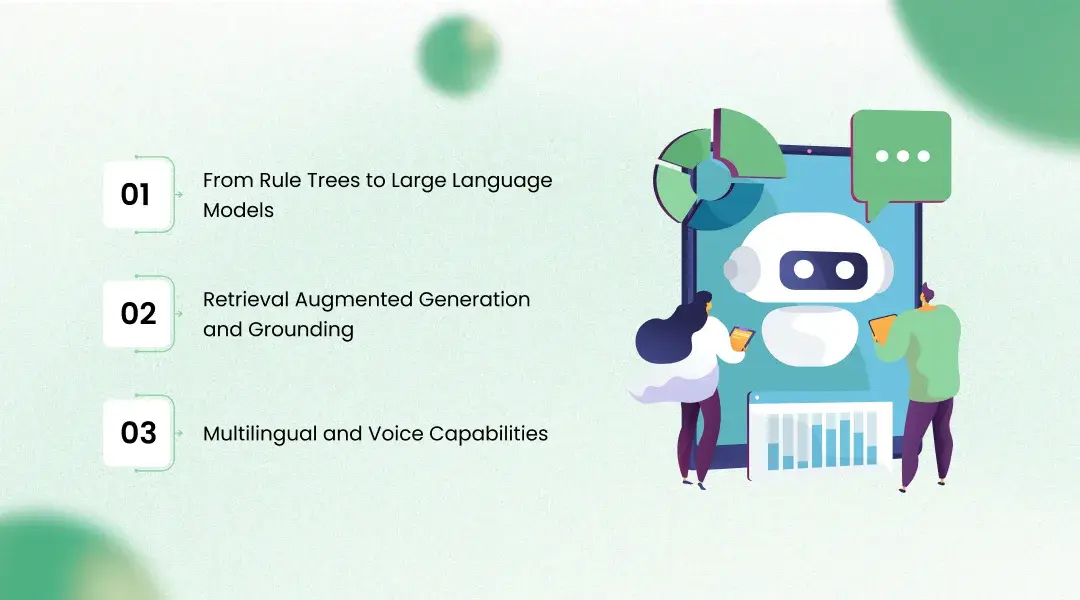
From Rule Trees to Large Language Models
Large language models replaced rigid scripts as the brain of modern conversational AI development. These models understand intent even when a customer phrases a request in unexpected ways. A user can ramble, misspell words, or mix two languages in one sentence. The model still extracts the actual meaning and responds appropriately.
This natural language understanding solves the single biggest historical failure point. Older bots broke the moment a question fell outside their script. Modern systems generalize across phrasings they have never seen before. This is why resolution rates have climbed so dramatically in recent deployments.
Retrieval Augmented Generation and Grounding
Raw language models are fluent, but they can confidently invent wrong answers. Retrieval augmented generation fixes this dangerous weakness directly. The system first pulls relevant facts from a verified company knowledge base. It then generates an answer grounded strictly in that retrieved information.
This grounding step is what makes enterprise chatbot solutions trustworthy at scale. Instead of guessing, the assistant cites your actual policies, prices, and product details. KriraAI builds retrieval pipelines that keep responses anchored to approved source content. This dramatically reduces the risk of a bot promising something the business cannot honor.
Multilingual and Voice Capabilities
Indian businesses serve customers who switch languages mid-conversation without warning. Modern models handle Hinglish, regional scripts, and code switching far better than older systems. A customer can begin in English and finish in Hindi seamlessly. The assistant follows along and replies in the customer's preferred language.
Several AI technologies now map cleanly to specific support problems:
Natural language processing interprets messy, real-world phrasing and routes intent correctly without scripted keywords.
Sentiment analysis detects frustration in real time and escalates angry customers to human agents faster.
Predictive analytics anticipates common follow-up questions and resolves them before the customer even asks.
Generative AI drafts personalized responses that feel human rather than robotic and repetitive.
Speech recognition extends the same intelligence to voice calls and not just text chat windows.
The combined effect is a system that understands, retrieves, reasons, and responds. This is the foundation of every serious custom chatbot development project today. KriraAI assembles these components into solutions tuned for each client industry and language mix.
The Quantified Business Impact of a Modern Chatbot Development Solution
A well-built chatbot development solution delivers returns that finance teams can actually measure. The improvements are not vague promises about a better experience. They show up directly in cost, speed, and revenue numbers.
Automated resolution is the headline metric most leaders care about first. Modern AI assistants commonly resolve between sixty and eighty percent of routine queries without any human help. This deflection rate alone reshapes the entire support cost structure. Every automated resolution removes a contact that would otherwise need a paid agent.
The cost savings compound quickly across high-volume operations. Businesses frequently report support cost reductions of thirty to fifty percent within the first year. For a company handling a million monthly contacts, this saving is enormous. The system pays back its build cost in a matter of months rather than years.
Speed improvements are equally striking and easy to verify. Average first response time often drops from several minutes to under five seconds. Customers receive instant answers at two in the morning just as easily as midday. This round-the-clock availability removes the staffing limits that once capped service quality.
Here are the impact areas that enterprises consistently track:
Resolution rate climbs as the assistant handles the long tail of repetitive questions automatically.
Cost per contact falls sharply because automation absorbs the highest volume, lowest complexity interactions.
Customer satisfaction scores rise when waiting disappears and answers arrive instantly and consistently.
Agent productivity increases because human staff focus only on complex, high-value conversations.
Revenue recovery grows as bots re-engage abandoned carts and answer pre-sale questions in real time.
Revenue impact deserves special attention because it surprises many teams. A responsive assistant can recover sales that would otherwise be lost to slow replies. Studies of conversational commerce suggest recovered revenue lifts of ten to twenty percent. KriraAI designs assistants that treat every conversation as both a support and a sales opportunity. This dual-purpose framing is what separates a cost-saving tool from a growth engine.
A Practical Implementation Roadmap for AI Chatbot Development
Knowing the benefits is easy, but capturing them requires a disciplined approach. Most failed projects skipped the groundwork and rushed straight into building. A structured rollout protects your budget and your customer trust. The following roadmap reflects how successful AI chatbot development actually unfolds.
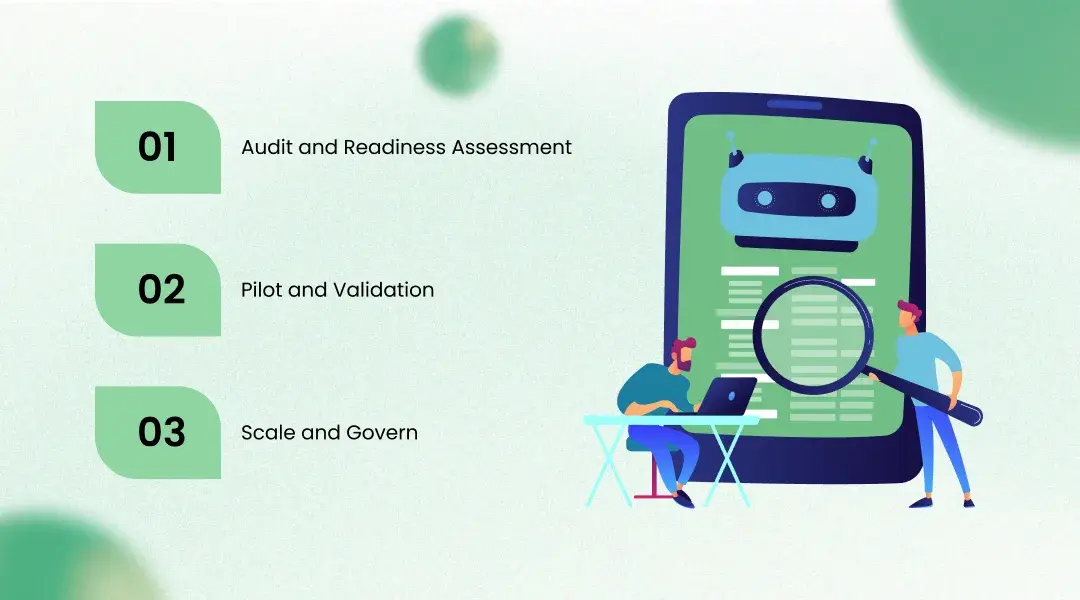
Phase One: Audit and Readiness Assessment
Start by mapping your real conversation volume and the questions behind it. Pull six months of support tickets and chat logs for analysis. Identify which queries repeat most often and consume the most agent time. These high-frequency, low-complexity questions are your ideal automation candidates.
Next, assess the state of your knowledge sources honestly. The assistant can only be as accurate as the documents feeding it. Outdated price lists and scattered policies will produce confused and wrong answers. Cleaning this knowledge base first is the most underrated step in the entire process.
Phase Two: Pilot and Validation
Never launch to your full customer base on day one. Begin with a narrow pilot covering a single high-volume use case. Route only a small share of traffic to the assistant initially. This controlled setting lets you measure accuracy without risking your whole brand reputation.
During the pilot, track resolution quality and escalation patterns closely. Read the transcripts where the bot failed and learn from each one. Feed those failures back into the retrieval and prompt design. This tight feedback loop is how a good conversational AI development cycle improves week over week.
Phase Three: Scale and Govern
Once the pilot proves reliable, expand coverage gradually and deliberately. Add new use cases one at a time rather than all at once. Connect the assistant to live systems like order tracking and account databases. This integration is what lets the bot take real actions instead of only talking.
Governance must scale alongside capability. Set clear rules for when conversations escalate to humans. Monitor a sample of transcripts continuously to catch drift early. KriraAI provides this ongoing monitoring layer so quality never silently degrades over time.
Common Mistakes and How to Avoid Them
Many teams repeat the same avoidable errors during rollout. Recognizing these patterns early saves months of wasted effort.
Automating everything at once overwhelms the system and produces poor answers across too many topics.
Ignoring the escalation path traps frustrated customers with a bot that cannot help them.
Skipping knowledge base cleanup guarantees the assistant will repeat your existing documentation errors.
Measuring only deflection rate hides whether customers were actually satisfied with the automated answers.
Treating launch as the finish line ignores that real performance gains come from continuous refinement.
The teams that succeed treat the assistant as a living product. They review, refine, and expand it month after month. This patient discipline is what turns a promising pilot into a durable enterprise asset.
Challenges and Limitations You Must Plan For
Honest planning means facing the genuine difficulties of this technology. AI chatbots are powerful, but they are not magic. Pretending otherwise sets teams up for the same disappointment that killed earlier projects.
Data quality remains the most stubborn obstacle by far. An assistant grounded in messy documents will give messy answers. Many businesses discover their knowledge base is contradictory and badly out of date. Fixing this takes real time and effort that leaders often underestimate.
Talent gaps create a second serious constraint for many companies. Building reliable enterprise chatbot solutions requires skills that are still scarce. You need people who understand retrieval design, prompt engineering, and conversation analysis. Most internal teams lack this experience and must either hire or partner externally.
Regulatory pressure adds another layer of complexity in India, specifically. The DPDP Act 2023 imposes real obligations around handling customer personal data. Conversations often contain sensitive details that must be stored and processed carefully. Compliance cannot be an afterthought bolted on after launch.
Integration complexity also slows many deployments more than expected. A chatbot that only talks is far less valuable than one that acts. Connecting it to legacy CRMs and order systems is rarely simple. These integrations frequently surface technical debt that has been ignored for years.
Change management is the quietest challenge yet often the most decisive. Support agents may fear the assistant will replace their jobs entirely. Without clear communication, adoption stalls and the project loses internal support. The most successful rollouts position the bot as a tool that removes drudgery, not people.
The Future of Chatbot Development Over the Next Five Years
Chatbot development will look very different within three to five years. The shift from answering to acting is already accelerating fast. Tomorrow, assistants will not just explain a refund policy. They will process the refund, update the account, and confirm the action.
Autonomous agents represent the next major leap forward. These systems will chain multiple steps together to complete entire workflows. A customer could change a flight, rebook a hotel, and adjust billing in one conversation. The assistant will handle each connected task without human intervention.
Proactive engagement will replace today's purely reactive model. Future assistants will reach out before customers even notice a problem. They will flag a delayed shipment and offer a solution unprompted. This anticipatory service will become a powerful competitive differentiator across industries.
The competitive landscape will split into clear winners and losers. Companies that build a strong data and automation foundation now will pull ahead decisively. Those who delay will face a widening capability gap that they cannot easily close. Custom chatbot development will become a core competency rather than an optional experiment.
Voice will also reclaim its place as a primary channel. As speech models mature, natural voice assistants will handle complex calls fluently. The line between chat and call will blur into one unified conversation layer. Businesses that prepare for this convergence early will own the advantage.
Conclusion
The story of chatbots is ultimately a story of redemption. Three lessons stand out from everything covered above. First, earlier bots failed because they could not understand real human language. Second, large language models and retrieval grounding finally solved that core failure. Third, a disciplined rollout through audit, pilot, and scale is what captures the measurable returns.
A modern chatbot development solution now delivers cost savings, faster service, and recovered revenue at the same time. The technology has matured, but the strategy behind it still determines success or failure. This is precisely where the right partner makes all the difference. KriraAI builds practical AI solutions for enterprises that are measurable, compliant, and engineered to scale across languages and channels. The focus stays on real business outcomes rather than flashy demos that never reach production.
If your earlier chatbot disappointed you, the problem was the era, not the idea. The tools are finally ready for the promise they always made. Explore how KriraAI can help you design and deploy a chatbot development solution built for genuine results, and reach out to start the conversation today.
FAQs
A chatbot development solution is a complete system for building, deploying, and maintaining an automated conversational assistant for a business. It combines large language models for understanding, retrieval systems for grounding answers in company data, and integrations that let the bot take real actions. The assistant interprets a customer message, finds the relevant verified information, and generates an accurate natural language reply. Modern versions handle messy phrasing, multiple languages, and follow-up questions far better than older scripted bots. The result is a system that resolves most routine queries automatically while escalating complex cases to human agents.
AI chatbot development costs vary widely based on complexity, integrations, and language coverage. A simple single-use case assistant may cost a few lakh rupees to build and deploy. A full enterprise-grade system with multiple integrations and multilingual support costs significantly more. However, the return usually justifies the investment within months for high-volume operations. Businesses commonly recover their build cost through support savings of thirty to fifty percent in the first year. The most important cost factor is not the initial build but the ongoing refinement needed to keep accuracy high over time.
Conversational AI development uses large language models that genuinely understand meaning rather than matching fixed keywords. Old rule-based chatbots followed rigid decision trees and broke the moment a customer phrased something unexpectedly. Modern systems generalize across phrasing they have never seen, handle multiple languages, and reason through context. They also retrieve verified company information before answering, which keeps responses accurate and grounded. This combination is why resolution rates jumped from frustratingly low to between sixty and eighty percent. The shift represents a complete rebuild of the underlying intelligence, not a small feature upgrade over previous bots.
AI chatbots can be safe and compliant when built with proper data governance from the start. In India, the DPDP Act 2023 sets clear rules for collecting, storing, and processing personal customer data. A responsible chatbot development solution encrypts sensitive information, limits data retention, and controls who can access conversation logs. It also gives customers transparency about how their data is used during interactions. Compliance must be designed into the architecture rather than added afterward. Businesses should work with partners who understand Indian regulatory requirements and build privacy protections directly into the conversational system.
Deploying enterprise chatbot solutions typically takes a few weeks to a few months, depending on the scope. A focused pilot covering one high-volume use case can launch in roughly four to eight weeks. Full deployment across multiple use cases with deep system integrations takes longer to complete properly. The timeline depends heavily on the state of your existing knowledge base and data systems. Clean, organized documentation accelerates the process significantly, while messy sources slow it down. The smartest approach starts small with a controlled pilot, validates real performance, and then scales coverage gradually over time.
Founder & CEO
Divyang Mandani is the CEO of KriraAI, driving innovative AI and IT solutions with a focus on transformative technology, ethical AI, and impactful digital strategies for businesses worldwide.