By 2026, over 85% of customer interactions across industries are managed without a single human agent touching the conversation at first contact. That number would have been unthinkable five years ago, when most chatbots were glorified FAQ pages that frustrated users more than they helped. The transformation happened not because businesses suddenly became more willing to adopt chatbots, but because the underlying AI powering services underwent a fundamental shift. Today, AI in chatbot development services is no longer about scripting decision trees or mapping keywords to canned responses. It is about building systems that understand context, remember history, detect emotion, and adapt in real time to the unpredictable ways humans actually communicate.
The chatbot development industry has reached a turning point where the gap between companies using AI native approaches and those still relying on rule based architectures is widening into a chasm. Enterprises that invested in intelligent chatbot solutions early are now seeing compounding returns, while those that delayed adoption are discovering that the cost of catching up grows steeper every quarter. This is not a trend that will plateau. As large language models become more capable, as multimodal understanding matures, and as integration frameworks become more accessible, the entire definition of what a chatbot can do is being rewritten.
This blog examines the full landscape of how AI is reshaping chatbot development services, from the specific technologies driving the change, to the measurable business outcomes companies are achieving, to the practical roadmap for implementation. It addresses the real challenges and limitations that organizations face, projects where the industry is heading in the next three to five years, and answers the most common questions decision makers are asking right now.
The chatbot development industry today is caught between two eras. On one side, there is a massive installed base of legacy chatbots built on intent classification models and rigid dialogue flows. These systems were the standard from roughly 2016 to 2022, and many enterprises still operate them because the cost of rebuilding feels prohibitive. On the other side, a new generation of AI native chatbot platforms has emerged, powered by large language models, retrieval augmented generation, and advanced dialogue management systems that make the previous generation look primitive by comparison.
The core challenge facing chatbot development firms is complexity. Customer expectations have risen dramatically. Users no longer tolerate bots that cannot handle multi turn conversations, that lose context when switching topics, or that fail to understand the intent behind ambiguously phrased questions. A 2025 survey by Salesforce found that 71% of consumers expect companies to communicate with them in real time, and 64% expect the same quality of interaction from a chatbot as they would from a human agent. Meeting these expectations with traditional rule based systems is effectively impossible at scale.
Cost pressures compound the problem. Building and maintaining a traditional chatbot with broad topic coverage requires a team of dialogue designers, NLP engineers, QA specialists, and content managers who continuously update intents, retrain classifiers, and fix edge cases. For a mid sized enterprise, the annual cost of maintaining a legacy chatbot can run between $300,000 and $800,000, depending on the number of supported languages, channels, and use cases. These costs scale linearly with complexity, meaning every new feature or language addition requires proportional investment.
The competitive dynamics are shifting rapidly as well. Startups offering AI native chatbot platforms are winning enterprise contracts by demonstrating faster deployment, lower total cost of ownership, and significantly higher customer satisfaction scores. Established chatbot vendors that have not modernized their core architecture are losing market share. According to Gartner's 2025 analysis of the conversational AI market, vendors with generative AI capabilities grew revenue at 3.4 times the rate of those relying solely on traditional NLU engines. This competitive pressure is forcing the entire industry to rethink how chatbots are designed, built, and deployed.
Integration complexity remains a persistent barrier. Enterprises need chatbots that connect seamlessly with CRM systems, payment gateways, inventory databases, ticketing platforms, and knowledge bases. Legacy chatbot architectures often treat these integrations as afterthoughts, resulting in brittle connections that break when backend systems are updated. Modern enterprise chatbot implementation demands architectures that treat integrations as first class components, with robust error handling, fallback mechanisms, and real time data synchronization.
The transformation of chatbot development services through AI is happening across multiple technology layers simultaneously. Understanding which technologies are solving which problems is critical for any organization evaluating its conversational AI strategy.
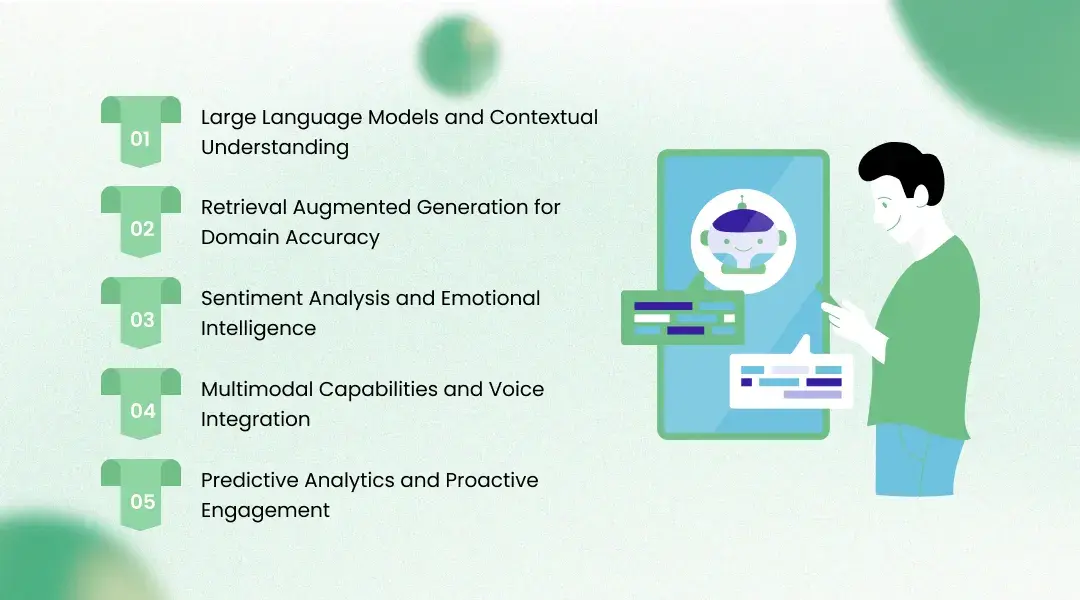
The most visible shift has been the integration of large language models into chatbot architectures. Unlike traditional intent classification systems that require exhaustive training data for every possible user utterance, LLM powered chatbots can understand and respond to queries they have never seen before. This capability eliminates the most painful bottleneck in traditional chatbot development, which is the months long process of collecting, annotating, and training on thousands of example utterances for each new intent.
In practice, companies like KriraAI are building hybrid architectures that combine the generative flexibility of large language models with the precision and control of structured dialogue management. This approach allows enterprises to benefit from the natural conversational ability of LLMs while maintaining guardrails around accuracy, brand voice, and regulatory compliance. The LLM handles open ended conversation and ambiguity resolution, while deterministic systems manage transactional flows like payment processing, appointment scheduling, and order tracking where precision is non negotiable.
One of the most significant technical advances in AI powered customer engagement has been retrieval augmented generation, commonly known as RAG. This technique addresses the fundamental limitation of language models, which is their tendency to generate plausible sounding but factually incorrect responses. RAG systems ground the chatbot's responses in verified knowledge by retrieving relevant documents, FAQs, product specifications, or policy documents from a curated knowledge base before generating a response.
For chatbot development services, RAG has been transformative because it dramatically reduces the time required to make a chatbot domain accurate. Instead of fine tuning a model on thousands of examples, developers can index an enterprise's existing documentation and the chatbot can begin answering domain specific questions within days rather than months. A well implemented RAG pipeline also makes the chatbot self updating, because when documentation changes, the indexed knowledge base is refreshed and the chatbot's responses automatically reflect the latest information.
Modern conversational AI for business goes beyond understanding what a user is saying to understanding how they feel while saying it. Sentiment analysis models integrated into chatbot pipelines can detect frustration, urgency, confusion, and satisfaction in real time. This capability enables dynamic conversation routing, where a chatbot recognizing an escalating negative sentiment can proactively offer to connect the user to a human agent before the interaction deteriorates further.
The business impact of emotionally aware chatbots is substantial. Companies deploying sentiment aware routing report a 28% reduction in customer churn from service interactions, because frustrated customers are intercepted before they reach the point of abandoning the brand entirely. This technology also provides valuable analytics, giving companies a real time emotional pulse of their customer base that was previously invisible.
The definition of a chatbot is expanding beyond text. AI in chatbot development services now encompasses voice enabled assistants, visual search chatbots that process images uploaded by users, and multimodal systems that can interpret screenshots, receipts, product photos, and documents within a conversation. A customer can photograph a damaged product and the chatbot can process the image, identify the product, assess the damage, and initiate a return, all without human intervention.
Voice integration has matured considerably, with neural text to speech models producing voices that are nearly indistinguishable from human speech. Chatbot development firms are building systems that transition seamlessly between text and voice channels, maintaining conversation context across modalities. This is particularly impactful in industries like healthcare, automotive, and accessibility services where voice interaction is not just convenient but essential.
AI powered chatbots are evolving from reactive responders to proactive agents. Predictive analytics models analyze user behavior patterns, purchase history, browsing activity, and previous conversation data to anticipate what a customer needs before they ask. A chatbot might proactively reach out to a user who has been browsing a product category for several sessions without purchasing, offering a personalized recommendation or addressing a likely concern.
This shift from reactive to proactive represents a fundamental change in how businesses think about conversational AI for business. The chatbot becomes a revenue generating channel rather than a cost center, driving upsells, reducing cart abandonment, and improving customer lifetime value through personalized, timely engagement.
The measurable impact of AI in chatbot development services extends across cost reduction, revenue generation, operational efficiency, and customer experience metrics. Organizations across sectors are reporting substantial returns that justify significant investment.
Cost reduction is the most immediately visible benefit. Enterprises replacing legacy rule based chatbots with AI native systems report an average 40% reduction in chatbot maintenance costs within the first year. The reduction comes primarily from eliminating the continuous manual effort of updating intents, retraining classifiers, and writing new dialogue flows. With LLM based systems, the chatbot adapts to new queries organically, and RAG pipelines ensure accuracy without manual content updates. A large European telecom company reported saving $2.1 million annually after migrating its customer service chatbot from a traditional NLU platform to an AI native architecture built with support from KriraAI's implementation methodology.
Resolution rates have improved dramatically. The average first contact resolution rate for AI powered chatbots in 2026 stands at 74%, compared to 41% for traditional rule based systems. This improvement means fewer conversations need escalation to human agents, which in turn reduces staffing requirements for first tier support. Companies in e-commerce and SaaS verticals have reported even higher figures, with some achieving first contact resolution rates above 85% for product and billing inquiries.
Customer satisfaction scores tell a compelling story as well. Net Promoter Scores for interactions handled by intelligent chatbot solutions average 12 to 18 points higher than those handled by legacy chatbots. The improvement correlates directly with the chatbot's ability to understand context, maintain conversation history, and resolve issues without forcing the user through repetitive verification steps. Customers consistently rate the experience of interacting with an AI native chatbot as closer to speaking with a knowledgeable human agent than to navigating an automated system.
Revenue impact is increasingly measurable. AI powered chatbots that incorporate proactive engagement and personalized recommendations are generating measurable revenue contributions. Retail companies deploying conversational commerce chatbots report a 15% to 22% increase in average order value when the chatbot provides product recommendations during the purchase journey. Financial services firms using AI chatbots for lead qualification report a 35% improvement in conversion rates from inquiry to application, because the chatbot can engage prospects instantly, answer detailed questions about products, and guide them through the application process without waiting for a human advisor.
Time to deployment has also compressed significantly. A chatbot that would have taken six to nine months to build using traditional approaches can now be deployed in production within six to eight weeks using AI native development frameworks. This acceleration is driven by the reduction in training data requirements, the availability of pre trained models, and modern orchestration platforms that simplify integration with enterprise systems. Faster deployment means faster time to value, which is a critical factor for enterprises evaluating their AI investments.
Implementing AI in chatbot development services successfully requires a structured approach that balances ambition with pragmatism. The companies that achieve the strongest outcomes follow a phased methodology that de risks the investment and builds organizational confidence progressively.
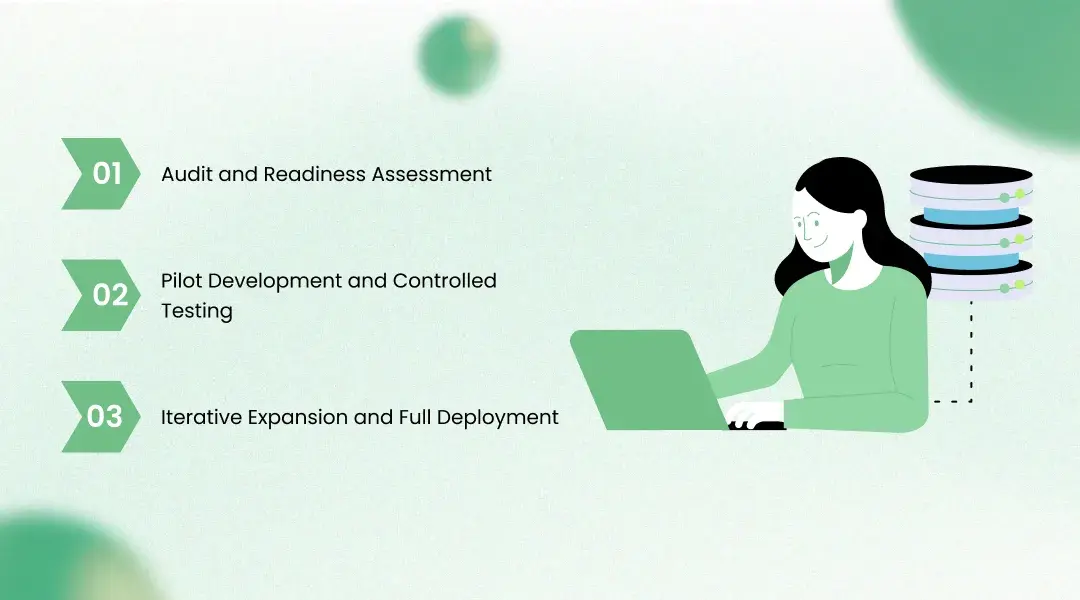
The first step is understanding where you stand today. This involves a comprehensive audit of existing customer interaction channels, including current chatbot performance metrics, call center logs, email support tickets, and live chat transcripts. The goal is to identify the highest volume, lowest complexity interactions that represent the best candidates for AI chatbot automation. Equally important is assessing the state of the organization's data infrastructure, specifically whether customer data, product information, and support documentation are structured and accessible in formats that an AI system can ingest.
Organizations should also evaluate their technical readiness, including the maturity of APIs connecting key business systems, the availability of clean training data, and the presence of internal teams capable of managing an AI system post deployment. KriraAI typically recommends this audit phase take two to three weeks and result in a prioritized opportunity matrix that ranks potential chatbot use cases by expected impact, technical feasibility, and implementation complexity.
Rather than attempting a full scale deployment, successful implementations begin with a tightly scoped pilot. The pilot should address a single, well defined use case, such as order status inquiries, password resets, or appointment scheduling. The purpose of the pilot is not only to prove technical viability but to establish baseline performance metrics that will guide subsequent expansion.
During the pilot phase, the chatbot should be deployed to a controlled subset of users, typically 10% to 15% of total traffic. This allows the team to monitor performance, identify failure patterns, and refine the system's knowledge base and conversation flows based on real user interactions. The pilot should run for a minimum of four to six weeks to capture sufficient data across different user segments and interaction patterns.
Based on pilot results, the chatbot's scope expands systematically. New use cases are added one at a time, with each expansion cycle including knowledge base updates, integration testing, and performance benchmarking against the established baseline. This iterative approach prevents the common failure mode of deploying too much functionality too quickly, which overwhelms the system and degrades user experience.
Full deployment should include robust monitoring dashboards that track key metrics in real time, including resolution rate, fallback rate, average conversation length, customer satisfaction, and sentiment distribution. These dashboards enable continuous optimization and provide early warning of issues before they impact a significant number of users.
The most frequent mistake in enterprise chatbot implementation is underestimating the importance of knowledge base quality. An AI chatbot is only as good as the information it can access. Organizations that feed poorly organized, outdated, or contradictory documentation into their RAG pipeline end up with chatbots that give inconsistent or incorrect answers, which erodes user trust faster than having no chatbot at all. The solution is treating knowledge base curation as a continuous process, not a one time setup task.
A second common mistake is failing to design effective human handoff flows. Even the best AI chatbot cannot handle every interaction. When the chatbot reaches the limits of its capability, the transition to a human agent must be seamless, preserving all conversation context so the user does not have to repeat themselves. Companies that treat human handoff as an afterthought consistently report lower customer satisfaction scores than those that invest in making the transition invisible.
A third mistake is neglecting change management. Introducing an AI chatbot affects customer service teams, sales teams, and sometimes product teams. Agents may feel threatened by automation, managers may resist giving up control over customer interactions, and stakeholders may have unrealistic expectations about what the chatbot can achieve. Successful implementations include structured change management programs that address these concerns, provide training, and establish clear roles for human agents in the AI augmented workflow.
Adopting AI in chatbot development services is not without significant obstacles, and organizations that enter this space with unrealistic expectations often find themselves disappointed. Acknowledging these challenges honestly is essential for setting the right strategy.
Data quality remains the most persistent challenge. AI models perform well when they have access to clean, comprehensive, and current data. Many enterprises discover that their internal documentation is fragmented, stored across dozens of systems, filled with contradictions, and written in inconsistent formats. Cleaning and structuring this data for use in a chatbot's knowledge base is often the single most time consuming and expensive phase of the entire implementation. There is no shortcut around this work, and no AI model can compensate for fundamentally bad data.
Talent gaps present another real barrier. Building and managing an AI native chatbot requires skills in machine learning engineering, prompt engineering, data engineering, and conversational design. These are specialized roles that are in high demand and short supply. Many organizations lack the internal expertise to evaluate AI vendors critically, design effective architectures, or troubleshoot performance issues when they arise. Partnering with firms like KriraAI that bring cross industry implementation experience can help bridge this gap, but organizations should also invest in upskilling their internal teams for long term sustainability.
Regulatory and compliance constraints add complexity in industries like healthcare, finance, and insurance. Chatbots handling personal health information, financial data, or insurance claims must comply with regulations including HIPAA, GDPR, PCI DSS, and sector specific rules. These requirements influence everything from how data is stored and processed, to what the chatbot is permitted to say, to how conversations are logged and audited. Compliance is not a feature that can be bolted on after development. It must be architected into the system from the beginning.
Hallucination and accuracy risks cannot be ignored. Despite advances in RAG and grounding techniques, language model based chatbots can still generate responses that sound confident but are factually incorrect. In low stakes scenarios this might be a minor annoyance, but in contexts like medical advice, financial guidance, or legal information, a hallucinated response can have serious consequences. Robust validation layers, confidence scoring, and human in the loop review processes are essential safeguards that add cost and complexity but are non negotiable for enterprise deployment.
Looking three to five years ahead, the chatbot development industry will undergo changes that make even today's AI native systems look limited by comparison. Several converging trends will reshape what is possible and redefine competitive advantage.
Autonomous agent architectures will replace the current conversational model. Instead of chatbots that respond to queries within a single conversation, enterprises will deploy AI agents that can execute multi step workflows across systems autonomously. A customer requesting a product exchange will interact with an agent that checks inventory, processes the return, issues a refund, schedules a pickup, and sends a replacement, all within a single conversation and without human intervention at any step. These agentic capabilities are already emerging in prototype form and will be production ready within two years.
Hyper personalization will become the baseline expectation. Future chatbots will maintain persistent memory across interactions, building a progressively richer understanding of each customer's preferences, communication style, and history. The chatbot will not just remember what you bought last month but will anticipate what you need next, adjust its tone to match your communication preferences, and proactively surface relevant information based on your evolving relationship with the brand.
The competitive implications are stark. Companies that fail to modernize their conversational AI infrastructure within the next two to three years will face a compounding disadvantage. Their customer acquisition costs will rise as competitors offer superior automated experiences. Their operational costs will remain elevated as manual processes persist where automation should exist. And their ability to attract and retain talent will suffer as skilled professionals gravitate toward organizations that embrace rather than resist AI transformation.
Cross language and cross cultural capabilities will reach near human fluency. Current multilingual chatbots still struggle with idiomatic expressions, cultural nuances, and code switching between languages within a single conversation. Advances in multilingual foundation models will close this gap, enabling enterprises to serve global customer bases with a single chatbot platform that communicates naturally in any language. For companies operating in diverse markets, this capability alone will represent a massive competitive advantage and a significant reduction in localization costs.
The transformation driven by AI in chatbot development services is reshaping how enterprises communicate with their customers at every level. Three insights stand above the rest. First, the technology gap between AI native chatbots and legacy rule based systems has become so wide that operating on older architectures is now a measurable competitive disadvantage, not merely a missed opportunity. Second, the business impact of intelligent chatbot solutions is no longer speculative. It is quantifiable in cost savings, revenue gains, resolution rates, and customer satisfaction scores. Third, successful implementation is not primarily a technology challenge but an organizational one, requiring clean data, structured rollout plans, and genuine change management.
For enterprises navigating this transformation, the right implementation partner makes a meaningful difference. KriraAI works with organizations across industries to design, build, and scale AI powered chatbot systems that deliver measurable business outcomes. Their approach emphasizes practical implementation over theoretical capability, focusing on architectures that integrate with existing enterprise systems, comply with regulatory requirements, and produce ROI within defined timelines. Whether you are modernizing a legacy chatbot or building conversational AI from scratch, the window to act is now.
If you are evaluating how AI can strengthen your customer engagement strategy, explore how KriraAI's enterprise chatbot implementation services can help you move from planning to production with confidence.
The cost of building an AI powered chatbot for an enterprise varies significantly based on the complexity of use cases, the number of integrations required, and the scale of deployment. For a mid market company with a focused scope of three to five use cases, the initial development cost typically ranges from $80,000 to $250,000 including knowledge base preparation, model configuration, integration development, and testing. Annual maintenance and optimization costs generally run between 20% and 30% of the initial build cost. Enterprise deployments with extensive custom integrations, multi language support, and regulatory compliance requirements can reach $500,000 or more for the initial build. However, these costs must be weighed against the operational savings and revenue gains that a well implemented AI chatbot delivers, which typically produce positive ROI within 8 to 14 months.
Deploying an AI chatbot in a production environment using modern AI native frameworks typically takes between six and twelve weeks for a focused initial deployment. This timeline includes two to three weeks for discovery and knowledge base preparation, two to three weeks for development and integration, and two to four weeks for testing, refinement, and staged rollout. This represents a significant acceleration compared to traditional chatbot development timelines of six to nine months. However, the timeline can extend considerably if the organization's data infrastructure is immature, if extensive custom integrations are needed, or if regulatory approval processes are required. The most common cause of delays is not technical complexity but organizational readiness, specifically the time required to assemble clean documentation, align stakeholders, and prepare internal teams for the change.
AI chatbots cannot and should not fully replace human customer service agents, at least not in the foreseeable future. The most effective enterprise chatbot implementations treat AI as an augmentation layer that handles routine, repetitive, and high volume interactions while freeing human agents to focus on complex, emotionally sensitive, and high value conversations. Current AI chatbots can resolve approximately 70% to 80% of incoming customer queries without human involvement, which dramatically reduces the volume of interactions that require human attention. However, scenarios involving nuanced judgment, empathy in emotionally charged situations, creative problem solving for unusual cases, and relationship building with high value clients still require human expertise. The optimal model is a collaborative one where the chatbot handles first contact triage, resolves straightforward issues, and seamlessly escalates complex cases to human agents with full conversation context preserved.
AI in chatbot development services delivers the strongest returns in industries with high volumes of repetitive customer interactions, complex product or service catalogs, and strong digital channel presence. E-commerce and retail lead in adoption and ROI, driven by use cases including order tracking, product recommendations, returns processing, and conversational commerce. Financial services benefit significantly from AI chatbots for account inquiries, loan application guidance, fraud alert handling, and investment education. Healthcare organizations use intelligent chatbot solutions for appointment scheduling, symptom triage, medication reminders, and insurance verification. Telecommunications companies leverage AI chatbots for billing inquiries, service troubleshooting, and plan comparisons. SaaS and technology companies use them extensively for customer onboarding, technical support, and feature adoption guidance. The common thread across all these industries is a large gap between the volume of customer interactions and the capacity of human support teams, which AI chatbots are uniquely positioned to fill.
Measuring the ROI of an AI chatbot implementation requires tracking metrics across four dimensions: cost reduction, revenue impact, operational efficiency, and customer experience. Cost reduction is measured by comparing the total cost of customer service operations before and after chatbot deployment, including agent salaries, training costs, infrastructure expenses, and chatbot maintenance costs. Revenue impact is measured through attributed sales, upsell conversion rates, lead qualification improvements, and cart abandonment reduction directly linked to chatbot interactions. Operational efficiency metrics include first contact resolution rate, average handling time, escalation rate, and the volume of interactions successfully automated. Customer experience is measured through CSAT scores, Net Promoter Scores, and sentiment analysis of chatbot conversations. A comprehensive ROI model should include both direct savings and indirect benefits such as reduced agent turnover, improved customer lifetime value, and faster time to resolution. Organizations should establish baseline measurements before deployment and track changes over rolling 90 day periods to account for seasonal variations and adoption curves.
Ridham Chovatiya is the COO at KriraAI, driving operational excellence and scalable AI solutions. He specialises in building high-performance teams and delivering impactful, customer-centric technology strategies.