Customer expectations are changing quickly. People want fast answers, consistent service, personalized interactions, and support that is available when they need it. For businesses, meeting those expectations can become difficult as customer volume increases.
This is where can provide practical value.
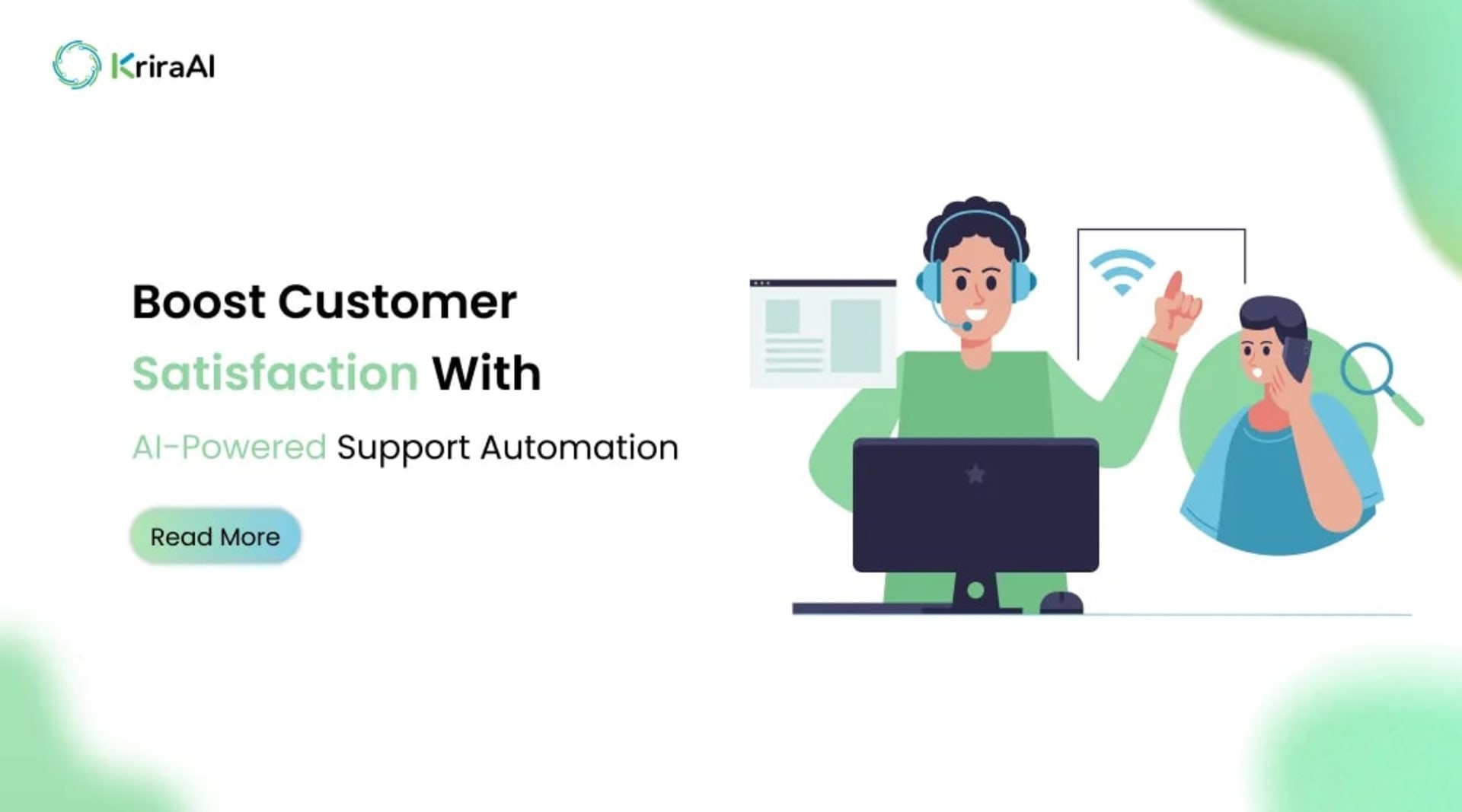
AI-powered support systems can help businesses handle repetitive questions, classify requests, retrieve information, assist support agents, route conversations, and escalate complex cases to the right person. The goal is not to remove human support. The goal is to make customer service faster, more consistent, and easier to scale.
For organizations evaluating customer support automation, the right approach is to combine artificial intelligence with clear workflows, reliable business data, human oversight, and measurable service goals.
AI customer support automation uses artificial intelligence to assist or automate customer service activities across channels such as websites, messaging platforms, email, voice, and helpdesk systems.
A conventional support workflow may require an employee to read every request, identify the issue, search for an answer, and respond manually.
An AI-assisted workflow can help automate parts of that process.
For example, when a customer asks about an order, an AI system can:
Understand the customer's intent.
Retrieve relevant information from approved systems.
Provide an appropriate response.
Create or update a support ticket when necessary.
Escalate the interaction when the request requires human judgment.
This model allows employees to spend more time on complex or sensitive conversations while AI handles suitable repetitive tasks.
Customer satisfaction is influenced by more than the quality of a product or service.
Support experience also plays an important role.
Customers often judge a business by how quickly and clearly it responds when something goes wrong. Long waiting times, inconsistent answers, repeated explanations, and difficult escalation processes can create unnecessary frustration.
A strong support operation should make it easy for customers to:
Find information quickly
Receive consistent answers
Resolve common issues without unnecessary delays
Reach a human when the issue is complex
Receive relevant updates throughout the support process
AI customer support automation can contribute to these goals when it is implemented around real customer journeys rather than simply adding a chatbot to a website.
AI systems can respond to common questions without requiring an employee to manually process every request.
This can be useful for questions related to:
Order status
Delivery information
Product details
Account access
Billing
Policies
Appointment scheduling
Frequently asked questions
Faster responses can reduce waiting time and help customers get basic information without entering a long support queue.
Human teams typically operate according to working schedules and staffing capacity.
AI-enabled support can provide automated assistance outside normal business hours.
This does not mean every conversation should be fully automated. Instead, customers can receive immediate assistance for routine requests while complex matters can be collected and routed for human follow-up.
Different agents can sometimes respond differently to the same question.
AI customer support systems can use approved knowledge sources, workflows, FAQs, and business rules to create more consistent responses.
This is especially useful when a company has:
Multiple support teams
Multiple locations
Large product catalogs
Frequent policy changes
High volumes of repetitive questions
The quality of the output still depends on the quality of the underlying information. Businesses should therefore maintain clear and current knowledge sources.
Not every support request should be handled in the same way.
AI can help identify the intent, urgency, category, and relevant context of a request before routing it.
For example:
A billing issue can go to the billing team.
A technical issue can be routed to technical support.
A high-priority complaint can be escalated to a senior agent.
A simple FAQ can be answered automatically.
This can reduce unnecessary manual sorting and help agents receive more relevant information before they begin working on a case.
Customer support teams often spend significant time answering repetitive questions.
AI can assist agents by suggesting responses, summarizing conversations, retrieving relevant information, categorizing tickets, and handling suitable routine interactions.
This allows human agents to focus on activities that require:
Empathy
Negotiation
Judgment
Problem solving
Exception handling
Relationship management
AI works best as an assistant and automation layer rather than an unconditional replacement for human support.
AI customer support automation can support many different business models.
Common use cases include:
Order tracking
Returns and refunds
Product questions
Delivery updates
Product recommendations
Customer account assistance
For online retailers, faster answers can reduce friction during both purchasing and post-purchase interactions.
AI can assist with:
Account setup
Password and access issues
Billing questions
Feature explanations
Troubleshooting
Product documentation
Support requests can also be categorized and escalated automatically when technical intervention is required.
Financial businesses can use AI support systems for suitable customer-facing workflows such as:
General account information
Product and policy questions
Application status
Service FAQs
Routine support requests
For sensitive financial workflows, automation should be designed with appropriate authentication, security, compliance, and human escalation controls.
Potential applications include:
Appointment scheduling
Appointment reminders
General administrative questions
Insurance-related information
Patient communication workflows
Healthcare implementations require additional consideration around privacy, data handling, accuracy, and escalation.
Educational organizations can automate common questions related to:
Enrollment
Courses
Schedules
Fees
Student services
Learning platforms
This can reduce repetitive administrative workload while keeping students informed.
Traditional customer support depends heavily on employees to process and respond to each interaction.
AI-supported operations add an automation layer.
Area | Traditional Support | AI-Assisted Support |
Routine questions | Mostly manual | Can be automated |
Availability | Staff dependent | Can provide 24/7 automated assistance |
Ticket classification | Manual or rule-based | AI-assisted classification |
Knowledge retrieval | Agent searches information | AI can retrieve relevant information |
Complex issues | Human-led | Human-led with AI assistance |
Escalation | Manual | Can be automated |
Agent productivity | Staff-dependent | AI can assist repetitive tasks |
The strongest model is usually a hybrid approach.
AI manages appropriate repetitive work, while people remain responsible for decisions that require context, judgment, empathy, or accountability.
Successful implementation starts with business requirements rather than technology selection.
Review historical conversations and identify the most common support requests.
Look for questions that are:
Frequent
Predictable
Well documented
Low risk
Easy to verify
These are often strong candidates for initial automation.
Do not attempt to automate everything immediately.
Choose specific workflows where automation can create measurable value.
For example, a business might start with order tracking, FAQs, or appointment scheduling before expanding to more complex workflows.
AI responses should be grounded in approved business information.
Depending on the use case, this may include:
Product documentation
FAQs
Policies
CRM data
Order systems
Internal knowledge bases
Helpdesk systems
Poor or outdated source information can lead to poor customer experiences.
Every automated support system should have clear escalation rules.
A conversation may need human intervention when:
The customer is highly frustrated
The request is unusually complex
Sensitive information is involved
The AI lacks sufficient confidence
A business exception is required
A customer explicitly asks for a human
Human escalation is an important part of responsible customer support automation.
Test common questions, unusual requests, ambiguous language, incorrect assumptions, and failure scenarios before expanding automation.
Measure:
Response accuracy
Escalation rate
Resolution rate
Customer satisfaction
Agent workload
Response time
The objective should be continuous improvement rather than maximum automation.
Businesses should evaluate AI customer support automation through operational and customer-focused metrics.
Track:
Customer satisfaction score
Customer effort score
Complaint rate
Repeat contacts
Resolution satisfaction
Monitor:
First response time
Average resolution time
Ticket volume
Automation rate
Escalation rate
Agent productivity
Depending on the business model, also evaluate:
Support cost per interaction
Customer retention
Conversion impact
Revenue influenced by support
Cost savings
Return on investment
This provides a more realistic view of whether automation is improving the customer experience.
Not every support workflow should be automated.
High-risk or emotionally sensitive requests may require human involvement.
An AI system is only as useful as the information available to it.
Businesses should maintain accurate and regularly reviewed knowledge sources.
Customers should have a clear path to human assistance when automation cannot adequately solve their problem.
Reducing support costs can be valuable, but customer experience should remain a core objective.
The best systems aim to improve both operational efficiency and customer outcomes.
Without defined metrics, it is difficult to know whether the system is actually creating value.
Customer support is moving toward a hybrid model where AI and human teams work together.
AI can handle increasing volumes of repetitive interactions, while support professionals focus on complex problems, customer relationships, exceptions, and strategic service improvements.
The future is not simply about replacing traditional support with AI.
It is about building support operations that are:
Faster
More available
More consistent
Better informed
Easier to scale
More responsive to customer needs
Businesses that approach AI support as an operational transformation rather than a simple chatbot deployment are more likely to create sustainable value.
KriraAI develops custom AI customer support solutions across chat, voice, email, helpdesk, and business-system integrations. The approach can include support process analysis, conversation design, AI development, integrations, testing, deployment, and ongoing optimization.
For organizations evaluating voice-based customer interactions, KriraAI also provides custom AI voice agent development for inbound and outbound use cases and multilingual customer communication.
Businesses that operate in regulated or compliance-sensitive environments can also consider tailored AI solutions designed around their existing systems, processes, and governance requirements.
AI customer support automation can help businesses respond faster, improve consistency, reduce repetitive workload, and scale customer service more effectively.
But successful automation is not about replacing every human interaction.
The strongest approach combines AI for suitable repetitive work with human expertise for complex, sensitive, and high-value interactions.
Start with clear use cases, reliable business information, measurable goals, and strong escalation workflows. Then expand automation based on real customer and operational results.
For businesses exploring customer support automation, the priority should be simple: make it easier for customers to get the right help at the right time.
AI customer support automation uses artificial intelligence to assist or automate customer service activities such as answering FAQs, classifying tickets, retrieving information, and routing conversations.
Yes. When implemented correctly, AI can improve response speed, support availability, consistency, and access to information. Results depend on the quality of the workflows, data, AI system, and escalation process.
Not in every situation. AI is well suited to repetitive and predictable requests, while human agents remain important for complex, sensitive, and emotionally difficult interactions.
E-commerce, SaaS, financial services, healthcare, education, retail, hospitality, and many other businesses can use AI customer support automation where repetitive support workflows can be clearly defined.
Start by analyzing historical support interactions and identifying repetitive, well-documented, low-risk requests. Automate a limited set of workflows first, measure results, and expand gradually.
Yes. Human escalation is important for complex issues, sensitive situations, low-confidence responses, exceptions, and cases where customers need direct assistance.
Founder & CEO
Divyang Mandani is the CEO of KriraAI, driving innovative AI and IT solutions with a focus on transformative technology, ethical AI, and impactful digital strategies for businesses worldwide.