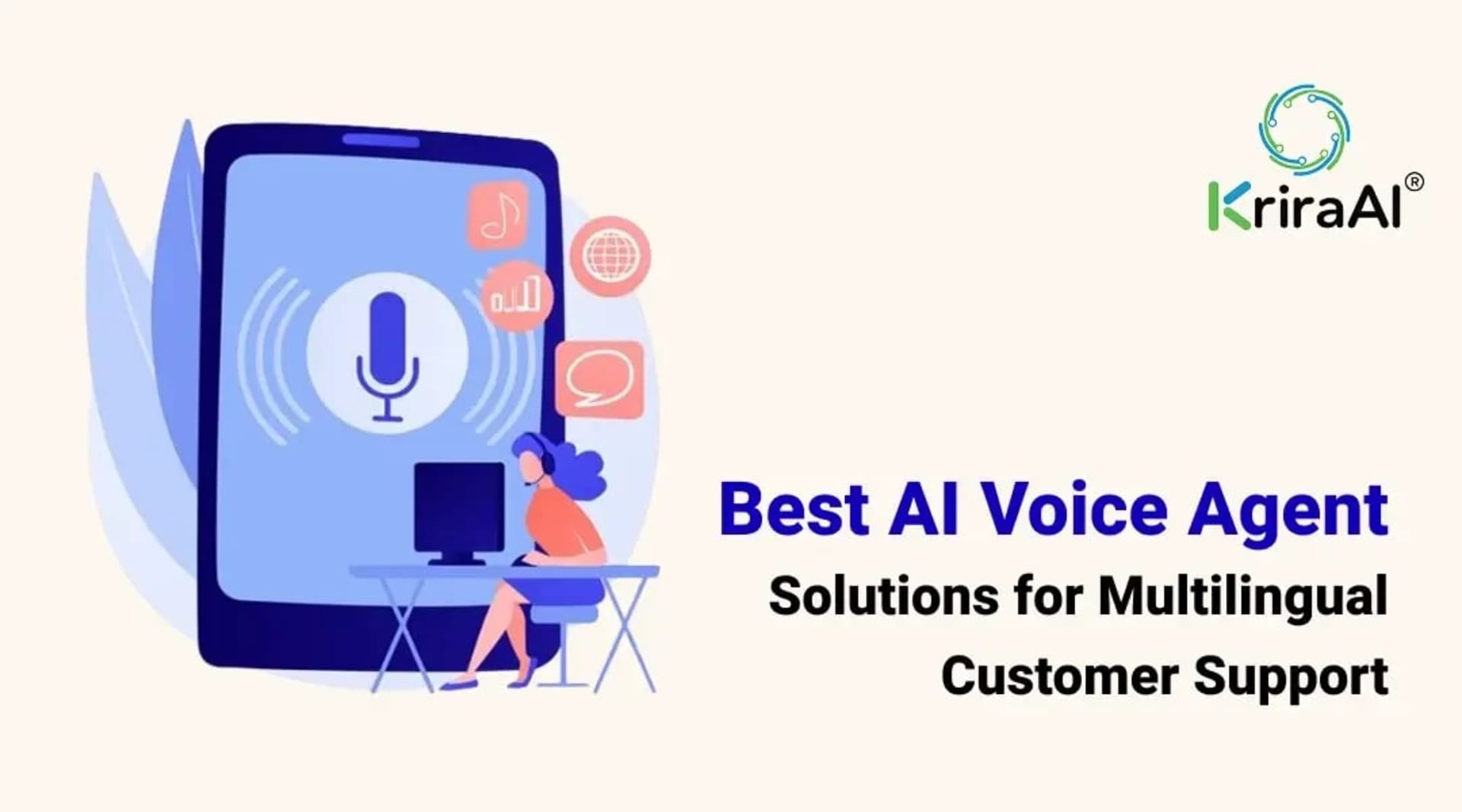
Best AI Voice Agent Solutions for Multilingual Customer Support
The best multilingual AI voice agent solutions understand callers in their own language, respond with a natural native voice, cope with people who switch languages mid-sentence and hand over to a human with full context when needed. Options range from developer voice platforms and contact centre suites to specialists in regional languages and fully custom builds, and the right choice depends on which languages your customers speak, how complex your calls are and where your data must stay. This guide explains how multilingual voice agents work, compares the main solution types and gives you a practical test plan before you buy.
Multilingual support used to mean separate teams, separate queues and long waits for less common languages. AI voice agents change that economics because the same agent can answer in many languages, around the clock, at a cost that does not rise with every new hire. The catch is that quality varies widely between languages and vendors, so a demo in English tells you very little about how an agent will perform in Tamil, Arabic or Portuguese.
What Is a Multilingual AI Voice Agent?
A multilingual AI voice agent is software that holds spoken conversations with customers in more than one language, usually over the phone or in an app. It listens, understands the request, takes actions such as checking an order or booking an appointment, and replies in a natural voice. Unlike older interactive voice response (IVR) menus, it understands free speech rather than forcing callers to press numbers or say fixed keywords.
What makes it multilingual is not just a list of supported languages. A strong agent detects the caller's language automatically, keeps the conversation in that language, understands regional accents and code-mixed speech, and uses voices that sound native rather than translated. It also applies the same business rules, knowledge and integrations in every language, so a customer in Hindi gets the same quality of answer as a customer in English.
How Multilingual Voice Agents Work
Most multilingual voice agents use a pipeline of speech recognition, a language model and speech synthesis, with language handling built into each stage. Some newer systems use speech-to-speech models that process audio directly, which can sound more natural but offer less control. Understanding the pipeline helps you ask vendors the right questions.
Language detection and switching
The agent first identifies which language the caller is speaking, either from the opening words or from a choice the caller makes. Good systems keep listening and switch if the caller changes language partway through the call. Weak systems lock into the first detected language and fail when a caller mixes languages.
Speech recognition per language
Speech-to-text accuracy varies a lot by language, accent and audio quality. A provider that performs well in English may struggle with Indian, African or Southeast Asian languages, especially on noisy mobile calls. This is why many solutions combine different speech models for different languages.
Understanding and reasoning
A large language model interprets the transcript, decides what to do and writes the reply. Modern models can reason directly in many languages, which avoids the errors that come from translating everything into English and back. For less common languages, some systems still translate internally, so ask vendors which approach they use for each language you need.
Native voice output
Text-to-speech converts the reply into audio. The best voices pronounce names, numbers, dates and local terms correctly and use natural rhythm for that language. Listen carefully for a foreign accent or flat intonation, because callers notice immediately when a voice sounds translated.
Types of Multilingual AI Voice Agent Solutions
The market for multilingual voice agents falls into five broad groups. Each one suits a different kind of business, and many companies combine two of them. Language lists and features change frequently, so confirm current support for your specific languages directly with each vendor.
Solution type
Developer voice agent platforms
Examples
Vapi, Retell AI
Best for
Tech teams that want to assemble agents quickly with their choice of models and voices
Trade-offs
Language quality depends on the speech providers you plug in
Solution type
Voice-first AI companies
Examples
ElevenLabs Agents
Best for
Businesses that prioritise very natural voices across many languages
Trade-offs
Integrations and call-centre features may need extra work
Solution type
Contact centre suites
Examples
Google Cloud contact centre AI, Amazon Connect, Microsoft Dynamics 365 Contact Center
Best for
Large enterprises already running on one of these clouds
Trade-offs
Longer setup, regional language depth varies
Solution type
Regional language specialists
Examples
OnDial, Sarvam AI
Best for
Businesses serving Indian language and code-mixed callers at scale
Trade-offs
Narrower focus outside their core regions
Solution type
Custom-built voice agents
Best for
Complex workflows, strict data residency, deep integration with legacy systems
Trade-offs
Higher upfront investment and longer build time
If you need standard support calls in widely spoken languages, a platform or voice-first provider can get you live quickly. If most of your customers speak regional languages or mix languages heavily, a specialist usually delivers better recognition and more natural voices. If your calls involve complex decisions, regulated data or several back-end systems, a custom build gives you the control those requirements demand.
How to Evaluate a Multilingual Voice Agent Solution
Vendors will all claim broad language coverage, so evaluate on evidence from your own calls. The criteria below separate real multilingual capability from a long list of supported languages. Score every shortlisted vendor on each one.
Native quality per language. Have native speakers rate understanding and voice quality in each language you need, not just English.
Code-mixing. Test sentences that switch languages, such as Hinglish or Taglish, because real customers speak this way.
Accents and audio quality. Use recordings from different regions and from mobile phones in noisy places.
Latency in every language. Response speed can differ by language if some languages route through slower models or translation.
Handoff with context. When the agent escalates, the human agent should receive the transcript and collected details in their working language.
Integrations. Check connections to your CRM, helpdesk, order system and telephony.
Compliance and data location. Confirm where audio and transcripts are stored and how long they are kept.
Transparent pricing. Compare per-minute costs including speech, model and telephony charges at your real call volume.
A Practical 30-Call Test Plan Before You Buy
The fastest way to compare multilingual voice agents is a short, structured pilot on your own scenarios. Thirty calls per language is enough to expose most weaknesses without a large investment. Run the same plan with every vendor so the results are comparable.
Pick five common scenarios from your real support queue, such as order status, refunds, address changes, appointment booking and complaints.
Write six variations of each covering a calm caller, an angry caller, a heavy accent, background noise, a mid-call language switch and an interruption.
Use native speakers to place the calls in each target language.
Score every call on resolution, accuracy, naturalness, speed and correct escalation.
Compare total cost for the pilot calls and extrapolate to your monthly volume.
Look closely at the worst calls, not the average. A vendor that handles 28 calls well but mishandles two angry customers in a regional language may create more damage than the efficiency is worth. The failures tell you where you will need human backup, extra training data or a different provider for certain languages.
Indian Languages and Code-Mixed Speech
India is one of the hardest markets for multilingual voice AI and a useful stress test for any vendor. Customers commonly speak Hindi, English and a regional language in the same call, accents vary by state, and many calls come from mobile phones in noisy surroundings. Agents trained mostly on Western English data tend to struggle here.
For businesses serving Indian customers, test recognition of numbers, addresses, names and product terms in each language, because these drive most errors. Voices should pronounce local names correctly and switch language naturally when the caller does. KriraAI has written more about this in our guide to Hindi voice AI agent development and our comparison of Hindi voice AI agents for multilingual customer queries.
Where Multilingual Voice Agents Deliver the Most Value
Multilingual voice agents pay off fastest where call volumes are high, questions repeat and customers speak several languages. They also help businesses expand into new regions without building a new support team first. These are the use cases we see most often.
Ecommerce and retail: order tracking, delivery updates, returns and cash-on-delivery confirmation.
Banking, lending and fintech: account queries, payment reminders and loan application follow-ups, with careful identity checks.
Healthcare: appointment booking, reminders and basic patient queries, with strict privacy controls.
Travel and airlines: booking changes, flight status and baggage queries for international customers.
Utilities and telecom: billing questions, outage updates and plan changes across large, diverse customer bases.
Common Pitfalls With Multilingual Voice AI
Most disappointing multilingual deployments fail for predictable reasons. The good news is that each one can be caught during evaluation if you know to look for it. Keep these risks on your checklist.
Judging by the English demo. Quality in English rarely reflects quality in other languages.
Translated scripts. Prompts and responses translated word for word sound unnatural and can be culturally wrong.
No plan for low-volume languages. Decide in advance whether rare languages get AI support, human support or a callback.
Weak escalation. Customers must be able to reach a human who speaks their language without repeating themselves.
Ignoring local regulations. Recording consent, AI disclosure and data storage rules vary by country.
Build, Buy or Combine?
Buying a platform is usually the fastest route when your calls are standard and your languages are well supported. Building a custom agent makes sense when calls are complex, data must stay in a specific region, or you need deep integration with internal systems. Many businesses combine the two, using a specialist provider for speech in certain languages and a custom layer for business logic and integrations.
KriraAI designs and builds custom multilingual AI voice agents for enterprises, including language testing, integrations, compliance and monitoring. If you are comparing providers, our list of the best AI voice agent agencies for ecommerce, banking and healthcare is a useful companion to this guide. Whatever you choose, let real calls in real languages make the decision.
Conclusion
The best multilingual AI voice agent solution is the one that sounds native, understands mixed and accented speech, and resolves real customer requests in every language you support. Platforms, voice-first providers, contact center suites, regional specialists and custom builds each have a place, depending on your languages, complexity and data rules. Run a structured test with native speakers before you commit, and design a clear human handoff for the calls AI should not handle alone.
FAQs
Trusted options include developer platforms such as Vapi and Retell AI, voice-first providers such as ElevenLabs, contact centre suites from Google, Amazon and Microsoft, regional specialists such as OnDial and Sarvam AI for Indian languages, and custom development partners such as KriraAI. Trust should be judged on tested language quality, security certifications, data handling and references from similar businesses. Run a pilot in your own languages before signing.
Many voice agent platforms support multiple languages, but fluency varies by language. Voice-first providers tend to offer very natural voices across many languages, while regional specialists often perform better on local accents and code-mixed speech. Have native speakers test each platform on your actual scenarios to judge fluency.
The best service depends on your mix of languages, call complexity and compliance needs. Global enterprises often use a contact centre suite or a custom build for control, while growing businesses start with a voice agent platform. Businesses with large Indian language audiences usually add a regional specialist.
Good multilingual voice agents can handle code-mixed speech such as Hinglish, but many still struggle with it. Test this directly with real examples during evaluation. Pay special attention to numbers, names and addresses spoken in mixed language.
Costs include setup or build fees and per-minute usage for speech recognition, the language model, voice synthesis and telephony. Prices vary by vendor, language and volume, and some languages cost more to support well. Ask for a monthly estimate at your expected call volume across all languages.
Regional specialists such as OnDial and Sarvam AI focus on Indian languages and code-mixed speech, and custom builds can combine the best speech models for each language. Global platforms also support Hindi and some regional languages, though depth varies. Test recognition and voice quality in each Indian language you need before choosing.
Founder & CEO
Divyang Mandani is the CEO of KriraAI, driving innovative AI and IT solutions with a focus on transformative technology, ethical AI, and impactful digital strategies for businesses worldwide.