
Your product is excellent. Your margins are thin. And your image library… is a mess.
Half the photos came from a rushed studio shoot. Some are phone shots. Some are vendor images with watermarks. None of them look like they belong to the same brand.
And every time you add new SKUs, the same nightmare begins again.
Studios. Samples. Models. Retouching. Weeks lost.
Here’s the uncomfortable truth I’ve learned after twelve years building e-commerce systems and visual AI pipelines:
Product photography is no longer a creative problem. It’s an operational bottleneck.
That’s why serious brands are now turning to an AI product image generator - not as an experiment, but as infrastructure.
Let me show you what this actually means. And which tools truly work.
An AI product image generator is software that creates professional product images using artificial intelligence - often from a single base photo, 3D render, or even a rough snapshot.
Instead of organizing a photoshoot, you upload one product image and tell the system:
Change the background
Place it in a lifestyle scene
Adjust lighting
Match brand style
Output marketplace-ready images
This is what modern AI product photography looks like.
No studios. No models. No waiting.
And yes, you can now generate product images using AI that are good enough for Shopify, Amazon, Flipkart, and even paid ads.
(That sentence would have been science fiction three years ago. Now it’s Tuesday.)
Because speed beats perfection.
Because catalogs never stop growing.
Because customers don’t wait.
But mostly?
Because the math finally makes sense.
Traditional photography scales linearly. More SKUs means more shoots, more editing, more invoices.
An AI product image generator for ecommerce scales exponentially.
One base image becomes fifty variants.
And suddenly your bottleneck disappears.
Here’s the moment brands usually convert: when they realize they can launch collections in days instead of months.
That’s not a productivity boost.
That’s a competitive advantage.
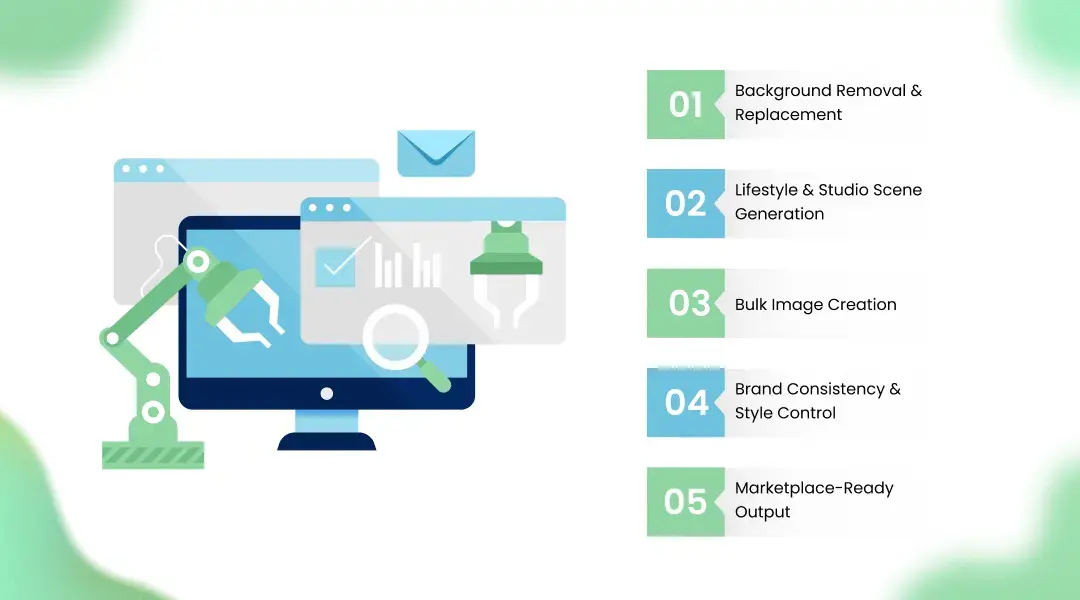
Not all tools are equal. Most demos look impressive. Production reality is less forgiving.
Here’s what I insist on when we evaluate an AI product image generator tool for clients.
This is the foundation.
A serious AI product background generator should:
Cut edges cleanly (no halos, no blur)
Replace with white, gradients, lifestyle, or branded sets
Preserve shadows and reflections
If this fails, everything else collapses.
This is where conversion lives.
The best AI product image generator can place your product:
In kitchens
On desks
In hands
In living rooms
Not pasted. Integrated.
Quick question for you:
Would you rather show a shoe on white… or on someone actually wearing it?
Exactly.
If you manage more than 100 SKUs, single-image workflows are useless.
You need an AI catalog image generator that supports:
CSV uploads
Batch background changes
Variant generation at scale
Speed matters. But consistency matters more.
This is where most “AI product image generator free” tools fail.
Real brands need:
Fixed lighting styles
Color preservation
Background templates
Aspect ratio control
Your catalog should look designed. Not generated.
Amazon. Flipkart. Meesho. Etsy.
Each platform has rules.
The right ecommerce product image generator exports:
Correct resolution
White background compliance
Shadow rules
Multiple angles
Otherwise, you’ll still be editing. Manually. Again.
Let’s talk outcomes. Not features.
What used to take weeks now takes hours.
I’ve seen brands launch 500-SKU catalogs in under three days.
Three days.
(And yes, the first time I saw it, I didn’t believe it either.)
Studios cost money. Models cost money. Retouching costs money.
AI product photos without photoshoot cut costs by 60–90%.
Not theoretical. Real invoices. Real budgets.
Lifestyle images outperform plain white backgrounds.
Consistently.
Better context means better understanding. Better understanding means more trust. More trust means more sales.
Simple chain.
This is the silent killer in e-commerce.
Large catalogs break creative teams.
AI doesn’t get tired.
Now the part everyone scrolls to.
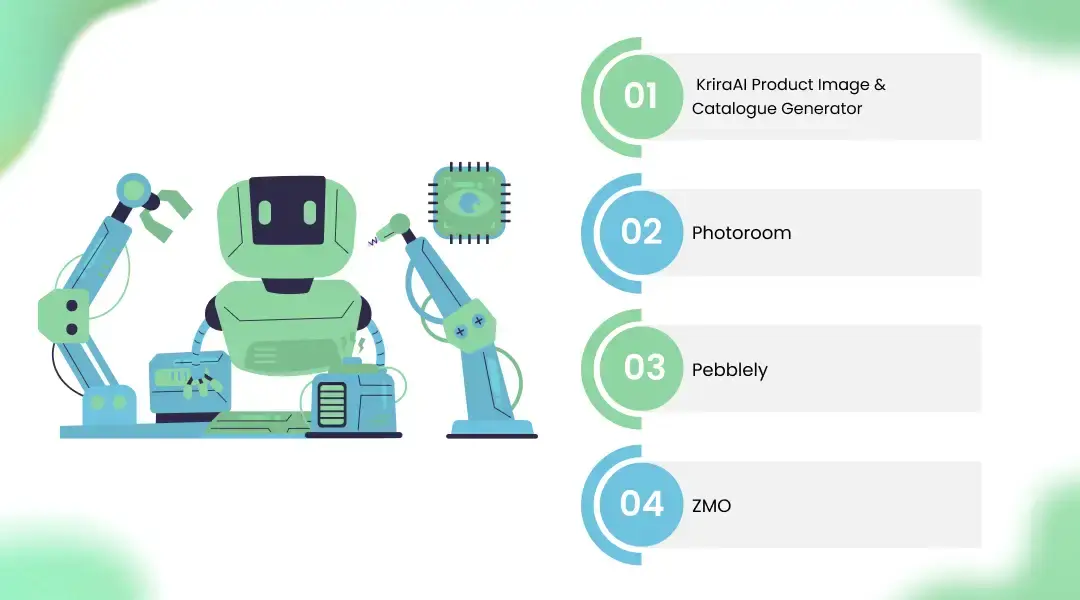
Here are the tools I actually recommend - based on client deployments, not marketing claims.
Yes, this is ours. And yes, I’m biased.
But I’m also honest.
We built this because existing tools failed enterprise catalogs.
What makes KriraAI different:
Custom-trained models per brand
Advanced AI product photography pipelines
Bulk generation for large inventories
Marketplace-specific exports
Style locking for brand consistency
More importantly, it integrates directly with your catalog systems.
We’re not a toy.
We’re built by the same engineers behind large-scale AI platforms at a Best AI development Company.
And we don’t sell subscriptions.
We build systems.
Excellent for:
Small sellers
Background removal
Fast social images
Limitations:
Limited style control
Weak bulk workflows
Great starter AI product image generator online. Not enterprise-grade.
Strong at:
Lifestyle scenes
D2C branding visuals
Shopify compatibility
This is a popular AI product photo generator for Shopify stores.
Downside? Limited customization depth.
Good for:
Fashion brands
Model replacement
Apparel scenes
Still improving on edge detection and lighting realism.
Forget feature lists.
Ask these four questions:
Does it preserve my product colors exactly?
Can it handle my catalog size?
Does it support my marketplace rules?
Can I control my brand style long-term?
If any answer is “no,” keep searching.
One more thing.
(Parenthetical confession: most tools are built for demos, not production.)
Choose infrastructure, not magic.
Hero images. Variant shots. Lifestyle banners.
Instant refresh without reshoots.
White background compliance. Shadow rules. Angle sets.
Many now use an AI product image generator for ecommerce exclusively.
Model replacement. Pose variations. Seasonal scenes.
This category benefits the most.
Room placement. Scale visualization. Style matching.
Conversion rates jump when customers see context.
This question comes up in every boardroom.
Here’s my answer.
Use both.
Traditional photography for:
Flagship campaigns
Hero banners
Brand launches
AI product image generator tool for:
Daily catalog updates
Variants
Marketplaces
A/B testing
AI doesn’t replace photographers.
It replaces inefficiency.
Because customers buy clarity.
Better lighting shows texture.
Lifestyle scenes show usage.
Multiple angles remove doubt.
I’ve seen stores improve CTR by 18% simply by replacing flat images with AI-generated lifestyle scenes.
No pricing changes.
No ads.
Just better visuals.
Let me save you pain.
Over-stylizing images until products look fake
Ignoring marketplace compliance rules
Mixing inconsistent styles across SKUs
Using “AI product image generator free” tools for production catalogs
One sharp warning:
If your product color shifts even slightly, returns will spike.
Trust me. I’ve debugged that disaster.
We’re moving toward:
3D-to-image pipelines
Dynamic scene generation per customer
Automated A/B visual testing
Personalized product imagery
Soon, your catalog won’t be static.
It will adapt.
And brands that build this early will own the shelf.
Because we’re not a SaaS tool.
We’re an engineering partner.
KriraAI builds:
Custom AI product image generators
Scalable catalog automation systems
Brand-locked visual pipelines
Deep marketplace integrations
We come from enterprise AI, not photo apps.
We’re a Best AI development Company because we solve systems, not symptoms.
And we care about one metric:
Does this increase your revenue?
Everything else is decoration.
If you’re still treating product photography as a creative task, you’re playing the wrong game.
In modern e-commerce, visuals are infrastructure.
An AI product image generator isn’t a shortcut.
It’s a strategy.
And the brands that understand this first?
They win the shelf. They win the click. They win the customer.
Quietly. Consistently. Relentlessly.
Yes. With a clean base image or 3D render, modern AI systems can create studio and lifestyle images without physical shoots.
Yes, as long as images meet platform guidelines. Many sellers now use AI-generated images for compliant listings.
For large catalogs and brand control, KriraAI leads. For small sellers, tools like Photoroom and Pebblely work well.
Some offer limited free versions, but production-quality workflows usually require paid or custom solutions.
When used correctly, yes. Better context and clarity consistently improve CTR and purchase confidence.
Founder & CEO
Divyang Mandani is the CEO of KriraAI, driving innovative AI and IT solutions with a focus on transformative technology, ethical AI, and impactful digital strategies for businesses worldwide.