I'll be honest with you.
Every week, I watch brilliant founders and savvy enterprise leaders make the same expensive mistake: they hire an AI development company based on a slick demo and a promise of "transformative innovation."
Six months later? They're stuck with a half-baked model that doesn't integrate with their systems, a burned budget, and a team that's lost faith in AI entirely.
I'm Rohan Mehta, and I've spent eight years building AI systems for everyone from bootstrapped startups to massive enterprises at KriraAI. I've seen what works, what fails spectacularly, and more importantly - why.
This isn't another listicle ranking companies by website design. This is a field guide to finding the best AI development company for startups and enterprises, written by someone who's actually done the work.
Let's strip away the mystique.
An AI software development company doesn't sprinkle magic algorithmic dust on your business. We architect systems that learn from data to solve specific problems—predicting customer churn, automating document processing, personalizing recommendations, detecting fraud.
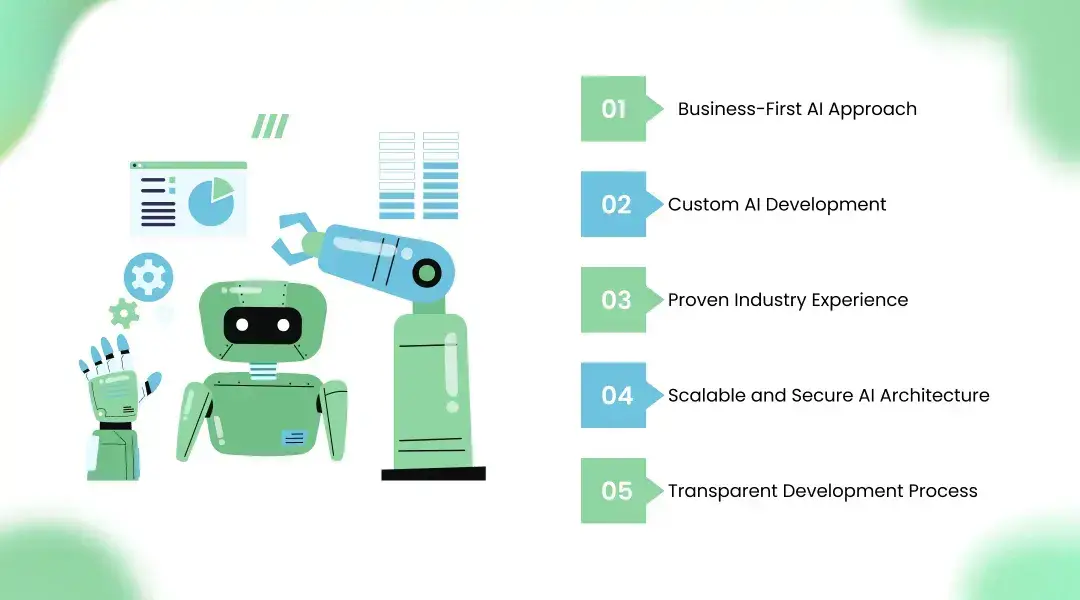
Here's the real workflow, from idea to production:
Discovery: We dissect your business problem. Not "we want AI." Rather, "we lose 23% of trial users in week two and don't know why."
Data Assessment: I audit your data infrastructure. Do you have clean, labeled data? Or are we starting from scratch? (Spoiler: most companies vastly overestimate their data readiness.)
Architecture Design: We design the ML pipeline—data ingestion, preprocessing, model training, deployment infrastructure. This is where startups and enterprises diverge dramatically.
Model Development: Building, training, and iterating on algorithms. This isn't one-and-done; it's continuous experimentation.
Integration & Deployment: The graveyard of AI projects. Your beautiful model is worthless if it can't talk to your CRM, ERP, or mobile app.
Monitoring & Iteration: Models drift. Performance degrades. The best AI development services for business include ongoing optimization, not just a handoff.
Most vendors excel at step four. The best AI development company for enterprises and startups? We obsess over steps one, five, and six.
Startups don't need perfection. They need to be viable.
When a seed-stage founder comes to me, they're usually sitting on 18 months of runway and a hypothesis that AI can 10x their value prop. They don't have time for six-month research projects or enterprise-grade infrastructure.
I worked with a healthcare startup that needed an NLP system to extract diagnoses from unstructured doctor notes. They had $40K and eight weeks.
We didn't build a custom transformer model from scratch (that's the enterprise approach). We fine-tuned an open-source model, deployed on lightweight infrastructure, and iterated based on real user feedback. Result? A working MVP that landed them their Series A.
The AI development company for startups you hire should think in bets, not guarantees. We prototype fast, fail cheap, and pivot quickly. Our deliverable isn't perfection—it's validated learning.
Mistake #1: Hiring a company that insists on building everything custom. You don't need a bespoke language model; you need a working product.
Mistake #2: Optimizing for accuracy instead of business impact. I've seen startups chase 95% precision when 80% would've been profitable.
Mistake #3: Underestimating integration complexity. Your AI model needs to live inside your product, not beside it.
(And here's the uncomfortable truth: most startup AI projects fail not because of bad algorithms, but because of bad product thinking.)
Enterprises play a different game entirely.
When an enterprise AI development company conversation starts, I'm not talking to founders - I'm talking to procurement teams, legal, InfoSec, compliance officers, and three layers of management. And that's before we write a single line of code.
A Fortune 500 client recently needed an AI system to process loan applications. Sounds straightforward, right?
Except it had to integrate with a 15-year-old mainframe system, comply with SOC 2 Type II and GDPR, handle 500,000 requests daily without latency spikes, and pass penetration testing by their cybersecurity team.
This is why AI development services for enterprises cost more and take longer. We're not just building models; we're navigating institutional complexity.
You know what's harder than training a neural network? Getting that network to talk to your SAP instance from 2008.
The best AI development company for enterprises brings DevOps maturity, API design expertise, and crucially the patience to deal with your IT infrastructure's "personality."
Enterprises need explainability. Auditability. Model versioning. Rollback capabilities. They need to prove to regulators why an AI system denied a loan application or flagged a transaction.
Startups need speed. Enterprises need defensibility.
Here's the cheat sheet I wish someone had given me eight years ago:
Dimension | Startups | Enterprises |
Budget | $20K-$150K | $200K-$2M+ |
Timeline | 6-16 weeks | 6-18 months |
Architecture | Cloud-native, serverless, fast iteration | Hybrid cloud, on-premise, robust failover |
Risk Tolerance | High—willing to beta test in production | Low—extensive UAT and phased rollouts |
Collaboration Model | Embedded partnership, founder-led | Committee-driven, multi-stakeholder approval |
Neither approach is "better." They're solving fundamentally different problems.
So how does a single custom AI development company serve both audiences?
By refusing to be dogmatic.
At KriraAI, we don't have a one-size-fits-all methodology. We have principles that flex based on your reality.
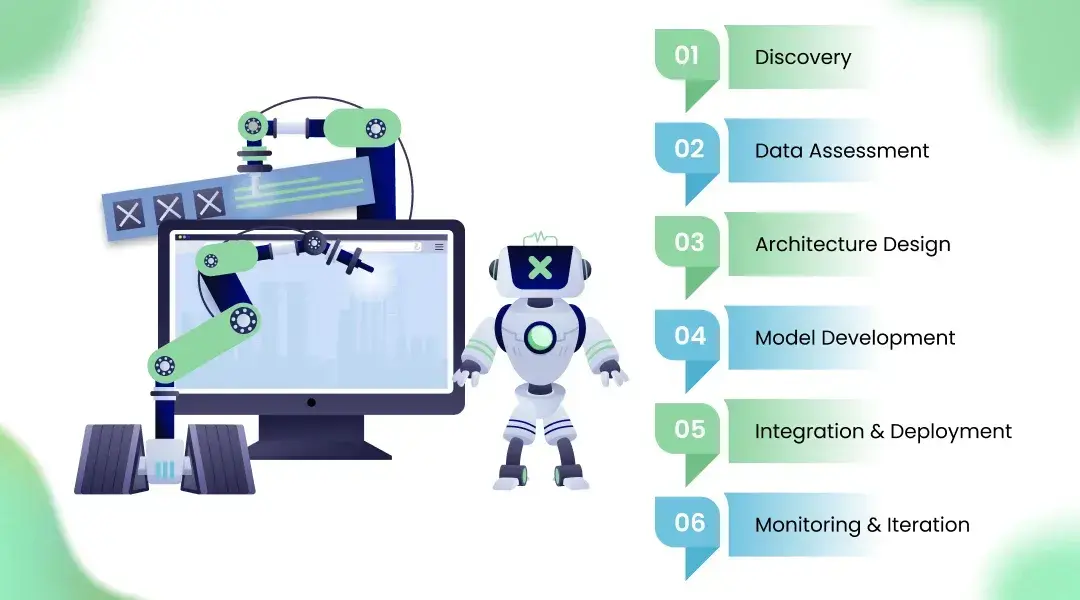
I start every project with one question: What business outcome changes if this works?
Not "What's your accuracy metric?" or "What framework should we use?" Those are downstream decisions.
If you can't articulate the revenue impact, cost savings, or strategic advantage, we're not ready to build anything.
You'll notice I keep saying custom AI development company. That's intentional.
Off-the-shelf AI tools have their place. But if your competitive advantage depends on it, you need something purpose-built for your data, your domain, and your constraints.
We've built:
A recommendation engine for an e-commerce startup that increased AOV by 34%
A predictive maintenance system for a manufacturing enterprise that reduced downtime by 18%
A document intelligence pipeline processing 2M+ insurance claims monthly
None of these could've been solved with Zapier and ChatGPT.
When you hire AI developers for startups or enterprises, ask them: What have you shipped?
Not "What can you build?" or "What technologies do you know?" What have you put into production that real users depend on?
At KriraAI, our portfolio spans fintech, healthcare, e-commerce, logistics, and SaaS. We debugged models at 3 AM when customer traffic spiked. We've re-architected systems after they failed in production.
Experience isn't just credentials. It's scar tissue.
Whether you're a five-person startup or a 5,000-person enterprise, your AI system will need to scale.
We design for growth from day one. That doesn't mean over-engineering; it means avoiding architectural dead-ends.
For startups: we build lean but extensible. For enterprises: we design for compliance, auditability, and operational resilience.
I've worked with vendors who treat AI development like a black box. You hand them requirements, they disappear for months, then deliver something unusable.
At KriraAI, you're in the loop. Weekly demos. Shared Slack channels. Access to our development roadmap. If something's not working, you know immediately—not three months later.
Trust isn't built through NDAs. It's built through radical transparency.
When evaluating AI development services for business, here's what should be on the menu:
Custom AI Development: Bespoke models trained on your proprietary data.
Generative AI Solutions: LLM fine-tuning, RAG systems, AI-powered content creation.
Machine Learning Model Development: Classification, regression, clustering, time-series forecasting.
NLP & Conversational AI: Chatbots, sentiment analysis, document understanding, voice interfaces.
Computer Vision Solutions: Object detection, image classification, OCR, video analytics.
AI Integration & Deployment: MLOps pipelines, API design, cloud infrastructure, monitoring.
If a company only offers one or two of these, they're specialists - which is fine if that's what you need. But the best AI development company has breadth and depth.
Here's my pre-flight checklist.
"Show me an MVP you built in under 12 weeks."
"How do you handle scope changes mid-project?" (Hint: if they say "change orders and delays," run.)
"What's your approach when the data is messy or incomplete?"
"Can you name a project that failed? What did you learn?"
"Walk me through your security and compliance protocols."
"How do you integrate with legacy on-premise systems?"
"What's your model governance and explainability strategy?"
"Who owns the IP and trained models after project completion?"
Overpromising accuracy: If someone guarantees 99% accuracy before seeing your data, they're lying.
Buzzword soup: "Quantum-blockchain-synergized deep learning" means they don't know what they're doing.
No product thinking: If they only talk algorithms and never mention user experience, integration, or business impact, you'll get a science project—not a solution.
Opaque pricing: Hidden costs are the norm in bad AI contracts.
Let me address the elephant in the Zoom room.
Yes, KriraAI is based in India. And yes, that gives us a cost advantage.
But here's what most people miss: India isn't just cheaper. It's become a global AI talent hub.
You can hire a senior ML engineer in San Francisco for $200K+ annually. Or you can access equivalent talent in India for 40-50% less - without sacrificing quality.
That cost differential doesn't mean "budget option." It means scalable AI solutions for enterprises become financially viable, and AI solutions for startups don't require VC money.
India produces 1.5 million engineering graduates annually. The top tier—IITs, NITs, BITS—are world-class. We're not talking about outsourcing to a call center. We're talking about engineers who've contributed to TensorFlow, published in NeurIPS, and built systems at Google and Amazon.
At KriraAI, our team includes PhDs in machine learning, former FAANG engineers, and domain experts across verticals.
Yes, time zones exist. But we've turned this into an advantage. Our clients wake up to progress. Asynchronous workflows mean faster iteration cycles, not slower ones.
And let's be real: I've worked with San Francisco companies where communication was abysmal despite being in the same building. Geography doesn't determine partnership quality - culture and process do.
I could give you a sales pitch here.
Instead, I'll give you evidence.
We've built AI systems for seed-stage startups that became their core product differentiator during Series A pitches. We've architected scalable AI solutions for enterprises processing millions of transactions daily with 99.97% uptime.
Our approach? Business problems first, technology second. Transparency over theater. Partnership over vendor relationships.
We're not the cheapest option. We're not the flashiest. But if you're looking for an AI product development company that treats your success as our success, we should talk.
Here's what I want you to remember:
The best AI development company isn't determined by their tech stack, their office location, or their marketing budget. It's determined by whether they understand your problem deeply enough to solve it.
Startups need speed and scrappiness. Enterprises need security and scale. Both need partners who speak business fluently and code competently.
Whether you're a founder with a bold vision or an enterprise leader navigating digital transformation, the right AI development company for business growth becomes an extension of your team - not just a vendor.
Ask hard questions. Demand transparency. Expect proof.
And if you're still reading this, you're exactly the kind of person we love working with.
Depends on complexity, but expect $20K-$80K for an MVP. A production-ready system with integrations? $50K-$150K. Anyone quoting $5K is either lying or delivering something unusable.
Startups: 6-16 weeks for an MVP. Enterprises: 6-18 months for a fully integrated, compliant, production system. Anyone promising faster timelines for enterprises hasn't dealt with procurement, security reviews, and change management.
Yes, but they need different muscles. At KriraAI, we do both because we've built systems that flex based on your constraints - not ours.
Ask them to walk you through a past failure. Ask about their post-deployment support. Ask how they handle data privacy. And critically: ask them to explain their approach in business terms, not technical jargon.
Ask for specifics: SOC 2, GDPR, HIPAA, ISO 27001. Ask them to describe a compliance challenge they've navigated. Vague answers mean they're learning on your dime.
Founder & CEO
Divyang Mandani is the CEO of KriraAI, driving innovative AI and IT solutions with a focus on transformative technology, ethical AI, and impactful digital strategies for businesses worldwide.