I've watched 23 companies in the last two years waste collective millions on "AI transformation" projects that failed.
Not because AI doesn't work. It does. But because they confused shiny demos with actual deployment experience. They picked vendors based on LinkedIn ads instead of proven technical depth. They bought solutions instead of partnerships.
Here's what nobody tells you: finding the best AI development company for AI automation and AI agents isn't about who has the fanciest website or the most buzzwords. It's about who can translate your messy, real-world business problems into elegant AI systems that actually run on Tuesday morning when your operations team is drowning.
I'm Rohan Mehta. I've spent eight years building AI systems that businesses bet their growth on. And I've learned that the gap between "AI that impresses in a demo" and "AI that survives production" is where most projects die.
Let me show you what that gap looks like and how to avoid falling into it.
AI automation isn't your grandfather's workflow automation. (Though honestly, his version probably worked better than half the "AI-powered" tools I see today.)
Traditional automation follows rules. If X happens, do Y. Simple. Reliable. Utterly helpless when X is slightly different than expected.
AI automation? It learns patterns, adapts to variations, and makes decisions based on context. It can read an invoice that's formatted differently than the training data. It can prioritize customer tickets based on sentiment, not just keywords. It can predict when your supply chain is about to have a problem—three weeks before your spreadsheets catch on.
Real-world examples I've personally deployed:
An e-commerce client used AI automation to process returns. Traditional automation handled maybe 60% of cases. Our AI system? 94%. Why? Because it understood that "this doesn't fit" and "the color looks different in person" require different routing logic.
A healthcare startup automated patient intake. The AI extracted information from handwritten forms (yes, really), insurance cards, and previous medical records, simultaneously. Processing time dropped from 18 minutes to 2.
The difference between traditional automation and AI automation is the difference between a calculator and a junior analyst. One follows instructions. The other interprets intent.
This is where it gets interesting.
An AI agent isn't just automation on steroids. It's a fundamentally different paradigm. Think of automation as a very efficient assembly line worker. An agent? That's your assistant who actually thinks ahead.
Task-based AI agents complete specific jobs: "Research these ten companies and summarize their AI strategies." They use tools (web search, databases, APIs), make micro-decisions, and deliver structured output.
Decision-making AI agents do something scarier and more valuable: they choose the next action based on goals. I built one for a logistics company that autonomously rerouted shipments when weather events occurred—no human intervention needed for decisions worth thousands of dollars.
Multi-agent systems are where this technology becomes genuinely transformative. Multiple specialized agents collaborate. One agent handles customer inquiries, another checks inventory, a third coordinates with shipping, a fourth updates the CRM. They negotiate, share information, and solve problems together.
(I realize that sounds like science fiction. I thought so too until I deployed one. Now I'm convinced that within five years, every company over $10M in revenue will run on multi-agent systems.)
Here's the honest answer most AI automation development companies won't give you: maybe neither. Maybe both. Maybe you need automation now and agents in six months.
AI automation is better when:
You have high-volume, repetitive processes
The input variations are predictable (even if numerous)
Speed and consistency matter more than creativity
You're replacing manual data entry, document processing, or routine decision trees
AI agents make sense when:
Your processes require judgment calls across multiple variables
You need systems that can handle exceptions without escalation
The task involves research, synthesis, or multi-step reasoning
You want something that improves its own performance over time
The best AI development company for AI agents will tell you when you don't need agents yet. The worst will sell you a $200K agent system when a $30K automation solution would work better.
I've turned down three projects in the last year because what the client needed was process re-engineering, not AI. That honesty is what partnership looks like.
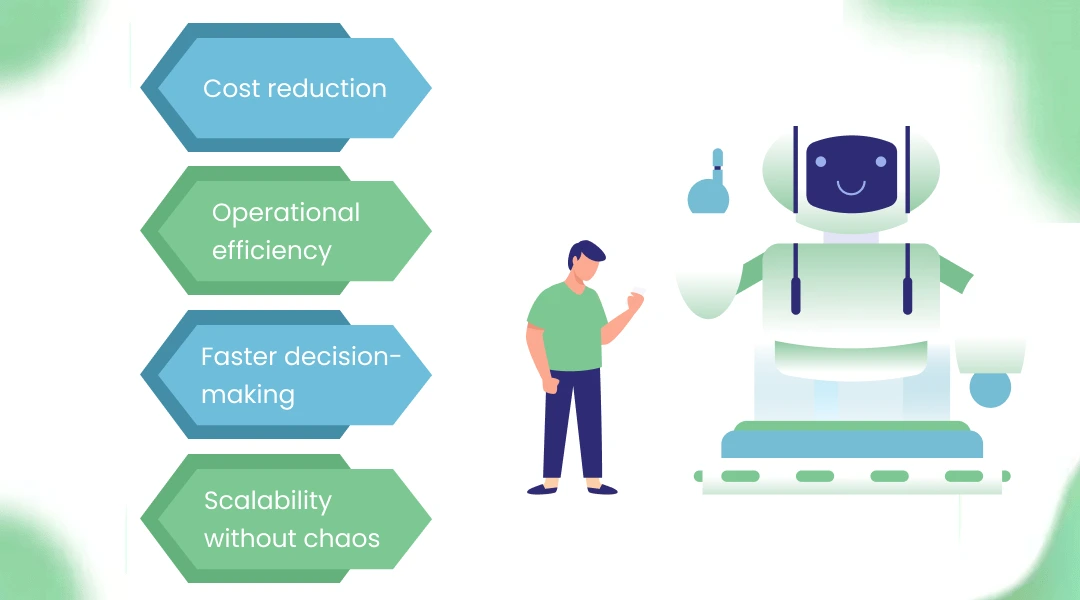
Let's cut through the hype. Why are smart companies actually spending real money on this?
Cost reduction: Yes, AI reduces labor costs. But I've seen bigger savings come from eliminating errors. One financial services client saved $1.2M annually not by reducing headcount, but by catching compliance issues before they triggered regulatory fines.
Operational efficiency: A 20% efficiency gain sounds modest. But when that gain applies to every transaction, every day, for years? The compounding effect is massive. I've watched a 25-person operations team handle 3x the volume without adding headcount.
Faster decision-making: Humans make maybe 50-100 quality decisions per day. AI agents? Thousands. When speed is a competitive advantage, that math changes everything.
Scalability without chaos: This is the one that keeps CEOs up at night. You can't 10x your business without 10x-ing your infrastructure—unless your infrastructure is intelligently automated.
AI automation in customer support: I built a system that handles 78% of tier-1 support tickets. Not with canned responses—with contextual understanding. It knows when to escalate, when to apologize, and when to offer a discount. Average resolution time dropped from 4 hours to 11 minutes.
AI agents in sales & CRM: One agent qualifies leads by analyzing website behavior, email engagement, and company signals. Another agent drafts personalized outreach. A third manages follow-up timing. The human sales team now spends 80% of their time actually talking to qualified prospects instead of chasing dead ends.
AI automation in operations & supply chain: Predictive maintenance, demand forecasting, inventory optimization. Boring? Maybe. Profitable? Absolutely. One manufacturing client reduced waste by 31% in six months.
AI agents in finance & reporting: Autonomous systems that don't just generate reports—they notice anomalies, investigate discrepancies, and flag issues before the CFO asks questions. This saves careers.
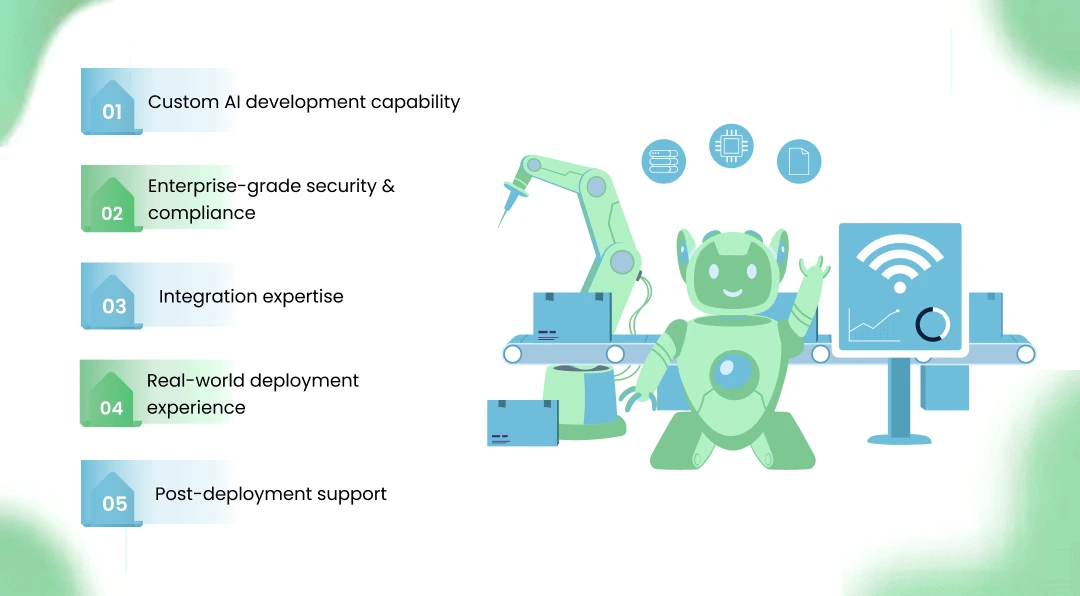
After evaluating dozens of AI agents development companies, here's my framework:
Custom AI development capability: Can they build something that doesn't exist? Or do they just resell OpenAI wrappers? (Nothing wrong with wrappers, but charge wrapper prices, not custom development prices.)
Enterprise-grade security & compliance: I've seen deals collapse because the vendor couldn't pass a security audit. If they're not talking SOC 2, GDPR, and data residency unprompted—run.
Integration expertise: Your AI doesn't exist in a vacuum. It needs to talk to your ERP, CRM, databases, APIs, and that one ancient system nobody wants to touch. Integration is where most projects succeed or die.
Real-world deployment experience: Ask for specifics. Not "we've done 100+ projects." Ask: "Tell me about a deployment that went wrong and how you fixed it." If they claim none ever have, they're lying.
Post-deployment support: The AI that works perfectly on day one will need tuning by day 30. Model drift is real. Edge cases emerge. You need a partner, not a vendor who ghosts after launch.
I've watched smart people make dumb decisions. Here are the patterns:
Mistake #1: Choosing based on portfolio size instead of relevant experience. A company that built 50 chatbots might be terrible at building autonomous procurement agents.
Mistake #2: Ignoring change management. The best AI in the world fails if your team doesn't trust it or doesn't know how to work alongside it.
Mistake #3: Optimizing for cost in the RFP stage. You know what's more expensive than an experienced AI automation services company? Rebuilding a failed system six months later.
Mistake #4: Not clearly defining success metrics upfront. "Make things better with AI" isn't a goal. "Reduce invoice processing time from 3 days to 4 hours" is.
Mistake #5: Expecting magic. AI is powerful, but it's not sentient (despite what the hype suggests). It needs good data, clear objectives, and realistic expectations.
The best AI development company for AI automation doesn't just build software. Here's what partnership actually looks like:
AI strategy consulting: Before writing a single line of code, we map your processes, identify bottlenecks, and prioritize opportunities. Sometimes the answer is "don't automate this yet."
Custom AI agent design: We architect agents around your workflows, not force your workflows around generic agents. This means fewer "exceptions" and more actual utility.
Continuous optimization: Models drift. Business rules change. We monitor performance metrics and retrain systems proactively. Your AI gets smarter over time, not stale.
ROI-driven deployment: Every system we build has measurable outcomes tied to business value. Not vanity metrics—actual P&L impact.
Look, I work here, so take this section with appropriate skepticism. But here's what I can back up with actual evidence:
Real business outcomes: Our clients measure us by hours saved, costs reduced, and revenue enabled. One fintech client achieved ROI in 4.2 months. Another reduced their customer churn by 18% through predictive AI agents.
Custom-built AI agents: We've deployed multi-agent systems for supply chain optimization, autonomous customer success, and financial forecasting. Not demos. Production systems handling millions in transaction value.
Scalable AI automation systems: Our automation frameworks process over 2 million documents monthly across clients. They handle exceptions, adapt to format changes, and maintain 96%+ accuracy.
Industry expertise: We've built AI for healthcare (HIPAA-compliant), finance (SOC 2 Type II), e-commerce (real-time at scale), and manufacturing (IoT integration). We speak your language, not just Python.
Transparency and partnership: We're based in India, which means you get world-class engineering at honest pricing. We're not here to sell you everything. We're here to solve actual problems. Some of our best client relationships started when we told them what they didn't need.
Autonomous enterprises are coming. Not in a dystopian sci-fi way—in a "most routine decisions happen without human intervention" way. We're already there in logistics and trading. Manufacturing is next.
AI-first operations will become table stakes. The companies that figure out human-AI collaboration now will dominate their industries in 2027. The ones that don't will be explaining to investors why their competitors are twice as efficient.
Human + AI collaboration is the real unlock. Not replacement. Augmentation. AI handles volume, speed, and consistency. Humans handle creativity, empathy, and complex judgment. Together? That's when businesses truly transform.
Finding the best AI development company for AI automation and AI agents isn't about picking the one with the most impressive website or the cheapest quote. It's about finding a partner who understands that AI is a means, not an end. Someone who will tell you the truth even when it's not profitable. Someone who measures success by your outcomes, not their project count.
We've built systems that process millions of transactions, save thousands of hours, and generate measurable ROI. But more importantly, we've helped businesses understand what AI can and cannot do—and how to bridge that gap strategically.
If you're ready to move beyond the hype and build AI systems that actually work in the real world, let's talk. Not a sales pitch. An honest conversation about whether AI makes sense for your specific situation.
Because that's what partnership looks like.
An AI automation development company typically focuses on streamlining repetitive processes with intelligent systems that follow learned patterns. An AI agents development company builds more autonomous systems that can reason, make decisions, and coordinate across multiple tasks. Many companies (including KriraAI) do both, but the technical approach and use cases differ significantly.
Anywhere from $30K to $500K+ depending on complexity, integration requirements, and scale. A simple document processing automation might be $30-50K. A multi-agent system coordinating across your entire operations could be $200-400K. The best AI development company will give you a range after understanding your specific needs—anyone quoting without discovery is guessing.
Most of our clients see measurable ROI within 3-8 months. Simple automation projects (document processing, data entry) often pay for themselves in 90-120 days. More complex agent systems take 6-12 months to reach full ROI, but show incremental value much sooner. If someone promises ROI in 30 days, be skeptical.
It depends on the risk profile. For low-stakes decisions (email routing, basic customer queries), AI agents can run with minimal oversight—we have systems that make thousands of autonomous decisions daily. For high-stakes decisions (financial transactions, legal compliance), we design agents that can operate independently but flag edge cases for human review. True autonomy is a spectrum, not a binary.
Look for three things: (1) Relevant project experience—not just "we do AI," but "we've solved problems like yours specifically," (2) Technical transparency—can they explain their approach in plain English and justify their technology choices? and (3) Post-deployment commitment—what happens after launch? The best partnerships extend far beyond the initial build.
Founder & CEO
Divyang Mandani is the CEO of KriraAI, driving innovative AI and IT solutions with a focus on transformative technology, ethical AI, and impactful digital strategies for businesses worldwide.