I’ve watched more executives lose faith in dashboards than in quarterly forecasts.
True story.
One CEO once told me, “We have 47 dashboards and zero answers.” He wasn’t joking. He was exhausted.
That’s the quiet crisis inside modern enterprises: oceans of data, starving decisions.
And this is where the AI Business Intelligence Assistant enters the room. Not as another shiny tool. But as something far more radical.
A conversation with your data.
Let me explain what I mean and why this shift is changing how serious enterprises make decisions.
Traditional BI was built for analysts. Modern business is run by leaders who don’t have time to become analysts.
That tension has been brewing for years. Now it’s breaking.
In classic BI, every question waits in a queue. In AI-powered business intelligence, the answer comes back while the question is still forming.
I’ve seen CFOs type: “Why did North region revenue dip last week?”
And get an answer. With causes. With trends. With suggested actions.
No ticket. No SQL. No delay.
That’s not automation. That’s velocity.
Static dashboards age like milk.
An AI analytics assistant works on live signals - streaming sales, inventory, customer behavior. This is real-time business intelligence AI doing what dashboards never could: reacting.
Here’s an uncomfortable truth.
Your data team didn’t sign up to answer ad hoc questions all day.
With a Conversational BI assistant, business users explore data themselves through natural language business intelligence. “Show churn risk by cohort.” “Forecast next quarter's revenue.”
No middleman. No friction.
This is what self-service BI with AI was always supposed to be.
Agility isn’t moving fast. Agility is knowing where to move.
An Intelligent BI assistant surfaces anomalies, risks, and opportunities before humans notice them. That’s how enterprises stop reacting and start anticipating.
Pause here.
Ask yourself one question: How many decisions did your leadership team make last month using outdated data?
Exactly.
Not all AI Business Intelligence Solutions are equal. Most are dashboards with a chatbot duct-taped on top.
The real ones go deeper.
This is the heart.
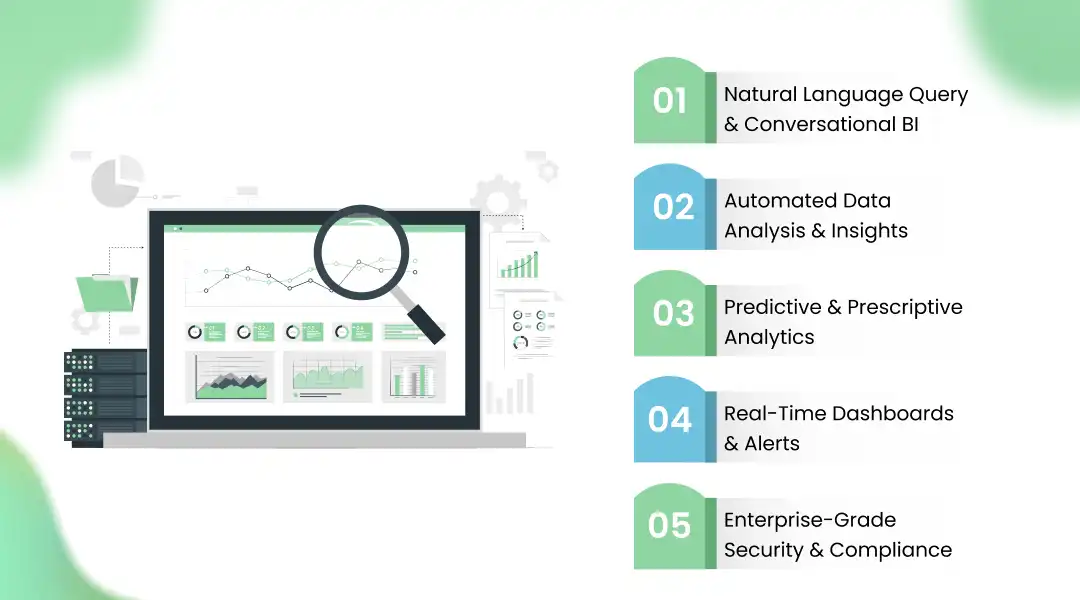
Executives talk. The system understands context, intent, business metrics, and data relationships.
Not keyword search. Conversation.
That’s the difference between a chatbot and a true Business Intelligence AI Assistant.
The best systems don’t wait for questions.
They surface patterns. They flag anomalies. They explain why something changed.
This is AI-driven decision-making without the noise.
Descriptive BI tells you what happened. Predictive BI tells you what will happen. Prescriptive BI suggests what to do next.
An enterprise-grade AI BI Assistant for Enterprises does all three.
In one interface.
Executives don’t watch dashboards. They get interrupted by alerts.
A mature Enterprise AI Business Intelligence system pushes signals when thresholds are broken, risks rise, or opportunities emerge.
Silence is replaced by relevance.
If your AI assistant can’t pass SOC2, HIPAA, ISO, and role-based access audits, it doesn’t belong in enterprise.
Period.
Let’s skip marketing. Let’s talk outcomes.
When leaders trust answers, decisions speed up.
That alone changes revenue, margins, hiring, pricing, and risk.
This is where AI-powered business intelligence quietly outperforms traditional BI.
One bank reduced analyst query volume by 62% in six months using an AI analytics assistant.
Not by firing people. By letting them work on real problems instead of tickets.
Forecasts become adaptive. Risk signals surface early.
That’s how finance teams stop explaining surprises and start preventing them.
Human analysts don’t scale linearly. AI does.
This is why Enterprise business intelligence AI becomes a strategic asset, not a tool.
This isn’t theory. These systems are already deployed.
Fraud detection in real time
Credit risk modeling integrated with financial analytics AI solutions through conversational queries
Regulatory reporting automation
Banks love AI BI because regulators love audit trails.
Demand forecasting
Basket analysis through chat
Real-time promotion impact
Retail is fast. AI makes it survivable.
Predictive maintenance
Supplier risk monitoring
Inventory optimization
This is where AI business intelligence solutions directly save millions.
Patient outcome forecasting
Resource utilization
Clinical performance dashboards
Here, insight isn’t profit. It’s patient safety.
Churn prediction
Usage behavior analysis
Revenue leakage detection
Every SaaS CFO eventually asks for this.
This is where most buyers make expensive mistakes.
Let me help you avoid mine.
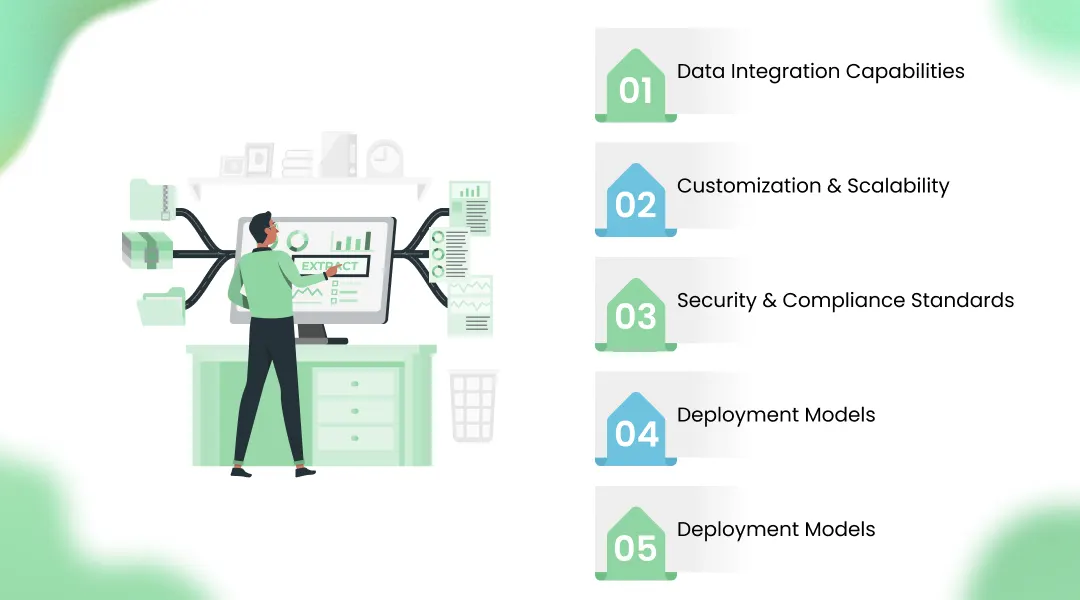
If it can’t connect cleanly to ERP, CRM, data lakes, and streaming systems, walk away.
Enterprise data is messy. Your AI must survive that.
Off-the-shelf tools fit demos. Custom systems fit businesses.
Real Enterprise AI Business Intelligence adapts to your metrics, language, and workflows.
Encryption. Governance. Audit trails. Role hierarchy.
Non-negotiable.
Banks want hybrids. Healthcare wants on-prem. SaaS wants the cloud.
Flexibility matters more than features.
Here’s a blunt truth.
Your AI partner matters more than your AI model.
bb
This debate never dies.
Let me simplify it.
Buy if:
You want fast pilots
Your needs are generic
You accept limited customization
Build if:
You run complex operations
You need proprietary logic
You want a long-term advantage
Every enterprise we’ve seen outgrow tools eventually builds.
Quietly.
Now we get technical. Stay with me.
Sources. Warehouses. Lakes. Streams. This layer cleans, normalizes, and governs.
Garbage in still means garbage out.
This is where forecasting, anomaly detection, segmentation, and optimization live.
This is the brain.
Here sits your Conversational BI assistant.
Intent detection. Context memory. Business vocabulary. Multilingual support.
This layer decides whether executives love or hate the system.
Charts still matter. But now they’re dynamic, explainable, and interactive.
Finally,
Three shifts I’m betting on.
Autonomous insight generation – systems that propose strategies, not just answers
Multimodal BI – voice, text, dashboards, and alerts blended
Decision intelligence platforms – BI merging with workflow automation
Soon, BI won’t just inform decisions.
It will participate in them.
Now I’ll speak as someone who actually builds these systems.
At KriraAI, we don’t sell dashboards. We build decision systems.
We’ve delivered AI and analytics platforms for BFSI, healthcare, manufacturing, and SaaS at scale.
Not demos. Production.
Every AI BI Assistant for Enterprises we build is tailored to metrics, language, workflows, and governance.
Because your business is not a template.
From data isolation to compliance mapping, our systems are designed for regulated industries.
Security isn’t added later. It’s designed first.
This is the quiet advantage.
We know how enterprises actually work.
That changes everything.
Dashboards don’t think. Reports don’t explain. Spreadsheets don’t warn you before things break.
An AI Business Intelligence Assistant does.
Not as hype. As infrastructure.
And the enterprises that adopt this early?
They don’t just move faster.
They see further.
Founder & CEO
Divyang Mandani is the CEO of KriraAI, driving innovative AI and IT solutions with a focus on transformative technology, ethical AI, and impactful digital strategies for businesses worldwide.