Roughly four out of five clinical trials fail to meet their original enrollment timelines, and slow recruitment remains one of the most cited reasons late-stage studies stall or get abandoned. Behind that number sits an enormous volume of manual voice work, including pre-screening calls, eligibility confirmation, visit scheduling, adherence reminders, and adverse event intake. Most of this is still handled by human coordinators reading from static scripts, one call at a time. As a specialized , we see this as precisely the operational surface where automation in biotechnology is starting to change the economics of trials, patient programs, and medical information lines.
The problem was never whether human conversation could be automated. The problem is that biotech conversations carry regulatory weight, clinical vocabulary, and mandatory safety obligations that generic voice bots were never engineered to respect. A misheard drug name or a missed adverse event mention is not a customer service inconvenience in this domain. It is a compliance failure with real consequences.
This blog examines where voice automation genuinely fits inside biotechnology operations, the specific architecture required to run it under compliance constraints, the integration and regulatory realities of deployment, and the business outcomes teams should actually expect. It is written for the people evaluating this technology inside life sciences organizations, not for a general audience curious about voice AI.
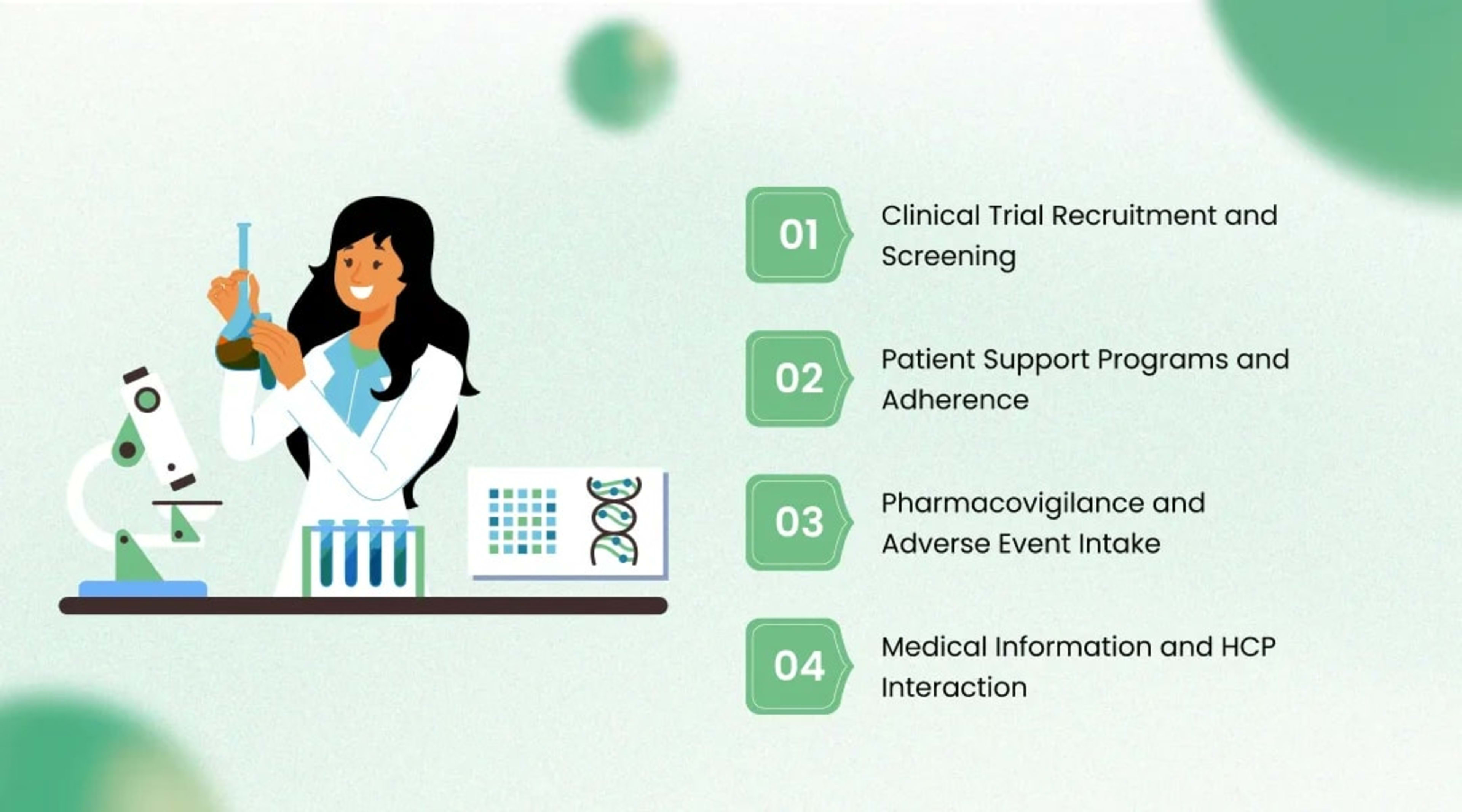
Implementing advanced biotech solutions is not about a single workflow; it is about managing a portfolio of high-volume voice interactions that share a common trait. Each involves structured conversations, sensitive data, and outcomes that must be logged with precision. Understanding which of these workflows are ready for automation is the first real decision, because forcing voice AI into the wrong process wastes budget and erodes trust.
The workflows below are the ones where voice agents consistently deliver value in life sciences settings. Each has a defined conversational structure, a clear escalation path, and a measurable outcome that leadership already tracks.
Trial recruitment is the single most expensive bottleneck in drug development, and it is dominated by repetitive outbound and inbound calling. A voice agent can conduct first-pass eligibility screening against inclusion and exclusion criteria, confirm basic demographic and condition data, and book qualified candidates directly into a site calendar. The agent removes the coordinator burden of chasing unresponsive leads while capturing structured screening data on every call.
The critical design constraint is that the agent must screen without giving medical advice or making clinical judgments. It collects answers, applies rule-based logic against the protocol, and routes anything ambiguous to a human coordinator. Handled this way, voice AI compresses the time between first contact and site visit from days to a single conversation.
Patient support program automation is the workflow where voice agents show their clearest recurring return. Hub services handle enrollment verification, benefits investigation status, refill reminders, injection training scheduling, and adherence check-ins at high volume. Medication nonadherence is estimated to cost health systems hundreds of billions of dollars annually, and much of it stems from missed reminders and unresolved logistical friction.
A voice agent can call patients on a schedule and answer defined logistical questions, effectively improving patient communication and care while escalating clinical concerns to a nurse line when necessary. The result is consistent outreach at a fraction of the per-contact cost of a fully staffed hub.
Pharmacovigilance voice automation is the most technically demanding workflow in this list, and also one of the most valuable. Every inbound patient or caregiver call is a potential adverse event report, and regulators impose strict timelines on when serious cases must reach safety databases. A well-built voice agent listens for adverse event and product complaint signals across the entire conversation, not only when the caller explicitly reports a problem.
When the agent detects a possible safety signal, it captures the four minimum reportability elements, flags the case, and routes it to a trained safety associate for follow-up. This turns a compliance risk into a structured, auditable intake pipeline.
Medical information lines field questions from healthcare professionals and patients that range from simple logistics to complex clinical inquiries. A voice agent can handle the high-frequency, low-complexity tier, such as dosing form availability, storage instructions, or where to find approved resources. Anything requiring medical judgment or off-label discussion is escalated immediately, with full context passed to the specialist.
Conversational AI for life sciences often gets deployed first as chat, and for good reason, because text is easier to log and moderate. Yet a large share of biotech interactions are inherently voice-based, driven by an older patient population, hands-busy clinical staff, and the reality that a phone call is still the default channel for urgent concerns. Choosing voice is not nostalgia; it is meeting the population where it already communicates.
Voice also captures signals that text discards. Prosody, hesitation, and emotional tone carry clinically relevant information, particularly in adherence and safety conversations where a patient may downplay a symptom in writing but reveal distress by voice. A voice pipeline can surface these cues for human review even when the words alone seem routine.
The operational case is equally direct. Voice agents run at concurrency levels no human team can match, handling thousands of simultaneous calls during a recruitment surge or a product launch without added headcount. This elasticity is why conversational AI for life sciences increasingly starts with the phone line rather than the chat widget.
The architecture that powers AI voice agents in biotechnology looks superficially like any voice pipeline, yet every layer carries domain-specific requirements that a general-purpose stack cannot satisfy. The difference is not the components; it is how they are tuned, guarded, and audited. This is where engineering depth separates a demo from a production system.
The underlying AI call agent architecture consists of a core stack with seven layers that must operate together within a tight latency budget. Natural turn-taking degrades noticeably once end-to-end response latency crosses roughly one second, so every layer is engineered against that ceiling.
The speech recognition layer transcribes caller audio in real time with domain-adapted models.
The natural language understanding layer classifies intent and detects safety signals.
The dialogue management layer controls conversation flow under strict guardrails.
The response generation layer produces grounded, compliant replies.
The text-to-speech layer synthesizes natural voice output with low first byte latency.
The telephony layer connects the pipeline to the public phone network.
The integration and audit layer writes structured records to backend systems.
Off-the-shelf automatic speech recognition fails on biotech vocabulary because drug names, gene identifiers, and clinical terms rarely appear in general training data. A streaming Conformer or RNN-T model is preferred over batch Whisper-style transcription here, because these architectures emit partial hypotheses within a few hundred milliseconds and keep the conversation responsive. For recruitment and safety calls where the caller may speak slowly or with an accent, streaming partials also let the dialogue manager begin planning before the utterance finishes.
The real work is domain adaptation. Contextual biasing, custom pronunciation lexicons, and a curated terminology list can reduce word erfirst-byten specialized pharmaceutical vocabulary by thirty to fifty percent compared to a generic model. Without this step, an agent that mishears a compound name will corrupt every downstream record it writes.
The natural language understanding layer in biotech does more than route intents; it acts as a safety net. A hybrid design works best, pairing a fine-tuned classifier such as a RoBERTa-based model for hig-frequency structured intents with a large language model-based zero-shot layer for open-ended safety signal detection. The classifier gives deterministic, low-latency routing for known flows, while the LLM layer catches the unexpected phrasing of a real adverse event.
Adverse event and product complaint detection must run continuously across the whole call, not only inside a dedicated reporting flow. A patient calling about a refill may mention a rash in passing, and the agent has to catch that and trigger the safety pathway. This always-on listening is a defining requirement of pharmacovigilance voice automation.
Fully generative conversation is attractive but risky in a regulated setting, because an unconstrained model can improvise medical statements it should never make. The right pattern for most biotech agents is a frame-based dialogue manager augmented by a retrieval-grounded language model. The frame enforces the required sequence of consent, identity verification, and data capture, while the grounded model handles natural phrasing within approved boundaries.
This is where KriraAI focuses much of its design effort, building dialogue layers that stay conversational while refusing to cross clinical or promotional lines. The agent is allowed to be fluent, but it is never allowed to be creative about medical facts. Every response is either retrieved from approved content or constrained by explicit guardrails.
Neural text-to-speech based on VITS style or comparable streaming architectures delivers natural prosody with first-byte latency under about three hundred milliseconds, which is essential for keeping the full response inside the one-second budget. Streaming synthesis matters more than raw audio quality here, because a warm voice that arrives late still feels robotic to the caller. Voice persona design also carries weight in patient-facing programs, where a calm and clear voice measurably improves completion rates.
On the telephony side, production biotech agents connect through SIP trunks and RTP media streams, integrating with platforms such as Twilio, Amazon Connect, or Genesys, and using WebRTC for browser-based channels. The infrastructure must support high concurrency, call recording with consent, and reliable failover, because a dropped safety call is not an acceptable failure mode.
In biotechnology, compliance is not a feature bolted on at the end; it is the constraint that dictates the architecture from the first design session. A voice agent that ignores these rules is not a minor liability; it is a system that cannot be deployed at all. The requirements below define what a compliant build looks like.
HIPAA-compliant voice agents must protect protected health information end to end, which means encryption in transit and at rest, strict access controls, and a signed business associate agreement with every vendor that touches the data. For trials and programs involving European participants, GDPR adds explicit consent, data minimization, and the right to erasure. The agent must capture and log consent verbally before collecting any personal data, and it must be able to prove that consent later.
Building HIPAA-compliant voice agents also means being deliberate about where audio and transcripts are stored and who can access them. Data residency, retention schedules, and de-identification of analytics data are all decisions made before a single call is placed. Getting this wrong invalidates the entire deployment regardless of how well the agent converses.
Any voice agent that creates or modifies records used in regulated processes falls under 21 CFR Part 11, which governs electronic records and electronic signatures. In practice, this means every action the agent takes must be captured in a tamper-evident audit trail, with timestamps, versioning, and traceability from the raw audio to the final structured record. A regulator must be able to reconstruct exactly what was said, what the system understood, and what it wrote downstream.
Pharmacovigilance obligations layer on top of this. Under ICH expedited reporting expectations, serious and unexpected adverse drug reactions must reach the relevant authority within fifteen calendar days, and fatal or life-threatening cases within seven. A voice agent that participates in intake must therefore timestamp detection and guarantee handoff to a qualified safety associate well inside those windows.
A voice agent delivers value only when it reads from and writes to the systems the organization already runs on. In biotech, that data environment is dense, regulated, and rarely designed for real-time access. Integration is usually the hardest part of the project, and it is where many pilots quietly fail.
The integration surface for a production biotech voice agent typically spans these systems, and each must be handled during the live conversation without breaking the latency budget.
The clinical trial management system holds site, visit, and schedule data for booking and confirmation.
The electronic data capture system receives structured screening and visit information.
The customer relationship and content platform, often Veeva, governs approved medical content and HCP records.
The safety database, such as Argus, receives flagged adverse event cases for formal processing.
The randomization and trial supply system coordinates enrollment status and drug logistics.
The identity and verification service authenticates the caller before any protected data is shared.
KriraAI approaches this layer as an engineering problem first, designing real-time lookups, caching strategies, and graceful degradation so that a slow backend never leaves the caller in silence. When a system is unreachable, the agent must know how to hold the conversation, capture the intent, and complete the transaction asynchronously. That resilience is what separates a reliable enterprise deployment from a fragile proof of concept.
The business case for voice automation in biotech is strong, but only when it is stated honestly with realistic numbers and clear tradeoffs. Leaders should expect meaningful savings and throughput gains, not the exaggerated deflection figures that vendors sometimes promise. The value is real, and it is also bounded by the regulated nature of the work.
The outcomes below are the ones that consistently justify investment across recruitment, patient support, and medical information programs.
Voice agents commonly handle fifty to seventy percent of routine, high-frequency interactions without human involvement, freeing coordinators for complex cases.
Cost per routine interaction typically drops substantially once the agent absorbs scheduling, reminders, and status calls that previously consumed staff time.
Recruitment cycles shorten because screening and booking happen in a single automated conversation rather than across days of phone tag.
Adherence program coverage becomes consistent, since every patient receives scheduled outreach regardless of call center staffing.
Adverse event intake becomes more complete and better timestamped, reducing the risk of late or missed reports.
The honest counterweight is that voice AI does not replace clinical judgment, and it does not eliminate human staff. It shifts the workforce from repetitive intake toward the exceptions and clinical conversations that genuinely need a person. The strongest ROI comes from designing for this partnership rather than pursuing full automation that the regulatory environment will never allow.
Most failed biotech voice projects fail for predictable reasons, and nearly all of them are avoidable with the right early decisions. The mistakes below recur across organizations that treat voice AI as a generic contact center upgrade rather than a regulated clinical system. Recognizing them before the build begins saves both budget and credibility.
The first mistake is treating adverse event detection as an afterthought bolted onto a scheduling bot. Safety listening must be architected from day one, because retrofitting it into a live system is both expensive and risky. The second mistake is skipping domain adaptation on the speech recognition layer, which guarantees corrupted records the moment a caller says a compound name.
The third mistake is allowing a generative model to speak freely about clinical topics, which invites regulatory and legal exposure. The fourth is underinvesting in integration, so the agent sounds intelligent but cannot actually update the systems of record. KriraAI structures its engagements to eliminate exactly these failure modes, sequencing safety design, terminology adaptation, guardrail definition, and integration before conversational polish.
A final and quieter mistake is deploying without a continuous quality pipeline. Intent accuracy, escalation rates, and safety detection recall drift over time as vocabulary and call patterns evolve. A production biotech agent needs ongoing monitoring, human review of flagged calls, and periodic retuning, not a launch-and-forget deployment.
The market for conversational AI for life sciences splits into three broad categories, and choosing the wrong one is a costly, slow-to-reverse decision. Generic voice bot platforms offer speed but lack the safety, compliance, and integration depth this domain demands. Horizontal enterprise voice vendors bring scale but rarely understand pharmacovigilance or 21 CFR Part 11 obligations out of the box.
Specialist providers that combine voice engineering with life sciences domain knowledge sit in the middle, and this is usually where serious deployments land. The build versus buy question then becomes whether the organization has in-house voice AI engineering, ASR adaptation capability, and regulatory fluency to construct and maintain the system alone. Most biotech teams do not, and the maintenance burden of a regulated voice pipeline is easy to underestimate.
The pragmatic answer for many organizations is a partnered build, where a specialist designs and delivers a production system tuned to the organization's protocols and data stack while the internal team retains ownership and oversight. This preserves control over clinical logic and compliance while importing the deep voice engineering that these systems require. It is the model that most reliably produces something that survives a regulatory audit and scales beyond the pilot.
Three points should stay with any biotech team evaluating this technology. First, voice agents deliver the most value in structured, high-volume workflows such as recruitment screening, patient support, and adverse event intake, where conversation is repetitive but the data is critical. Second, the architecture that makes this work is defined by its constraints, including domain-adapted speech recognition, always-on safety detection, guardrailed dialogue management, and a 21 CFR Part 11 grade audit trail. Third, integration and compliance, not conversational polish, are where these projects succeed or fail.
KriraAI designs and deploys production-grade AI voice agent systems for exactly this kind of regulated, high-stakes environment. The team brings serious voice engineering depth, life sciences domain knowledge, and the delivery experience to build agents that recognize clinical vocabulary, respect regulatory boundaries, and integrate cleanly with the systems biotech organizations already run on. KriraAI treats safety design, terminology adaptation, and audit integrity as first-order engineering problems, which is why its voice automation holds up in real enterprise operations rather than only in a demo.
If your organization is weighing voice automation for trials, patient programs, or safety intake, the KriraAI team can help you scope a system that performs reliably and survives regulatory scrutiny. Bring your specific workflow and compliance requirements to a conversation, and let the engineering shape the solution around them.
AI voice agents in biotechnology automate high-volume voice workflows including clinical trial pre-screeniappointment scheduling, patient adherence outreach, medical information triage, and adverse event intake. They handle routine conversations at scale while escalating clinical or ambiguous cases to trained human staff for judgment and follow-up.
Voice agents can be HIPAA compliant when built with encryption in transit and at rest, strict access controls, verbal consent capture, and a signed business associate agreement with every vendor. Compliance is an architectural requirement designed in from the start, not a feature added after deployment, and it also often requires GDPR alignment for European participants.
A properly engineered voice agent listens for adverse event and product complaint signals across the entire conversation, not only during a d,edicated reporting flow. When it detects a possible safety signal, it captures the minimum reportability elements, timestamps the case, and routes it to a qualified safety associate to meet regulatory timelines of seven to fifteen calendar days.
Yes, but only with domain adaptation. Generic speech recognition fails on drug names and gene identifiers, so production systems use contextual biasing, custom pronunciation lexicons, and curated terminology lists. These techniques can reduce word error rate on specialized pharmaceutical vocabulary by roughly thirty to fifty percent compared to an unadapted model.
Voice agents commonly automate fifty to seventy percent of routine, high-frequency interactions such as scheduling, reminders, and status calls, which substantially lowers cost per interaction. The gain comes from shifting human staff toward complex and clinical conversations, not from eliminating people, since regulatory constraints require human oversight of judgment-based work.
Ridham Chovatiya is the COO at KriraAI, driving operational excellence and scalable AI solutions. He specialises in building high-performance teams and delivering impactful, customer-centric technology strategies.