Across enterprise contact centres today, the average cost of a single inbound call handled by a human agent runs between $6 and $12 depending on complexity, handle time, and agent tier. At volumes of 50,000 calls per month, that is a cost structure that compounds fast. An AI call agent, when designed and deployed correctly, can resolve 60 to 80 percent of routine call types at a per-call cost below $0.50, without hold queues, without shift constraints, and without the performance degradation that comes from agent fatigue. The business case is clear. What is less clear, and what most organisations underestimate, is what it actually takes to build an AI call agent that performs at that level reliably.
This blog covers the full architecture of a production AI call agent, the specific engineering decisions that determine whether it works or fails at scale, the telephony integration requirements that most teams overlook, the dialogue design principles that separate high-resolution agents from frustrating ones, the implementation journey a team will go through, and the business outcomes that are realistic to target. Every section is written at the level of someone who will actually build, evaluate, or deploy one of these systems.
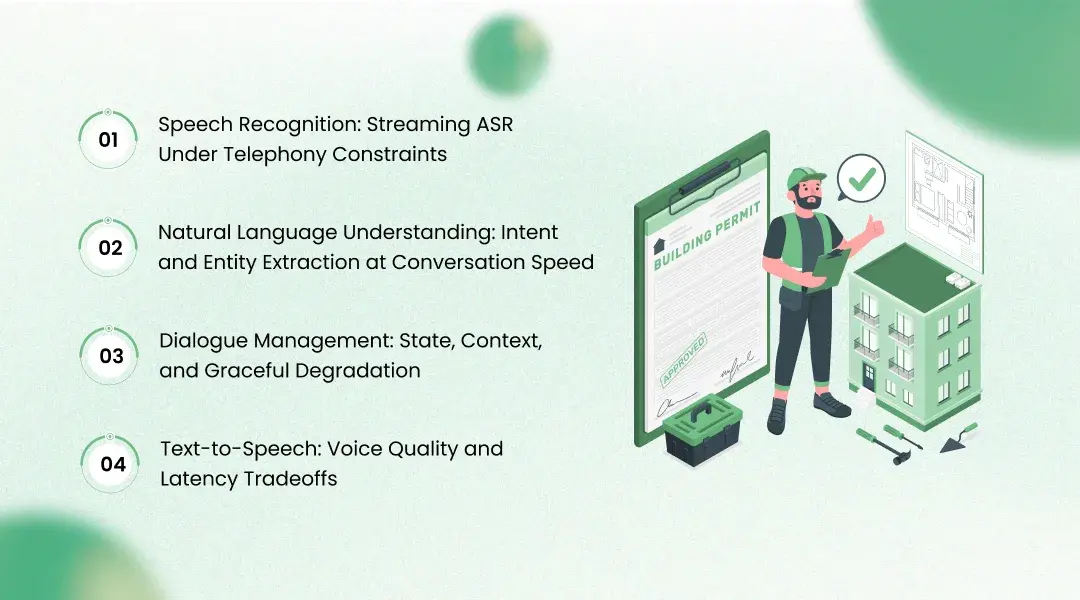
A production AI call agent is not a single model. It is a pipeline of specialised components, each with its own latency budget, accuracy requirement, and failure mode, all coordinated in real time across a live telephone connection. Understanding this pipeline at component level is the prerequisite for making good architectural decisions.
The first component in the pipeline is automatic speech recognition. In a call agent context, the ASR layer receives audio streamed over a telephony connection, typically encoded in G.711 or G.722 codec at 8kHz or 16kHz sample rate over RTP. The acoustic environment is constrained, noisy, and variable. The ASR model must produce a transcript in real time, not after the caller finishes speaking, because the downstream components need partial transcripts to begin processing before the utterance ends.
For production call agents, the dominant ASR architectures are:
Streaming Conformer-based models such as Google's Conformer or the streaming variants of Whisper large-v3, which use a convolution-augmented transformer architecture and support chunk-based streaming with low first-token latency.
RNN-Transducer (RNN-T) models, which are designed for streaming inference and produce token-by-token output with end-to-end latency below 200 milliseconds on modern inference hardware.
CTC-based streaming models, which are computationally lighter but sacrifice some accuracy on conversational speech with disfluencies, false starts, and overlapping speech.
For general business call automation, a streaming Conformer model fine-tuned on telephony-grade audio outperforms a general-purpose Whisper deployment. Word error rate on clean read speech is not the right benchmark. The benchmark that matters is word error rate on spontaneous telephony speech with background noise, accented English, and domain-specific vocabulary such as product names, account identifiers, and medical terminology. Fine-tuning on a representative in-domain corpus of 20 to 50 hours of labelled telephony audio typically reduces domain-specific WER by 15 to 25 percent compared to a zero-shot baseline.
Once the ASR layer produces a transcript, the NLU layer must extract intent and entities from it. This sounds straightforward but is where most call agent implementations fail at the edges.
The architectural choice here is between three approaches. A fine-tuned BERT or RoBERTa classifier trained on labelled intent data is fast, deterministic, and highly accurate within its training distribution, but requires labelled data per intent and degrades on out-of-distribution utterances. A zero-shot LLM-based classifier using a model like GPT-4o or Claude Sonnet is far more robust to novel phrasings and can handle intent combinations, but adds 300 to 800 milliseconds of latency per turn depending on infrastructure. A hybrid approach, where a lightweight classifier handles high-confidence cases and falls back to an LLM for low-confidence or complex turns, gives the best balance of speed and robustness for production call agents.
Entity extraction requires separate attention. In a call centre context, entities such as account numbers, dates, policy numbers, and named products are the slots that drive backend action. Slot filling must handle partial speech, reformulation, and confirmation loops. A frame-based slot filling architecture, where the system maintains a structured frame of required and optional entities and asks targeted clarification questions for missing slots, consistently outperforms generative-only approaches for transaction-oriented call flows.
Dialogue management is the component that determines conversational quality. The conversation must maintain context across multiple turns, handle topic switches, manage clarification cycles, and know when to escalate to a human agent without creating a frustrating loop.
Production call agents today use one of three dialogue management approaches:
Finite state machine (FSM) dialogue managers, which define explicit states and transitions for every supported path. These are deterministic, auditable, and reliable for narrow task-oriented flows, but become unmanageable as the number of flows grows beyond 30 to 40 distinct call types.
LLM-based dialogue managers with tool calling, where a large language model manages the conversational state and calls defined tools to query backends or execute transactions. This approach handles conversational variability well but requires careful prompt engineering and guardrails to prevent off-topic responses or hallucinated transaction confirmations.
Hybrid architectures, where high-stakes or compliance-sensitive flows use FSM logic while exploratory, informational, and qualification flows use LLM-based management. KriraAI, which designs and deploys production-grade AI voice agent systems across enterprise environments, uses this hybrid model for call agents where regulatory accuracy requirements coexist with natural conversational flexibility.
Context window management is a specific engineering concern in long calls. For calls exceeding 10 to 15 turns, the dialogue manager must summarise earlier context into a compressed representation rather than passing the full transcript to an LLM on every turn, both to control latency and to manage inference cost.
The TTS layer converts the agent's response text into speech. In a call agent context, two things matter above all: latency and naturalness. A TTS system that produces excellent audio but takes 900 milliseconds to return the first audio chunk creates a perceptible pause that callers interpret as confusion or system failure.
Neural TTS systems using VITS (Variational Inference with adversarial learning for Text-to-Speech) or its descendants produce near-human quality speech with streaming capability. Streaming TTS implementations can return the first audio chunk in under 150 milliseconds by synthesising and streaming in sentence or phrase chunks rather than waiting for the full response to be synthesised. For a typical agent response of 15 to 25 words, a well-optimised streaming TTS pipeline adds 120 to 180 milliseconds of perceived latency, which is imperceptible in natural conversation.
Custom voice design is increasingly a production requirement rather than a luxury. A call agent voice that matches the brand's tone, speaks at the right pace for the caller demographic, and handles prosody correctly on questions versus statements creates materially better caller experience. Voice cloning approaches based on YourTTS or proprietary systems from ElevenLabs or Cartesia can produce a deployable custom voice from 30 to 60 minutes of high-quality reference audio.
An AI call agent is only as reliable as its telephony integration. This is the layer that most teams with software backgrounds underestimate, and where production incidents most commonly originate.
Voice calls in enterprise environments travel over SIP (Session Initiation Protocol) for call setup and teardown, and RTP (Real-time Transport Protocol) for the actual audio stream. A production AI call agent must be a SIP endpoint, capable of receiving SIP INVITE messages, negotiating codec parameters via SDP, and exchanging RTP audio streams bidirectionally.
The most common integration patterns are:
Direct SIP trunk integration, where the call agent registers as a SIP UA (User Agent) on a SIP trunk from a provider such as Twilio Elastic SIP Trunking, Vonage SIP Connect, or a direct carrier connection. This pattern gives the most control over audio quality and latency.
Contact centre platform integration via APIs, where the call agent integrates with Amazon Connect, Genesys Cloud, or NICE CXone through their respective bot integration APIs. This pattern is faster to deploy but constrains what the agent can do with the audio stream.
WebRTC-based integration for browser or app-based call routing, where audio is transported over DTLS-SRTP inside a WebRTC session. This is common for call agents embedded in web applications or mobile apps.
End-to-end latency in a production voice pipeline, measured from the moment the caller finishes speaking to the moment the first audio byte of the agent's response reaches the caller's handset, must be below 800 milliseconds to feel natural. Achieving this requires the ASR, NLU, dialogue management, response generation, and TTS steps to complete in under 600 milliseconds total, leaving 200 milliseconds for network transit. This is an aggressive target that requires careful infrastructure design and component-level latency budgeting.
An AI call agent that cannot look up account data, check order status, or create a ticket during the call is a voice IVR, not a call agent. Real backend integration during a live call requires low-latency APIs, because every backend call adds directly to the caller's wait time.
Backend lookup operations that complete in under 100 milliseconds are transparent to the caller. Operations taking 200 to 400 milliseconds are tolerable with a brief acknowledgement phrase. Operations taking more than 500 milliseconds require a holding phrase to fill the silence. Call agent architectures that prefetch likely-needed data during the IVR collection phase, before the NLU layer has even determined intent, consistently outperform those that wait for intent confirmation before beginning data retrieval.
Authentication within a voice call is a specific challenge. DTMF-based PIN entry is the most reliable mechanism and remains appropriate for high-security operations. Voice biometric authentication using a speaker verification model adds a frictionless layer for lower-risk transactions and can achieve false acceptance rates below 0.1 percent with a well-tuned model on enrolled callers.
Architecture determines what a call agent can do. Dialogue design determines whether it actually does it well. The gap between a technically capable call agent and one that callers find helpful is almost entirely a dialogue design problem.
Every turn in a call agent conversation has a cost. Unnecessary confirmation turns, overly long system prompts read aloud, and asking for information the system already has are the most common causes of caller abandonment before resolution. Turn economy, designing conversations to reach resolution in the minimum number of turns, is a measurable dialogue quality metric.
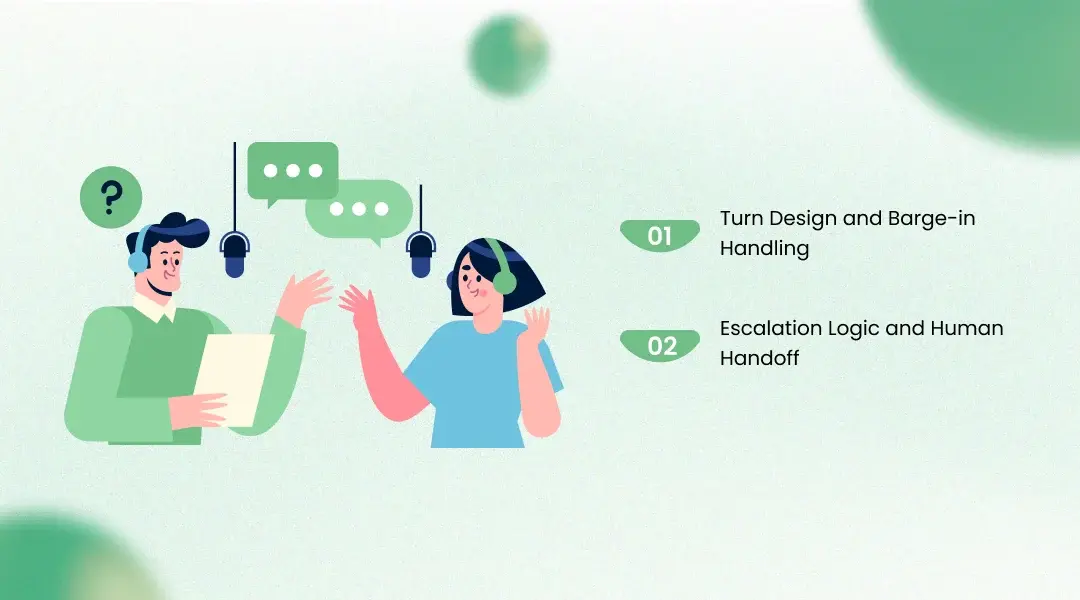
Barge-in, the ability for a caller to interrupt the agent mid-utterance, is essential and technically non-trivial. It requires the telephony layer to detect voice activity during TTS playback, suppress the TTS audio immediately, and route the caller's speech to the ASR layer without the agent's own audio contaminating the acoustic input. Acoustic echo cancellation and proper VAD (voice activity detection) configuration are prerequisites. Call agents without functional barge-in feel like old IVR systems regardless of how sophisticated the NLU layer is.
Every production call agent must have a defined escalation path to a human agent. The escalation logic must be specific, not just a fallback after three failed turns. KriraAI's production deployments implement escalation triggers based on a combination of factors: expressed caller frustration detected from prosody signals, explicit escalation requests, intent confidence below threshold for three consecutive turns, identification of a call type outside the agent's defined scope, and detection of high-value account status that triggers a premium service routing rule.
Human handoff must include a context packet: a structured summary of the call so far, the entities collected, the actions taken, and the reason for escalation, delivered to the receiving agent screen before the call connects. Callers who must re-explain their situation to a human after an AI escalation report significantly lower satisfaction scores than callers who were transferred with full context.
The financial case for an AI call agent deployment is strong, but it must be built on realistic assumptions rather than vendor best-case figures.
A representative enterprise contact centre handling 100,000 inbound calls per month, with an average handle time of 4 minutes and a fully-loaded agent cost of $18 per hour, is spending approximately $1.2 million per month on call handling. An AI call agent that resolves 65 percent of call volume autonomously at $0.40 per call reduces that resolved portion to $26,000, a saving of approximately $754,000 per month on that portion of volume, against which the agent development, telephony infrastructure, and ongoing model costs must be offset.
Implementation costs for a production AI call agent vary significantly by scope. A focused deployment covering three to five call types with existing telephony infrastructure in place typically runs $150,000 to $400,000 in development and integration costs with a 12 to 18 week delivery timeline. A full-scale deployment covering 20 or more call types with custom voice, full CRM integration, and new telephony infrastructure can run $600,000 to $1.5 million with a six to twelve month timeline. Payback periods in the 4 to 9 month range are common for deployments that hit their automation rate targets.
KriraAI approaches call agent business cases with a structured pre-deployment assessment that models automation rate by call type, identifies integration complexity early, and produces a realistic cost and timeline estimate before any development begins. This upfront investment in scoping prevents the budget overruns and timeline slippage that are common when teams move directly from a demo to a full deployment.
Understanding what makes call agent deployments fail is as important as knowing what makes them succeed.
The most common failure mode is overestimating automation rate before deployment. Demo environments use scripted callers, ideal audio conditions, and a narrow set of utterance variations. Production environments have background noise, accented speech, callers who speak in incomplete sentences, and edge cases the demo never encountered. Teams that design for 85 percent automation and launch expecting that number typically land at 45 to 55 percent in the first weeks of production operation.
The second most common failure mode is underbuilding the fallback and escalation experience. An AI call agent that fails badly, meaning it loops the caller, repeats itself, or fails to escalate cleanly, generates more damage to customer satisfaction than the original call routing problem it was meant to solve. Every failure mode must have a graceful exit.
A third failure mode is neglecting post-call analytics and improvement pipelines. A call agent that does not have a structured process for reviewing failed calls, identifying systematic misclassifications, and deploying corrected models will degrade over time as caller vocabulary and call types evolve. Production call agents require ongoing maintenance budgets, typically 15 to 20 percent of initial development cost per year, to sustain performance.
Delivering a production AI call agent follows a structured sequence that experienced teams follow consistently.
Phase 1 covers discovery and scoping, taking two to three weeks. This involves analysing call recordings to identify call types and volumes, building an intent taxonomy, identifying integration requirements, assessing telephony infrastructure, and establishing performance baselines.
Phase 2 covers foundation build, taking four to six weeks. This involves configuring the ASR pipeline and tuning it on in-domain audio, building the NLU layer with initial intent classifiers and entity extractors, defining dialogue flows for the highest-volume call types, and establishing the telephony integration with test extensions.
Phase 3 covers integration and dialogue development, taking four to eight weeks depending on scope. This involves CRM and backend API integration, dialogue development for all in-scope call types, TTS voice configuration, escalation logic implementation, and DTMF and authentication flow development.
Phase 4 covers testing and calibration, taking three to four weeks. This involves structured user acceptance testing with representative callers, end-to-end latency measurement and optimisation, intent recognition accuracy testing against a held-out test set, load testing at peak concurrency targets, and failure mode validation.
Phase 5 covers production launch and stabilisation, taking four to six weeks post-launch. This involves phased traffic rollout starting at 5 to 10 percent of call volume, daily review of misclassification logs, dialogue refinement based on real call analysis, automation rate tracking against target, and handoff of ongoing operations to the client team or managed service.
An AI call agent deployment without a measurement framework is not a deployment, it is an experiment. The metrics that matter in production are specific and must be tracked continuously.
The core performance metrics for any AI call agent are:
Containment rate: the percentage of calls handled end-to-end by the AI agent without human escalation. This is the primary automation metric and the leading indicator of cost impact.
First-call resolution rate: the percentage of calls where the caller's issue was fully resolved, whether by the AI or after escalation. A high containment rate with low resolution rate indicates the agent is containing calls incorrectly.
Intent recognition accuracy: the percentage of caller utterances where the system correctly identified the intent. Measured on a sampled and labelled set of production calls, not on a static test set.
End-to-end latency: the 95th percentile round-trip latency from end of caller utterance to first byte of agent audio. This must be tracked continuously because infrastructure changes, model updates, and traffic spikes all affect it.
Escalation reason distribution: a breakdown of why escalations occurred, segmented by call type, time of day, and caller segment. This distribution drives the improvement backlog.
Customer satisfaction signal: post-call survey completion rates and scores, or automated sentiment inference from post-call transcripts where direct survey is not feasible.
Three things matter most when building an AI call agent that performs reliably at enterprise scale. The first is architectural rigour: every component in the pipeline must be selected and configured for telephony-grade audio conditions, not general-purpose speech environments, and the end-to-end latency budget must be engineered deliberately rather than assumed. The second is dialogue design discipline: automation rate is primarily a dialogue quality problem, not a model quality problem, and teams that invest in turn economy, barge-in handling, and graceful escalation consistently outperform those that focus only on NLU accuracy. The third is realistic scoping: deployments that begin with a structured call type analysis, model automation rates per call type honestly, and build iteratively from the highest-volume simplest flows outward are the deployments that reach their ROI targets.
KriraAI designs and deploys production-grade AI call agent systems with the engineering depth to get these decisions right. From streaming ASR pipeline configuration and LLM-based dialogue management to SIP trunk integration and CRM connectivity, KriraAI brings the architecture knowledge and delivery experience to build AI call agents that perform reliably at scale across enterprise telephony environments. The team has worked across contact centre, healthcare, financial services, and logistics environments, and understands both the technical requirements and the operational realities of each.
If your organisation is evaluating or planning an AI call agent deployment, speak with KriraAI about your specific requirements.
An AI call agent is a software system that conducts natural spoken conversations with callers, understands their intent and context, executes backend actions, and resolves calls without human intervention. It differs from a traditional Interactive Voice Response system in three fundamental ways. A traditional IVR routes callers through a menu of numbered options and requires callers to conform to its structure. An AI call agent understands natural speech, handles free-form requests, and adapts to the caller's phrasing rather than requiring them to follow a script. An AI call agent also maintains conversational context across turns, meaning it can reference what the caller said three turns earlier and use that information without asking again. Finally, an AI call agent can integrate with backend systems in real time to look up data, create records, and execute transactions, rather than only routing to a human for those actions.
A production AI call agent should achieve an end-to-end latency of below 800 milliseconds at the 95th percentile, measured from the end of the caller's utterance to the first audio byte of the agent's response reaching the caller. This target requires a carefully budgeted pipeline: streaming ASR contributing no more than 150 to 200 milliseconds, NLU processing completing in 50 to 150 milliseconds depending on whether a lightweight classifier or an LLM call is required, dialogue management and response selection completing in 100 to 200 milliseconds, and streaming TTS returning a first audio chunk in 120 to 180 milliseconds. Network latency between components adds a further 50 to 100 milliseconds in a well-architected deployment. Achieving this requires co-locating pipeline components in the same cloud region, using streaming inference throughout rather than waiting for full utterance completion, and prefetching backend data where possible.
Calculating the ROI of an AI call agent deployment requires three inputs: current cost per call, expected automation rate, and total implementation and operating cost. Current cost per call is derived from total contact centre operating cost divided by call volume, typically running $6 to $12 for routine inbound calls in a well-run operation. Expected automation rate should be modelled per call type, not as a single aggregate figure, because automation rates vary dramatically: simple balance inquiries may automate at 90 percent while complex billing disputes may automate at 30 percent. A weighted average automation rate across the full call mix of 55 to 70 percent is realistic for a well-scoped first deployment. AI call agent operating cost including telephony, inference, and maintenance typically runs $0.30 to $0.60 per call. The payback period calculation divides total implementation cost by monthly cost saving, and most production deployments achieve payback in four to nine months.
For an AI call agent deployed over telephony, the most important ASR selection factors are streaming capability, telephony audio robustness, and domain adaptability. Streaming capability means the ASR system can produce partial transcripts as the caller speaks rather than waiting for utterance completion, which is essential for achieving sub-800-millisecond end-to-end latency. Telephony audio robustness means the model performs well on 8kHz narrowband audio encoded in G.711, which degrades audio quality significantly compared to broadband microphone audio. Many ASR benchmarks report accuracy on clean 16kHz audio, which is not representative of telephony conditions. Domain adaptability means the system can be fine-tuned or prompted with domain-specific vocabulary including product names, account identifiers, and industry terms that would otherwise produce high error rates. Streaming Conformer architectures and RNN-T models generally outperform other architectures on these three criteria for call centre applications.
Escalation from an AI call agent to a human agent should be designed as a first-class experience, not a failure state. The escalation trigger logic should be multi-dimensional, firing on any of several conditions: the caller explicitly requests a human, the agent fails to correctly identify intent after two clarification attempts, the call type falls outside the agent's defined scope, caller frustration signals are detected from prosody or explicit language, or the account or transaction value exceeds a threshold that warrants human handling. When escalation triggers, the system should acknowledge the transfer naturally and set a realistic wait time expectation. Critically, the system must assemble and transmit a context packet to the receiving human agent's screen before the call connects. This packet should include the caller's identified intent, all entities collected, any actions taken by the AI agent during the call, and the reason for escalation. Callers who must re-explain their situation after an AI-to-human transfer report satisfaction scores 35 to 40 percent lower than those transferred with full context.
Founder & CEO
Divyang Mandani is the CEO of KriraAI, driving innovative AI and IT solutions with a focus on transformative technology, ethical AI, and impactful digital strategies for businesses worldwide.