India operates more than 146 million agricultural holdings. Roughly 86 percent of them are smallholders farming under two hectares. Most of these farmers reach for advice on a basic phone, not an app. The Kisan Call Centre already fields millions of such calls each year across 22 languages. Yet wait times grow, trained agronomists stay scarce, and most queries arrive in dialects that generic systems mishear. This is the exact operational gap that custom AI voice agent systems in agriculture are built to close. A well-built voice agent answers a farmer in their own language, at 2 a.m., over a weak 2G line, with grounded and specific guidance.
The value is real, but the engineering is unforgiving. Field noise, code-mixed speech, and safety-critical advice make agriculture one of the harder voice AI domains. This guide breaks down which agricultural workflows voice agents automate, what the production architecture looks like, why crop advisory demands strict grounding, and how compliance, ROI, and rollout actually play out in the field.
Agriculture is a voice-first industry by default, not by preference. A large share of the farming population has low text literacy but high spoken fluency. Feature phones still dominate in many rural belts, so app-based flows exclude the core user. Voice removes the interface barrier that has blocked most AI in agriculture and agtech from reaching smallholders at scale.
The demand pattern also suits automation well. Farmer queries cluster around a repeatable set of topics like weather, prices, pests, inputs, and schemes. These are high-volume, seasonal, and time-sensitive, which is precisely where human helplines break down. During a pest outbreak or a sowing window, call volume can spike five to ten times within days.
Human advisory simply cannot flex to that curve affordably. A single trained agronomist handles a limited number of calls per day, and hiring for peak load is uneconomical. AI voice agents in agriculture absorb these spikes at near-flat cost per additional call. This is why input companies, cooperatives, and agri-fintech firms are moving core farmer engagement to voice automation.
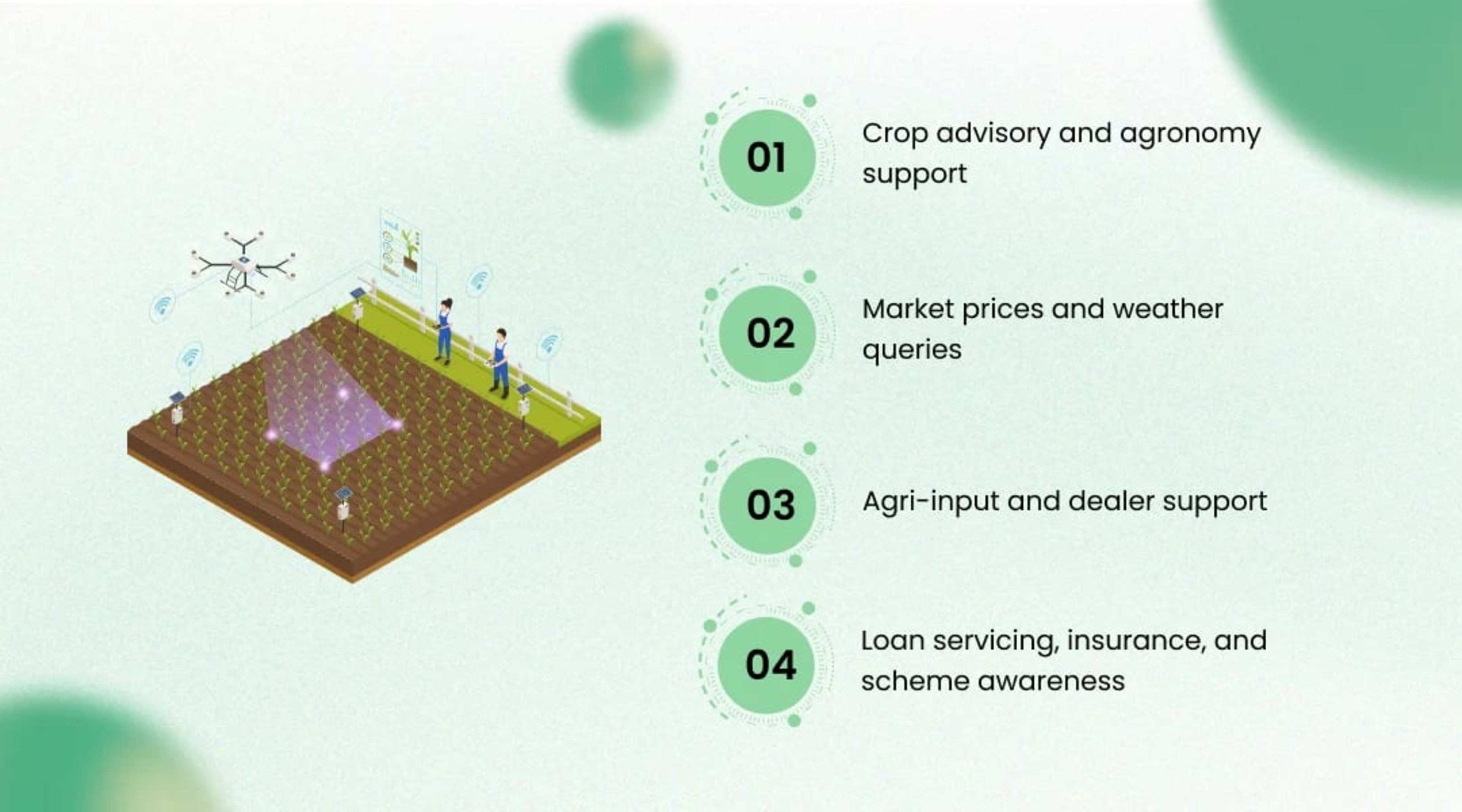
Voice agents in agriculture are not a single product. They are a family of flows built on shared infrastructure but tuned to distinct jobs. The most valuable deployments target repeatable, data-backed interactions where a wrong answer is either low-risk or fully grounded. Below are the workflows we see driving real adoption.
Voice AI for crop advisory answers questions on pests, diseases, nutrients, and crop stages. The agent identifies the crop, growth stage, and symptom, then returns grounded guidance. This is the highest-value use case and also the most safety-sensitive. It only works when the response layer is tightly grounded in vetted agronomy content.
Farmers constantly ask two questions: what is my crop worth today, and will it rain? A voice agent pulls live mandi prices from feeds like Agmarknet and district weather from forecast APIs. These are structured lookups with deterministic answers, making them ideal early wins. Accuracy here depends on data integration quality, not on model reasoning.
Input companies use voice agents to handle product usage, dosage, availability, and complaint intake. The agent can also route order status and connect farmers to the nearest dealer. This offloads a large share of repetitive calls from field sales teams. It keeps the human staff focused on relationship and escalation work.
An AI voice agent for farmer helpline work also covers agri-loans, crop insurance, and government schemes. Typical flows include the tasks below.
Reminding borrowers of upcoming installment dates and confirming payment intent under lender compliance rules.
Guiding farmers through crop insurance claim intimation and required documentation for schemes like PMFBY.
Explaining eligibility and application steps for subsidies and welfare programs such as PM-Kisan.
Capturing structured onboarding and KYC details for agri-fintech products through a guided voice flow.
These flows raise the compliance stakes significantly, which the later sections address in detail. KriraAI designs and deploys production-grade AI voice agent systems that separate these regulated flows from open advisory, so each is governed by the right controls.
Agriculture breaks assumptions that hold in clean contact-center voice AI. The audio is noisier, the language is messier, and the network is weaker. Any team promising smooth demos should be pressure-tested against field conditions. These four problems separate a prototype from a system that survives production.
Farmers rarely speak clean textbook language. They mix Hindi with English and switch into regional tongues and local dialects. A query can contain a crop name in the dialect, a chemical name in English, and grammar in Hindi. Standard ASR models trained on formal speech degrade sharply on this input.
Handling this needs multilingual voice AI for farmers built on models tuned for Indian languages. This means fine-tuned Indic ASR rather than off-the-shelf English-first systems. It also means custom vocabulary biasing for crop, variety, and agrochemical names. Without domain adaptation, word error rates on rural speech can exceed 30 percent.
Farmers call from open fields, markets, and near running machinery. Wind, livestock, and background chatter contaminate every utterance. On top of that, many calls run over 2G voice with narrowband compression and packet loss. The ASR layer must stay robust when the signal is degraded.
A large share of the target users have no smartphone or stable data. The agent must therefore work over plain PSTN and cellular voice, not just WebRTC. This constrains latency budgets and rules out heavy client-side processing. The system has to feel responsive even when the network does not cooperate.
Many users cannot read menus or type replies, so the entire interaction must be spoken. The agent must handle open-ended speech, not just rigid DTMF keypresses. It must also tolerate silences, false starts, and long rambling answers gracefully. Designing for a first-time, low-literacy caller is a different discipline entirely.
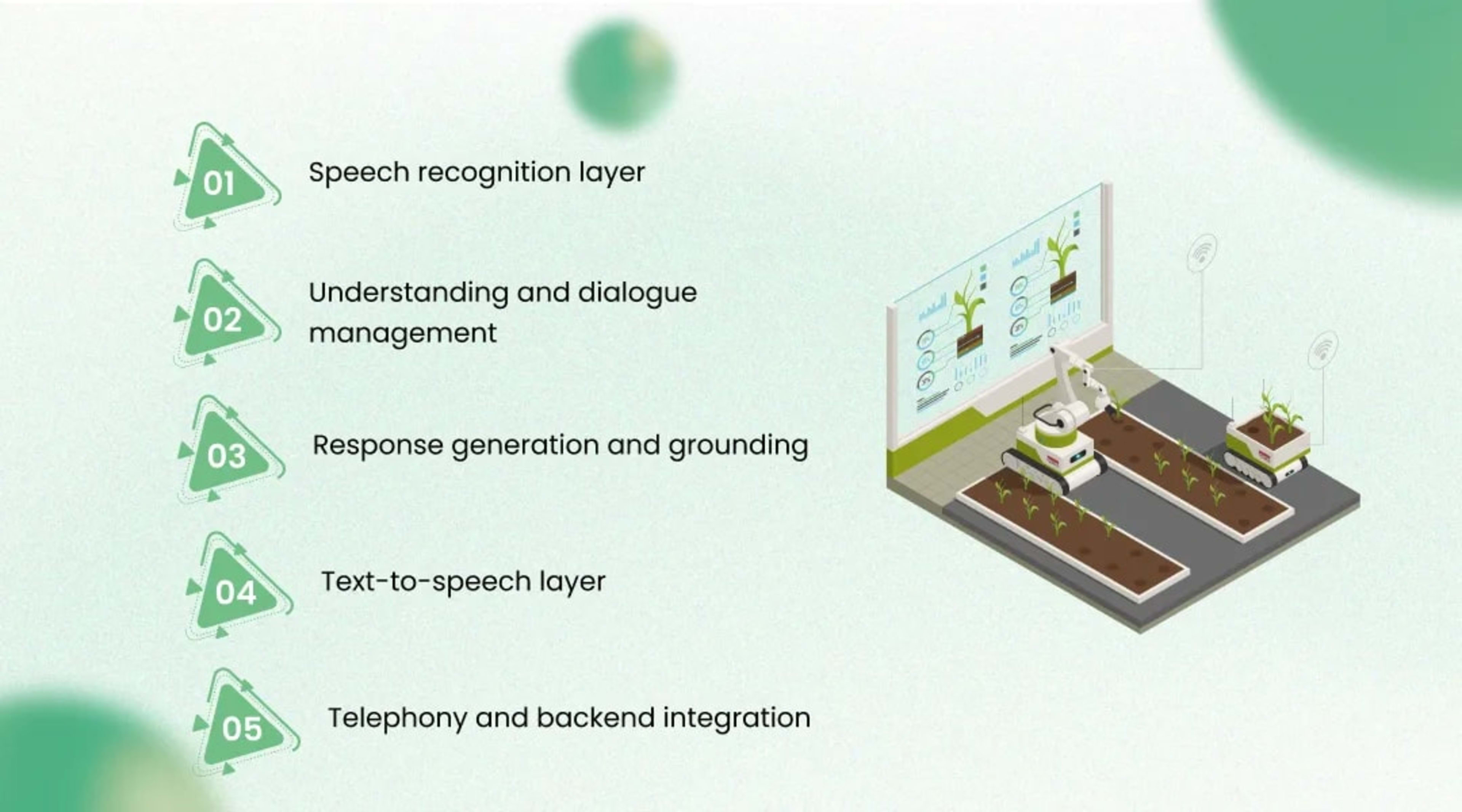
A production agricultural voice agent is a low-latency pipeline of specialized layers. Each layer has to be chosen for field conditions, not benchmark leaderboards. The goal is a full turn latency under roughly 800 milliseconds, even on weak lines. Below is how we architect AI voice agents in agriculture for that target.
The ASR layer must be streaming, multilingual, and noise-robust. We favor streaming architectures like RNN-T or Conformer over batch Whisper for real-time turns. Whisper large-v3 gives strong multilingual accuracy but adds latency that hurts conversation flow. For Indian languages, we lean on fine-tuned Indic ASR such as IndicConformer-class models with streaming decoding.
Domain adaptation is where most of the accuracy gain comes from. We apply contextual biasing and shallow fusion with a domain language model. Crop names, chemical brands, and scheme terms are injected as boosted vocabulary. This alone can cut domain word error rates by a meaningful margin.
The NLU and dialogue layers use a hybrid design, not a single model. High-frequency intents like price and weather run through a fine-tuned Indic classifier such as a MuRIL or IndicBERT model. Open agronomy questions route to an LLM-based understanding path for flexibility. This keeps the common flows fast and cheap while preserving open-ended capability.
For dialogue control, we split by risk. Structured flows like insurance claims and loan reminders use a frame-based, slot-filling manager for predictability. Advisory conversations use a retrieval-augmented LLM that stays grounded in vetted content. A finite state machine wraps compliance-critical steps so they never deviate.
Response generation must be fast and factually safe. We use retrieval-augmented generation over a curated agronomy and product knowledge base. Free-form LLM generation without grounding is unacceptable for advisory. The retrieval layer supplies the facts, and the model only phrases them for voice.
The TTS layer must sound natural in the farmer's language at low latency. We use neural TTS such as VITS-based Indic voices with streaming synthesis. Streaming first-byte audio under 300 milliseconds keeps replies from feeling laggy. Number and price pronunciation get special handling so figures are never garbled.
The telephony layer bridges the agent to real phone networks. We integrate over SIP and RTP through Indian providers like Exotel, Ozonetel, or Twilio. PSTN and 2G support is mandatory, with DTMF fallback for menu-style steps. Outbound campaigns run through progressive or predictive dialers under strict consent rules.
The backend layer connects the conversation to live systems. This includes price feeds, weather APIs, dealer and inventory databases, and loan or insurance cores. Real-time lookups happen mid-call so answers reflect current data. Warm handoff to a human agronomist triggers whenever confidence or risk thresholds are crossed.
Wrong agronomic advice is not a minor error; it is a real-world harm. A hallucinated pesticide dose can damage a crop or endanger a farmer. This is why voice AI for crop advisory cannot rely on ungrounded model output. Grounding is the single most important design constraint in the entire system.
Are AI voice agents accurate enough for crop advisory? They are, but only when advisory is retrieval-grounded rather than freely generated. The agent must answer from a vetted knowledge base of agronomy content and label-approved product usage. When the retrieved context does not cover a query, the correct behavior is to escalate, not to guess. A safe agent knows the boundary of what it can answer.
We enforce this with several controls layered together. Retrieval confidence thresholds gate whether the agent answers or escalates to a human expert. Dosage, chemical, and safety statements are pulled from approved sources, never paraphrased loosely. Every advisory response is logged for later audit by domain agronomists. KriraAI brings serious engineering depth to enterprise conversational AI, and treats advisory grounding as a safety requirement rather than a feature.
Farmer-facing voice at scale sits inside real regulation. Outbound calling, financial servicing, and personal data all carry obligations. Teams that ignore this build systems that get suspended or fined. Compliance has to be designed in from the first flow, not bolted on later.
What regulations apply to agricultural voice automation in India? Several regimes intersect depending on the flow. The key ones are summarized below.
Outbound and promotional calling falls under TRAI rules, including DLT registration, consent, and permitted calling hours.
Loan reminders and collection calls must follow lender and RBI-aligned conduct norms on disclosure and behavior.
Crop insurance and claims flows touch insurance regulation and demand accurate, auditable process handling.
Personal and financial data collected by voice must respect data protection and localization expectations.
Beyond regulation, data handling deserves its own discipline. Call recordings, transcripts, and captured KYC details are sensitive assets. They need encryption, access controls, retention limits, and clear consent capture at call start. A voice automation for farmer engagement program should treat AI data governance and privacy as core infrastructure.
The business case for agricultural voice agents is concrete, not aspirational. A human helpline agent handles a limited number of calls per shift at a fixed cost. Voice automation for farmer engagement shifts that curve from linear to nearly flat. Once built, each additional call costs a fraction of a rupee in compute and telephony.
How much do voice AI systems save agribusinesses? In our deployments, a well-scoped agent deflects 60 to 75 percent of routine calls from human staff. Cost per automated call typically lands far below the loaded cost of a human-handled call. Concurrency also stops being a constraint, since one system can hold thousands of simultaneous calls. This is what lets input companies cover peak season without seasonal hiring.
The value is not only cost; it is reach and consistency. A voice agent is available 24 hours a day in every supported language, without fatigue. It gives the same grounded answer to the first caller and the ten-thousandth. It also captures structured data from every conversation for analytics and follow-up. KriraAI delivers voice automation that works reliably in real enterprise environments, so these gains hold under production load rather than only in pilots.
Most agricultural voice projects fail on rollout, not on technology. Teams launch a broad agent, hit field conditions, and lose farmer trust fast. A staged rollout that respects real-world messiness works far better. The phases below reflect how we sequence production deployments.
Start with structured, low-risk flows like price and weather where answers are deterministic and easy to verify.
Add agri-input and dealer support once the ASR and language coverage prove stable on real field calls.
Introduce grounded crop advisory only after the retrieval knowledge base and escalation thresholds are validated.
Layer in regulated flows such as loans and insurance last, with full compliance and audit controls in place.
Two operational practices matter throughout every phase. First, run continuous evaluation on real call samples, tracking intent accuracy, escalation rate, and word error rate per language. Second, keep a human-in-the-loop escalation path live from day one, so hard or risky calls always reach an expert. These practices are what separate a durable system from a demo that collapses under real users.
Language coverage should expand deliberately, not all at once. Launch with the two or three dominant languages of the target region and prove quality there. Adding a new language means new data, new tuning, and fresh field testing, not a config switch. Rushing coverage is the fastest way to erode trust with the exact users you want to serve.
Three points matter most for anyone evaluating AI voice agents in agriculture. First, this is a voice-first, multilingual domain where field noise, dialects, and feature phones set the real engineering bar. Second, crop advisory must be strictly grounded in vetted content, because a wrong answer causes real harm. Third, the ROI is strongest when you start with structured flows and expand deliberately by risk and language.
Getting this right takes both voice AI engineering and genuine agricultural domain understanding. KriraAI designs and deploys production-grade AI voice agent systems that combine that engineering depth with real delivery experience across industries. Our teams build agents that hold up under field conditions, seasonal spikes, and the compliance demands of regulated farmer-facing flows. If you are planning a farmer engagement or agri-advisory voice deployment, our team would be glad to discuss your specific requirements and constraints.
An AI voice agent in agriculture answers a farmer's spoken query by chaining several layers together. Streaming speech recognition transcribes the call, an understanding layer identifies the intent, and a grounded response layer generates the answer. Neural text-to-speech then speaks the reply back in the farmer's language over a normal phone line.
Yes, but only with models tuned for the task, not off-the-shelf English systems. Multilingual voice AI for farmers uses fine-tuned Indic speech recognition with custom vocabulary for crops, chemicals, and schemes. This handles code-mixed Hindi and English speech, though heavy dialects still require targeted data collection and ongoing tuning per region.
Voice agents automate crop and pest advisory, live mandi price lookups, weather queries, and agri-input and dealer support. They also handle loan reminders, crop insurance claim intimation, government scheme guidance, and voice-based KYC onboarding. Structured, high-volume, and seasonal query types deliver the strongest early results for most agribusinesses.
They are accurate enough when advice is retrieval-grounded rather than freely generated by a model. The agent answers only from vetted agronomy content and approved product usage, and escalates to a human expert when confidence is low. Ungrounded generation is unsafe for crop advice and should never be deployed for dosage or chemical guidance.
Cost depends on languages, call volume, and integration scope, but the economics favor automation at scale. A well-scoped agent typically deflects 60 to 75 percent of routine calls, at a cost per automated call far below a human-handled one. The larger and more seasonal the call volume, the stronger the return becomes.
Founder & CEO
Divyang Mandani is the CEO of KriraAI, driving innovative AI and IT solutions with a focus on transformative technology, ethical AI, and impactful digital strategies for businesses worldwide.
