The average marketing team today generates thousands of leads per month through digital advertising, content syndication, webinars, and paid social. Yet studies consistently show that only 27% of those leads ever receive a single follow-up call, and the ones that do wait an average of 47 hours before a human agent contacts them. This gap between lead generation and lead engagement is the single most expensive leak in modern marketing operations, and it is the precise reason AI voice agents for marketing have moved from experimental curiosity to operational priority for performance-driven teams.
The economics are blunt. A lead contacted within 5 minutes of form submission is 100 times more likely to be reached and 21 times more likely to convert than one contacted after 30 minutes. Human sales development teams cannot sustain five-minute response times across thousands of inbound leads generated by always-on digital campaigns. AI voice agents close this structural gap by initiating outbound calls within seconds of a lead event, conducting qualification conversations at scale, and routing high-intent prospects directly to sales representatives with full context already captured. Organizations implementing AI Voice Agent solutions can automate immediate customer engagement while integrating seamlessly with existing CRM and marketing automation platforms.
This blog examines how AI voice agents integrate into marketing and advertising operations at an architectural level, what the real performance metrics look like in production, and what teams must consider when deploying voice AI across campaign workflows.

AI voice agents are not a replacement for marketing strategy. They are an execution layer that automates specific high-volume, time-sensitive, and repetitive voice-based workflows that marketing teams have traditionally outsourced to BPO call centers or assigned to junior SDR teams. The value emerges from precision, speed, and consistency applied to workflows that degrade rapidly when handled manually at scale.
The most impactful deployment pattern for AI voice agents in marketing is speed-to-lead automation. When a prospect fills out a landing page form, clicks a call-to-action on a paid ad, or registers for a webinar, the voice agent initiates a call within 60 to 90 seconds. The agent confirms the prospect's interest, asks qualifying questions specific to the campaign offer, captures responses as structured data, and either books a meeting with sales or routes the call live to a human representative. KriraAI has deployed this pattern across high-volume B2B SaaS campaigns where the speed-to-lead window directly determines conversion economics, consistently achieving contact rates above 65% when calls are placed within two minutes of the lead event compared to under 15% when the same leads are called manually within 24 hours.
Beyond initial contact, AI voice agents conduct structured qualification conversations that capture information marketing teams need to score and segment leads accurately. Unlike form-based qualification that relies on self-reported data, conversational qualification extracts budget ranges, decision timelines, current vendor relationships, and pain points through natural dialogue. The agent maps responses to predefined qualification frameworks such as BANT or MEDDIC and pushes structured lead scores directly into the CRM. This voice AI lead qualification automation produces richer data than static form fills because prospects share more in conversation than they type into fields, and the agent can probe deeper based on initial responses.
Marketing teams running webinar programs, virtual events, or in-person conferences generate large batches of registrant and attendee data that need timely follow-up. AI voice agents execute these follow-up campaigns within hours of the event, confirming attendance interest, capturing post-event feedback, and scheduling one-on-one meetings for prospects who expressed buying intent during the session. The difference between calling a webinar attendee two hours after the event versus two days later translates directly into 3x to 5x higher meeting booking rates because intent decays rapidly.
Dormant lead databases are among the most underutilized marketing assets. AI voice agents run re-engagement campaigns across thousands of aged leads, identifying which contacts still have active interest, which have changed roles or companies, and which should be removed from the database entirely. These campaigns typically recover 8% to 12% of previously disqualified leads into active pipeline at a fraction of the cost of acquiring net-new leads through paid channels.
Production-grade voice agents serving marketing workflows require a specific architectural design that balances conversational quality, ultra-low latency, and deep integration with the marketing technology stack. The architecture differs from general-purpose voice bots in its emphasis on rapid campaign deployment, dynamic script injection, and real-time CRM synchronization.
The automatic speech recognition layer in marketing voice agents must handle diverse caller demographics, background noise environments, and the specific vocabulary of the products or services being marketed. Streaming ASR models based on Conformer or RNN-Transducer architectures are preferred over batch transcription systems because marketing conversations are short, typically 90 seconds to four minutes, and the agent must process each utterance in real time to maintain conversational flow. Domain adaptation is critical for campaigns involving industry-specific terminology. Production systems achieve this through shallow fine-tuning of the ASR decoder on campaign-specific vocabulary or by applying weighted finite-state transducer (WFST) biasing at inference time. Word error rates below 8% on marketing conversation audio are the baseline for production acceptability, with well-tuned systems reaching 4% to 6% on clean telephony audio.
Marketing voice agents typically operate within a hybrid dialogue management architecture that combines frame-based dialogue control with retrieval-augmented LLM generation for handling off-script responses. The core qualification flow follows a structured frame: the agent has specific slots to fill (company size, current solution, budget range, decision timeline) and guides the conversation through these slots in a natural sequence. When the prospect asks questions or raises objections that fall outside the scripted flow, the system routes the request to an LLM-based response generator grounded in a campaign-specific knowledge base.
This hybrid approach is essential because purely scripted systems fail when prospects deviate from expected responses, while fully generative LLM dialogue managers introduce hallucination risk unacceptable in marketing contexts where brand messaging must remain precise. KriraAI implements this hybrid architecture with configurable guardrails that allow marketing teams to define the boundaries of acceptable generated responses per campaign, preventing the agent from making promises, quoting prices, or sharing competitive claims that the marketing team has not approved.
Voice persona is a marketing asset. The TTS layer must produce speech that aligns with brand identity in terms of tone, pace, warmth, and energy level. Neural TTS systems based on VITS or proprietary architectures from providers like ElevenLabs, or Amazon Polly Neural offer the quality required for marketing conversations, but latency is the critical constraint. The TTS engine must synthesize the first audio chunk within 200 milliseconds of receiving the text input to maintain sub-500ms end-to-end response latency that feels conversational rather than stilted. Streaming TTS, where synthesis begins before the full response text is generated, is now standard practice in production marketing voice agents.
Marketing teams should invest in voice persona testing just as they invest in ad creative testing. A/B testing different voice personas across the same campaign script has shown conversion variance of 10% to 18% in production deployments, making voice selection a meaningful optimization lever. Designing effective conversational experiences also depends on customer psychology, explored further in How AI Voice Bots Are Transforming User Experience.
The intelligence layer of a marketing voice agent extends beyond basic intent recognition into nuanced conversational capabilities that directly impact campaign performance. Marketing conversations are inherently persuasive in nature, which demands capabilities that differ substantially from those of customer support or informational voice agents.
Marketing voice agents encounter objections that must be handled with the same sophistication a trained SDR would bring. Common objections in marketing contexts include "I'm not interested," "I already have a solution," "Send me an email instead," and "I don't have a budget right now." Each objection type requires a distinct response strategy. The agent must classify the objection in real time, select the appropriate response pattern, and deliver it with the right conversational cadence to maintain engagement without being pushy.
Production systems map objection types to response strategies that marketing teams configure per campaign. A "send me an email" objection might trigger a response acknowledging the request while briefly stating why a 60-second conversation is worthwhile. This requires intent-plus-sentiment analysis that distinguishes between a firm refusal and a soft deflection, because the appropriate agent behavior differs significantly between the two.
Beyond explicit responses, marketing voice agents extract implicit signals from the conversation that inform lead scoring. Speaking pace, response length, question-asking behavior, and expressed urgency are all signals that correlate with purchase intent. A prospect who asks detailed questions about implementation timelines and pricing structure signals higher intent than one who gives monosyllabic answers, even if both technically qualify based on explicit criteria. Production voice agents feed these conversational signals into the lead scoring model as weighted features, producing composite scores that are 30% to 40% more predictive of conversion than form-based scoring alone, according to internal benchmarks from KriraAI deployments across B2B marketing campaigns.
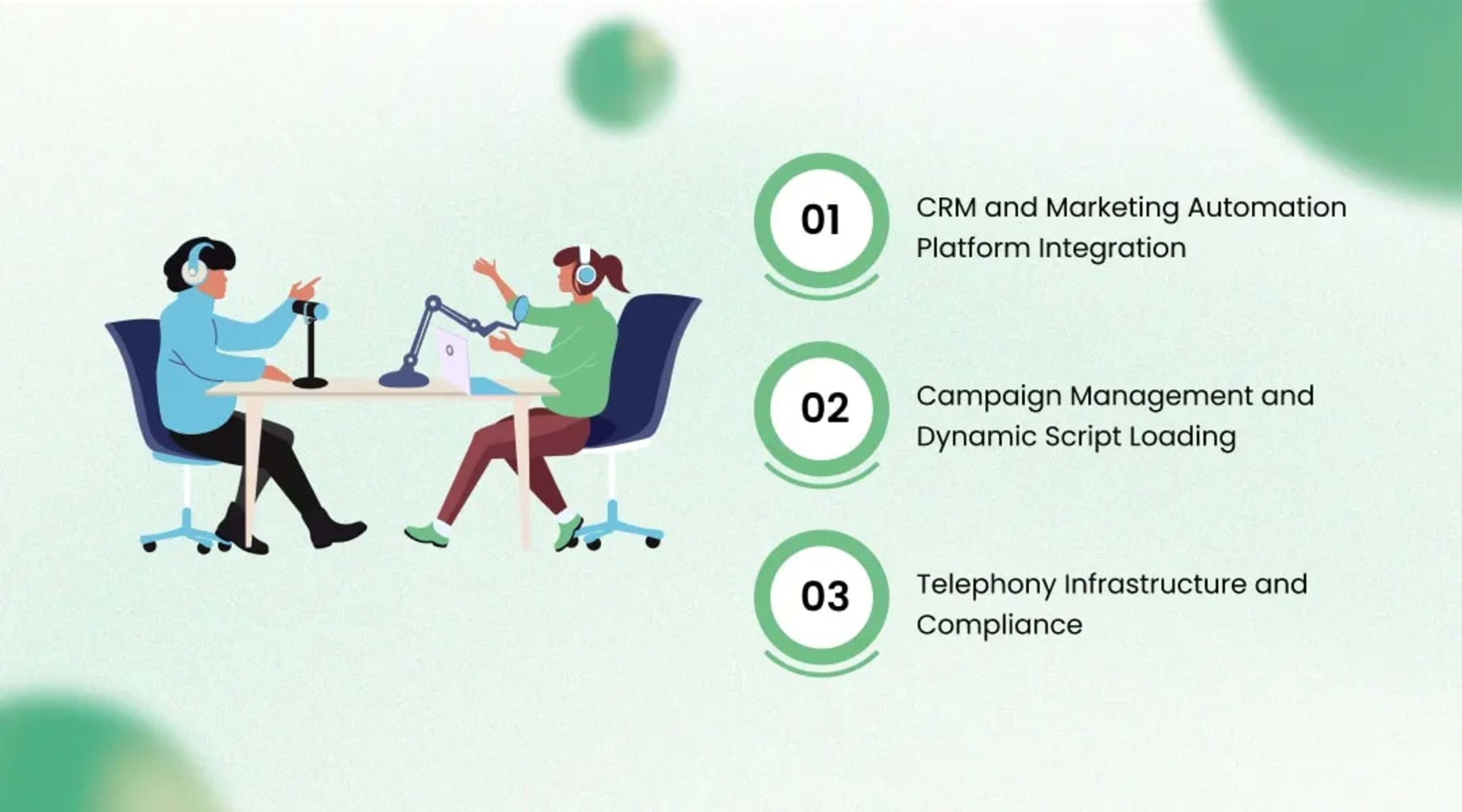
The value of AI voice agents in marketing is fully realized only when they operate as a native component of the broader marketing technology ecosystem rather than as a standalone tool. This integration layer determines whether the voice agent is a novelty or a revenue driver.
Every voice agent conversation must synchronize bidirectionally with the CRM (Salesforce, HubSpot, Zoho, Pipedrive) and the marketing automation platform (Marketo, HubSpot, Pardot, ActiveCampaign). Inbound integration means the voice agent receives lead context before initiating the call: the campaign source, the content asset downloaded, the ad creative clicked, and any prior engagement history. Outbound integration means the voice agent writes structured call outcomes back to the CRM, including qualification status, captured field values, next-step actions, and full conversation transcripts. Building these integrations typically requires experienced Custom AI Development Services capable of connecting CRM platforms, telephony systems, and marketing automation tools into one production workflow.
The technical integration typically uses webhook-triggered API calls. When a lead event fires in the marketing automation platform, a webhook triggers the voice agent to initiate the call, and upon completion, structured datais pusheds back via the CRM API. The critical design consideration is latency between the lead event and the webhook trigger. Direct, event-driven triggers with sub-5-second delivery are the production standard.
Marketing teams run multiple campaigns simultaneously, each with different qualification criteria, messaging, and target personas. The voice agent platform must support dynamic script loading where each campaign maps to a distinct conversation flow, knowledge base, and qualification framework. When a lead tagged with a campaign identifier enters, the voice agent loads the corresponding script and persona configuration automatically.
This configurability must extend to A/B testing. Marketing teams should run multiple script variants within a campaign, with the platform splitting traffic and reporting conversion metrics per variant. The best platforms support testing at the conversation-segment level, testing individual objection responses or opening lines rather than only full-script variants.
The telephony layer for marketing voice agents requires specific infrastructure considerations:
SIP trunk provisioning with local caller ID presentation for each target geography to maximize answer rates, since calls from local numbers achieve 40% to 60% higher pickup rates than toll-free or out-of-area numbers.
STIR/SHAKEN attestation compliance to prevent calls from being flagged as spam by carrier-level call filtering systems.
Concurrent call capacity planning based on campaign volume, with auto-scaling to handle lead spikes from high-performing ad campaigns or event registrations.
Call recording storage with encryption at rest and configurable retention policies aligned with data governance requirements.
Real-time call monitoring dashboards that allow marketing operations teams to listen to live conversations and intervene when necessary during campaign launches.
Measuring the return on investment of AI voice agents in marketing requires a specific metrics framework that connects voice agent activity to downstream revenue outcomes. Vanity metrics like total calls made or average handle time are insufficient. The metrics that matter tie directly to the marketing pipeline and revenue contribution.
The primary conversion metrics for marketing voice agents are contact rate (percentage of leads successfully reached), qualification rate (percentage of contacted leads that meet qualification criteria), meeting booking rate (percentage of qualified leads that schedule a follow-up), and pipeline contribution (total pipeline value generated from voice-agent-sourced meetings). Production benchmarks for well-optimized campaigns show contact rates of 55% to 70%, qualification rates of 25% to 35%, and meeting booking rates of 40% to 55% of qualified leads. These figures vary significantly by industry, campaign type, and lead source quality.
AI calling for marketing campaigns ROI becomes clear when comparing the cost per qualified lead across engagement models. A human SDR handling outbound qualification costs between $25 and $45 per qualified lead when fully loaded. BPO call center agents cost $15 to $30, with typically lower qualification accuracy. AI voice agents at scale reduce cost per qualified lead to $3 to $8, a reduction of 70% to 85%. The AI voice bots vs human callers marketing cost gap shifts the calculus of which leads are worth calling. With AI voice agents, teams can profitably engage every lead, including lower-scoring prospects that would never justify human follow-up but still convert at rates exceeding their marginal engagement cost. Smaller organizations evaluating adoption economics should also read AI Voice Agents for Small Businesses: A Practical Adoption Guide for implementation considerations and ROI expectations.
The voice agent platform must attribute every conversation to its originating campaign, ad group, and creative variant to enable return on ad spend (ROAS) calculation inclusive of the voice engagement layer. This requires passing UTM parameters or campaign identifiers from the lead capture form through the voice agent platform and into the CRM opportunity record. When this attribution chain is complete, marketing teams can optimize ad spend allocation based on which campaigns produce the highest quality conversations, not just the highest volume of form fills.
Marketing voice agents operate in a regulatory environment that is more complex than many marketing teams initially expect. Non-compliance carries significant financial and reputational risk, making regulatory architecture a first-order design concern rather than an afterthought.
In the United States, the Telephone Consumer Protection Act (TCPA) requires prior express written consent before placing marketing calls using an automatic telephone dialing system or artificial voice. Marketing teams must ensure that lead capture forms include TCPA-compliant consent language and that consent records are stored with timestamps. The FTC's Telemarketing Sales Rule adds requirements for scrubbing against the National Do Not Call Registry.
In India, TRAI regulations require businesses to register templates and maintain DND compliance through the DLT platform. KriraAI builds regulatory compliance into the voice agent platform layer, automatically scrubbing call lists against DNC registries, enforcing calling window restrictions, and logging consent provenance for every call initiated.
Several jurisdictions now require that callers disclose when the call is conducted by an AI system. California's Bolus Act and similar regulations mandate that AI voice agents identify themselves as non-human at the start of the conversation. Production voice agents must include a compliant disclosure statement in the opening seconds, delivered naturally as part of the greeting. Properly implemented, AI disclosure does not materially impact conversion rates. Production deployments show less than a 3% difference in qualification rates between calls with and without AI disclosure.
Marketing and advertising campaigns frequently span multiple geographies, languages, and cultural contexts. Scaling AI voice agents across these dimensions introduces technical and operational challenges that marketing teams must address at the platform architecture level rather than treating them as individual campaign decisions.
Deploying voice agents for advertising response across multilingual campaigns requires language-specific ASR models, NLU pipelines, TTS voices, and conversation scripts. The architecture must support language detection at call initiation, either from lead metadata or through real-time identification in the first seconds, and dynamic routing to the appropriate language configuration. Production multilingual deployments serve campaigns across 10 or more languages from a single platform instance, each independently tunable for accent coverage, domain vocabulary, and voice persona.
The cost advantage over human teams amplifies dramatically in multilingual contexts, and this is where the comparison of AI voice bots vs human callers' marketing economics becomes most compelling. Staffing human agents who speak Bahasa, Tamil, Arabic, Portuguese, and Mandarin for a single global campaign requires either a large multilingual team or multiple BPO vendors. A multilingual AI voice agent platform serves all these languages from a unified infrastructurewith ah marginal cost per additional language limited to model fine-tuning and script localization, making previously uneconomical campaign localizations viable.
Marketing operates on campaign cycles, and the voice agent platform must support rapid deployment without engineering involvement. A marketing operations manager should configure a new campaign (script, qualification criteria, CRM mapping, calling schedule, voice persona) within hours, not weeks. The production standard is a self-service campaign builder with template libraries, drag-and-drop conversation flow design, and one-click CRM integration configuration.
Three operational realities define why AI voice agents for marketing have become essential infrastructure for performance-driven marketing organizations. First, the speed-to-lead gap between lead generation and lead engagement is the most expensive inefficiency in modern marketing operations, and voice agents eliminate it by engaging every lead within seconds of the trigger event. Second, conversational qualification through voice produces richer, more predictive lead data than any form-based or digital-only approach, giving sales teams better pipeline quality and higher close rates. Third, the economics of AI voice engagement fundamentally change which leads are worth pursuing, making previously uneconomical segments and markets viable for personalized outreach.
KriraAI designs and deploys production-grade AI voice agent systems that integrate deeply into marketing and advertising operations, combining sub-500ms response latency, campaign-level configurability, full martech stack integration, and regulatory compliance into a platform built for the demands of high-volume, multi-market marketing execution. The engineering depth behind these systems reflects years of building voice automation that performs reliably at scale across industries and geographies. Marketing and advertising teams evaluating AI voice agents for their campaign operations are invited to discuss their specific requirements with KriraAI and explore how voice AI can transform their lead engagement economics.
AI voice agents improve marketing campaign conversion rates primarily through speed-to-lead automation, contacting prospects within 60 to 90 seconds of a lead event compared to the 47-hour average for human follow-up. This immediate engagement captures prospects while their intent is at its peak, resulting in contact rates above 65% and meeting booking rates 3x to 5x higher than delayed manual outreach, which directly increases the percentage of marketing-generated leads that convert into sales pipeline.
AI voice agents qualify leads from digital advertising campaigns by conducting structured conversational assessments immediately after a prospect submits a form or clicks a call-to-action. The agent asks targeted qualifying questions mapped to frameworks like BANT or MEDDIC, captures responses as structured CRM data, and scores leads based on both explicit answers and implicit conversational signals like question-asking behavior and expressed urgency, producing qualification data that is significantly richer than form-based self-reported information.
The cost of AI voice agents for marketing outreach typically falls between $3 and $8 per qualified lead at scale, compared to $25 to $45 per qualified lead for human SDR teams and $15 to $30 for BPO call center agents. This 70% to 85% cost reduction enables marketing teams to profitably engage every lead in their database, including lower-scoring prospects that would never justify the cost of a human follow-up call but still convert at rates exceeding their marginal engagement cost.
Voice AI agents handle objections through real-time intent-plus-sentiment classification that distinguishes between firm refusals and soft deflections, then selects the appropriate response strategy from a marketing-team-configured response library. Each objection type maps to a distinct handling pattern, such as acknowledging a "send me an email" request while briefly stating the value of a 60-second conversation, delivering responses with natural cadence that maintains engagement without aggressive persistence.
AI voice agents are highly effective for B2B marketing lead generation, particularly in high-volume demand generation programs where the speed and consistency of follow-up directly determine pipeline conversion. Production deployments in B2B SaaS, financial services, and technology sectors demonstrate qualification rates of 25% to 35% of contacted leads, with the conversational intelligence layer extracting intent signals that produce lead scores 30% to 40% more predictive of downstream conversion than scores based on form data and digital behavior alone.Core Marketing Workflows That AI Voice Agents Transform
Founder & CEO
Divyang Mandani is the CEO of KriraAI, driving innovative AI and IT solutions with a focus on transformative technology, ethical AI, and impactful digital strategies for businesses worldwide.