A single state transport helpline in India can receive more than 40,000 citizen calls in one day during a fare revision or a strike. Legacy IVR menus abandon a large share of those callers long before anyone answers a real question. AI voice agents for government are now the most practical way to absorb that volume without seasonal hiring of thousands of temporary agents.
Public sector call operations are structurally different from commercial contact centres. A citizen calling a pension helpline, a municipal grievance line, or a disaster relief number is often anxious, sometimes elderly, and rarely fluent in the language the system was built for. The stakes are entitlements, safety, and trust in the state itself.
This blog explains where voice automation actually fits inside government service delivery. It covers the citizen service problem, the technical architecture that a government-grade system requires, the multilingual and compliance constraints unique to the public sector, a realistic deployment path, and how to measure return on a public investment.
Government helplines fail in a very specific pattern. Demand is spiky and event-driven, tied to policy announcements, deadlines, seasonal schemes, and emergencies. Staffing is fixed and budget constrained, so capacity never matches the peaks when citizens need answers most.
The result is measurable and severe. Many state helplines run call abandonment rates above 40 percent during peak windows, and average wait times stretch past several minutes. A citizen who abandons a call rarely disappears; they simply call again, which inflates volume further and deepens the backlog.
IVR was supposed to fix this, and it made things worse in important ways. Traditional touch-tone menus force citizens through rigid trees that assume the caller already knows which department owns their problem. Most callers do not, so they mash zero to reach a human who is not available.
The deeper issue is that government queries are not evenly distributed. A small set of high-frequency intents dominates every helpline, such as application status, document requirements, office timings, scheme eligibility, and complaint registration. These repetitive intents are exactly what a voice agent handles well, freeing scarce human staff for the genuinely complex and sensitive cases.
AI voice agents for government are not commercial bots with a public sector logo. The design constraints are materially different, and ignoring them produces systems that embarrass the agency in production. A senior architect has to design for the citizen who is hardest to serve, not the average caller.
Three factors reshape the entire build. First, linguistic diversity is not optional, because a citizen has a legal and moral right to be served in their own language. Second, data sensitivity is extreme, since a single call may touch Aadhaar-linked identity, health status, or financial entitlement. Third, accountability is public, so every automated decision has to be explainable and auditable.
Availability requirements also differ sharply from the private sector. A grievance line or a disaster helpline cannot degrade under load, because the moment of peak load is precisely the moment the service matters. The system must sustain thousands of concurrent calls with predictable latency rather than failing gracefully into a busy tone.
At KriraAI, our AI consulting services help government agencies evaluate architecture, compliance, scalability, and deployment strategies before implementing production-grade AI voice agent systems. A government voice agent is engineered around the failure modes of the public sector, not retrofitted from a sales bot. That distinction determines whether the deployment survives its first policy announcement.
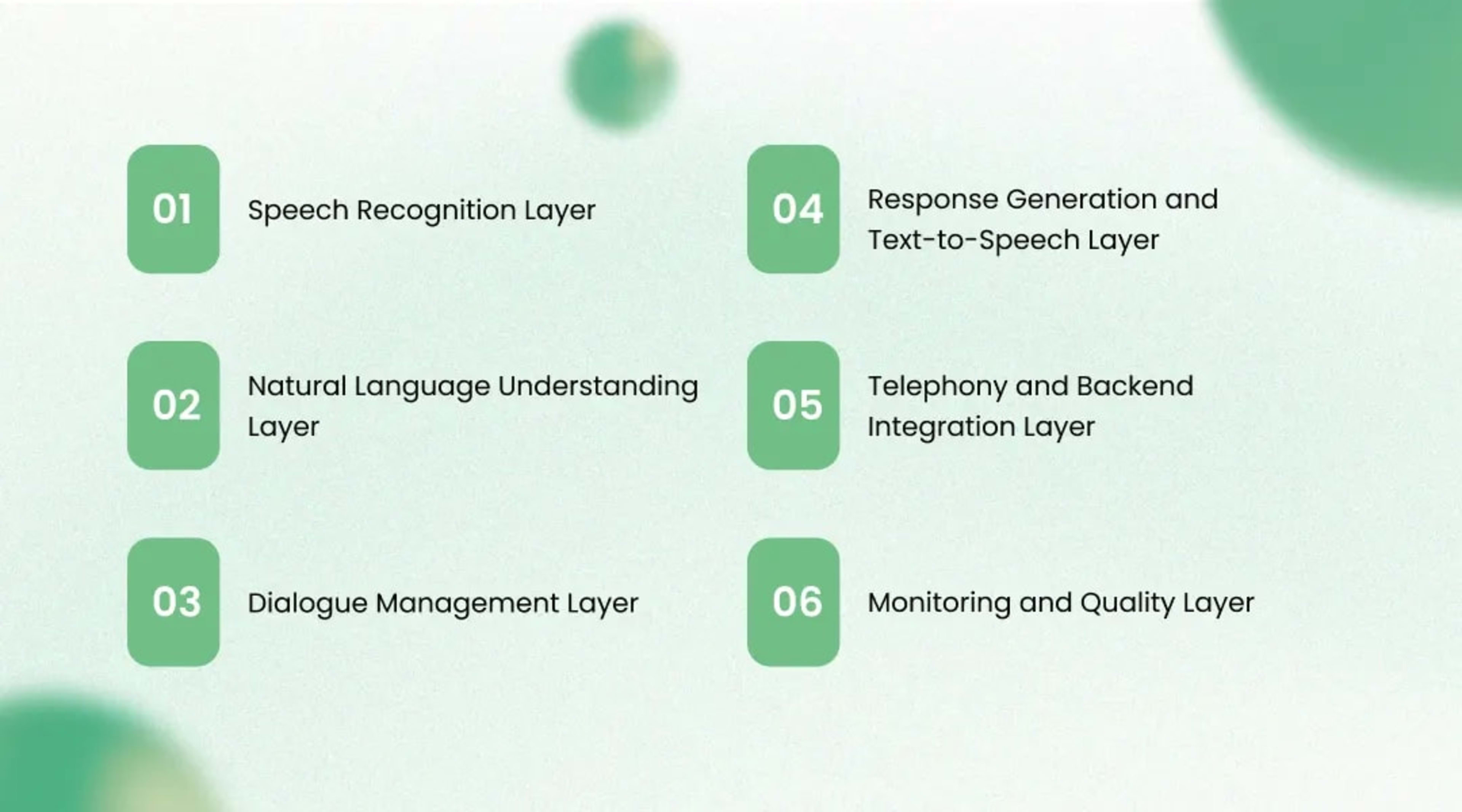
A production government voice agent is a pipeline of specialised layers, each with its own engineering tradeoffs. The architecture below reflects how these systems are actually built for high-concurrency, multilingual, compliance-bound environments. Each layer earns its place because a weakness there breaks citizen trust.
Government audio is difficult audio. Callers use low-cost handsets, speak from noisy streets and markets, and code-switch mid-sentence between a regional language and English. The ASR layer has to stay accurate under exactly these conditions.
We favour streaming ASR because citizens will not tolerate long silences. The practical choices are a Conformer-based streaming model or an RNN-T architecture, both of which emit partial transcripts token by token as the caller speaks. A streaming CTC model is cheaper but weaker on the long, unstructured utterances typical of grievance calls.
Whisper variants are strong for offline transcription and post-call analytics, but standard Whisper is batch-oriented and adds unacceptable latency for live turns. For live recognition, we deploy domain-adapted streaming models fine-tuned on Indian-accented speech and scheme-specific vocabulary. This domain adaptation alone can lift intent-critical word accuracy by 8 to 15 percent over a generic model.
Government intents are numerous but bounded, which shapes the NLU design. A pure fine-tuned classifier such as a distilled BERT or RoBERTa model is fast and cheap for the high-frequency intents that dominate call volume. It struggles, however, with the long tail of unusual phrasings that citizens actually produce.
The robust pattern is a hybrid NLU stack. A lightweight fine-tuned classifier handles the top intents at very low latency, while an LLM-based zero-shot classifier catches the ambiguous and rare cases. Entity extraction and slot filling pull structured values such as application numbers, dates, and pincodes so the backend can act. Enterprise-grade Natural Language Processing (NLP) services enable accurate intent detection, entity extraction, and multilingual understanding across government citizen interactions.
This hybrid approach matters for cost at government scale. Routing 80 percent of turns through a small classifier and only 20 percent through an LLM cuts inference spend dramatically without sacrificing coverage. It also keeps median latency low while preserving accuracy on the hard cases.
Dialogue design is where most government bots fail. A rigid finite state machine is predictable and auditable but collapses the moment a citizen answers out of order or asks two things at once. A fully generative LLM is flexible but risks hallucinating entitlements, which is unacceptable for a public authority.
The correct architecture for citizen service automation is a frame-based dialogue manager augmented with a retrieval-grounded LLM. The frame enforces the mandatory steps for a regulated process, such as identity verification before disclosing case details. The retrieval layer grounds every factual answer in official policy documents rather than model memory.
This design gives controllability where it is legally required and flexibility where it improves the citizen experience. Clarification and escalation logic sit on top, so the agent asks a targeted follow-up question rather than guessing. When confidence drops below a set threshold, the agent hands off cleanly to a human.
Factual grounding is non-negotiable in government responses. Every answer about eligibility, deadlines, or documents is generated through retrieval-augmented generation over a curated, versioned policy corpus. A generated answer that cannot cite a source is suppressed rather than spoken.
The TTS layer decides whether the agent sounds like a trustworthy public service. Neural TTS systems based on VITS-style architectures or comparable proprietary models produce natural prosody across Indian languages. Streaming TTS is essential because synthesising audio in small chunks lets the agent begin speaking within a few hundred milliseconds instead of after a full sentence.
The persona design deserves deliberate attention for a government voice. The voice should be calm, clear, and neutral, and it should read numbers, dates, and reference codes slowly and correctly. A well-tuned pipeline keeps total end-to-end response latency under 800 milliseconds, which is the threshold where conversation feels natural rather than robotic.
Government voice agents live on the public telephone network, so telephony integration is core, not peripheral. The system connects through SIP trunks to the PSTN, with RTP carrying the media stream and WebRTC available for app and web channels. Platform integration typically runs through Twilio, Vonage, Amazon Connect, or an on-premise Genesys or Asterisk stack when data residency demands it.
Backend integration is what turns a talking bot into a service. The agent performs real-time lookups against departmental databases and case management systems during the call. It authenticates the citizen through OTP or knowledge-based verification before disclosing any personal case data.
A public deployment must be observable to be defensible. The quality layer tracks intent recognition accuracy, containment rate, escalation rate, and per-language performance in real time. Full call transcripts and recordings feed a post-call analytics pipeline for audit, dispute resolution, and continuous model improvement. Continuous optimization depends on robust data science services that analyze call transcripts, citizen intent trends, and language-specific performance metrics.
Language is the single hardest requirement in Indian government voice AI. A national or state scheme must serve citizens who speak Hindi, Bengali, Tamil, Telugu, Marathi, Gujarati, and many more, often within the same helpline. Multilingual voice agents for public services have to detect, understand, and respond in the caller's language without ever asking them to switch.
The engineering answer combines automatic language identification with per-language ASR and TTS models. The agent detects the spoken language within the first utterance and pins the session to that language pipeline. Multilingual voice agents for public services also have to handle code-switching, where a citizen mixes English words into a regional-language sentence, which is the norm rather than the exception.
Dialect and accent robustness is a separate challenge from language coverage. A Tamil speaker from Chennai and one from Madurai differ acoustically, and the model must serve both. This is why domain-adapted, regionally fine-tuned ASR outperforms any generic multilingual model on real government traffic.
At KriraAI, we build these systems with India-specific language coverage as a first-class requirement, not a bolt-on translation layer. Our voice agents are engineered so a citizen who speaks only their mother tongue receives the same quality of service as an English-speaking caller. That equity of access is often the entire point of the public deployment.
Can AI voice agents be trusted with sensitive citizen data? Yes, but only when compliance is designed into the architecture rather than layered on afterward. Government voice AI in India operates under the Digital Personal Data Protection Act 2023 and the TRAI DLT framework for telecom communication, and both shape the build directly. Organizations planning nationwide deployments should also understand the architectural and compliance considerations covered in our guide on AI Calling Agent India: Architecture, Compliance, Outcomes.
Data governance starts with minimisation and purpose limitation. The agent collects only the data a specific transaction requires, and it discloses personal case details only after successful verification. Consent for recording and processing is captured at the start of the call in the citizen's own language.
Security architecture for a public deployment includes several mandatory controls. The following components are standard for a government-grade system:
End-to-end encryption of media in transit and encryption of all stored recordings and transcripts at rest.
Data residency inside Indian infrastructure, achieved through on-premise or sovereign-cloud deployment where policy requires it.
Role-based access control with full audit logging of every human who reads a transcript or recording.
Configurable retention windows so records are purged in line with departmental and DPDP retention rules.
Explainability is the compliance requirement most teams underestimate. Every automated response must be traceable to a policy source, and every escalation must be logged with its reason. This audit trail is what lets an agency defend an automated interaction if a citizen later disputes it.
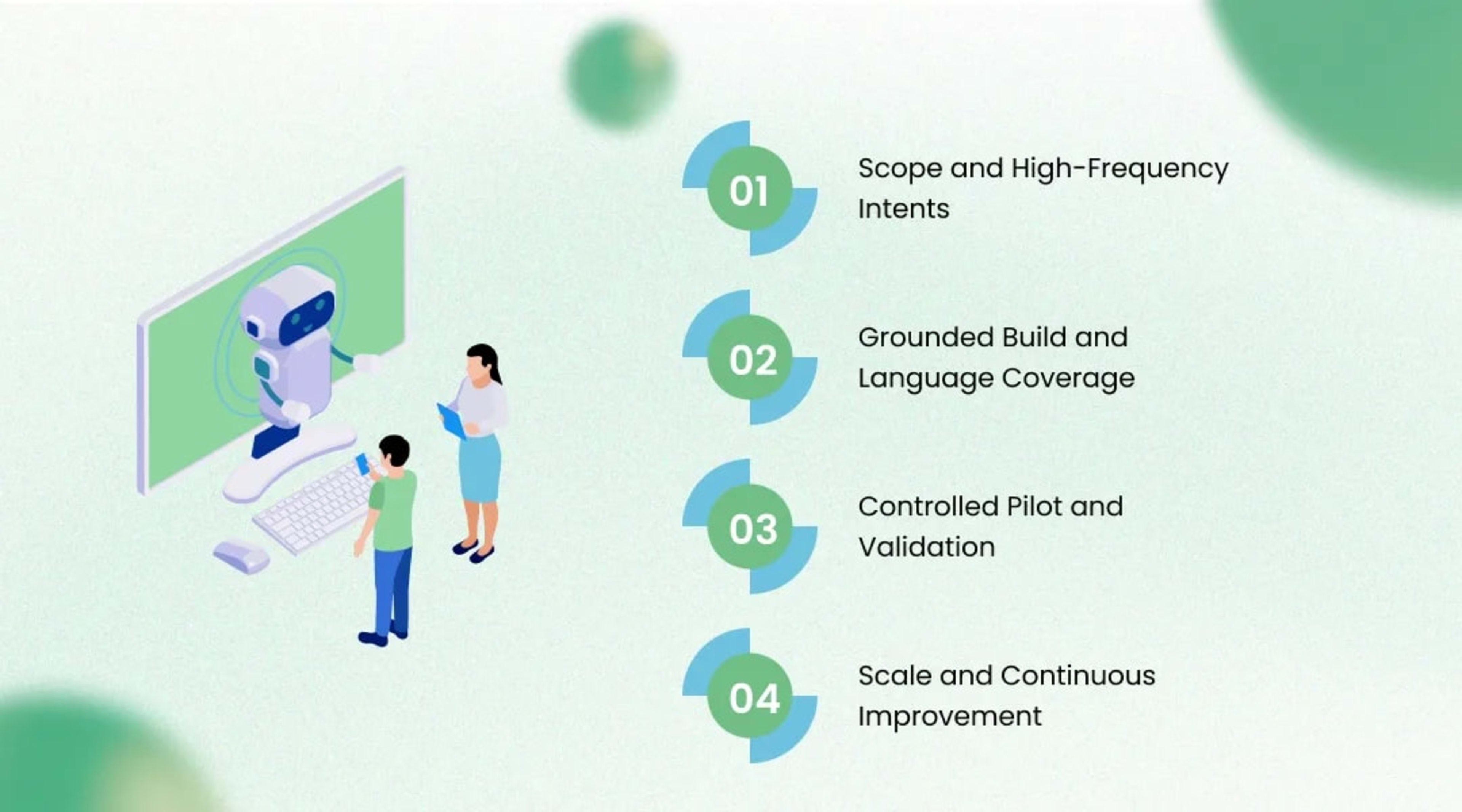
Deploying voice AI in government agencies is a phased engineering program, not a single launch. Rushing a full rollout across every intent and every language is the most common way these projects fail publicly. A disciplined sequence protects both citizens and the agency's reputation.
Start by mining historical call data to identify the intents that dominate volume. On most helplines, the top ten intents cover 70 to 80 percent of all calls. Automating these first delivers the largest relief for the least risk.
Build the retrieval corpus from official, versioned policy documents so every answer is defensible. Deploy the two or three highest-demand languages first, then expand coverage as accuracy is validated. Design the escalation path to human agents before launch, not after.
Run a limited pilot on a fraction of live traffic with human oversight on every escalation. Track containment, accuracy, and citizen satisfaction against clear thresholds. Deploying voice AI in government agencies safely means expanding only when the numbers hold in production, not in a demo.
Once validated, scale concurrency and add intents and languages iteratively. Feed misrecognitions and escalations back into model retraining on a regular cadence. A mature deployment improves monthly because its own call data becomes its training signal. The same multilingual deployment framework is increasingly adopted across education AI solutions for university admissions and student support services.
The choice between AI voice agents vs IVR for government is not close on the metrics that matter. Traditional IVR forces citizens down predefined menu trees and cannot understand natural speech or intent. A conversational voice agent lets the citizen simply state their problem and routes or resolves it directly.
The performance gap is quantifiable. Where IVR-based helplines commonly see containment below 20 percent and heavy zero-out to human queues, a well-built voice agent can contain 60 to 75 percent of high-frequency queries end to end. When comparing AI voice agents vs IVR for government, the containment difference alone reshapes the entire staffing model.
There is a transition consideration worth stating honestly. IVR is cheap to run and fully deterministic, which appeals to risk-averse procurement. A voice agent costs more per minute but resolves far more calls per rupee spent, because it actually answers questions instead of routing them.
Return on a government deployment is measured in both money and access. On the cost side, human-answered government calls in India typically cost between 15 and 40 rupees each once staffing, infrastructure, and overhead are counted. A voice agent handles the same high-frequency query for a fraction of that once concurrency is high.
The larger return is service reach that human staffing can never fund. A voice agent runs 24 hours a day across all seven days and answers every simultaneous caller during a peak event. Citizen service automation converts an abandoned call, which is a failed public service, into a resolved one.
The metrics that justify continued investment are specific and should be tracked from day one:
Containment rate, the share of calls fully resolved without human transfer, targeting 60 percent or higher on covered intents.
Average wait time, which should fall to near zero because the agent has effectively unlimited concurrency.
Cost per resolved query, compared honestly against the fully loaded cost of the previous human or IVR channel.
Per-language service parity, ensuring regional-language callers are resolved at rates comparable to the majority language.
A realistic payback horizon for a well-scoped deployment is six to twelve months on a high-volume helpline. The investment concentrates in the build and integration phase, after which per-call cost drops sharply with volume. This is why citizen service automation favours the highest-traffic lines first.
Most government voice AI failures are predictable and preventable. The first is scoping the bot too broadly, trying to automate every rare intent instead of the high-frequency majority. The fix is disciplined scoping driven by real call data.
The second failure is weak escalation design. A citizen trapped in a loop with a bot that cannot help and will not transfer generates more anger than IVR ever did. Every uncertain turn must have a clean, fast path to a human, and that path must be tested under load.
The third failure is neglecting the long tail of languages and accents. A system that serves the majority language well but fails regional callers violates the equity mandate that justified the project. Continuous monitoring of per-language accuracy catches this before citizens do.
Three points define whether AI voice agents for government succeed. First, they must be engineered around the hardest citizen to serve, which means multilingual coverage and accent robustness are core requirements, not features. Second, compliance, security, and explainability have to be designed into the architecture from the first line, because a public authority must defend every automated interaction. Third, disciplined scoping toward high-frequency intents is what turns the deployment into measurable relief rather than a public embarrassment.
The gap between a demo and a helpline that stays up during a strike is pure engineering. That gap is where KriraAI works, designing and deploying production-grade AI voice agent systems that hold their latency, accuracy, and language coverage under real government load. We bring the ASR, dialogue, telephony, and compliance depth that public sector citizen service automation actually demands, backed by delivery experience across high-concurrency, multilingual environments.
If your agency is evaluating voice automation for a helpline or citizen service, the KriraAI team is ready to discuss your specific requirements, constraints, and rollout path. The right question is not whether voice AI can serve citizens, but how well it can serve the citizen who needs it most, in the language they speak, at the moment they call.
Government voice agents protect citizen data by minimising collection, encrypting recordings in transit and at rest, and disclosing personal details only after identity verification. In India, they operate under the DPDP Act 2023 and TRAI DLT rules, with data residency and full audit logging built into the architecture.
Yes, multilingual voice agents for public services detect the caller's language within the first utterance and respond using per-language speech recognition and text-to-speech models. Well-built systems also handle code-switching, where citizens mix English into a regional-language sentence, which is common across Indian helplines.
Voice agents automate high-frequency, structured intents such as application status checks, document requirements, scheme eligibility, office timings, and complaint registration. These repetitive queries usually make up 70 to 80 percent of call volume, which lets scarce human staff focus on complex, sensitive, or disputed cases.
Voice AI can cut per-call cost substantially because human government calls in India cost roughly 15 to 40 rupees each, while an agent handles high-frequency queries for a fraction of that at scale. Containment rates of 60 to 75 percent shrink human queue volume and reduce staffing pressure during peaks.
Yes, when security is architected in from the start rather than added later. Government-grade deployments use encryption, role-based access control, data residency inside Indian infrastructure, configurable retention, and explainable responses grounded in official policy sources, which together create the audit trail agencies need to defend automated interactions.
Ridham Chovatiya is the COO at KriraAI, driving operational excellence and scalable AI solutions. He specialises in building high-performance teams and delivering impactful, customer-centric technology strategies.