AI Calling Agent India: Architecture, Compliance, Outcomes
Indian enterprises now place over 2.5 billion outbound business calls every month. These span BFSI collections, EdTech admissions, logistics delivery exception handling, insurance renewals, and ecommerce verification flows. A meaningful share of these calls fail within the first ten seconds. Customers hang up when they cannot get a Hindi or regional language agent. Others disengage when the script feels rigid and slow.
A 200 seat Tier 2 call center now costs between 1.8 and 2.4 crore rupees per year. Attrition rates above 45 percent push hidden retraining costs higher. Customer expectations have moved sharply toward instant language matching and round the clock availability.
This is exactly where AI calling agent India deployments have moved from curiosity into operational infrastructure. The technology has crossed the production threshold for sub second response latency. It handles Hinglish code switching reliably and supports TRAI DLT compliant outbound calling at scale. This blog examines what an AI calling agent in India actually is in production. It covers the full architecture, the regulatory constraints, the high impact use cases, and the realistic economics that decide whether deployment is worth it.
What an AI Calling Agent Means in the Indian Market
An AI calling agent is a fully automated voice system that conducts business phone conversations with humans. It listens to natural speech in real time and understands caller intent. It pulls relevant context from backend systems during the call. It responds with a natural sounding voice and appropriate Indian persona. The agent operates over the standard PSTN telephony and VoIP infrastructure used by Indian businesses.
In the Indian context this definition carries specific weight. The agent must handle Hindi, English, and regional languages within a single conversation. It must respect TRAI scrubbing windows and DLT registered templates for outbound calls. It must obtain valid consent under the DPDP Act 2023 when capturing personal data. These are not optional design choices. They define whether a deployment can legally and operationally function in India at scale.
How an AI Calling Agent Differs From an IVR
An IVR system is a menu tree. The customer presses 1 for English or 2 for Hindi, then navigates through prompts until they reach a static response or get routed to a human. An AI calling agent is conversational. It asks open ended questions, understands free form answers, follows up with clarifying questions, and pulls live information from CRM and order systems mid call. The shift from IVR to AI calling agent is not an incremental upgrade. It is a different category of system entirely.
Inbound Versus Outbound AI Calling Agents
Inbound AI calling agents pick up incoming calls and serve customers who initiated contact. Typical inbound use cases in India include order tracking, balance inquiries, ticket booking, claim status, and lead qualification. Outbound AI calling agents place calls to a target list. Outbound use cases include collections, EMI reminders, insurance renewals, admissions counseling, and delivery confirmation. Outbound deployments carry stricter regulatory weight in India because of TRAI rules on unsolicited commercial communication.
The Production Architecture of an AI Calling Agent for India
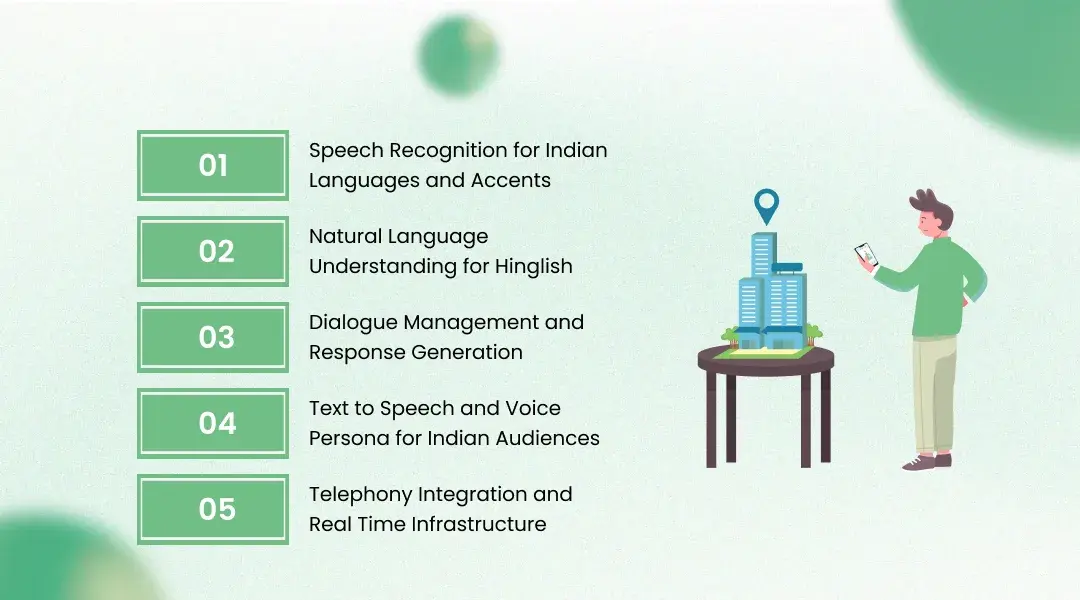
A production AI calling agent for the Indian market is a six layer real time pipeline. Each layer carries strict latency budgets to keep round trip response time below 800 milliseconds. Anything slower feels unnatural in conversation. The total end to end latency in a well engineered Indian deployment sits between 450 and 700 milliseconds. KriraAI builds these pipelines with explicit latency budgets allocated per stage and instrumentation at every hop.
The complete production stack includes these layers:
Speech recognition tuned for Indian telephony audio and code switched language input.
Natural language understanding that extracts intent and entities from Hinglish and regional language utterances.
Dialogue management that controls turn taking, state tracking, and policy decisions.
Response generation that produces grounded contextual replies within tight latency budgets.
Text to speech rendering that delivers natural sounding Indian voice personas.
Telephony and backend integration that connects the agent to phone networks and enterprise systems.
Speech Recognition for Indian Languages and Accents
The ASR layer transcribes caller speech into text in real time. Indian deployments must handle 22 official languages and multiple regional accents. They must also handle frequent code switching within a single utterance. Standard Whisper large v3 performs reasonably on Hindi and major regional languages. It often struggles with the narrow band audio typical of telephony calls. Production systems combine fine tuned Whisper variants with AI4Bharat IndicConformer or proprietary streaming ASR models.
The choice between transducer based ASR and streaming CTC architectures depends on the latency budget. Transducer architectures offer better accuracy on code switched audio. They carry slightly higher first token latency than streaming CTC variants. KriraAI typically deploys hybrid ASR stacks tuned per language pair and acoustic environment. Domain adaptation on customer specific call recordings lifts word error rate by 18 to 30 percent compared to off the shelf models.
Natural Language Understanding for Hinglish
The NLU layer extracts intent, entities, and dialogue state from transcribed text. Indian voice traffic creates unique NLU challenges. A loan recovery call might shift between Hindi, English, and Marathi in three turns. The same customer may say bees hazaar rupay in Hindi and twenty thousand rupees in English. A fine tuned multilingual BERT or RoBERTa classifier handles frequent intents with low latency. For unstructured agentic dialogue, a large language model based NLU is more flexible.
Production Indian deployments often blend approaches. Frequent intents like balance check, EMI status, or order tracking go through a fast classifier. Open ended utterances fall through to an LLM reasoning step. This hybrid keeps median NLU latency under 80 milliseconds. It also preserves full conversational flexibility for edge cases.
Dialogue Management and Response Generation
The dialogue manager controls turn taking, state tracking, and policy decisions across the conversation. Indian deployments rarely use pure finite state machines because the conversation paths are too varied. A frame based dialogue manager combined with an LLM policy works well for transactional flows like collections or appointment booking. For more open conversations, a retrieval augmented LLM with strict grounding constraints performs better.
Response generation must complete in under 200 milliseconds for natural turn taking. This rules out large frontier models that take seconds to respond. Production Indian systems often use distilled 7 to 13 billion parameter models hosted on dedicated GPU infrastructure. KriraAI tunes these models on domain specific call transcripts to control hallucination and enforce script compliance for regulated verticals like BFSI and insurance.
Text to Speech and Voice Persona for Indian Audiences
The TTS layer converts the generated response into natural sounding speech. Indian deployments need voices that sound culturally familiar to callers. A North Indian customer responds differently to a heavy South Indian accent and vice versa. Most production systems use neural TTS models like VITS, YourTTS, or proprietary streaming TTS engines. AI4Bharat Indic TTS covers many regional languages with reasonable naturalness for first generation deployments.
Streaming TTS is essential for low latency operation. The first audio chunk should reach the caller within 150 to 200 milliseconds of the LLM response starting. Voice persona design is a strategic decision. A 28 year old female voice in clear Hindi often outperforms male voices for collections in BFSI. The opposite is sometimes true for outbound sales in real estate and B2B service categories.
Telephony Integration and Real Time Infrastructure
Telephony integration determines whether the AI calling agent can actually reach Indian phone numbers reliably. Production deployments connect through SIP trunks to providers like Exotel, Knowlarity, Ozonetel, Plivo, or Twilio India. WebRTC is used for app embedded scenarios and web initiated calls. RTP carries the actual voice payload between caller and agent in real time.
Concurrency planning is critical for Indian outbound campaigns. A BFSI collections deployment may need 500 to 2000 concurrent voice sessions during peak windows. Each session consumes GPU bound TTS and LLM capacity. The infrastructure must scale horizontally without breaking conversation state. AI voice agent architecture decisions taken at this layer determine whether the system survives a Monday morning campaign launch.
Indian Regulatory Reality: TRAI DLT and DPDP Act 2023
Outbound AI calling agent India deployments operate within a strict regulatory frame. The Telecom Regulatory Authority of India mandates that all commercial outbound voice messages flow through a DLT registered template. Every business must register as a sender, register each header, and submit each content template for approval. DLT uses distributed ledger technology to block unauthorized commercial communications and enforce customer preferences.
The DPDP Act 2023 governs how personal data is collected and processed during these calls. Voice recordings, transcripts, and any extracted personal data fall under the act. Explicit consent must be captured at the beginning of the call. Customers must be told the call is being recorded and processed. They must be given a way to opt out and withdraw consent later.
There are several operational implications for AI calling agent design. The conversation script must include a recorded consent prompt as the first turn. Data retention windows must be configurable per use case. Call recordings should be encrypted at rest with key management aligned to DPDP requirements. Cross border data transfer rules apply if the LLM or storage sits outside India.
Tier 1 enterprises increasingly require India hosted inference for the entire pipeline. This includes ASR, NLU, LLM, and TTS components. KriraAI architects voice deployments with India region inference, encrypted at rest storage, and DPDP aligned consent capture as defaults rather than retrofits.
Solving the Hinglish and Multilingual Challenge
Hinglish is not Hindi mixed with English. It is a distinct conversational mode with its own grammar patterns and word order. A typical Hinglish utterance might be mujhe apna current balance check karna hai. The first words are Hindi, the middle words switch to English, and the last word returns to Hindi. ASR and NLU systems trained on pure Hindi or pure English data fail on this consistently.
Production Hinglish handling requires three engineering choices. First, the ASR model must be trained on Hinglish telephony audio, not just clean studio recordings. Second, the NLU layer must accept code switched inputs without forced language detection at the utterance level. Third, the TTS engine must pronounce English loan words correctly within Hindi sentence flow without sounding mechanical.
Regional language support extends this challenge further. A logistics delivery call in Bengaluru may need Kannada, Tamil, Hindi, and English handling in the same campaign list. Production systems detect caller language from the first three to four seconds of audio. They switch the active language model dynamically. The TTS voice persona is matched per detected language.
Accent diversity within each language adds another dimension. Punjabi accented Hindi sounds different from Bihari Hindi or Mumbai Hindi. All must be transcribed accurately. Fine tuning ASR on regional accent samples lifts word level accuracy on hard accents by 12 to 18 percent in production deployments.
High Impact Use Cases for AI Calling Agents Across Indian Industries
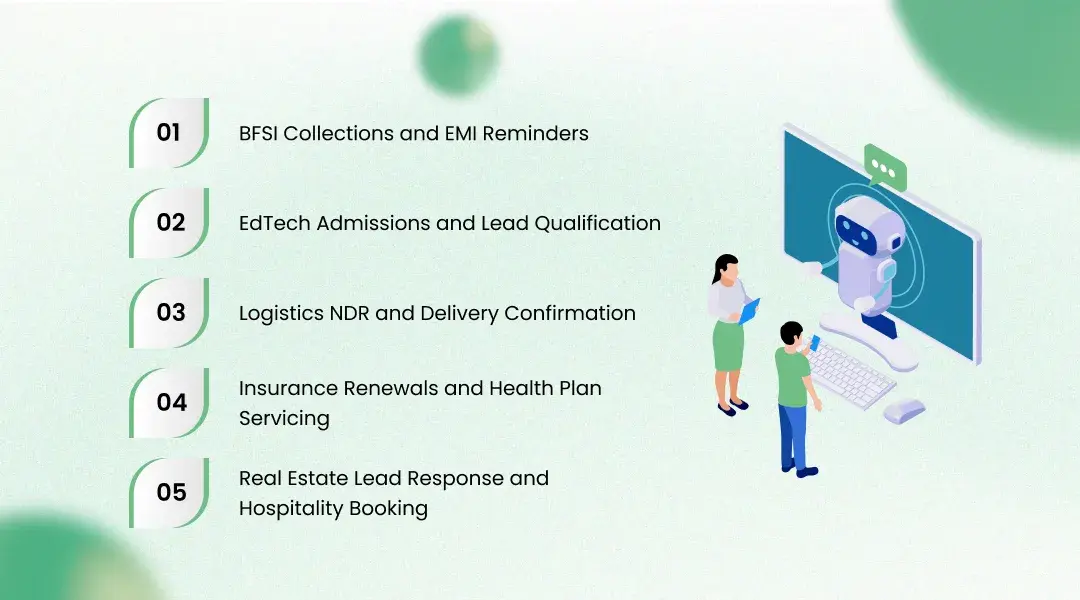
AI calling agent deployments in India concentrate in specific high volume operational workflows. The common pattern is repetitive structured conversations with measurable business outcomes. The following use cases consistently show strong ROI within 90 to 180 days of deployment.
BFSI Collections and EMI Reminders
Loan collection in India runs on outbound calling at massive scale. A mid size NBFC may make 8 to 15 lakh outbound calls per month for early stage collections. AI calling agents handle pre due reminders, post due collections up to bucket one, payment promise capture, and payment link delivery. They escalate to human agents only for complex hardship cases. Typical contact rate improvement is 30 to 45 percent over traditional auto dialers.
EdTech Admissions and Lead Qualification
EdTech companies in India process millions of inbound and outbound calls for admissions counseling every month. AI calling agents qualify leads, schedule counselor appointments, send course brochures via SMS during the call, and re engage cold leads. Conversion to qualified counselor meeting improves substantially. The cost per qualified lead drops by 50 to 65 percent versus human only operations.
Logistics NDR and Delivery Confirmation
Non Delivery Reports and Return To Origin rates cost Indian ecommerce companies hundreds of crores per year. An AI calling agent confirms delivery address, captures rescheduling preferences, and offers alternative time slots. It reaches consignees in their preferred language across Tier 2 and Tier 3 geographies. Production deployments cut RTO rates by 18 to 25 percent in cash on delivery heavy categories.
Insurance Renewals and Health Plan Servicing
Insurance renewals in India are repetitive, time bound, and high volume. AI calling agents handle premium reminders, policy detail confirmation, and renewal payment flows. They book human agent callbacks for complex queries that require licensed advice. Renewal pickup improves by 22 to 35 percent in well tuned deployments compared to traditional renewal call centers.
Real Estate Lead Response and Hospitality Booking
Real estate inbound leads decay rapidly in value. A lead called within five minutes converts six to seven times higher than a lead called after one hour. AI calling agents handle instant inbound response, qualification, and site visit booking around the clock. Hospitality groups use similar deployments for reservation confirmation, pre arrival upsell, and loyalty program activation calls.
Economics of an AI Calling Agent in India
The cost economics of AI calling agent India deployments are favorable but require honest accounting. A trained human agent in a Tier 2 city costs around 28,000 to 42,000 rupees per month including infrastructure and overheads. Each agent handles roughly 80 to 120 outbound calls per day at sustainable quality. The fully loaded cost per minute lands between 5.5 and 8 rupees for human calling.
AI calling agent operational costs typically sit between 3 and 9 rupees per minute. This includes ASR, LLM inference, TTS, telephony, and platform overhead. The variation depends on call length, language complexity, and concurrency profile. Outbound calls usually run cheaper than inbound due to shorter average duration and simpler intent distribution.
The headline savings often look like 40 to 60 percent on a per minute basis. The real economics include three other factors that often matter more. First, AI calling agents operate around the clock without shift premiums or attrition costs. Second, they scale to ten times normal volume during campaign peaks without hiring lead times. Third, conversation quality is consistent and measurable across every call.
Total cost of ownership requires careful modeling beyond per minute rates. Initial implementation costs in India range from 8 lakh to 1.2 crore rupees depending on use case scope and integration depth. Ongoing maintenance and model retraining add 12 to 20 percent annually. Payback periods of 4 to 9 months are typical for high volume use cases when AI calling agent cost is measured against fully loaded human operations.
AI Calling Agent Implementation Roadmap and Common Pitfalls
A successful AI calling agent implementation in India follows a disciplined phased rollout. Jumping straight to full production deployment is the single most common cause of failure. The recommended sequence has four phases that have proven repeatable across verticals.
The four phase rollout looks like this:
Discovery and call audit lasting two to three weeks of analyzing 500 to 2000 recorded calls from current operations to produce a use case prioritization, language mix analysis, and intent taxonomy.
Pilot deployment spanning six to ten weeks of building the agent for one focused use case with limited language coverage and running against 5 to 10 percent of live traffic in shadow mode.
Scaled rollout over eight to twelve weeks of expansion to full traffic, additional languages, and adjacent use cases including load testing, failover validation, and human escalation tuning.
Continuous optimization with weekly review of conversation quality, intent recognition accuracy, and escalation rates plus model retraining cycles every 30 to 60 days based on new call patterns.
Three pitfalls consistently appear in failed Indian deployments. First, teams underestimate the data labeling effort required for Hinglish ASR fine tuning. Plan for 200 to 500 hours of human labeled call audio per major language to reach production accuracy. Second, teams skip human escalation design and frustrate customers with rigid agent loops on edge cases. Third, teams treat the agent as a one time build rather than an evolving system that needs ongoing tuning.
AI calling agent vs human agents comparisons that ignore these factors produce misleading ROI projections that fall apart in production.
FAQs
An AI calling agent in India is an automated voice system that conducts business phone conversations end to end without human intervention. It handles Hindi, English, and regional languages, understands intent in real time, retrieves data from CRM systems during the call, and responds with natural sounding voice over standard telephony. Production deployments operate at sub 700 millisecond response latency for natural conversation flow.
Yes, AI calling agents are legal in India when deployed within the TRAI DLT framework for commercial communications and the DPDP Act 2023 for personal data processing. Outbound calls require DLT registered headers and approved content templates. Calls must capture recorded consent at the start when personal data is processed. Data retention and India region hosting requirements apply for full compliance.
AI calling agent operational costs in India typically range from 3 to 9 rupees per minute including ASR, LLM, TTS, and telephony charges. Implementation costs range from 8 lakh to 1.2 crore rupees depending on use case complexity, language coverage, and integration scope. Payback periods of 4 to 9 months are common for high volume operations like collections, renewals, and delivery confirmation.
Modern AI calling agents handle Hindi, English, and major regional languages including Tamil, Telugu, Marathi, Bengali, Gujarati, Kannada, Punjabi, and Malayalam. Hinglish code switching within a single utterance is fully supported by production systems trained on Indian telephony audio. Language detection runs in the first three to four seconds of the call and switches active models dynamically per caller.
BFSI collections, EdTech admissions, logistics non delivery resolution, insurance renewals, real estate lead response, hospitality, and ecommerce verification consistently show the strongest returns from AI calling agent deployment in India. These use cases share high call volume, repetitive structured conversations, and direct revenue or cost outcomes that allow clean measurement of agent impact within the first 90 to 180 days of going live.
Three takeaways shape successful AI calling agent India deployments. First, the architecture must be engineered for Indian language reality including Hinglish code switching, regional accent diversity, and sub 700 millisecond response latency. Second, regulatory compliance under TRAI DLT and DPDP Act 2023 is a design input, not a post deployment afterthought. Third, the economics work best when use case selection focuses on high volume structured workflows with clear measurable outcomes. KriraAI designs and deploys production grade AI voice agent systems for Indian enterprises across BFSI, EdTech, logistics, insurance, real estate, and ecommerce. Our engineering team brings deep expertise in multilingual ASR, Hinglish NLU, low latency LLM serving, neural TTS for Indian voices, and India compliant infrastructure. We deliver voice automation that performs reliably at the concurrency, language complexity, and regulatory weight that real Indian operations demand. If you are evaluating an AI calling agent for your Indian operations, talk to the KriraAI team about your specific use case, current call volumes, and language mix. A focused discovery conversation will surface the architecture, economics, and rollout plan that fit your business and put you on a credible path to deployment.
Founder & CEO
Divyang Mandani is the CEO of KriraAI, driving innovative AI and IT solutions with a focus on transformative technology, ethical AI, and impactful digital strategies for businesses worldwide.