Every year, online retailers watch roughly $4.6 trillion worth of merchandise get added to shopping carts and then quietly abandoned before checkout. That figure, compiled across global e-commerce research, represents the single largest source of recoverable revenue in online retail. The average cart abandonment rate across industries hovers near 70%, meaning that for every ten shoppers who express clear buying intent by adding products to their cart, seven leave without completing the purchase. For a mid-sized e-commerce store generating $2 million in annual revenue, that translates to nearly $4.7 million in lost potential sales sitting just beyond the checkout button.
Most online retailers have tried the standard recovery playbook. They send automated emails, trigger push notifications, and deploy retargeting ads across social media and display networks. These methods work to a degree, but they share a critical limitation: they are passive, easily ignored, and increasingly filtered out by consumers who receive dozens of promotional messages daily. Email open rates for cart recovery campaigns typically range between 40% and 45%, but click-through rates drop to roughly 10%, and actual conversion from those clicks falls further still. The result is a recovery rate that rarely exceeds 5% to 10% of abandoned carts, leaving the vast majority of that lost revenue permanently on the table.
What most e-commerce businesses have not yet explored is the channel that consistently produces the highest engagement and conversion rates in sales contexts: the human voice. Not a robocall, not a pre-recorded message, but an intelligent, conversational voice interaction that reaches the customer within minutes of abandonment, understands why they hesitated, addresses their concern in real time, and guides them back to checkout. AI voice agents now make this possible at scale, without requiring a single human agent to pick up the phone. This blog examines exactly how AI voice agents recover abandoned cart revenue, why they outperform every other recovery channel, what the implementation looks like for e-commerce businesses of different sizes, and what results you can realistically expect when you deploy this approach.
Cart abandonment is not a minor operational inconvenience. It is the largest single source of revenue leakage in online retail, and its scale is growing as consumer expectations rise and attention spans compress. Understanding exactly why carts get abandoned, and why traditional recovery methods fail to recapture most of that revenue, is essential before evaluating any new solution.
The reasons behind cart abandonment are well documented but poorly addressed by most recovery strategies. Research from the Baymard Institute, which has tracked checkout usability for over a decade, consistently identifies the same core drivers. Unexpected shipping costs account for roughly 48% of abandonments, making it the single most common reason. A complicated or lengthy checkout process causes about 22% of shoppers to leave. Concerns about payment security stop approximately 18% of potential buyers. Requirements to create an account before purchasing drive away about 26% of first-time visitors. And a significant portion of shoppers, estimated at 30% to 40%, are simply comparison shopping or saving items for later with no immediate intent to buy.
What makes this problem particularly frustrating for e-commerce operators is that the majority of these abandonment reasons are addressable in a real conversation. A shopper who left because of unexpected shipping costs might complete the purchase if offered free shipping or a small discount. A shopper concerned about payment security might convert after hearing a brief explanation of the store's security certifications and return policy. A shopper who was comparison shopping might return if contacted promptly with a compelling reason to choose your store over a competitor. The problem is not that these objections are unresolvable. The problem is that emails and push notifications are structurally incapable of handling real-time objection resolution.
Email remains the default cart recovery tool for most e-commerce businesses, and it does produce measurable results. A well-optimized three-email recovery sequence, sent at intervals of one hour, 24 hours, and 72 hours after abandonment, can recover between 5% and 10% of abandoned carts. SMS recovery campaigns perform slightly better in terms of open rates, often exceeding 90%, but conversion rates from SMS still plateau around 10% to 15% because the interaction is one-directional. The shopper reads the message, but there is no mechanism to address their specific hesitation in the moment.
The fundamental limitation of text-based recovery channels is that they cannot listen. They cannot ask the shopper what went wrong. They cannot adapt their message based on the shopper's response. They cannot handle the nuanced, real-time conversation that turns a hesitant browser into a confirmed buyer. This is precisely the gap that AI voice agents fill, and it is why voice-based cart recovery consistently outperforms every text-based alternative by a significant margin.
AI voice agents for abandoned cart recovery work by initiating an intelligent outbound phone call to the shopper shortly after they leave the checkout flow. Unlike robocalls or pre-recorded messages, modern AI voice agents conduct natural, two-way conversations that adapt in real time based on what the shopper says. The technology has matured to the point where most callers cannot distinguish between an AI voice agent and a well-trained human sales representative, particularly when the agent is built on a platform like OnDial that delivers sub-500 millisecond response latency, eliminating the awkward pauses that previously made AI calls feel robotic.
A typical AI voice agent cart recovery interaction follows a structured but flexible conversation flow. The agent identifies itself, references the specific items the shopper left in their cart, and asks whether they are still interested in completing the purchase. Based on the shopper's response, the agent branches into the appropriate path. If the shopper mentions price concerns, the agent can offer a pre-approved discount or free shipping incentive. If the shopper expresses uncertainty about product fit, the agent can provide additional product details, sizing guidance, or review summaries. If the shopper mentions a technical issue at checkout, the agent can offer to send a direct checkout link or assist with an alternative payment method. If the shopper indicates they are no longer interested, the agent gracefully ends the call and tags the lead accordingly for future marketing segmentation.
This entire interaction happens without human intervention. The AI agent handles the call from greeting to resolution, updates the CRM or e-commerce backend with the outcome, and triggers the appropriate follow-up action, whether that is sending a checkout link, applying a discount code, or scheduling a callback for a higher-value purchase that requires more consideration.
One of the most critical factors in cart recovery is speed. Research on lead response times in sales contexts shows that contacting a prospect within five minutes of their expressed interest produces conversion rates up to 400% higher than waiting 30 minutes. The same principle applies to cart abandonment. A shopper who left your site three minutes ago still has your products in mind, still has their payment method accessible, and is far more receptive to a recovery conversation than the same shopper 24 hours later when they have moved on to other priorities.
AI voice agents make this immediate response operationally feasible. A human call centre cannot staff enough agents to call every cart abandoner within five minutes, especially during peak shopping periods when abandonment volumes spike. OnDial's AI voice agents can initiate hundreds of simultaneous outbound calls within minutes of cart abandonment events firing from the e-commerce platform. This speed advantage alone accounts for a substantial portion of the performance gap between AI voice recovery and email recovery, which typically waits at least one hour before sending the first message.
E-commerce businesses evaluating AI voice agents for cart recovery need concrete numbers, not vague promises of improvement. The economics of voice-based recovery are compelling when examined in detail, and they scale favorably compared to both email-only recovery and human agent recovery.
AI voice agents typically recover between 15% and 25% of abandoned carts when deployed with proper timing and conversation design, compared to 5% to 10% for email sequences and 10% to 15% for SMS campaigns. The higher recovery rate stems directly from the interactive nature of voice. When a shopper can voice their objection and receive an immediate, relevant response, the friction that caused the abandonment often dissolves within the first 30 seconds of the call.
To put this in revenue terms, consider a mid-sized e-commerce business processing 10,000 orders per month with an average order value of $85 and a cart abandonment rate of 70%. That business sees approximately 23,300 abandoned carts monthly, representing roughly $1.98 million in unrealised revenue. An email recovery campaign converting at 7% would recover about 1,631 carts worth $138,635. An AI voice agent campaign converting at 20% would recover about 4,660 carts worth $396,100. The incremental revenue from switching to AI voice recovery in this scenario is approximately $257,000 per month, or over $3 million annually, from a solution that costs a fraction of what a human outbound calling team would require.
The cost efficiency of AI voice agents becomes even more apparent when compared to human agents performing the same function. A trained outbound sales agent handling cart recovery calls typically manages 40 to 60 calls per shift, factoring in dialling time, conversation time, after-call work, and breaks. At a fully loaded cost of $3,500 to $5,000 per month per agent in North America, or $800 to $1,200 per agent in offshore locations, the cost per recovery attempt ranges from $2.50 to $5.00 for domestic agents and $0.80 to $1.50 for offshore teams. AI voice agents reduce this cost to between $0.10 and $0.50 per call attempt, depending on call duration and platform pricing. OnDial's pricing structure makes this particularly accessible for small and mid-sized e-commerce businesses that cannot justify the overhead of a dedicated outbound calling team but stand to recover significant revenue from abandoned carts.
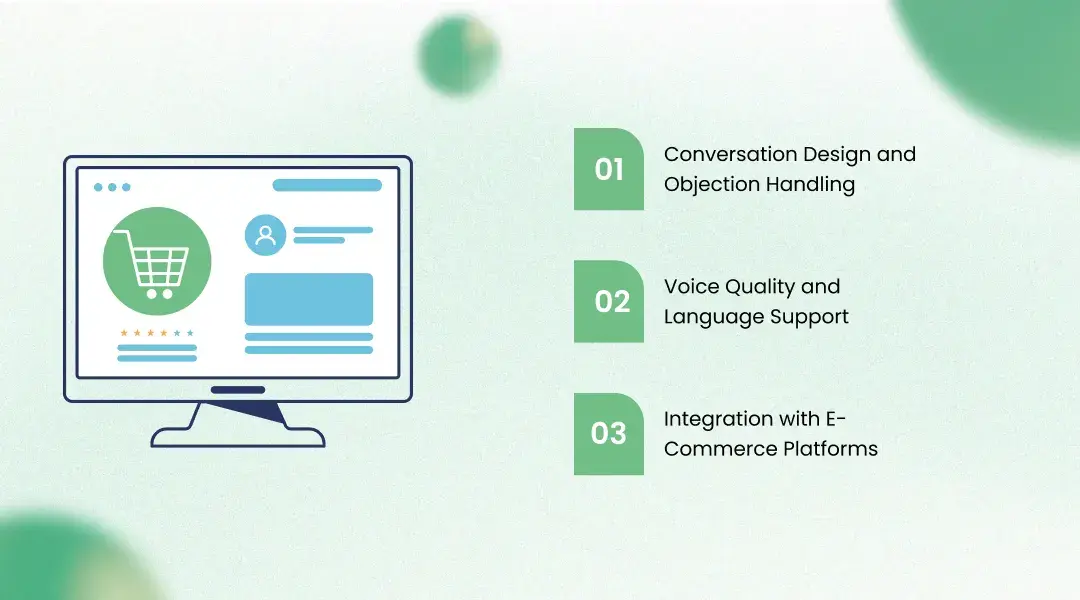
Not all AI voice agents are equally effective at recovering abandoned carts. The quality of the recovery conversation depends on several technical and design factors that separate a productive AI agent from one that annoys customers and damages brand perception.
The most important factor in AI cart recovery performance is the quality of conversation design. An effective recovery agent must handle at least six to eight common objection categories naturally and persuasively. These include price sensitivity, shipping cost concerns, product uncertainty, payment security worries, comparison shopping behaviour, technical checkout issues, timing concerns, and general disinterest. Each objection path must lead to a specific resolution strategy, whether that is applying a discount, offering additional information, providing social proof, or gracefully ending the call and scheduling a follow-up.
OnDial's platform enables e-commerce businesses to design these conversation flows using both pre-built templates and custom logic, with the AI agent adapting its responses based on real-time sentiment analysis of the caller's tone and language. This sentiment-aware approach means the agent can detect frustration, hesitation, or enthusiasm and adjust its approach accordingly, a capability that transforms recovery calls from scripted interactions into genuinely persuasive conversations.
Voice quality directly impacts trust, and trust directly impacts conversion. If the AI agent sounds robotic, uses unnatural pacing, or struggles with common words and phrases, the shopper will disengage within seconds. Modern AI voice platforms have largely solved the naturalness problem, but quality varies significantly across providers, especially when handling regional accents and multiple languages.
For e-commerce businesses serving the Indian market, language support is not optional. India's e-commerce sector is growing rapidly in tier two and tier three cities where consumers prefer conducting transactions in their native language. An AI voice agent that can only operate in English misses a massive segment of potential cart recoveries. OnDial supports over 100 languages including 9 Indian languages with more than 80 Indian voice variations, making it possible to deploy cart recovery agents that speak to shoppers in Hindi, Tamil, Telugu, Kannada, Bengali, Marathi, Gujarati, Malayalam, or Punjabi with natural fluency. This multilingual capability is especially valuable for e-commerce platforms selling across India, where a single store might serve customers spanning five or six language preferences.
An AI cart recovery agent is only as effective as its integration with the e-commerce backend. The agent needs real-time access to cart data, product information, customer purchase history, available promotions, and inventory status to conduct an informed recovery conversation. It also needs the ability to trigger actions such as sending checkout links, applying discount codes, and updating order status directly within the e-commerce platform.
OnDial provides both API-based and no-code deployment options, enabling integration with major e-commerce platforms without requiring extensive development resources. The API integration allows custom-built e-commerce systems to push cart abandonment events directly to OnDial's calling engine, while the no-code option provides pre-built connectors for platforms that support webhook-based triggers. This flexibility means that a Shopify store with no in-house development team and an enterprise retailer with a custom-built commerce stack can both deploy AI cart recovery within days rather than months.
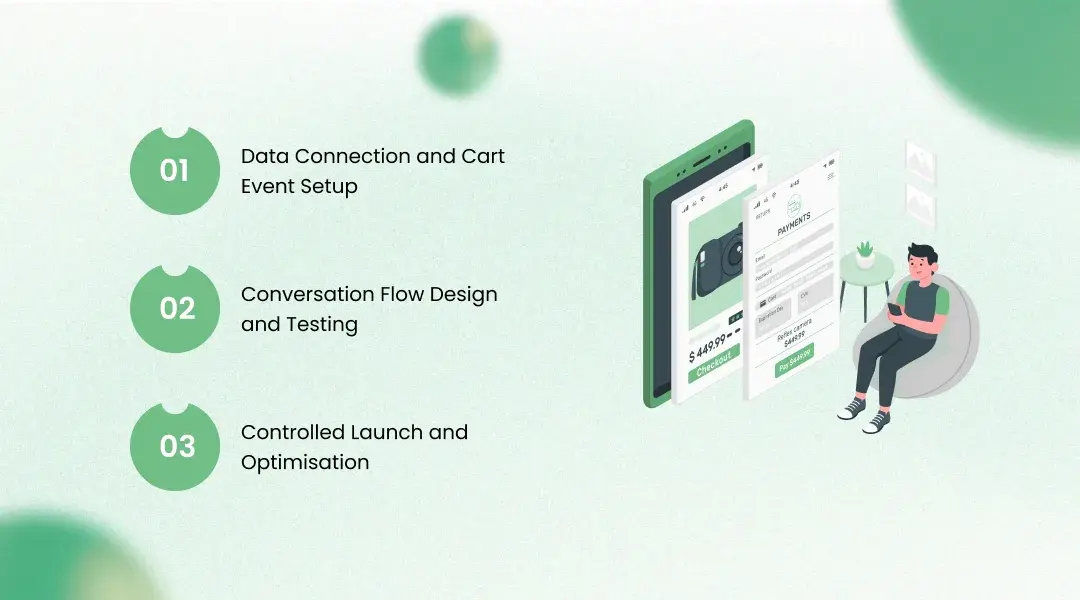
Deploying AI voice agents for cart abandonment recovery is not a complex, multi-quarter IT project. For most e-commerce businesses, the implementation follows a straightforward path from initial setup to full-scale operation within two to four weeks.
The first step involves connecting your e-commerce platform's cart abandonment events to the AI voice agent platform. This typically requires configuring a webhook that fires when a cart is abandoned after a defined period of inactivity, usually 15 to 30 minutes. The webhook sends the relevant data, including the customer's name, phone number, cart contents, cart value, and any applicable promotions, to the AI calling platform. Most e-commerce platforms, including Shopify, WooCommerce, Magento, and custom-built systems, support webhook configuration either natively or through existing plugins.
With the data connection established, the next step is designing the recovery conversation. This involves mapping the primary objection categories for your specific product vertical and customer base, scripting the agent's responses for each scenario, configuring discount and incentive thresholds, and setting the call timing rules. OnDial's platform provides conversation design tools that allow non-technical users to build and test these flows without writing code, while also offering API-level customisation for businesses that want deeper control over the agent's behaviour.
Testing should include at least 50 to 100 test calls across different objection scenarios, different times of day, and different customer segments before moving to live deployment. This testing phase typically takes one to two weeks and is essential for identifying conversation gaps and optimising the agent's persuasion strategies.
The recommended approach for initial deployment is a controlled launch targeting 10% to 20% of abandoned carts for the first week. This allows the team to monitor call outcomes, listen to recorded conversations, review sentiment analysis data, and identify any issues with the conversation flow or integration. OnDial's smart analytics dashboard provides real-time visibility into recovery rates, average call duration, objection frequency, and customer sentiment scores, enabling rapid optimisation of the agent's performance.
After the controlled launch validates performance, scaling to full deployment is simply a matter of increasing the percentage of abandoned carts routed to the AI agent. The platform handles scaling automatically, with the ability to manage thousands of simultaneous outbound calls without any degradation in voice quality or response latency.
While general e-commerce cart recovery is the most common application, AI voice agents for abandoned transaction recovery extend across multiple verticals within the broader online commerce ecosystem.
Subscription e-commerce businesses use AI voice agents to recover customers who begin the subscription signup process but abandon before entering payment details. The agent can address common subscription hesitations such as commitment concerns, pricing questions, and cancellation policy clarity. Travel and tourism e-commerce platforms deploy AI voice agents to recover abandoned booking inquiries, where a shopper searched for flights or hotels, reached the booking page, and left without completing the reservation. Given that travel purchases involve higher consideration and higher average transaction values, the ROI per recovered booking is substantial.
Food delivery and grocery e-commerce businesses use AI recovery calls to recapture abandoned orders, particularly during peak meal times when a timely call can recover a purchase that the customer still needs. In the education technology space, platforms selling online courses or certification programmes use AI voice agents to follow up with prospects who added a course to their cart but did not enroll, addressing questions about course content, career outcomes, and payment plans through a natural voice conversation.
Financial services e-commerce, including insurance comparison sites and lending platforms, represents another high-value application. When a customer begins a loan application or insurance quote and abandons partway through, an AI voice agent can call to address concerns about documentation requirements, interest rates, or coverage details, recovering applications that represent significant lifetime customer value.
Cart abandonment represents the single largest recoverable revenue opportunity in e-commerce, and the businesses that capture even a fraction of that lost revenue gain a significant competitive advantage. The three most important insights from this analysis are clear. First, voice-based recovery outperforms email and SMS by a factor of two to five because it enables real-time objection handling that text channels cannot replicate. Second, timing is the critical variable, and AI voice agents are the only scalable way to reach every cart abandoner within the optimal 5 to 30 minute recovery window. Third, the economics favour AI voice agents decisively, with cost per recovery attempt running 80% to 95% lower than human agents while delivering equal or superior conversion rates.
OnDial delivers precisely the capabilities that effective AI cart recovery demands: sub-500 millisecond response latency that eliminates robotic pauses, multilingual support that reaches every customer in their preferred language, seamless integration with e-commerce platforms through both API and no-code options, and smart analytics that enable continuous optimisation of recovery performance across every call. For e-commerce businesses ready to stop leaving millions in recoverable revenue on the table, the path forward is a conversation with OnDial. Schedule a demo to see how AI voice agents can transform your abandoned cart recovery rate and add a measurable new revenue stream to your business within weeks, not months.
The optimal timing for an AI voice agent to initiate a cart recovery call is between 5 and 30 minutes after the abandonment event. Calling within this window catches the shopper while they still have active purchase intent and can recall the specific items they were considering. Research on sales response timing consistently shows that contact within the first five minutes produces the highest conversion rates, but the practical sweet spot for cart recovery is typically 15 to 20 minutes, which allows enough time for the shopper to have genuinely abandoned rather than simply pausing during checkout. Calling too quickly, within one to two minutes, can feel intrusive and suggests surveillance. Calling too late, after several hours or the next day, produces results only marginally better than email. AI voice agent platforms like OnDial allow businesses to configure precise timing rules based on their customer behaviour data, including different timing for different cart values, product categories, or customer segments.
Customer reception of AI cart recovery calls depends entirely on execution quality. Poorly designed calls with robotic voices, aggressive scripts, or irrelevant offers do generate negative reactions and can damage brand perception. However, well-designed AI voice interactions that sound natural, reference the specific products the customer was considering, and offer genuine value such as addressing a concern or providing a relevant incentive are received positively by the majority of shoppers. Studies on consumer attitudes toward proactive customer service consistently show that 60% to 70% of consumers appreciate follow-up contact from brands they were actively shopping with, provided the contact is timely, relevant, and respectful. The key factors are voice quality, conversation naturalness, the ability to handle "not interested" gracefully, and compliance with calling regulations and consent requirements. OnDial's platform is built with GDPR and CCPA compliance as foundational requirements, ensuring that all recovery calls meet regulatory standards for consent and data handling.
E-commerce businesses deploying AI voice agents for cart recovery can realistically expect to recover between 15% and 25% of abandoned carts, depending on factors including product category, average order value, conversation design quality, call timing, and whether incentives such as discounts or free shipping are offered during the recovery call. This compares favourably to email recovery rates of 5% to 10% and SMS recovery rates of 10% to 15%. Higher-value carts tend to show higher recovery rates because customers who have invested more time in product selection are more receptive to a conversation that addresses their specific hesitation. The first month of deployment typically shows recovery rates at the lower end of this range as the conversation flows are optimised, with performance improving steadily as the AI agent's objection handling is refined based on real call data and sentiment analysis.
Yes, modern AI voice agent platforms support multilingual cart recovery, which is essential for e-commerce businesses serving diverse markets. The AI agent can detect the customer's preferred language based on their profile data, browser language settings, or previous interaction history, and conduct the entire recovery conversation in that language. This capability is particularly important for e-commerce businesses operating in multilingual markets such as India, where a single store might serve customers who prefer Hindi, Tamil, Bengali, Telugu, or English. OnDial supports over 100 languages and offers more than 80 Indian voice variations across 9 Indian languages, enabling e-commerce businesses to deploy recovery agents that communicate fluently in the customer's native language without maintaining separate agent teams for each language.
AI voice agents for abandoned cart recovery work most effectively as part of an orchestrated multi-channel recovery strategy rather than as a replacement for email and SMS. The recommended approach is to position the AI voice call as the first recovery touchpoint, initiated within 15 to 30 minutes of abandonment, followed by email and SMS sequences for carts that the voice agent did not recover. This sequencing leverages the voice channel's higher conversion rate for the initial, highest-intent window while using email and SMS as lower-cost follow-up channels for shoppers who were unreachable by phone or who need more time to decide. The integration requires coordination between the AI voice platform and the e-commerce platform's marketing automation system, typically managed through shared cart status data that prevents a shopper from receiving a recovery email for a cart that was already recovered via a voice call. OnDial's API integration enables this orchestration by updating cart and customer status in real time as recovery calls are completed.
Ridham Chovatiya is the COO at KriraAI, driving operational excellence and scalable AI solutions. He specialises in building high-performance teams and delivering impactful, customer-centric technology strategies.