Organisations operating phone-based customer workflows are losing an estimated 15 to 20 percent of inbound calls to hold abandonment, and the average cost of a single human-handled call across industries sits between 6 and 12 US dollars. At the same time, caller expectations for immediate, accurate, and consistent responses have risen sharply. The gap between what traditional IVR systems deliver and what callers expect has never been wider, and it is precisely this gap that the modern AI voice agent is engineered to close.
An AI voice agent is a software system that conducts real-time, spoken conversations with humans over phone or VoIP channels, understands natural language intent, accesses backend data, and takes meaningful action, without human intervention. This is not an upgraded IVR. It is a fundamentally different system built on automatic speech recognition, large language model based understanding, neural text-to-speech, and deep backend integration.
This blog covers the complete technical architecture of a production AI voice agent, the key design decisions that separate reliable systems from fragile ones, the business use cases where voice agents deliver measurable ROI, the implementation journey organisations should expect, and the operational considerations that determine long-term performance. Whether you are evaluating vendors, planning a build, or benchmarking what good looks like, this guide gives you the engineering depth and business grounding to make that decision well.
A production AI voice agent is not a single model. It is a pipeline of specialised components, each with its own latency budget, accuracy requirements, and failure modes. Understanding each layer is essential for anyone building, buying, or evaluating a voice agent system.
Every voice agent conversation begins and ends at the telephony layer. This layer handles call routing, signalling, and the real-time audio stream that the rest of the pipeline depends on. In production deployments, this means SIP trunk integration for PSTN connectivity, WebRTC for browser or app-based voice, and platform-specific APIs for contact centre environments such as Amazon Connect, Genesys, Twilio, or Vonage.
The engineering challenge at this layer is audio quality and concurrency. Real-world telephony introduces codec compression, background noise, variable bitrates, and network jitter. Systems that perform well in lab conditions frequently degrade in production because the telephony layer was not treated as a first-class engineering concern. A well-architected voice agent buffers audio with adaptive jitter compensation, selects codecs that preserve speech intelligibility, typically G.711 or Opus depending on the channel, and scales to hundreds of concurrent sessions without latency spikes.
Automatic speech recognition is where audio becomes meaning. The architectural choice here has enormous consequences for downstream accuracy. Three dominant approaches exist in production AI voice agents:
Streaming CTC models process audio in real time with low latency, typically 100 to 200 milliseconds, making them suitable for conversational applications. OpenAI Whisper in streaming mode and Conformer-based CTC models such as those from NVIDIA NeMo are widely deployed.
RNN-T architectures deliver strong accuracy on conversational speech with competitive latency, and are the basis of many cloud ASR APIs including Google Speech-to-Text v2 and Amazon Transcribe Streaming.
Whisper large-v3 or domain-fine-tuned variants offer the best transcription accuracy, particularly for accented speech and domain-specific vocabulary, but require careful latency management when used in synchronous voice pipelines.
Domain adaptation matters enormously. A generic ASR model trained on broad speech corpora will transcribe "ibuprofen" as "I be pro fan" and "PAN Aadhaar" as unintelligible noise. Production voice agents operating in healthcare, banking, logistics, or any domain with specialised terminology must be fine-tuned or given a custom vocabulary layer. Word error rate on domain-specific vocabulary can improve from over 30 percent on a base model to under 5 percent on a properly adapted one.
Once the ASR layer produces a transcript, the NLU layer must extract what the caller actually wants. This involves intent classification, entity extraction, slot filling, and context tracking across multiple conversational turns.
The architectural choice here is between three approaches. A fine-tuned BERT or RoBERTa classifier gives high accuracy and low latency for a well-defined intent taxonomy, typically 10 to 50 intents, but degrades badly on out-of-distribution inputs. A zero-shot or few-shot LLM-based classifier using a model like GPT-4o or Claude handles novel phrasings and complex multi-intent utterances more gracefully but introduces higher latency. A hybrid approach, using a fine-tuned classifier as the primary path with an LLM as a fallback for low-confidence outputs, is the architecture KriraAI recommends for production deployments because it optimises both accuracy and latency across the full intent distribution.
Entity extraction for voice requires special handling. Callers do not spell out values the way typed inputs do. Date parsing, number normalisation, and fuzzy matching on entity values must all be handled before the extracted slot values are passed to downstream logic.
Dialogue management is the component that decides what the voice agent does next in a conversation. It holds conversational state, decides when to ask clarifying questions, manages multi-turn flows, and triggers escalation when the conversation exceeds the agent's confidence or authority.
Three dominant paradigms exist in production voice agents, and the right choice depends on the use case.
Finite state machine dialogue managers define all possible conversation paths explicitly. Every branch, every prompt, and every action is pre-authored. This gives extremely predictable behaviour and is appropriate for tightly scoped workflows such as appointment booking, payment processing, or account verification. The limitation is brittleness. A caller who deviates from the expected path, or who addresses two topics in a single utterance, can break the state machine in ways that are difficult to recover gracefully.
Frame-based dialogue managers, as used in systems like Rasa or older Alexa Skills Kit flows, track named slots across turns and advance the conversation toward slot completion. They handle more variation than pure FSMs but still struggle with open-domain conversation and complex multi-intent scenarios.
LLM-based dialogue managers use a large language model with a structured system prompt, tool call definitions, and conversation history to dynamically determine the next conversational action. This approach handles the full range of human conversational behaviour including topic switches, interruptions, and implicit corrections. The tradeoff is latency, cost, and the risk of hallucination if the LLM is not properly constrained with grounding logic and response validation.
Any production voice agent must handle conversations it cannot resolve. Escalation logic determines when to transfer to a human agent, when to offer a callback, and when to log an unresolved intent for review. Well-engineered escalation uses a combination of confidence thresholds from the NLU layer, sentiment signals from the audio stream, and explicit caller requests. Systems without proper escalation logic create the worst possible customer experience: a caller trapped in a loop with an agent that clearly does not understand them and will not let them speak to a human.
Text-to-speech is where the voice agent produces its spoken output. The engineering requirements for conversational TTS are fundamentally different from those for audiobook narration or podcast production. In conversation, a response delay of over 700 milliseconds is perceptible as unnatural. Over 1,200 milliseconds, it actively degrades caller experience and increases hang-up rates.
Modern neural TTS systems use flow-based or diffusion-based generative models to synthesise natural-sounding speech. VITS, Variational Inference with adversarial learning for end-to-end Text-to-Speech, produces highly natural speech in a single model pass and is deployable with synthesis latency under 200 milliseconds for short utterances when run on GPU infrastructure. YourTTS extends VITS with voice cloning capabilities, enabling organisations to deploy a branded voice without licensing a proprietary TTS platform.
Streaming TTS is essential for conversational applications. Rather than synthesising the full response before beginning playback, a streaming TTS system begins transmitting audio as soon as the first sentence is ready. This reduces perceived latency by 40 to 60 percent compared to batch synthesis for typical response lengths. Production voice agents from teams like KriraAI architect their TTS pipelines with streaming synthesis as a baseline requirement, not a nice-to-have, because the alternative consistently produces unacceptable conversational cadence.
The voice a caller hears is the most direct expression of the brand in a voice interaction. Voice persona design involves selecting or cloning a voice with appropriate prosody, speaking rate, and perceived warmth for the use case. A clinical scheduling agent requires a calm, measured, and reassuring voice. An outbound sales agent requires energy and natural variation in pitch. Getting this wrong is immediately noticed by callers and degrades trust in the system regardless of how accurate the underlying language understanding is.
The architecture above is not theoretical. It has been deployed across a wide range of business contexts, and the business outcomes across those contexts are well-documented.
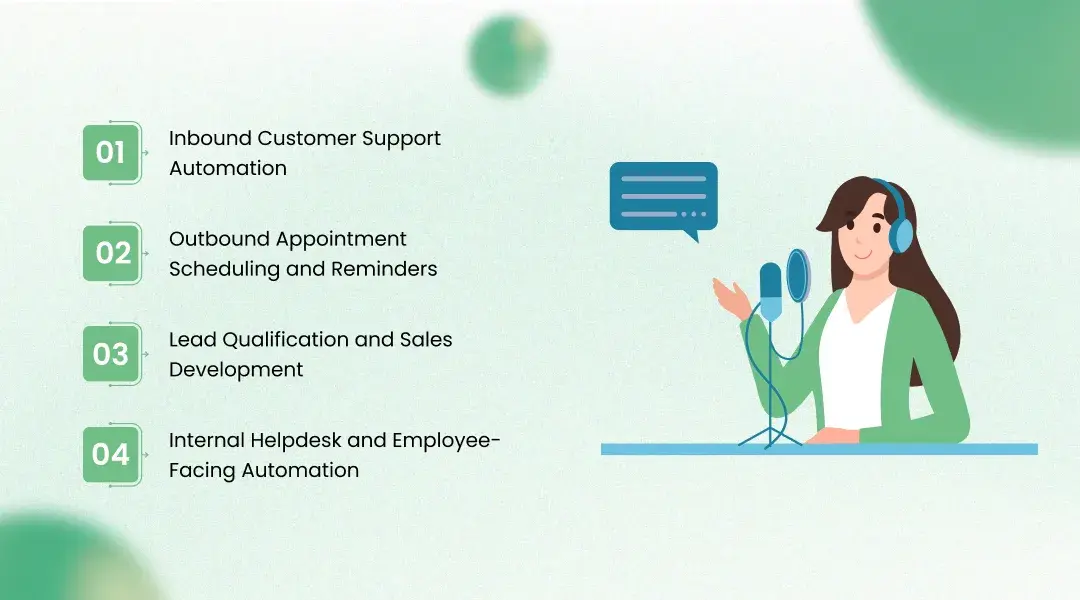
The most common and best-evidenced use case for AI voice agents is inbound customer support. A well-deployed voice agent can handle 60 to 80 percent of inbound call volume without human escalation on structured use cases such as account status enquiries, FAQ resolution, order tracking, and payment processing. The remaining 20 to 40 percent of calls that require human handling are escalated with full context transferred, reducing average handle time on escalated calls by 25 to 35 percent compared to cold-transferred IVR escalations.
AI voice agents are highly effective for outbound calling in high-volume, structured scenarios. Healthcare providers using voice agents for appointment reminders and rescheduling have reported no-show rate reductions of 20 to 35 percent. The economics are compelling: a human agent can make 40 to 60 outbound calls per hour, while a voice agent can run hundreds of concurrent outbound sessions at a marginal cost per call of under 0.05 US dollars at current API pricing.
Outbound AI voice agents are increasingly deployed to handle first-contact lead qualification in sales development workflows. The agent conducts a structured qualification conversation, captures key data points, scores the lead against predefined criteria, and either books a meeting or transfers to a human sales representative. Organisations using this model have reported reductions in cost per qualified lead of 40 to 60 percent compared to fully human-staffed SDR teams.
AI voice agents are not limited to customer-facing applications. Internal IT helpdesks, HR query handling, and field workforce support are strong use cases where the ROI is driven by reduced ticket volume and faster resolution time rather than customer satisfaction metrics. KriraAI has deployed internal-facing voice agents that resolve over 70 percent of tier-one IT helpdesk queries without human involvement, reducing support costs for enterprise clients while improving resolution times from hours to seconds.
Building a production voice agent is a multi-phase engineering and product process. Teams that treat it as a simple integration project consistently underestimate the work involved and deploy systems that fail in production within weeks.
Before any code is written, the conversation design must be complete. This means:
Defining the full intent taxonomy for the specific use case, typically 20 to 80 intents for a mid-complexity deployment.
Designing the dialogue flows for each intent including happy paths, clarification paths, and error recovery paths.
Defining the entity types the system must extract and the validation logic for each entity value.
Establishing escalation triggers and the human handoff protocol.
Writing sample utterances, at minimum 20 to 30 per intent, to train and evaluate the NLU component.
Skipping or rushing this phase is the single most common cause of production voice agent failures. Systems built on poorly designed conversation architecture cannot be fixed at the model layer.
With conversation design complete, the technical build begins with ASR domain adaptation and NLU model training. Domain-specific vocabulary is added to the ASR pronunciation dictionary. If the use case involves a language other than English or a regional accent population, the ASR model must be evaluated against representative audio samples before proceeding.
The NLU component is trained on the utterance library from Phase 1 and evaluated against a held-out test set. Intent classification accuracy should exceed 92 percent on the test set before the system proceeds to integration testing. Entity extraction accuracy on the entity types critical to the business workflow should exceed 95 percent.
Backend integrations are built and tested in this phase. Every database lookup, CRM write, and external API call the voice agent makes must be tested for latency and reliability under load. A voice agent that makes a CRM lookup mid-conversation cannot tolerate a 3-second API response time without breaking the conversational flow. Backend integration latency targets should be set at under 300 milliseconds for any synchronous call that occurs within a conversational turn.
End-to-end testing must include real telephony conditions, not just clean audio input. Testing against recorded calls from the production environment, including calls with background noise, accented speech, and callers who interrupt or speak over prompts, is essential before go-live.
A voice agent is not a static deployment. Post-launch, the system requires ongoing monitoring of intent recognition accuracy, escalation rate, average call duration, task completion rate, and caller satisfaction. KriraAI instruments every production voice agent deployment with a real-time quality dashboard that tracks these metrics at the conversation level, enabling rapid identification of dialogue failures and targeted improvement of the specific intents and flows that are underperforming.
The target operational profile for a mature production voice agent is an intent recognition accuracy above 90 percent, a task completion rate above 75 percent for fully automatable intents, and an escalation rate below 25 percent of total call volume. Systems that fall below these thresholds in sustained operation require a structured re-tuning process, not just model retraining.
The comparison between AI voice agents and traditional IVR is frequently framed incorrectly as a technology comparison. The real comparison is between two fundamentally different approaches to the same problem: resolving caller intent efficiently and accurately.
Traditional IVR systems use touch-tone or simple voice keyword recognition to route callers through a pre-defined menu tree. Caller intent must be expressed within the vocabulary of the menu options, and the system cannot handle anything outside those options. Caller abandonment rates for IVR systems average 30 to 40 percent, and first-call resolution rates rarely exceed 55 percent. These are not limitations that can be fixed by improving the IVR; they are structural properties of the menu-tree architecture.
An AI voice agent understands natural language intent expressed in any phrasing, handles multi-turn conversations to collect missing information, integrates with live backend data to provide personalised responses, and escalates intelligently when appropriate. First-call resolution rates for well-deployed AI voice agents on structured use cases consistently reach 75 to 85 percent. Average handle time for fully automated calls is 40 to 60 seconds compared to 3 to 8 minutes for human-handled calls. The cost differential, typically 0.03 to 0.08 US dollars per automated call versus 5 to 12 US dollars per human-handled call, makes the ROI case straightforward for any organisation handling more than a few thousand calls per month.
ROI calculation for AI voice agents must account for both the cost reduction side and the revenue impact side of the equation, as well as the total cost of ownership of the voice agent system itself.
On the cost reduction side, the primary metric is the containment rate: the percentage of calls handled fully by the voice agent without human escalation. A containment rate of 65 percent on a call centre handling 100,000 calls per month, at an average human handling cost of 8 US dollars per call, translates to monthly savings of 520,000 US dollars. Against a total cost of ownership for the voice agent system of 15,000 to 40,000 US dollars per month depending on call volume and deployment complexity, the payback period is typically three to five months from go-live.
On the revenue impact side, outbound voice agents reduce no-show rates, improve lead conversion, and extend the reach of revenue-generating workflows beyond what human teams can execute. These impacts are harder to model precisely before deployment but typically add 20 to 40 percent to the direct cost-saving ROI calculation when measured post-deployment.
The total cost of ownership must include the platform cost for ASR, NLU, and TTS APIs, the infrastructure cost for hosting the dialogue management and integration layer, the telephony costs for call minutes, and the ongoing engineering cost for monitoring and improvement. Teams that model only the API costs consistently underestimate total system cost by 40 to 60 percent.
Three takeaways stand above everything else in this guide. First, the AI voice agent is a multi-layer engineering system, and every layer, from telephony through ASR, NLU, dialogue management, TTS, and backend integration, must be designed and tuned for the specific use case or the system will fail in predictable and avoidable ways. Second, the business case for AI voice agents is well-evidenced and the ROI is typically realised within three to five months at any meaningful call volume, but only when the deployment is engineered properly, not when a generic product is dropped in front of real callers. Third, the gap between a voice agent that sounds impressive in a demo and one that delivers reliable performance across thousands of real calls is entirely a function of engineering depth, conversation design quality, and ongoing operational discipline.
KriraAI designs and deploys production-grade AI voice agent systems for enterprise clients across industries. Our team brings serious engineering depth to every layer of the voice AI stack, from ASR domain adaptation and NLU architecture to dialogue management design, TTS integration, telephony engineering, and post-launch monitoring. We do not build demo systems. We build voice agents that handle real call volumes, integrate with production backends, and improve measurably over time. If you are evaluating AI voice agents for your organisation or planning a deployment, we would welcome the opportunity to discuss your requirements and share what we have learned building these systems at scale.
An AI voice agent is a system that conducts real-time spoken conversations with humans over phone or VoIP channels, using automatic speech recognition to convert speech to text, natural language understanding to extract intent and entities, a dialogue manager to determine responses and actions, and neural text-to-speech to deliver spoken output. The fundamental difference from a text-based chatbot is the real-time audio processing requirement, which imposes strict latency constraints on every component in the pipeline. A chatbot can tolerate a 2-second response time without seriously degrading the user experience; an AI voice agent must produce a response and begin speaking within 700 to 1,000 milliseconds of the caller finishing their utterance, or the conversation begins to feel unnatural and callers disengage. The audio modality also introduces noise robustness, accent handling, and prosody design challenges that do not exist in text channels.
Intent recognition accuracy in a well-built and domain-tuned AI voice agent consistently reaches 90 to 95 percent on the intents the system was designed to handle. ASR word error rate on clean telephony audio with domain adaptation is typically 3 to 8 percent. The most common accuracy failures are not at the model level but at the design level: intents that are too similar in their utterance patterns, entity types that were not anticipated during design, and edge-case conversational flows that were not covered in training data. Accuracy can be maintained and improved post-deployment through structured analysis of misclassified conversations and targeted retraining, but only if the system has been instrumented to capture and review those cases. Raw model capability is necessary but not sufficient for high production accuracy.
The total cost to build and deploy a production AI voice agent ranges from 25,000 US dollars for a narrowly scoped single-use-case system built on a voice agent platform to over 300,000 US dollars for a custom-built, multi-intent, multi-channel system with deep backend integrations. Platform-based deployments using services like Twilio Voice, Amazon Lex, or specialised voice agent platforms reduce build time and initial cost but carry ongoing per-minute or per-call charges that can become significant at scale. Custom-built systems have higher upfront costs but lower ongoing marginal costs. The ongoing operational cost in production, including ASR and TTS API costs, telephony costs, and infrastructure, typically ranges from 0.03 to 0.10 US dollars per call minute depending on call volume and architecture choices.
A focused, well-scoped AI voice agent for a single use case with two to three backend integrations typically takes eight to fourteen weeks from project kick-off to production go-live when the conversation design, data collection, and integration work proceed in parallel. The largest variable is conversation design and utterance data collection, which cannot be rushed without sacrificing accuracy. Projects that attempt to compress the timeline by skipping thorough testing consistently spend more time post-launch fixing issues than they saved in the build phase. Complex deployments with ten or more intents, multiple backend systems, and multi-language support should budget sixteen to twenty-four weeks for a reliable production launch. Ongoing improvement and expansion of the system's capabilities is a continuous process that typically requires one to two days of engineering effort per week in the first six months after launch.
The most common reason AI voice agent deployments fail in production is not a failure of the underlying AI technology but a failure of conversation design and scope management. Teams that attempt to automate too broad a set of call types in the initial deployment end up with a system that handles nothing reliably. Teams that skip thorough testing against real telephony audio from the target caller population deploy systems that break immediately on the accents, noise conditions, and conversational patterns of actual users. Teams that fail to design and implement proper escalation logic create experiences that trap callers in unresolvable loops, generating complaints that can take months to overcome. A production AI voice agent requires the same engineering discipline, testing rigour, and post-launch monitoring investment as any other critical customer-facing system. Treating it as a quick integration project is the reliable path to a failed deployment.
Founder & CEO
Divyang Mandani is the CEO of KriraAI, driving innovative AI and IT solutions with a focus on transformative technology, ethical AI, and impactful digital strategies for businesses worldwide.