Only 11.9 percent of businesses with between ten and forty-nine employees used AI in 2024, compared to 40 percent of firms with more than 250 employees. In the sports and fitness industry, that gap does not merely represent a missed efficiency opportunity. It represents a growing chasm between the studios and gyms that are quietly automating their member experience and the ones still running on spreadsheets, group text chains, and manual follow-up calls.
If you own or manage a fitness studio, boutique gym, personal training facility, or sports academy with somewhere between ten and fifty staff members, this blog was written specifically for you. Not for a solo trainer trying to book three more clients a week. Not for a regional fitness chain with a dedicated IT department and a seven-figure technology budget. For the owner of the thirty-member staff gym who is genuinely good at running fitness operations but is feeling the pressure from competitors who seem to be everywhere, always responding, always retaining members, always filling classes.
The uncomfortable truth is that AI adoption in the fitness industry is no longer a future consideration for your size of business. Studios in your market are already using AI tools for small fitness businesses to automate the exact workflows that are currently consuming your staff's time and draining your retention numbers. This blog will show you what those tools are, what they cost at your scale, what measurable returns they produce, and how to implement them without disrupting the human community that makes your business worth coming back to.
Running a fitness business at this size occupies a uniquely difficult position in the industry. You are far beyond the solo operator who can hold every member relationship in their head. But you are nowhere near the scale of a regional chain that can absorb inefficiency across hundreds of locations and thousands of recurring memberships.
Your team is typically structured around a mix of full-time and part-time instructors, one or two front-desk coordinators, possibly a studio manager, and perhaps a part-time marketing or social media coordinator. Total headcount anywhere from ten to fifty people means that the same person booking your intro classes on Monday is probably also chasing unpaid memberships on Thursday and scheduling Instagram posts on Saturday morning. Role overlap is not a temporary growing pain at this size. It is a permanent operational reality.
Your technology stack is probably patchwork. Most small fitness businesses at this scale have invested in a gym management platform such as Mindbody, Zen Planner, PushPress, or Gymdesk. On top of that, you likely have a separate email tool, a separate social scheduling tool, and possibly a manual CRM or just a spreadsheet for lead follow-up. Each system generates data. Almost none of them talk to each other in a meaningful way that produces actionable insight without someone manually pulling reports.
Your budget pressures are real and specific. Instructor wages, rent or lease costs, equipment maintenance, and insurance consume the majority of your revenue. The fitness industry typically operates on net margins of eight to fifteen percent for studios of this size. That means a thirty-thousand-dollar per month gross revenue studio might clear three thousand to four thousand dollars in profit after all expenses. There is not a six-figure line item available for AI transformation. But there is absolutely room for targeted AI tools that cost two hundred to eight hundred dollars per month and demonstrably reduce churn, fill classes, and recover lapsed members.
Your decision-making speed is one of your genuine competitive advantages. Unlike a large chain where technology adoption requires board sign-off, procurement processes, and IT security reviews, you can evaluate and deploy a new AI tool in a matter of weeks. This speed of adoption is something larger competitors cannot match, and it is one of the primary reasons AI investments at your scale have the potential to generate disproportionate returns.
The pressure you feel that larger and smaller operators do not share is a specific kind of squeeze. You are large enough that personal relationships can no longer substitute for proper member engagement systems. But you are small enough that any member churn hits your monthly revenue immediately and personally. Losing thirty members in a single quarter can be the difference between a comfortable month and a payroll conversation.
When business media covers AI transformation, it almost exclusively covers what Fortune 500 companies are doing. The result is that small fitness business owners often assume that AI is either trivially easy (just use ChatGPT for emails) or impossibly complex and expensive (machine learning engineers, proprietary datasets, multi-year implementation timelines). Both assumptions are wrong for your segment, and both lead to bad decisions.
A large fitness enterprise such as Planet Fitness or Equinox approaches AI adoption with dedicated data science teams, custom model training on millions of member records, and the ability to absorb eighteen months of implementation before seeing a return. Their AI projects typically cost six to seven figures and require integration with legacy systems built on enterprise infrastructure that took years to establish. The complexity is genuine. The investment is warranted at their scale because the return operates across millions of members.
A solo personal trainer at the other end of the spectrum can genuinely get meaningful value from a fifty-dollar-per-month AI writing assistant that helps them create weekly training content and automate a few client reminder messages. The complexity is low. The expectation should be appropriately modest.
Your business lives between these two realities, and that middle position actually puts you in the best possible position for AI adoption in 2025 and 2026. Here is why. The AI tools specifically designed for small fitness businesses have matured significantly over the past two years. Platforms built for your segment now offer AI-driven member churn prediction, automated re-engagement campaigns, intelligent class scheduling, and AI-assisted lead nurturing. These are not simplified versions of enterprise tools. They are purpose-built for businesses with your member volume, your team size, and your budget.
The budget reality for AI adoption at your scale is far more accessible than most owners realise. Meaningful AI functionality for a ten to fifty person fitness business typically sits in the range of two hundred to nine hundred dollars per month across one to three tools. That is less than the cost of a single part-time front-desk hire and substantially less than the revenue cost of losing five members per month to churn that AI could have predicted and prevented.
The internal skill requirement is also dramatically lower than enterprise AI demands. You do not need a data scientist. You do not need to train a custom model. You need a staff member who can configure workflows within a platform, interpret a dashboard, and adjust messaging templates. Most gym management platforms with built-in AI or AI integrations are designed for fitness operators, not technologists. The learning curve for a motivated front-desk coordinator or studio manager is measured in days, not months.
The timeline to see meaningful returns is also compressed at your scale. A small fitness business implementing an AI-powered churn prevention tool can typically see measurable impact on its monthly member loss rate within sixty to ninety days of proper configuration. An enterprise deploying AI across multiple business units might wait twelve to eighteen months for statistically meaningful performance data. Your smaller, more responsive member base means that when AI-driven changes in communication or scheduling take effect, the results show up in your metrics quickly.
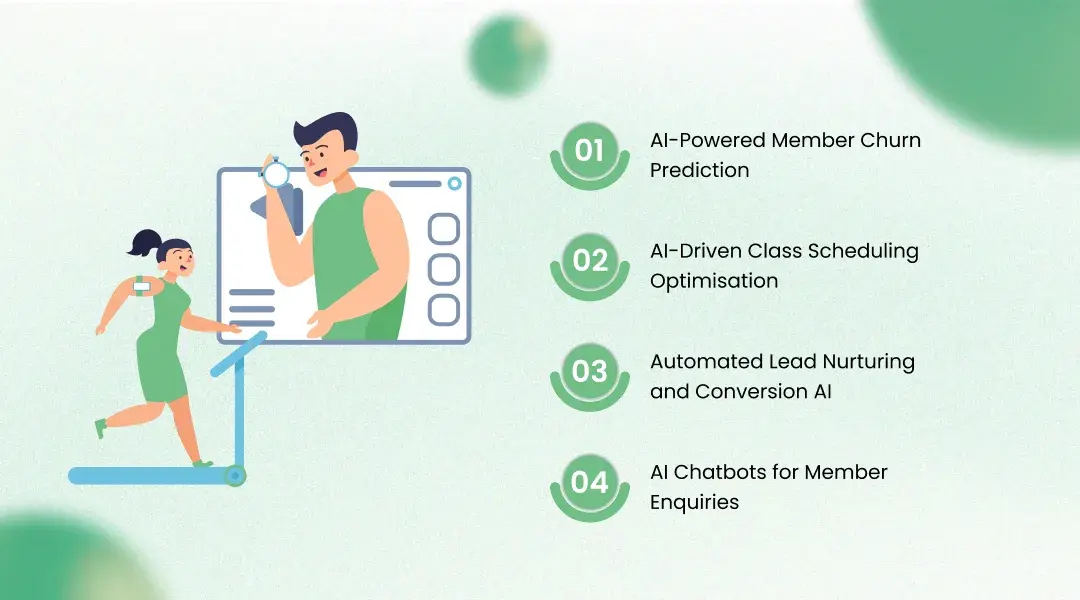
The most important filter for evaluating any AI tool as a small fitness business is not how impressive the feature list is. It is whether the tool directly addresses one of the three specific value levers that determine financial outcomes for your size of operation: keeping members longer, filling classes more consistently, or recovering revenue from leads and lapsed members. Every AI application that genuinely earns its place in your budget does at least one of these three things measurably.
This is the highest-impact AI application available to small fitness businesses right now, and it is dramatically underused at your scale. Churn prediction tools analyse behavioural signals in your existing member data, including attendance frequency, class booking patterns, app engagement, payment history, and check-in gaps, to identify members who are at high statistical risk of cancelling before they actually cancel.
The practical power of this for a studio of your size is significant. The average fitness facility at the ten to fifty employee scale loses between twenty and forty percent of its member base annually. Most of that churn happens without warning and without intervention because staff are not monitoring individual member behaviour at the granularity required to notice the early signals. An AI tool watching two hundred to five hundred member profiles simultaneously can flag the member who used to attend four times a week and has now missed three consecutive weeks, triggering a personalised re-engagement message while the relationship is still salvageable.
Cost at your scale: churn prediction tools built into platforms such as Zen Planner, Virtuagym, or Gymdesk typically cost between zero and one hundred fifty dollars per month in addition to base platform fees, placing them firmly within reach for any studio with fifty or more active members.
Realistic result: studios implementing predictive retention tools report reducing monthly churn rates by fifteen to thirty percent within the first ninety days, which translates directly to recurring revenue protection that far exceeds the tool's cost.
Most small fitness studios schedule their classes based on a combination of historical intuition, instructor availability, and the hope that popular slots will fill. AI scheduling tools replace this guesswork with pattern-based optimisation that analyses historical attendance data to recommend the optimal class types, times, and instructor pairings for maximum fill rates.
For a studio running twelve to twenty-five classes per week, the difference between a sixty-five percent average fill rate and an eighty-two percent average fill rate is not a minor operational footnote. It is the difference between a profitable programme and a schedule that is haemorrhaging sunk costs in instructor wages for half-empty classes.
Cost at your scale: scheduling optimisation AI is typically included in or available as an add-on to major gym management platforms, with standalone tools starting at around one hundred dollars per month.
Realistic result: data from fitness management platforms indicates that AI-optimised scheduling improves average class fill rates by twelve to twenty percentage points, with the strongest gains coming from identifying underperforming time slots that were previously filled based on assumption rather than evidence.
The gap between a prospect completing a trial class or submitting a contact form and actually converting to a paying membership is where small fitness businesses lose enormous amounts of otherwise reachable revenue. Most studios at your scale do not have the staff bandwidth to follow up with every lead within the first twenty-four hours, which is when conversion probability is highest.
AI-powered lead nurturing automates the entire follow-up sequence across SMS and email, personalising messages based on which class the lead attended, what their stated fitness goal was, and how they have engaged with previous communication. This is not batch-and-blast email marketing. It is behaviour-triggered communication that responds to what the individual lead has actually done.
Cost at your scale: AI lead nurturing functionality is available within platforms such as PushPress and as standalone tools, with relevant capability typically accessible for one hundred fifty to three hundred dollars per month.
Realistic result: fitness studios using automated AI lead nurturing report conversion rate improvements of twenty to forty percent on trials and free class leads, with the largest gains coming from the simple act of consistent, timely follow-up that manual processes consistently fail to deliver.
Members and prospects ask repetitive questions constantly. Class schedules, membership prices, parking instructions, cancellation policies, and personal training availability make up the vast majority of inbound enquiries that consume front-desk staff time. AI chatbots configured with your studio's specific information handle these enquiries twenty-four hours a day without requiring staff intervention.
Cost at your scale: fitness-specific chatbot tools start at approximately seventy-five to one hundred fifty dollars per month, with integration into your website and Facebook page typically included.
Realistic result: studios implementing AI chatbots report a thirty to fifty percent reduction in routine inbound enquiry volume handled by staff, freeing front-desk personnel to focus on in-studio member experience rather than phone and email administration.
This is exactly the kind of practical, cost-calibrated AI application that KriraAI specialises in helping small fitness businesses identify and implement. KriraAI builds AI solutions designed for businesses with real budget constraints, helping operators focus their limited technology investment on the applications that produce the fastest and most measurable return, rather than chasing tools designed for enterprise scale.
The business case for AI tools for small fitness businesses is not theoretical. Measurable outcomes are accumulating from real operators of your size, and the numbers are calibrated to what actually matters at ten to fifty employees, not what sounds impressive in a press release from a company with ten thousand members.
Member retention improvement is the most financially significant outcome. A small fitness studio with two hundred active members paying an average of seventy-five dollars per month generates fifteen thousand dollars in monthly recurring revenue. If AI-driven churn prediction reduces monthly attrition from five percent to three and a half percent, that is three additional members retained per month. At seventy-five dollars each, that is two hundred twenty-five dollars per month in protected recurring revenue, or two thousand seven hundred dollars annually, from a tool that costs one hundred to one hundred fifty dollars per month. The return on investment is clear before any additional benefits are counted.
Lead conversion improvements compound this further. If your studio converts twenty percent of trials to members currently, and AI nurturing improves that to twenty-eight percent, a studio running forty trials per month gains an additional three-point-two members per month at every dollar of monthly value those members represent. For a seventy-five dollar per month membership, that is an additional two hundred forty dollars per month in new recurring revenue from improved conversion alone.
Staff time recovery is a third category of measurable impact that small fitness businesses consistently undercount. Front-desk coordinators at studios of your scale typically spend eight to twelve hours per week on tasks that AI can automate, including answering repetitive enquiries, manually sending class reminders, chasing failed payments, and following up with inactive members. At a loaded wage cost of eighteen to twenty-five dollars per hour, that represents one hundred forty-four to three hundred dollars per week in staff cost applied to work that AI tools handle for a fraction of that amount.
Class revenue recovery from improved scheduling optimisation is often invisible to operators until they see it. A studio running twenty-two classes per week at an average fill rate of sixty-eight percent with a ten-dollar drop-in equivalent per slot leaves meaningful revenue on the table in classes that run at thirty to fifty percent capacity because they were scheduled based on habit rather than demand data. Improving average fill rates by fifteen percentage points across a twenty-two-class schedule at realistic capacity assumptions generates hundreds of additional revenue dollars per week.
Taken together, a small fitness business implementing AI across member retention, lead conversion, staff automation, and scheduling optimisation can realistically expect to protect or generate an additional three thousand to six thousand dollars per month in revenue and cost savings, against a total AI tool spend of five hundred to nine hundred dollars per month. This is a genuine, achievable return for your size of business, not an enterprise-scale projection divided by headcount.
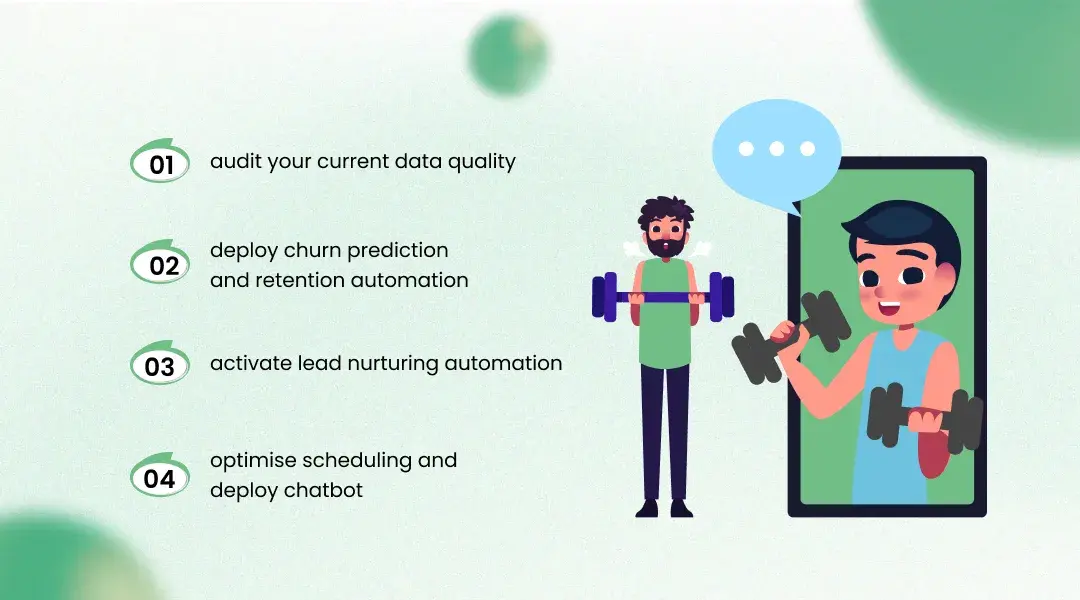
The most common mistake small fitness businesses make with AI adoption is either moving too slowly because the project feels overwhelming or moving too fast by attempting to transform every process at once and creating operational chaos in a business that runs on tight margins and staff trust.
The right approach is sequential, starting with the application that addresses your most expensive problem first, proving the return, and then building outward from that foundation.
No AI tool produces useful output from poor input data. Before deploying any AI application, spend one to two weeks ensuring your gym management system contains accurate member contact information, clean attendance records going back at least twelve months, and complete lead capture data. Most studios at your scale have messy data accumulated over years of partial entries and staff turnover. This cleanup is unglamorous but foundational. An AI churn prediction tool trained on incomplete attendance records will generate unreliable risk scores. Two weeks of data hygiene work protects the entire investment that follows.
Select your first AI tool based on your single most expensive problem. For most small fitness businesses, that is member churn. Configure your churn prediction tool, set the risk thresholds that trigger automated re-engagement, and write two or three message templates that match your studio's voice. Run this system for four to six weeks before evaluating its impact. Resist the temptation to add more tools during this phase. Learn how your members respond and refine your approach based on actual behaviour data.
Once your retention system is operating and producing visible results, layer in automated lead nurturing. Map out your current trial-to-member journey, identify where prospects are currently dropping out of contact, and configure your AI to fill those gaps with timely, personalised follow-up. Measure conversion rate weekly against your pre-AI baseline.
With retention and lead conversion improvements generating measurable financial returns, you now have demonstrated ROI to justify expanding the AI stack. Use scheduling analytics to realign your class programme to actual demand data. Deploy a chatbot to handle routine enquiries, and brief your front-desk staff on the new workflow that frees their time for higher-value member interactions.
The fitness industry discussions around AI challenges tend to be written from an enterprise perspective, focusing on data governance frameworks, model bias in large-scale recommendation engines, and the complexity of integrating AI with legacy ERP systems. None of these are your challenges.
Your real challenges are more human and more immediate.
Data volume is the first genuine friction point specific to your scale. AI tools that predict churn or optimise scheduling require a meaningful volume of behavioural data to generate reliable outputs. A studio with sixty active members and six months of attendance records is operating at the lower edge of what most AI retention tools need to produce confident risk scores. This does not mean AI is not worth adopting. It means you should prioritise tools that are specifically designed for smaller member bases, and that you should understand the confidence limitations of early predictions before relying on them heavily.
Staff resistance is more acute at your scale than at larger organisations, because your team is smaller, more interconnected, and the culture around member relationships is often deeply personal. An instructor who has been manually texting members she knows personally for three years may feel threatened or devalued when an AI system begins sending automated messages to those same members. The solution is framing AI as a system that handles the administrative layer so that she can invest more time in the human layer, not as a replacement for her relationship with members.
Integration complexity is a real but solvable challenge at your scale. Most small fitness businesses are running gym management software, a separate email platform, and possibly a social scheduling tool, none of which share data automatically. AI tools that sit outside your primary gym management system require either API integration or manual data syncing to function effectively. Before adopting any AI tool, verify whether it integrates natively with your existing platform or requires a connector tool such as Zapier. Budget an additional fifty to one hundred dollars per month for connector tools if needed.
Budget allocation decisions are genuinely harder at your margin level than they sound in technology marketing. Every hundred dollars per month spent on an AI tool is a hundred dollars not available for a part-time instructor hour, a new piece of equipment, or a marketing campaign. The discipline to frame AI tools as revenue-generating investments rather than cost-centre expenses requires financial clarity about what each tool is expected to return and a honest willingness to discontinue tools that are not meeting that expectation after a fair evaluation period.
The fitness businesses in your market that begin deploying AI tools for member retention and operational automation in 2025 and 2026 will not simply be slightly more efficient than competitors who wait. They will be operating from a compounding structural advantage that becomes increasingly difficult to close.
Here is the specific mechanism of that compounding advantage. A studio that reduces its monthly churn rate from five percent to three and a half percent through AI-driven retention does not just retain more members in the first year. It builds a larger, more stable base that generates higher word-of-mouth referral volume, higher average tenure per member, and lower cost-per-acquisition for new members because it needs to replace fewer churned members with paid acquisition. By year three, a studio that has been operating AI-driven retention since 2025 will have a member base that is structurally more stable than its non-AI competitor, even if both studios started from the same position.
The personalisation gap will be the most visible competitive differentiator by 2027 to 2028. Members who have experienced AI-enabled personalised communication, custom class recommendations, and proactive milestone acknowledgment from one fitness provider will find generic mass email communication from a competitor comparatively impersonal and disengaging. The expectation bar will shift. What feels like exceptional service today will feel like the basic minimum expectation within two years, and studios that have not built the AI infrastructure to deliver it will feel the gap in member satisfaction scores and social review sentiment.
Instructor and staff quality will also become a competitive differentiator linked to AI adoption. Fitness professionals at your skill level increasingly prefer working for operators who have invested in systems that reduce administrative burden and allow them to focus on coaching. Studios where staff are spending significant time on manual follow-up calls, spreadsheet management, and routine scheduling will have greater difficulty attracting and retaining the best local instructors compared to studios where AI has absorbed those tasks.
The studios that build AI-driven operational capacity now, while tools are affordable and implementation complexity is manageable for a motivated owner, will face far less competition for the top twenty to thirty percent of fitness professionals in their local market. This creates a talent acquisition advantage that is independent of, and additive to, the member retention advantage.
Three years from now, the distinguishing line in local fitness markets between growing studios and declining ones will not primarily be about class quality, equipment investment, or location. It will be about which operators built AI-powered member experience infrastructure while the early-mover advantage was still available.
Three things are most important to take away from everything in this blog. First, the financial case for AI tools for small fitness businesses is demonstrably real at your scale, with returns on investment that are measurable within ninety days and achievable with a monthly tool budget that is well within the operating reality of a ten to fifty employee fitness business. Second, the implementation path does not require technical expertise, enterprise infrastructure, or months of project planning. It requires sequential decision-making, starting with the tool that addresses your most expensive operational problem and building from there. Third, the competitive window for capturing the early-mover advantage in your local market is genuinely open right now, because fewer than twelve percent of businesses your size are currently using AI in meaningful ways, which means you can differentiate substantially before the market catches up.
KriraAI works specifically with businesses like yours to close the gap between knowing AI is important and actually deploying it in a way that produces measurable results. What makes KriraAI different from a generic software vendor is that its team builds and configures AI solutions calibrated to the actual budget, team capacity, and growth stage of small and growing businesses. KriraAI does not scale down enterprise systems and call them small business solutions. It designs practical implementations that fit within your real operational and financial constraints, starting from what your business actually needs rather than what a platform wants to sell you.
If you manage a fitness studio, gym, or sports facility and you are ready to move from thinking about AI to operating with it, reach out to KriraAI to explore how the right AI applications for your size and stage can begin returning measurable value within the first quarter of deployment.
For a fitness studio with fewer than one hundred active members, the AI tools that generate the clearest and most immediate return on investment are churn prediction tools integrated with automated re-engagement messaging, and AI-powered lead nurturing for trial-to-member conversion. At member volumes below one hundred, the data set is smaller than ideal for complex predictive models, but churn prevention tools built specifically for boutique studios, such as those embedded in platforms like Zen Planner or Gymdesk, are calibrated for exactly this member volume. A studio retaining even two additional members per month who would otherwise have cancelled represents a recurring revenue protection of one hundred fifty dollars per month or more, against a tool cost that is typically under one hundred fifty dollars per month. That alone creates a return on investment that justifies adoption, independent of any additional benefits from staff time saved or improved conversion rates. The key is selecting tools that were designed for small member bases rather than enterprise platforms with minimum scale requirements.
A realistic AI implementation budget for a small fitness business with ten to fifty employees sits between three hundred and nine hundred dollars per month depending on how many applications you deploy and whether they are standalone tools or built into your existing gym management platform. If your current platform such as Zen Planner, PushPress, or Gymdesk already includes AI features, you may pay nothing additional or a small upgrade fee of fifty to one hundred fifty dollars per month to unlock them. Adding a standalone AI chatbot for member enquiries typically costs seventy-five to one hundred fifty dollars per month. An AI lead nurturing tool adds another one hundred to two hundred fifty dollars per month. The important framing is that even the upper end of this range, nine hundred dollars per month, should be evaluated against what each tool is saving or generating in retained member revenue, recovered leads, and reduced staff hours. At a seventy-five dollar average membership value, retaining twelve additional members per month that would otherwise have churned covers the entire AI budget with revenue to spare.
Yes. The AI tools built for small fitness businesses in 2025 and 2026 are explicitly designed for operation by non-technical staff. Platforms such as Zen Planner, Virtuagym, and PushPress have embedded AI functionality that operates through dashboard interfaces, workflow configuration menus, and template editors that require no coding or data science knowledge. The typical implementation process involves configuring triggers in a visual workflow builder, for example setting a rule that sends a specific message when a member has not checked in for fourteen days, and writing the message templates that the AI will send when those triggers fire. A studio manager or front-desk coordinator with basic computer literacy can complete the initial configuration of most AI retention and communication tools within four to eight hours of guided setup. More sophisticated applications such as predictive analytics dashboards require some investment in learning how to interpret outputs, but this is closer to learning a new reporting tool than it is to learning data science. KriraAI specifically structures its implementation support for small fitness operators around empowering existing staff rather than creating dependency on technical personnel.
The biggest risk for a small fitness studio deploying AI is creating a member communication experience that feels impersonal or disconnected from the human community that makes boutique fitness valuable. If AI-generated messages arrive with generic language, poor timing, or factual errors about a member's actual behaviour, they can actively damage the trust relationship that your instructors and front-desk staff have built. The way to avoid this is through careful template design that uses personalisation tokens consistently, for example referencing the member's first name and the specific class they attend, combined with a clear process for staff to review and override automated communications when they have specific personal context that the AI lacks. AI should handle the consistent, timely, and scalable layers of member communication. Your staff should retain the ability to add human judgement and personal context when it matters. Studios that treat AI as a replacement for human relationship management see worse outcomes than those that treat it as infrastructure supporting human connection.
A small fitness business implementing AI-powered churn prevention and lead nurturing can typically expect to see measurable improvements in member retention within sixty to ninety days of proper configuration and consistent operation. The first thirty days are primarily a calibration period during which the AI system accumulates enough behavioural data to generate reliable risk scores and the automated communication sequences run their first complete cycle. Between days thirty and sixty, you should begin to see lower attrition in the cohort of at-risk members who received AI-triggered re-engagement. By day ninety, you will have a complete before-and-after comparison of your monthly churn rate against your pre-AI baseline, which will tell you clearly whether the tool is producing the retention improvement you need to justify its continued investment. Lead conversion improvements from AI nurturing typically show up faster, often within the first thirty days, because trial-to-member conversion cycles are short and the impact of timely, consistent follow-up is immediate. Scheduling optimisation results take longer, often four to six months, because they require a full programme cycle to evaluate whether the adjusted class schedule is producing sustained fill rate improvements rather than temporary fluctuations.
Founder & CEO
Divyang Mandani is the CEO of KriraAI, driving innovative AI and IT solutions with a focus on transformative technology, ethical AI, and impactful digital strategies for businesses worldwide.