AI Software Development for Midsize Companies: A Survival Guide
Recent industry surveys indicate that 76 percent of professional developers now use or plan to use AI tools in their daily workflow. For software companies with 50 to 500 employees, the implications of AI software development for midsize companies are uniquely uncomfortable. You are too large to pivot like a five-person startup. You are too small to fund custom platform teams like a global enterprise.
You ship real production software to paying customers. You also face two parallel threats every quarter. AI native startups now ship features in days that used to take you weeks. Large enterprises spend hundreds of millions building proprietary AI tooling that your team cannot match.
The companies most at risk over the next three years are not the laggards. They are the well-run midsize software firms that assumed their current trajectory was safe. This guide is written specifically for engineering leaders and founders at midsize software companies. It covers the practical AI applications that pay back inside one quarter, the implementation realities at your scale, and the competitive timeline you actually have left.
The Midsize Software Company Reality in 2026
A midsize software company in 2026 typically has between 50 and 500 total employees. Engineering accounts for 25 to 40 percent of headcount. Annual revenue usually falls between 10 million and 200 million dollars. The product has a clear market fit and a roadmap shaped by signed customer contracts rather than open experimentation.
The engineering organization is structured around six to fifteen teams. Each team owns specific services or product surfaces. Most teams have accumulated three to seven years of legacy code that nobody fully remembers writing. Test coverage is uneven across the codebase. Documentation is sparse exactly where it matters most.
Two or three senior engineers carry institutional knowledge that would take six months to replace. Budgets at this scale are real but bounded. The CFO will approve a 200 thousand dollar annual spend on developer tooling without much friction. The CFO will not approve a 5 million dollar internal AI platform without a board-level conversation.
Procurement still happens through normal channels rather than dedicated vendor management teams. Decision-making sits in a narrow band. A single VP of Engineering can usually approve tool purchases under 50 thousand dollars per year. Anything larger requires alignment between engineering, finance, and security.
This is faster than enterprise governance and slower than the founder approving spend over Slack. The pressures unique to this stage are equally specific. You need to grow revenue 30 to 80 percent per year to justify your valuation. You need to maintain the product reliability that paying customers contractually expect. Every one of these pressures rewards AI software development directly.
Why AI Adoption Looks Different at This Scale
AI adoption at a midsize software company looks fundamentally different from what either Google or a two person startup is doing. The Fortune 500 approach assumes you can fund a 50 person AI platform team. The startup approach assumes you have no legacy code and no compliance burden. Neither model fits a 200 person company with eight years of production code and an enterprise customer base.
The Budget Gap Between Startups and Enterprises
A solo developer can adopt Claude Code, Cursor, or Copilot for 20 to 40 dollars a month and call it done. A Fortune 500 company can spend 80 million dollars building an internal model gateway with custom evaluation pipelines. A midsize software company has neither option available at sensible cost.
At your scale, the realistic developer tooling budget for AI is 200 to 500 dollars per engineer per year for coding assistants. The realistic platform spend is 100 thousand to 500 thousand dollars annually for inference, observability, and security tooling combined. Custom model training is almost never economical at this scale. You are buying capability rather than building it from scratch.
Skills and Talent Reality
The talent constraints at midsize companies create the most important strategic difference. You probably have zero dedicated ML engineers on payroll. You might have two or three senior engineers who have shipped AI features somewhere before. You cannot hire a Chief AI Officer because the candidates with real track records command 700 thousand dollar packages.
This means your AI adoption strategy must rely on three structural choices. It must rely on tools that augment existing engineers rather than requiring new specialists. It must rely on vendor partnerships rather than internal builds for anything that involves training. It must rely on incremental adoption that fits into existing sprint cycles. KriraAI works with midsize software companies precisely because the adoption pattern at this scale needs partner expertise that the company cannot economically hire full time.
The Right AI Software Development Applications for Midsize Companies
The biggest mistake midsize software companies make is chasing the most impressive AI applications instead of the most practical ones. A custom fine tuned coding model is not what your business needs in the next six months. The applications below are the ones that consistently pay back within one or two quarters at this scale.
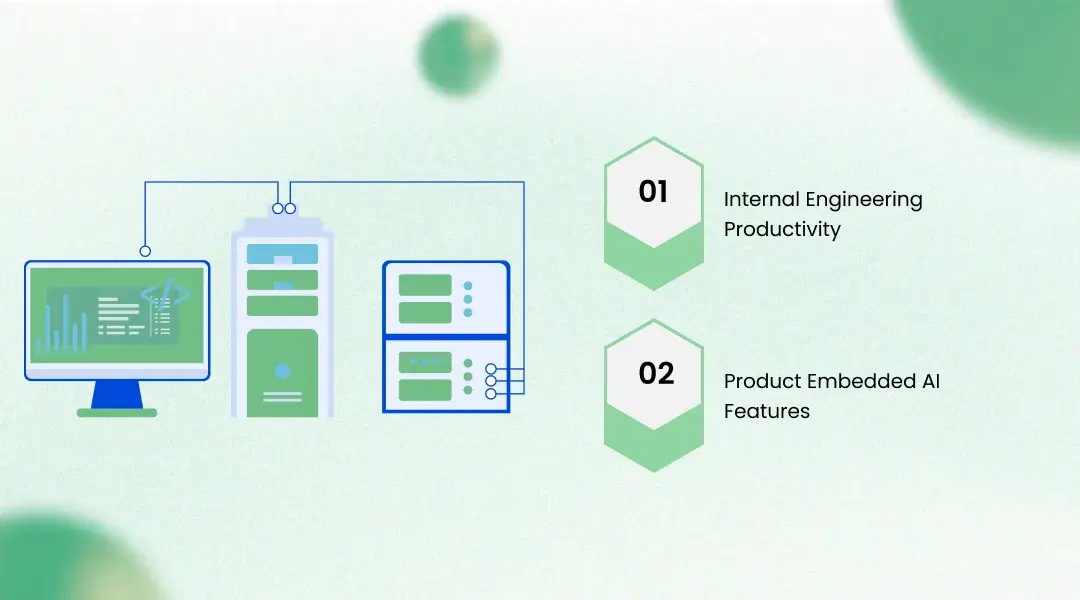
Internal Engineering Productivity
AI coding assistants are the highest ROI investment for any midsize software company. Modern assistants like GitHub Copilot, Cursor, and Claude Code can reduce the time spent on routine coding tasks by 30 to 55 percent on measured benchmarks. At a 100 engineer company with average loaded cost of 180 thousand dollars per engineer, even a 15 percent productivity gain represents 2.7 million dollars in annual capacity recovered.
Code review acceleration is the second highest ROI application. AI review tools can flag bugs, security issues, and style violations before human reviewers see them. Median pull request cycle time at midsize companies typically drops by 20 to 35 percent within three months of adoption. Faster cycle time directly translates to faster feature delivery and lower context switching cost across teams.
Test generation and maintenance is the third practical win. AI tools can generate unit tests for legacy code that nobody is willing to test manually. Coverage typically improves by 15 to 30 percentage points within two quarters. This matters most at midsize scale, where the legacy code burden is real but the budget for dedicated test engineers does not exist.
Product Embedded AI Features
Beyond internal productivity, midsize software companies need to ship AI features inside their actual products. This is where competitive survival is decided over the next three years. Customers now expect natural language interfaces, intelligent search, and contextual recommendations in software they buy.
The practical embedded applications include intelligent product search using vector embeddings, AI assisted onboarding for new users, summarization of customer activity for support teams, automated data extraction from documents, and copilot interfaces inside complex workflows. Each of these can be built with managed API providers like Anthropic, OpenAI, or Google in weeks rather than months. None of them requires custom model training at midsize scale.
Customer support automation is the application with the fastest payback at this scale. A midsize SaaS company with 50 thousand active customers can typically reduce support ticket volume by 25 to 40 percent within four months. The reduction comes from deploying an AI agent trained on documentation and historical tickets. KriraAI builds these production grade AI agents for midsize software companies, integrating them with existing tools like Zendesk, Intercom, and Salesforce without disrupting current workflows.
Quantified Business Impact for Midsize Software Firms
The financial impact of AI software development at midsize scale is measurable and consistent across companies that adopt thoughtfully. Generic AI ROI claims do not help your CFO defend the budget. The numbers below are calibrated to what a 100 to 300 person software company can realistically expect within twelve months.
Engineering productivity gains typically land between 15 and 30 percent on output measured by story points, pull requests merged, or features shipped per quarter. At a 100 engineer company, this translates to the equivalent of 15 to 30 additional engineers without any new hires. The financial value sits between 2.7 million and 5.4 million dollars annually in recovered engineering capacity.
Time to ship new features drops by 25 to 40 percent for teams that fully adopt AI assisted workflows. A feature that used to take six weeks now ships in four weeks. For a midsize SaaS company shipping 20 major features per year, this represents 8 weeks of additional roadmap throughput annually. The throughput gain is what closes the gap with faster startup competitors.
Customer support cost reduction lands between 20 and 35 percent within six months of deploying AI support agents. For a midsize SaaS company spending 2 million dollars annually on support, this represents 400 thousand to 700 thousand dollars in direct savings. The savings compound because faster ticket resolution also improves customer retention.
Sales engineering productivity improves by 30 to 50 percent through AI assisted demo generation, technical question answering, and proposal drafting. This shows up as faster deal cycles and higher win rates against AI native competitors. Total quantified impact at midsize scale typically runs between 4 and 12 million dollars in annualized value for a 200 person software company. Payback periods of 4 to 8 months are realistic and common when implementation is sequenced thoughtfully.
Implementation Roadmap for Midsize Software Companies
A practical AI software development rollout at midsize scale follows a six month sequence. The pattern below assumes a 100 to 300 person software company with normal constraints. Each month builds on the prior month's measurement and learning.
Month one focuses on baseline measurement and quick wins. The engineering leadership team should measure current cycle time, deployment frequency, and customer support ticket volume before any AI deployment. In the same month, deploy AI coding assistants company wide as the lowest risk, highest visibility win.
Months two and three focus on internal workflow integration. Pick two engineering teams as pilot groups for deeper AI workflow integration including AI code review, AI test generation, and AI documentation tools. Measure the impact relative to non pilot teams using the baselines from month one.
Months four and five focus on product embedded AI. Select one high value product surface for AI feature deployment such as customer support automation, intelligent search, or in product copilots. Build with managed API providers rather than custom models, and ship to a small customer cohort before broader release.
Month six focuses on measurement and expansion planning. Compare baseline metrics from month one against current performance and calculate actual ROI. Plan the next six months based on what actually worked, not what was supposed to work in the original plan.
The Three Most Common Mistakes Midsize Companies Make
The first common mistake is starting with the most ambitious project. Midsize software companies often try to build a custom AI agent platform before they have deployed coding assistants. This always fails because the ambitious project requires capabilities the company does not yet have. Start with adoption that requires no new infrastructure, then graduate to harder projects with confidence.
The second common mistake is treating AI as an engineering only initiative. The largest gains at midsize scale come from cross functional applications like customer support, sales engineering, and product analytics. If your AI strategy is entirely owned by engineering, you will miss the highest ROI applications. Assign business owners alongside technical owners for every initiative from day one.
The third common mistake is ignoring evaluation and observability. AI systems behave probabilistically. They drift over time. They fail in ways traditional software does not fail. Midsize companies frequently deploy AI features without any evaluation harness or monitoring beyond standard application metrics. Six months later, accuracy has degraded by 15 percent and nobody noticed until customers complained loudly.
Challenges Specific to Midsize Software Companies
The challenges at midsize scale are different from anything you read in enterprise or startup AI guides. Your friction points are unique to this stage and require deliberate handling rather than generic playbooks. Four challenges show up consistently across midsize software organizations.
The first specific challenge is the legacy code burden without the budget to refactor. A startup has a small fresh codebase. An enterprise has a dedicated platform team to modernize systems. A midsize company has years of accumulated code and no spare capacity. AI tools that work brilliantly on greenfield projects often struggle with your actual codebase, so you need tools that handle messy reality rather than demoware optimized for clean examples.
The second specific challenge is procurement and security review at scale. You probably have enterprise customers who demand SOC 2 compliance, GDPR alignment, and increasingly AI specific security attestations. Every AI vendor must pass security review by your two or three person security team. AI vendor onboarding can take three months when it should take three weeks. Standardize the review process before scaling AI adoption broadly.
The third specific challenge is internal change management. Engineers at startups happily adopt new tools without much friction. Engineers at enterprises follow whatever the platform team approves. Engineers at midsize companies have strong opinions and limited tolerance for tools imposed from above. AI adoption fails when it is mandated rather than designed together with the teams that will use it daily.
The fourth specific challenge is the skills gap that the company cannot afford to close through hiring alone. The market rate for senior AI engineers exceeds what your salary bands allow. The realistic path is to upskill existing engineers through structured learning and to use implementation partners like KriraAI for the specialized work that does not justify a full time hire at your scale.
The Competitive Landscape Three Years From Now
The competitive landscape for midsize software companies will look dramatically different by 2029. The gap between AI mature and AI immature companies at this scale will determine who survives the next consolidation cycle. The compounding nature of AI workflow improvements makes the gap widen every quarter.
Companies that adopted AI software development in 2025 and 2026 will have engineering productivity 40 to 60 percent higher than companies that waited until 2028. This is not a marketing projection. It is a direct consequence of compounding workflow improvements over multiple sprints. Teams that have been refining their AI augmented workflows for three years will simply ship more software per engineer than teams just starting.
Customer expectations will harden in ways that punish slow movers. By 2028, every B2B software buyer will expect AI features as default rather than premium add ons. Vendors without natural language interfaces, intelligent automation, and contextual assistance will lose deals to AI native competitors. This is already happening in HR tech, customer support, and analytics categories, and it will spread to every category within three years.
Acquisition economics will favor AI mature midsize companies disproportionately. Private equity firms now apply a 15 to 25 percent valuation premium to software companies with proven AI integration in both their products and their operations. Companies without this story will trade at lower multiples regardless of revenue growth. This affects exit outcomes for every founder and investor at the midsize stage.
The midsize software companies that thrive in 2029 will share three traits. They will have AI augmented engineering as the default mode of work rather than a special initiative. They will have AI features deeply integrated into their products rather than bolted on. They will have working partnerships with implementation specialists who handle the work that does not justify dedicated internal teams.
Conclusion
Three points stand out from everything covered above. First, midsize software companies face a genuinely unique competitive position that requires AI adoption tailored to their specific scale, not enterprise playbooks or startup hacks. Second, the highest return AI investments at this scale are practical applications like coding assistants, AI code review, customer support automation, and embedded product features, all of which pay back within one or two quarters. Third, the window for catching up to AI native competitors narrows every quarter, and companies that wait until 2027 to start will compete from a structural disadvantage that compounds over time.
KriraAI works with midsize software companies on exactly this transition. We build practical AI implementations designed for the budget realities, team structures, and growth pressures of companies with 50 to 500 employees. Our work covers production AI agents for customer support and sales operations, AI augmented development workflow design, evaluation and observability infrastructure, and integration with existing tools like Salesforce, Zendesk, Jira, and Slack. KriraAI does not sell enterprise software with midsize pricing, and we do not sell startup tools that fail at midsize complexity. We build solutions that fit your actual constraints.
If you are an engineering leader or founder at a midsize software company thinking through your AI strategy for the next twelve months, talk to KriraAI about a focused implementation plan that matches your scale and timeline. The companies that act on AI software development for midsize companies in the next two quarters will define the competitive landscape of the next five years.
FAQs
The most effective AI tools for midsize software companies are AI coding assistants like GitHub Copilot, Cursor, and Claude Code, paired with managed inference APIs from Anthropic, OpenAI, or Google for product features. This combination delivers high productivity gains without requiring custom model training or dedicated ML infrastructure that companies at this scale cannot economically support.
A 100 person software company with roughly 30 to 40 engineers should expect to spend between 200 thousand and 500 thousand dollars annually on AI tooling, inference, and integration partner fees. This budget covers coding assistants for all engineers, managed inference for product features, evaluation tooling, and external implementation support. Custom model training is rarely worth the additional cost at this company scale.
A well executed AI software development rollout at midsize scale typically shows measurable ROI within four to eight months. Engineering productivity gains appear within the first quarter through coding assistant adoption. Product feature impact and customer support savings appear within the second quarter. Full payback on year one investment is realistic and common when implementation is sequenced thoughtfully across teams.
Midsize software companies can compete with AI native startups by combining their existing market position with rapid AI adoption, rather than trying to outbuild the startups on raw AI capabilities. Your installed customer base, revenue, and brand are advantages that the startup simply does not have yet. The risk is moving too slowly on AI, which neutralizes those advantages within two to three years.
The first AI software development practice every midsize company should adopt is rolling out AI coding assistants to every engineer, paired with a baseline productivity measurement system. This single decision delivers immediate productivity gains, creates internal familiarity with AI tools, and generates the measurement infrastructure needed to evaluate every subsequent AI investment with hard data rather than opinion.
Ridham Chovatiya is the COO at KriraAI, driving operational excellence and scalable AI solutions. He specialises in building high-performance teams and delivering impactful, customer-centric technology strategies.