AI in Software Development: The Coming Engineering Divide
GitHub data from early 2025 showed developers using Copilot completed coding tasks 55% faster than those without it. That single number reshaped how engineering leaders think about hiring, velocity, and competitive moats. The question is no longer whether AI in software development belongs inside the lifecycle. The harder question is what your organization actually does with it.
Most engineering teams still treat AI as a smarter autocomplete bolted onto their IDE. A smaller group treats it as a structural change to how software gets built, reviewed, and shipped. The gap between these two groups is widening every quarter. The leaders pulling ahead are not the ones with the largest model budgets. They are the ones who restructured their actual workflows around AI capability.
This blog examines what is happening inside high-performing software organizations using AI today. It covers the technologies driving the change, the measurable outcomes companies are recording, and the implementation steps that work. It also addresses the real challenges that derail adoption inside enterprise engineering teams. And it projects what the next five years look like for teams that act now versus those that wait.
The State of Software Engineering Before the AI Wave
Software development as an industry has been quietly drowning in its own complexity for over a decade. Modern applications routinely depend on hundreds of third-party libraries. They run across dozens of managed cloud services per company. Engineering teams maintain codebases that no single person fully understands.
The cost pressure on software organizations is severe. A senior software engineer in the United States now costs between 180,000 and 350,000 dollars per year fully loaded. Equivalent talent in India and Eastern Europe costs significantly less, but finding qualified senior engineers anywhere has become difficult. The 2024 Stack Overflow Developer Survey found 60% of developers spend a third of their time debugging code.
The Hidden Costs of Modern Software Engineering
That debugging burden is the silent tax on software companies. Code review queues stack up across pull requests every day. Test suites become slow and flaky over months of accumulated drift. Deployment pipelines accumulate brittle steps that fail under load. Documentation rots faster than it gets written.
Add to this the structural problem of context loss. Engineers rotate teams every 18 to 24 months on average. Each rotation costs three to six months of ramp-up time. Tribal knowledge about architectural decisions disappears with them. The result is a compounding complexity tax that grows with every codebase year.
Competitive dynamics make this worse. Product timelines have compressed dramatically across the past decade. Customers expect features that took six months in 2018 to ship in three weeks today. Engineering leaders are caught between rising complexity, rising salaries, and shareholders demanding margin expansion. This is the real condition AI is walking into.
How AI in Software Development Is Restructuring the Lifecycle
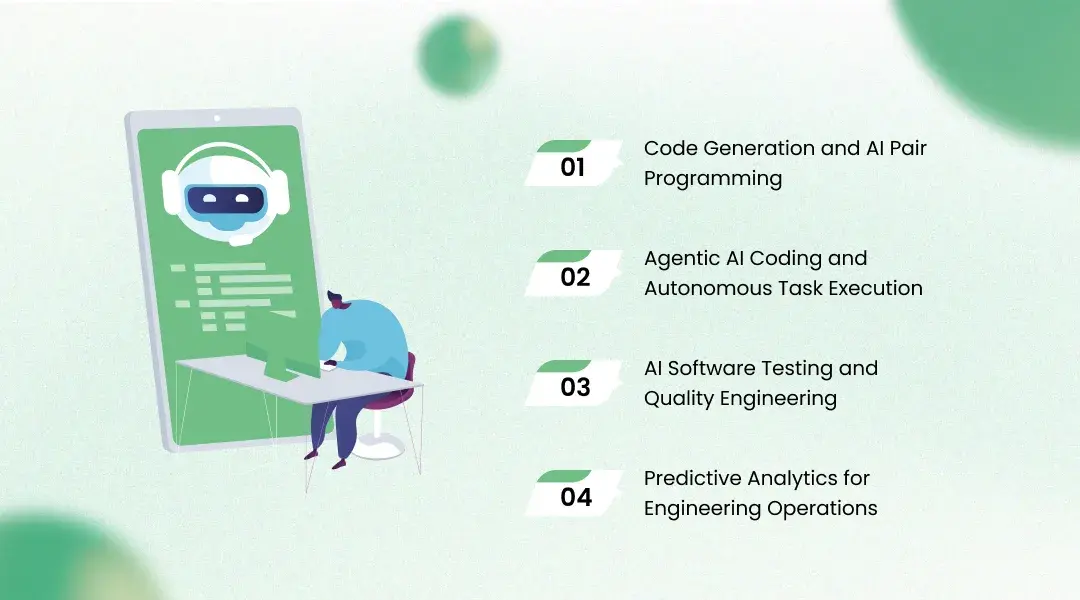
AI in software development now operates across every stage of the SDLC, not just inside the IDE. The technologies driving this change fall into four broad categories. Each maps to specific bottlenecks in the engineering workflow.
Code Generation and AI Pair Programming
Large language models trained on code now handle a meaningful portion of routine implementation work. Tools like GitHub Copilot, Cursor, and Claude Code generate function bodies from natural language comments. They write unit tests from existing implementation code. They scaffold entire microservices from architectural descriptions. The 2024 GitHub Octoverse report confirmed Copilot users accept around 30% of all suggestions.
The newer wave of AI code generation tools goes further than autocomplete. Cursor and Claude Code can hold the full repository in context. They make coordinated edits across multiple files for a single feature. They run the test suite, read the failures, and propose fixes without manual prompting. This is a different category of capability than what most teams have integrated.
Agentic AI Coding and Autonomous Task Execution
Agentic AI coding is the most significant shift currently underway in software engineering. These systems do not just suggest code. They plan multi-step tasks, execute them, verify the results, and iterate until complete. Devin and Claude Code can now take a GitHub issue and produce a working pull request automatically.
The accuracy is still imperfect, but the trajectory is clear. SWE-bench scores climbed from under 5% in early 2024 to over 70% by mid-2025 on the verified benchmark. Engineering leaders who dismissed these tools 18 months ago are now scrambling to evaluate them. The teams that started early have learned how to use them effectively. The rest are starting from zero.
AI Software Testing and Quality Engineering
AI software testing has matured rapidly across the past two years. Modern AI testing platforms generate test cases from production traffic patterns. They identify untested code paths automatically. They predict which tests will fail before they run, allowing smart test selection. Companies like Diffblue, Mabl, and Testim are building production-grade tools around these capabilities.
Visual regression testing using computer vision now catches UI bugs that traditional snapshot tests miss. Property-based test generation uses LLMs to find edge cases human engineers would not consider. Mutation testing combined with AI prioritization helps teams focus on the highest-risk areas of their codebase.
Predictive Analytics for Engineering Operations
Predictive analytics inside engineering platforms is the least visible but most strategic application. Tools analyze pull request data, commit patterns, and incident history to predict where bugs will occur. They flag pull requests likely to cause production incidents before they merge. They predict which engineers are heading toward burnout based on commit patterns.
These systems also forecast project completion dates with significantly more accuracy than human estimates. They identify which dependencies are accumulating technical debt fastest. They route code review requests to the engineer most likely to give useful feedback.
The combination of these four categories is what makes AI in software development genuinely transformational. Treating any one of them as the whole picture leads to disappointing results. KriraAI works with engineering organizations specifically to map these four categories against their actual workflow bottlenecks. Most teams discover their highest-leverage AI application is not where they initially expected.
The Quantified Impact on Engineering Organizations
The measurable results emerging from AI-mature engineering organizations are now substantial enough to compare across companies. Productivity gains are real, but the distribution of those gains is uneven. Companies that restructured workflows around AI capability see dramatically different numbers than those bolting on tools.
The 2025 DORA report indicated elite teams using AI throughout the SDLC ship code 2.4 times faster than peers. They also recover from production incidents 3.1 times faster on average. Their change failure rate drops by around 30% compared to teams using AI only at the IDE layer. These numbers reflect compounding effects, not one-time improvements.
Cost and Time Savings
Specific dollar impacts are also becoming clear. McKinsey estimated in late 2024 that AI could add 30 to 45 percent to developer productivity at scale. Goldman Sachs reported their internal Copilot rollout saved engineers around four hours per week each. For a 10,000-engineer organization, that is roughly 2 million engineer-hours saved per year. At loaded cost, that translates to 200 to 300 million dollars annually.
Code review cycle times have compressed by 40 to 60 percent at companies using AI code review tools. Pull requests that previously sat for two days now merge within hours. Bug discovery is shifting earlier in the cycle. The cost of fixing a bug in production is 100 times the cost of fixing it during design. AI tools that catch issues at the pull request stage save millions yearly for organizations above 200 developers.
Onboarding and Customer Impact
Time to first commit for new engineers has dropped from six weeks to under two weeks with mature AI onboarding. New hires can ask the AI to explain unfamiliar code. They get immediate answers about why a service is structured a certain way. The institutional knowledge problem is partially solved by AI memory of the codebase.
Customer-facing impact is equally significant. Companies reporting strong AI adoption inside engineering are shipping features 1.8 times faster on average. They have 35 percent fewer post-release defects. Their engineering operating costs as a percentage of revenue have dropped by an average of 12 percent over 18 months. These numbers will only widen as the technology matures.
Building an AI-Native Engineering Practice
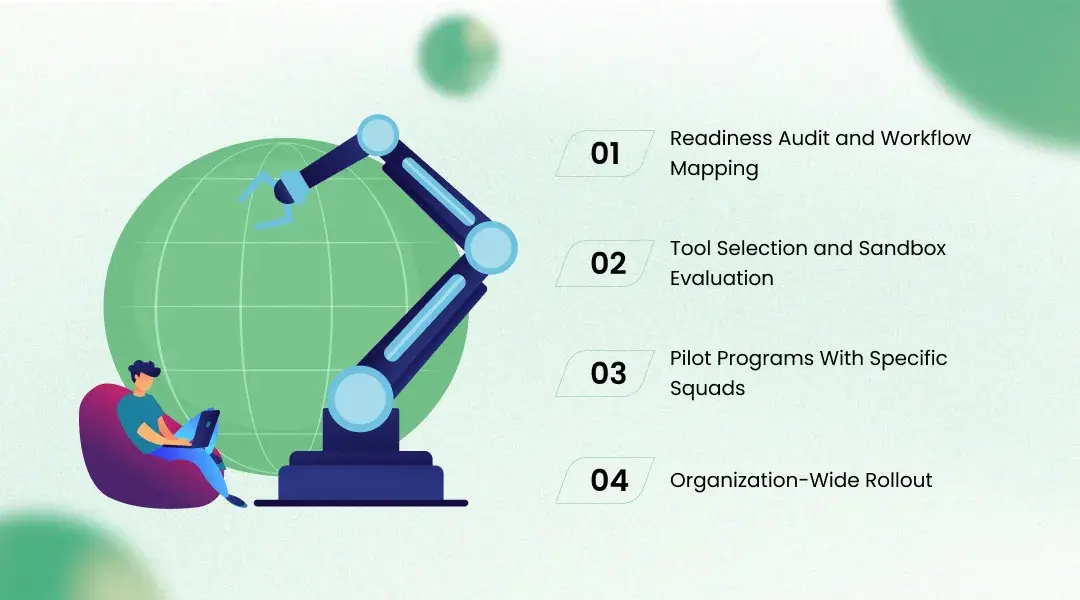
Implementing AI in software development properly requires more than purchasing tool licenses. It requires honest assessment, careful pilots, and a willingness to restructure how teams actually work. Companies that get this right follow a recognizable pattern across five stages.
Stage One: Readiness Audit and Workflow Mapping
The first step is a clear-eyed audit of where engineering time is actually going. Most leaders are surprised when they measure this rigorously. The audit covers code review queue depth, test cycle time, incident response duration, and onboarding ramp time. It also covers the qualitative friction points engineers complain about most.
This stage produces a heat map of where AI can have the biggest impact in that specific organization. It also surfaces the cultural and technical prerequisites needed for adoption. Companies with no observability data, no good linting standards, and inconsistent code styles will struggle with AI tooling. The audit shows what to fix first.
Stage Two: Tool Selection and Sandbox Evaluation
The second stage is structured evaluation of specific tools against the identified bottlenecks. Generic claims from vendors should be treated with skepticism. Most engineering organizations need to run their own benchmarks against their own codebase. A tool that works brilliantly on JavaScript microservices may fail on a legacy Java monolith.
Sandbox evaluation periods should last four to six weeks per tool. They should involve real engineers solving real tasks. The metrics should be cycle time, defect rate, and engineer satisfaction. Vanity metrics like suggestion acceptance rate matter less than whether the team actually ships better software.
Stage Three: Pilot Programs With Specific Squads
Pilot programs should focus on two or three squads, not the whole organization. The chosen squads should include both AI-enthusiastic engineers and skeptics. This mix produces the most honest feedback about what is actually working. Pilots should run for two to three months minimum.
The pilot phase is where workflow restructuring becomes critical. Teams cannot simply add AI tools on top of their existing process. They must rethink their definition of done, their code review rubrics, and their testing standards. Without this rethinking, AI becomes a marginal accelerator instead of a structural improvement.
Stage Four: Organization-Wide Rollout
Full rollout follows successful pilots and includes mandatory training. Engineers need clear guidance on what tasks are appropriate for AI assistance. They need documentation on common failure modes. They need rubrics for reviewing AI-generated code. Without this, quality drops as the technology scales.
Governance becomes important at this stage. Security review processes must adapt to AI-generated code. Licensing and IP questions need clear answers. Audit trails for AI-assisted commits need to exist. KriraAI helps enterprise engineering teams build this governance layer during rollout, because retrofitting it later costs far more. The AI developer productivity gains compound only when governance scales with adoption.
Common Mistakes That Derail AI Adoption
The most common mistakes engineering organizations make during AI adoption follow predictable patterns. Avoiding them is often more valuable than choosing the right tool.
Treating AI as a procurement decision instead of a process change. Buying licenses and announcing tools without restructuring workflows produces disappointing results every time.
Ignoring the skeptics on the team. Senior engineers who push back often have legitimate concerns about code quality, security, and maintainability that deserve serious engagement.
Over-relying on AI for tasks where it is genuinely unreliable. Complex architectural decisions, novel algorithm design, and security-sensitive code still need human judgment.
Skipping observability and feedback loops. Teams that cannot measure whether AI tools are helping or hurting will lose the political battle within 12 months.
Underinvesting in training and change management. The gap between an engineer using a tool at 10% capability versus 80% capability is often three days of focused training.
The Honest Challenges of AI in Software Development
The genuine challenges of adopting AI in software development are larger than vendor marketing suggests. Data quality is the first hurdle. AI tools trained on public code repositories have absorbed patterns from low-quality codebases. They will happily generate plausible-looking code that contains subtle security vulnerabilities. Engineering teams must develop new review skills to catch this.
Talent gaps are real and growing. The engineers who direct AI tools effectively are not the same engineers who were valuable in the pre-AI era. Senior engineers who built careers on memorizing language syntax and library APIs find their advantage shrinking. The new advantage is system design, problem decomposition, and verification skills. Reskilling existing teams takes deliberate effort and time.
Regulatory and compliance constraints are significant for many industries. Code that touches financial records, healthcare data, or critical infrastructure faces audit requirements that AI tools complicate. Many regulated companies cannot send their code to third-party AI services. They need self-hosted models or carefully scoped cloud deployments. This adds operational complexity.
Integration, Culture, and Security Realities
Integration complexity is consistently underestimated by leadership teams. AI tools work best when they have access to the full development context. That means integrations with source control, issue trackers, CI pipelines, documentation systems, and monitoring platforms. Each integration is a project of its own. The total integration effort often exceeds the cost of the AI tools themselves.
Change management remains the deepest challenge. Engineering culture is built on craftsmanship, autonomy, and skepticism. Mandating AI usage triggers resistance. Banning AI usage triggers underground adoption. Both extremes are bad. The successful path requires honest dialogue about what AI changes and what stays the same in the craft.
Security and IP concerns deserve serious attention. AI tools that learn from your codebase may leak proprietary patterns to other tenants. Code suggestions may contain GPL-licensed snippets without attribution. Prompt injection attacks against AI agents handling production code are an emerging attack vector. KriraAI emphasizes security and governance review as a non-negotiable part of any enterprise AI rollout in software development.
The Next Five Years of Software Engineering
The trajectory of AI in software development over the next five years will be shaped by three forces. Each will reshape what software engineering looks like as a profession.
The Three Forces Reshaping the SDLC
The first force is the maturation of agentic AI coding into production-grade reliability. By 2028, autonomous AI agents will handle the majority of routine engineering tasks unsupervised. They will fix bugs reported by users overnight. They will implement small features from product requirements documents. They will refactor legacy code modules on schedule. Human engineers will spend more time on architecture, problem definition, and verification.
The second force is the rise of AI developer productivity platforms as a category. Today these tools are fragmented across vendors. By 2028, integrated platforms will manage the full SDLC with AI woven through every step. Engineering metrics will be tracked in real time. Resource allocation decisions will be partly automated. Engineering leadership will look more like operations management.
The third force is the redefinition of engineering team structure. Today a typical product team has six to eight engineers. In five years, teams of three engineers supported by AI agents will outperform teams of ten without them. The ratio of senior to junior engineers will shift. Companies will hire fewer engineers but pay them more. Junior engineering as an entry path will become structurally smaller.
The Coming Three-Tier Industry Divide
The competitive landscape will divide cleanly into three groups. The first group restructured early and now operates with structurally lower engineering costs. They ship faster, iterate more aggressively, and have better unit economics than peers. The second group adopted AI tools at the surface level. They captured 20 to 30 percent of available gains but kept their old organizational structures. The third group resisted or moved too slowly. By 2029 they will face a cost structure crisis they cannot easily fix.
Open-source AI coding tools will reach parity with proprietary tools in many areas by 2027. This will democratize access to the technology globally. But the gap between organizations using AI well and those using it poorly will be larger than the tool gap. Process and culture will determine the winners.
Conclusion
The transformation underway in software development through AI is structural, not incremental. Three points matter most for engineering leaders making decisions today. First, AI in software development is no longer a productivity add-on. It is a restructuring of how software gets built across every stage of the lifecycle. Second, the gap between organizations that restructure their workflows and those that bolt on tools is widening every quarter. Third, the next five years will divide engineering organizations into three tiers based on decisions being made right now.
KriraAI works with enterprise engineering organizations to plan and execute this transformation in a way that produces measurable results. The work starts with a clear audit of where engineering time is going today. It moves through tool evaluation, pilot design, and full deployment with governance built in from day one. KriraAI builds AI solutions that are practical, measurable, and built for scale. These are not vendor demos that fail when they meet a real codebase. Teams serious about getting AI in software development right can contact KriraAI for an assessment. The conversation usually starts with an audit and produces a deployment roadmap.
FAQs
AI in software development is used across the entire software lifecycle today, not just for writing code. It generates code from natural language descriptions, reviews pull requests for bugs, and writes test suites. It also predicts where defects are likely to occur in production. It powers intelligent CI/CD pipelines that choose which tests to run based on code changes. It helps onboard new engineers by explaining unfamiliar code in plain English. The most advanced organizations use agentic AI coding systems that complete entire engineering tasks autonomously. These systems can move from reading a bug report to opening a verified pull request.
AI will not replace software developers in the next five years, but it will substantially change what they do. The repetitive parts of the job are increasingly handled by AI. This includes boilerplate code, routine bug fixes, and standard test generation. Human engineers are shifting toward architecture, system design, problem decomposition, and verification work. Teams will become smaller and more senior on average across the industry. Junior engineering roles will compress because AI now handles much of what junior engineers traditionally did. The profession is changing significantly, but skilled engineers remain essential to building production software systems.
The best AI tools for software development in 2026 depend on the use case. A few have emerged as category leaders worth evaluating. GitHub Copilot and Cursor dominate inline AI code generation and AI pair programming workflows. Claude Code and Devin lead in agentic coding scenarios where the AI completes full tasks autonomously. Diffblue and Mabl are strong choices for AI software testing and quality engineering needs. Sourcegraph Cody and Tabnine offer good enterprise options with self-hosting capabilities for regulated industries. The right choice depends on your stack, your security requirements, and your appetite for workflow restructuring.
AI improves developer productivity by 25 to 55 percent on coding tasks specifically. This is according to research from GitHub, McKinsey, and Goldman Sachs in 2024 and 2025. The gains are larger for routine work like writing tests, boilerplate code, and documentation. They are smaller for complex architectural work and novel problem solving. AI developer productivity gains are also highly dependent on workflow design. Organizations that restructure processes around AI capability see higher gains than those adding tools to existing workflows. Real total productivity uplift at the organization level typically ranges from 15 to 35 percent in the first two years.
The biggest risks of using AI in software development fall into three categories. The first is security vulnerabilities introduced by AI-generated code that looks plausible but contains subtle flaws. The second is intellectual property concerns from tools that may reproduce copyrighted code patterns without attribution. The third is skill atrophy among engineers who become over-reliant on AI suggestions. There are also operational risks from AI tools that fail unpredictably under unusual inputs. Governance risks emerge from a lack of audit trails for AI-assisted decisions. Regulated industries face additional compliance risks because many AI tools cannot be used with sensitive code.
Founder & CEO
Divyang Mandani is the CEO of KriraAI, driving innovative AI and IT solutions with a focus on transformative technology, ethical AI, and impactful digital strategies for businesses worldwide.