The AI services industry is undergoing one of the most self-referential disruptions in the history of professional services. According to IDC, global spending on AI services reached $154 billion in 2024, yet a staggering 42% of AI services firms still deliver their work through manual analysis, human-heavy reporting cycles, and consulting models that were designed before large language models existed. The firms selling AI transformation to their clients have not yet transformed themselves. That contradiction is now a competitive liability, and the market is beginning to price it accordingly. This blog covers the current state of the AI services industry, how leading firms are applying AI to their own operations and delivery models, the measurable business impact of doing so, a practical implementation roadmap, the honest challenges that come with it, and where the industry will stand five years from now.
The AI services sector sits at a paradoxical inflection point. Demand has never been higher. Boards are mandating AI strategies, chief information officers are under pressure to show AI-driven productivity gains, and procurement cycles for AI projects have shortened dramatically over the past two years. Yet the supply side of the market remains structurally inefficient in ways that are increasingly difficult to defend.
Most AI services firms still price by the hour or by the project. Their margins depend on billable headcount. Their quality assurance is human. Their knowledge management is tribal. When a senior consultant leaves, they take years of institutional context with them. When a client asks for a progress report, someone builds it manually in PowerPoint. When a model deployed six months ago begins to drift, the client finds out through degraded business outcomes rather than proactive monitoring.
These inefficiencies compound at scale. A firm with 200 consultants delivering AI projects to 40 enterprise clients is managing thousands of moving parts across model versions, data pipelines, compliance requirements, and stakeholder communication. The operational surface area is enormous, and almost none of it is automated. The result is margin compression despite premium billing rates, client satisfaction scores that plateau after the initial deployment phase, and renewal rates that fall short of what the relationship should logically produce.
The competitive dynamics are also shifting. Hyperscale cloud providers including Amazon Web Services, Microsoft Azure, and Google Cloud are packaging increasingly sophisticated AI tooling into their platforms, lowering the barrier for enterprises to run projects internally. Open-source model ecosystems are maturing fast. Enterprises that once needed a services firm to navigate the AI landscape can now access pre-built pipelines, fine-tuning infrastructure, and evaluation frameworks without a single external consultant. The AI services firms that survive and grow will be those that embed intelligence into their own delivery so deeply that the client experience becomes qualitatively different from anything a hyperscaler or internal team can replicate.
AI services transformation is not about firms simply using the tools they sell. It is about restructuring how knowledge is captured, how delivery is orchestrated, how quality is assured, and how client value is demonstrated in real time. The specific AI technologies being applied span several categories, and each maps to a concrete operational problem.
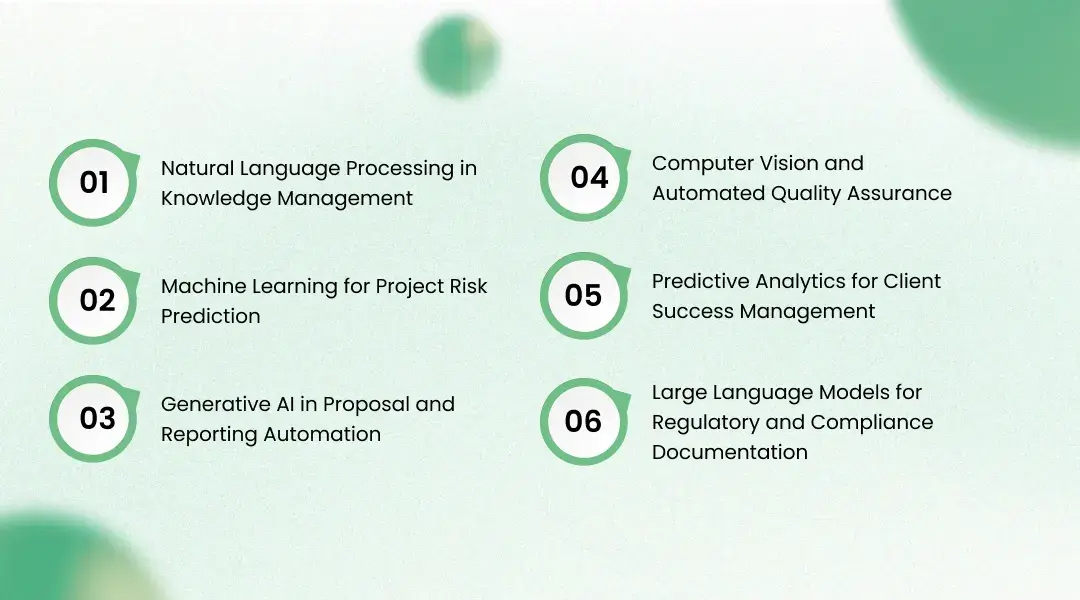
The most persistent operational failure in AI services firms is knowledge loss. Every engagement produces documents, model evaluation results, client-specific fine-tuning decisions, and lessons learned. In most firms, this material sits in shared drives and never gets retrieved again. Natural language processing applied to internal document repositories changes this completely. Vector-embedded knowledge bases allow consultants to query the entire intellectual output of the firm in seconds, surfacing relevant prior work, comparable client situations, and validated solution patterns. Firms implementing retrieval-augmented generation across their internal corpora report that consultant onboarding time drops by 30 to 35% and that the quality of early-stage client proposals improves measurably because they are grounded in real precedent rather than generic frameworks.
Project overruns in AI services are disproportionately caused by a small set of recurring failure modes: scope ambiguity in data contracts, underestimated integration complexity, client data quality gaps discovered late, and stakeholder misalignment at the milestone review stage. Machine learning models trained on historical project data can identify the leading indicators of these failures weeks before they surface. Firms that have built internal risk scoring systems report a 25% reduction in project overruns and a significant improvement in their ability to have honest client conversations before a problem becomes a crisis.
The business development function in most AI services firms is deeply labour-intensive. Proposals are written from scratch or from loosely maintained templates. Client reporting is assembled manually from multiple data sources. Generative AI applied to these workflows does not replace the consultant's judgment, but it eliminates the administrative drag. A proposal that previously required three days of senior consultant time can now be produced in draft form in four hours, reviewed and personalised in another two, and submitted with a higher degree of internal consistency. Monthly client reports that previously required analyst time across two days can be generated from integrated project data in under an hour.
For AI services firms delivering computer vision solutions to manufacturing, retail, or infrastructure clients, automated quality assurance of their own model outputs has become a critical capability. Rather than relying on human review cycles to catch model drift or annotation errors, leading firms now run continuous evaluation pipelines that flag anomalies in model performance within hours of detection. This capability is itself a demonstration of the firm's technical maturity and becomes a competitive differentiator in enterprise procurement conversations.
Client retention in AI services is driven by one variable more than any other: whether the client can see the value of what was deployed. Predictive analytics applied to model performance telemetry, business outcome metrics, and client engagement signals allows account managers to identify at-risk relationships before renewal conversations. KriraAI, which builds practical AI solutions for enterprises, has found that firms with instrumented client success pipelines achieve net revenue retention rates 18 to 22 percentage points higher than those relying on quarterly business reviews alone.
AI services firms operating across regulated industries face a growing documentation burden. Every model deployment requires explainability artifacts, bias assessments, data lineage documentation, and risk frameworks tailored to the client's regulatory environment. Large language models fine-tuned on regulatory language and internal compliance templates can generate first-draft versions of these artifacts at a fraction of the previous cost, allowing compliance-focused consultants to concentrate on judgment rather than drafting.
AI services transformation produces measurable results across every dimension of the business model when implemented with discipline and instrumentation.
Delivery efficiency is the most immediate area of impact. Firms that have automated their internal reporting, knowledge retrieval, and quality assurance workflows report a 35 to 45% reduction in non-billable hours per engagement. For a firm billing at standard enterprise rates, this translates directly into margin improvement without any change in pricing. A 200-person firm recovering 30% of previously non-billable administrative time is effectively adding the productive capacity of 60 full-time equivalents without additional headcount cost.
Proposal win rates improve significantly when proposals are grounded in real precedent and produced faster. Industry data from consulting benchmarks suggests that AI-augmented proposal development improves win rates by 12 to 18% compared to traditionally produced proposals, primarily because the quality of problem framing and solution specificity increases when the entire firm's prior work is accessible at proposal time.
Client retention is the area where the financial impact compounds most dramatically. An AI services firm with a 75% annual retention rate that improves to 90% through better client success instrumentation does not merely add 15 percentage points to a metric. It fundamentally changes the revenue base the firm can build on. Assuming an average contract value of $800,000, moving from 75% to 90% retention on a portfolio of 40 clients represents approximately $12 million in preserved annual recurring revenue.
Model deployment timelines are shortening across the industry. Firms that have standardised their internal MLOps infrastructure report that the time from model validation to production deployment has dropped from an average of 14 weeks to between 5 and 7 weeks. This compression matters to clients because it directly affects how quickly they see business value from the engagement.
KriraAI has documented that enterprise clients served by AI-native delivery models, meaning firms that have instrumented their own operations with AI, report 28% higher satisfaction scores at the six-month engagement mark compared to clients served by traditionally structured delivery teams. The difference is attributed primarily to transparency, responsiveness, and the quality of proactive communication.
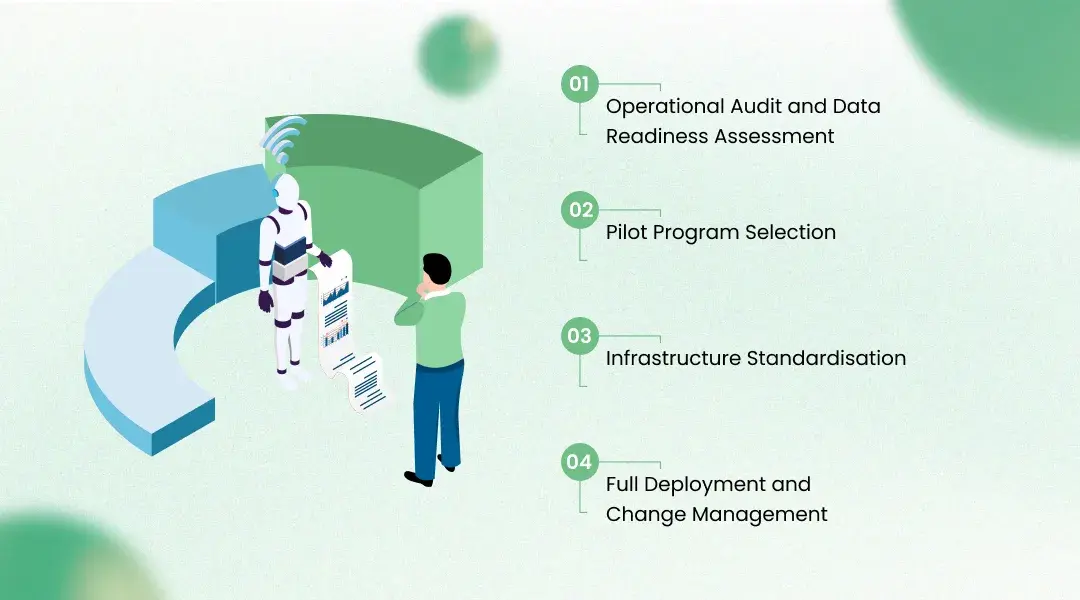
Implementing AI services transformation requires a disciplined sequence. Firms that attempt to deploy AI across all functions simultaneously typically achieve partial results in many areas and meaningful results in none. The following roadmap reflects the approach that produces durable outcomes.
Before any tool is deployed, the firm must understand where its knowledge lives, how projects are currently tracked, and what data is being generated but not captured. This audit typically takes four to six weeks and should cover:
Project management system completeness and historical data quality
Document repository structure and retrieval patterns
Client communication logs and their accessibility for analysis
Model performance telemetry, if any currently exists
Consultant time-tracking data and its granularity
The highest-value pilots for most AI services firms fall into three categories. First, internal knowledge retrieval using retrieval-augmented generation across the document repository. Second, automated first-draft generation for proposals and monthly client reports. Third, project risk scoring using historical project completion data. Each of these pilots can be scoped to six to ten weeks, requires minimal infrastructure investment, and produces results that are measurable within the pilot window.
Once pilots validate the value of AI-augmented operations, the firm must standardise the underlying infrastructure. This means establishing a unified data model for project and client information, deploying a vector database for knowledge retrieval, integrating with existing project management and CRM systems, and building the monitoring and evaluation layer that will track model performance over time.
Full deployment is where most transformation initiatives stall. The technology is rarely the bottleneck. The challenge is adoption.
The most frequent mistake is deploying AI tools without changing the workflows around them. A generative AI proposal tool that produces a draft nobody reads because the existing process does not include a review step adds no value. Every AI deployment must be paired with a redesigned workflow that makes using the tool the path of least resistance.
The second common mistake is failing to instrument success. Firms deploy internal AI tools and then have no mechanism to measure whether they are producing the outcomes they were designed to produce. Every deployment should have a defined metric, a baseline measurement, and a review cadence of no longer than 30 days.
The third mistake is treating AI transformation as a technology initiative rather than a leadership initiative. The firms that achieve the fastest adoption are those where senior leadership uses the tools visibly and publicly. When partners and directors are retrieving knowledge through the AI system and referencing its outputs in client meetings, adoption cascades through the firm naturally.
Honest assessment of AI services transformation requires confronting the real difficulties, not just the opportunity.
Data quality is the foundational challenge. AI services firms often have years of project history stored in formats that are not machine-readable, in locations that are not centralised, or with inconsistencies that make pattern extraction unreliable. A firm that has operated for ten years across multiple office locations and project management systems may find that its historical data requires six to eight months of remediation before it can support meaningful machine learning applications. This timeline is almost never reflected in initial transformation plans.
Talent gaps inside AI services firms are a genuine irony. These firms hire AI talent to serve clients, but that talent is typically allocated to client-facing delivery and has limited bandwidth for internal tool development. Building internal AI capabilities requires either protecting engineering time from billable work, which creates short-term margin pressure, or hiring specifically for internal engineering roles, which is a cultural shift for firms accustomed to revenue-generating headcount models.
Regulatory constraints are becoming more complex, particularly for firms serving financial services, healthcare, or government clients. Internal AI tools that process client data must comply with the same data handling requirements as client-facing deployments. This means that the knowledge base powering a firm's internal retrieval system may need to be segmented by client, encrypted at a granular level, and governed by policies that are themselves expensive to maintain.
Integration complexity is underestimated in almost every transformation program. Legacy project management systems, billing platforms, and CRM tools were not designed to expose data in formats suitable for machine learning pipelines. Integrating these systems requires custom engineering work that extends timelines and introduces maintenance obligations.
Change management remains the most human and most difficult challenge. Consultants who have built their professional identity around expertise and judgment can perceive AI tools as threats to that identity rather than amplifiers of it. Firms that do not invest deliberately in reframing AI as a capability multiplier rather than a replacement risk seeing their most experienced staff disengage from transformation programs precisely when their engagement is most needed.
Looking three to five years forward, the AI services industry will look structurally different from what it is today, and the differences will separate firms that have invested in transformation from those that have not.
The most significant shift will be the normalisation of outcome-based pricing. As AI tools give firms greater visibility into the relationship between inputs and business outcomes, the argument for time-and-materials pricing becomes progressively harder to sustain. Clients will increasingly expect AI services firms to price on delivered outcomes, whether that is cost reduction achieved, accuracy improvement measured, or revenue growth generated. Firms with instrumented delivery models will be able to accept this pricing structure and profit from it. Firms without instrumentation will either resist outcome-based contracts and lose them to competitors, or accept them without the data infrastructure to manage the risk.
Autonomous delivery agents will handle an increasing share of routine engagement tasks within five years. Monitoring pipelines, generating performance reports, flagging model drift, scheduling remediation work, and communicating status updates to client stakeholders are all tasks that current AI agent architectures can partially automate. The firms investing in agentic infrastructure today will have compounding advantages as the technology matures.
The competitive landscape will consolidate around two types of survivors. The first is the AI-native boutique, a small, highly instrumented firm that can deliver outcomes at a cost structure that larger, traditionally staffed firms cannot match. The second is the scaled AI-native platform, a larger firm that has successfully standardised its delivery infrastructure and can operate across dozens of simultaneous enterprise engagements with a fraction of the human overhead that legacy competitors require.
Firms that delay AI services transformation by more than two years from today will find themselves in a position where the productivity gap between their cost structure and that of transformed competitors is too large to close through incremental improvement. The window for catching up without structural disruption is open now and will not remain open indefinitely.
KriraAI, as a company that builds practical AI solutions for enterprises, is already observing this bifurcation in its client portfolio. Firms that began internal transformation programs in 2023 and 2024 are now competing on terms that firms starting in 2026 will find very difficult to match without a significant leap in investment and urgency.
Three points from this analysis deserve to carry forward. First, the AI services industry is experiencing a structural divide between firms that have embedded AI into their own delivery and those that continue to sell AI transformation while operating with pre-AI internal models. That divide is widening, not narrowing. Second, the measurable business impact of AI services transformation is real and well-documented across margin improvement, client retention, and competitive win rates, but it requires disciplined implementation, not opportunistic tool deployment. Third, the window for catching up to early movers is still open, but it will not remain open for more than two to three years before the cost and capability gaps become structurally prohibitive.
KriraAI works directly with AI services firms and enterprises to design and build internal AI infrastructure that is practical, instrumented, and built to scale. Rather than delivering a generic technology assessment and leaving implementation to the client, KriraAI constructs the actual pipelines, evaluation frameworks, and delivery automation systems that produce measurable outcomes. The firms that KriraAI has partnered with on internal transformation programs have consistently outperformed industry benchmarks on retention, margin, and competitive win rate within 18 months of program initiation. If your firm is ready to close the gap between the AI you sell and the AI you operate, reaching out to KriraAI is the most direct next step you can take.
AI services transformation refers to the process by which an AI consulting or managed services firm applies artificial intelligence to its own internal operations, delivery model, and client management functions rather than only advising clients to do so. This includes deploying machine learning for project risk prediction, using retrieval-augmented generation to surface institutional knowledge, automating proposal and reporting workflows with generative AI, and building continuous evaluation pipelines for model quality assurance. A transformed AI services firm differs from a traditional one in that its delivery quality scales with data accumulation rather than headcount growth, its cost structure improves over time rather than tracking linearly with revenue, and its client outcomes are measurable in near real time rather than reported quarterly after manual assembly. Firms that have completed meaningful transformation report 35 to 45% reductions in non-billable hours and significantly higher client retention rates.
The timeline for AI services transformation depends heavily on the firm's starting data quality and existing infrastructure. For a firm with reasonably centralised project data and modern project management tooling, a meaningful first phase covering knowledge retrieval, proposal automation, and project risk scoring can be completed in four to six months. Full transformation, including standardised MLOps infrastructure, integrated client success monitoring, and redesigned workflows across all delivery functions, typically requires 12 to 18 months of sustained investment. The critical variable is not technology but change management. Firms that invest in leadership alignment and workflow redesign alongside tool deployment consistently achieve transformation faster than those that treat it as a purely technical program. Attempting to accelerate beyond this timeline by skipping the audit and pilot stages typically produces poor adoption and no measurable business impact.
The return on investment for enterprise AI implementation within an AI services firm materialises across three primary areas. First, margin improvement from recovered non-billable hours, which at standard billing rates can represent $2 million to $5 million annually for a firm of 150 to 200 consultants. Second, revenue preservation through improved client retention, where a 10 to 15 percentage point improvement in annual retention can protect $8 million to $15 million in recurring contract value depending on average deal size. Third, competitive win rate improvements, where AI-augmented proposal development typically improves close rates by 12 to 18%, translating directly into new revenue. Firms that instrument their transformation correctly and measure it rigorously generally recover their internal investment within 14 to 20 months and achieve compounding returns in the years that follow, as their data assets appreciate and their operational models improve continuously.
The most common causes of failure in internal managed AI services adoption fall into three categories. The first is poor data quality, where the historical project and client data required to train risk models or power knowledge retrieval is incomplete, inconsistent, or siloed across systems. The second is adoption failure, where tools are deployed but workflows are not redesigned to incorporate them, resulting in parallel processes that consume more time than the old approach. The third is misaligned expectations, where leadership expects transformational results within 90 days from a program that requires 12 months to produce durable outcomes. Firms that treat internal AI transformation with the same rigor they apply to client engagements, including defined success metrics, staged milestones, and executive sponsorship, experience significantly higher success rates than those that approach it as an internal IT project with a narrow scope and a tight timeline.
AI consulting ROI for large enterprises and mid-market firms differs primarily in the speed of realisation and the nature of the highest-value applications. Large enterprises typically have more complex data environments, longer procurement cycles, and greater regulatory overhead, which extends the time to measurable value but also increases the absolute size of the return when it arrives. A productivity improvement of 15% in a 10,000-person enterprise generates far larger absolute savings than the same percentage improvement in a 500-person firm. Mid-market firms, by contrast, tend to achieve measurable AI consulting ROI faster because their data environments are less fragmented, their decision-making cycles are shorter, and the proportion of manual processes suitable for automation is often higher relative to their size. For both segments, the most reliable predictor of ROI is not the sophistication of the AI deployed but the quality of the change management and measurement infrastructure surrounding it.
Founder & CEO
Divyang Mandani is the CEO of KriraAI, driving innovative AI and IT solutions with a focus on transformative technology, ethical AI, and impactful digital strategies for businesses worldwide.