I’ve spent the last seven years inside real customer call datam restaurants flooded with delivery calls, clinics juggling appointment bookings, logistics teams dealing with “Where is my order?” chaos. Somewhere along the way, I became the person companies call when they finally say: “Okay, tell me how an AI phone agent actually understands speech.”
And honestly? Most people expect magic. Something mystical. Something sci-fi.
But Speech AI isn’t magic. It’s engineering. It’s language science. It’s math wearing a headset.
Still, the biggest surprise for business owners is this: AI phone agents don’t just “hear.” They understand. They understand accents, noisy calls, half-sentences, slang - because Speech AI is built exactly for that.
Let me show you how the entire thing works without the jargon that normally sends people running.
At KriraAI, whenever we provide custom AI voice agent development for a restaurant, a small business, or a SaaS platform, the heart of the system is always Speech AI.
Speech AI allows an AI phone agent, voice AI agent, or AI voice bot to:
Listen to a customer’s voice
Convert that voice into text
Decode the meaning behind the words
Decide what the caller actually wants
Respond instantly like a trained human agent
Whether you call it an AI calling agent, AI phone automation, automated phone answering AI, or an affordable AI phone agent, it’s designed to do one thing: handle real conversations in real time.
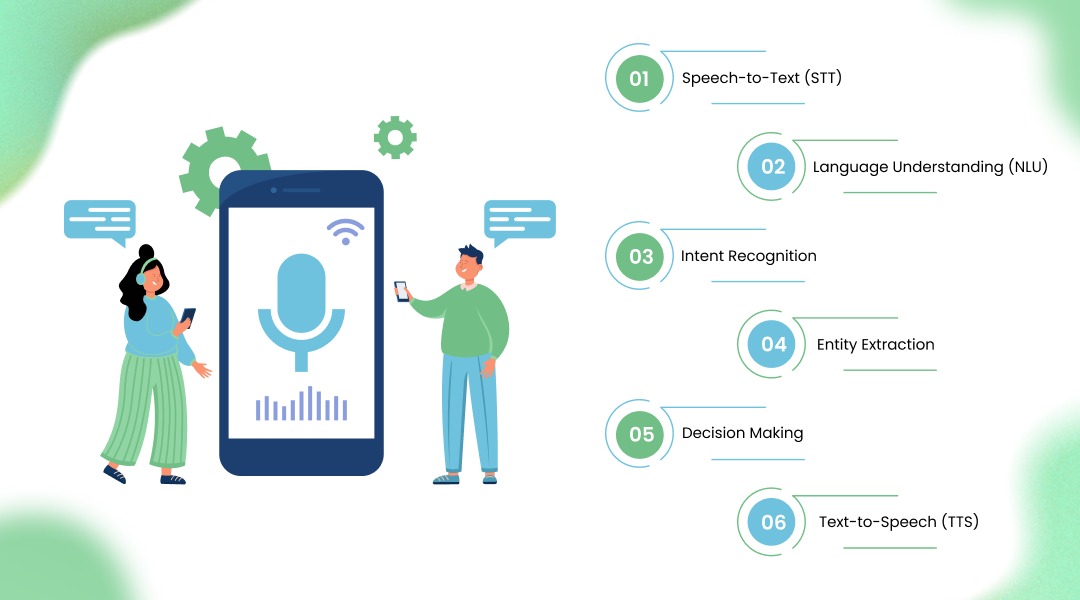
This is the part people misunderstand most. So let me show you the real workflow we use in every project.
This is the moment the AI “hears” the call.
Your customer says: "I want to book an appointment for tomorrow morning."
Speech recognition AI converts the sound waves into written text. Not perfect text. Not punctuation-rich text. Just text that captures the spoken content.
This is also where accents come into the picture. I’ve worked with Gujarati, Marathi, Tamil, and North Indian accents. (Yes, Speech AI handles them better than most humans assume.)
Once we have text, the AI needs to understand the sentence, not just the words.
It asks: “What does this person mean?”
That’s the job of Natural Language Understanding.
This is where the AI identifies the caller’s purpose:
Booking appointment
Checking order status
Requesting price
Placing a food order
Asking for business hours
Cancelling a reservation
When I build models for businesses, I usually create around 20–50 intents depending on the industry. For a clinic, the top intent is always booking an appointment. For restaurants, it’s placing an order. For logistics, it’s tracking a shipment.
This is my favorite part because it feels the most “human.”
The AI pulls important details out of the conversation:
Date
Time
Location
Name
Order number
Menu item
Size or quantity
Example: "Can you send a parcel to Surat tonight?"
Entities:
Action: send parcel
City: Surat
Time: tonight
This is where advanced Speech AI quietly does the heavy lifting.
Now the AI phone agent must respond correctly.
It checks business logic like:
Availability
Store hours
Delivery constraints
Customer history
Current operational rules
This is why small businesses find AI phone agents refreshing; they follow logic without losing patience, getting tired, or making errors at 10 PM.
This is the moment the AI “speaks back.”
But here’s a fun misconception: People think TTS voices must sound robotic.
Not true. Not anymore.
Modern voice engines give the AI calling agent warm, human-like tones that feel natural, even friendly.
You don’t need it to mimic a human perfectly. You just need it to be clear, consistent, polite, and fast.
Here’s what surprised one of my clients the most:
AI agents can understand
“Bhai, kal morning me ek appointment laga do.”
“Hello, order cancel karna hai.”
“Table for four tonight?”
“My package still hasn’t arrived yaar.”
“I need a return pickup tomorrow.”
Even mid-sentence switches:
"Haan, tomorrow morning jo slot hai… book that."
And because everything is processed in milliseconds, the AI feels responsive and sharp.
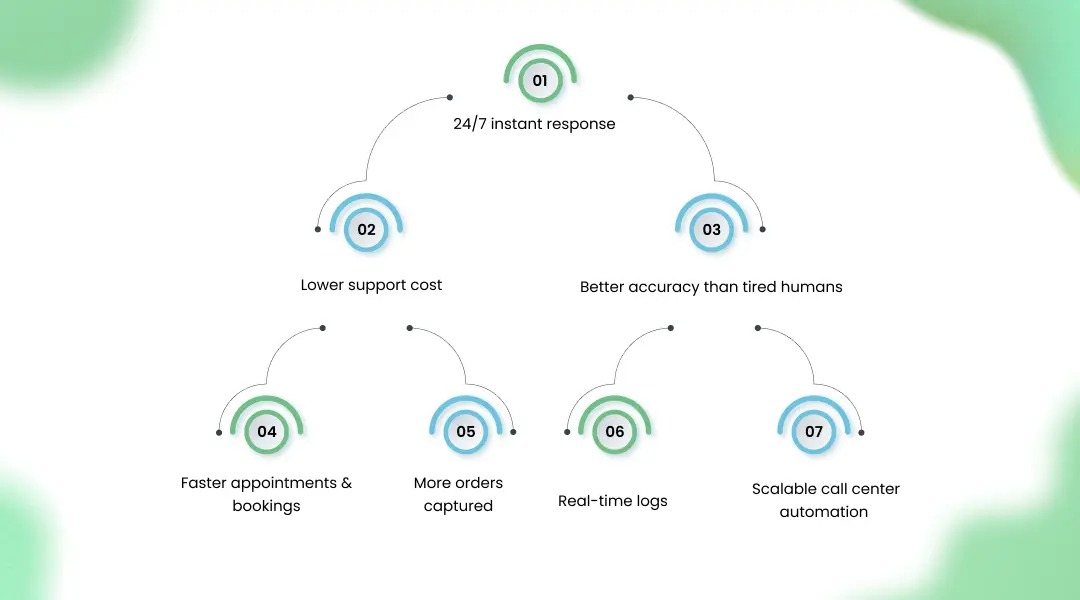
Once the Speech AI foundation is solid, the business impact is straightforward.
No ringing. No waiting. The AI answers immediately.
Many small businesses use AI phone agents for small business scenarios to reduce staffing load.
AI doesn’t lose concentration. Your 11 PM caller gets the same quality as your 11 AM caller.
Clinics and salons love this.
Restaurants see fewer missed calls.
You know exactly what callers asked for.
Large support teams leverage scalable AI call center automation strategies to handle heavy peak-hour call traffic seamlessly without agent burnout. Many companies find us through Best AI Voice Agent Solutions, AI Voice Agents Company, AI Chatbots, or when they specifically want to Hire AI Developer for custom implementations.
Over the years, I’ve deployed AI phone agents across:
Restaurants
Clinics & hospitals
Logistics & courier services
Real estate
E-commerce brands
Home service businesses
Hotels
Educational institutes
Car rental companies
Anywhere customers still make calls, AI helps.
Feature | AI Phone Agent | IVR |
Understands speech | Yes | No |
Conversations | Natural | Menu-based |
Accent support | Strong | None |
Handles complex queries | Yes | No |
Call routing | Intelligent | Rigid |
Personalization | High | Zero |
Updates | Real-time | Manual |
Customer satisfaction | High | Low |
Traditional IVR feels like a maze. AI feels like a conversation.
The next evolution is already happening:
Real-time sentiment detection
AI that adjusts tone based on caller mood
Multi-language switching mid-call
Context memory across multiple calls
Industry-specific intelligence models
Give it 12–18 months, and AI calling agents will feel less like “tools” and more like digital team members.
At KriraAI, we believe Speech AI is not a mystery. It’s not magic. It’s not overhyped tech waiting to fail.
It’s a practical, reliable system that helps businesses handle more calls, more accurately, at lower cost and with zero ego.
I’ve seen AI phone agents go from “risky experiment” to “daily necessity.” And if you’re still wondering whether it’s right for your business, here’s my honest take:
If customers call you often, AI will help you. Period.
Yes. Modern Speech AI models are built with large, diverse datasets and perform well across Indian regional accents.
Restaurants, clinics, logistics, hotels, and service businesses that receive frequent calls.
Usually within 200–500ms, making the conversation feel natural and interruption-free.
Yes. Unlike rigid menu-based IVR, AI understands speech, intent, and context—making the call feel human.
Absolutely. Many businesses use AI to book appointments, take restaurant orders, and handle repetitive tasks end-to-end.
Founder & CEO
Divyang Mandani is the CEO of KriraAI, driving innovative AI and IT solutions with a focus on transformative technology, ethical AI, and impactful digital strategies for businesses worldwide.