
AI in Marketing and Advertising: The Real Cost of Waiting
A recent industry survey found that marketing teams using AI-powered tools now produce campaign variations nearly five times faster than teams still relying on manual workflows, yet fewer than four in ten agencies report moving past the pilot stage. That gap between capability and adoption is the real story of AI in marketing and advertising today. The technology has moved well past the experimental phase. It now sits inside the tools planners use to buy media, the software copywriters use to draft headlines, and the dashboards executives use to forecast quarterly performance.
Brands that still treat AI as an optional add-on are quietly losing ground to competitors who have already rebuilt their workflows around it. This is not a story about robots replacing marketers, even though that fear gets most of the headlines. It is a story about which marketing organizations will still be competitive three years from now, and which ones will spend that time explaining to leadership why they waited so long to act. The businesses that move first are not necessarily the ones with the biggest budgets. They are the ones willing to restructure how decisions get made, often by bringing in focused AI consultancy support rather than attempting that shift alone.
This article walks through where the marketing and advertising industry stands today, which AI technologies are reshaping campaigns and media buying, the measurable results companies are reporting, how to implement AI without wasting budget, the real limitations nobody likes to talk about, and where this is heading by the end of the decade. Readers will come away with a grounded, practical view rather than another list of buzzwords. Each section builds toward one practical question: what a marketing leader should actually do this quarter.
Why Marketing and Advertising Teams Are Under More Pressure Than Ever
Marketing and advertising have always been a high-pressure business, but the last several years have tightened the vice in ways that are structural rather than cyclical. Media costs across paid search and paid social have climbed steadily as more advertisers compete for the same inventory, and that competition shows no sign of easing. At the same time, consumer attention has fragmented across dozens of platforms, formats, and devices, which means the old model of running one strong campaign across two or three channels no longer reaches enough of the target audience. Agencies and in-house teams are being asked to produce more creative variations, for more channels, on shorter timelines, with flat or shrinking budgets.
Privacy regulation has added another layer of difficulty. The gradual removal of third-party cookies, combined with tightening rules under frameworks like GDPR and CCPA, has forced marketers to rebuild targeting and measurement systems that took a decade to mature. Attribution, once already imperfect, has become genuinely difficult across a customer journey that might span a podcast ad, a retargeted display banner, a search query, and an in-store visit. Marketing leaders are being asked to prove return on investment with data that is measurably less complete than it was five years ago.
Talent adds a further constraint. Skilled media buyers, performance marketers, and creative strategists remain expensive and hard to retain, particularly at agencies competing against better-funded in-house teams for the same specialists. Client expectations have not adjusted downward to match these constraints, and the pressure to show quarterly growth has intensified, especially in categories like e-commerce, where dedicated e-commerce marketing support matters most because competitors are aggressive and switching costs are low. None of this touches AI yet. It is simply the operating reality that any technology adopted in this industry now has to solve for.
How AI in Marketing and Advertising Is Changing Campaign Strategy
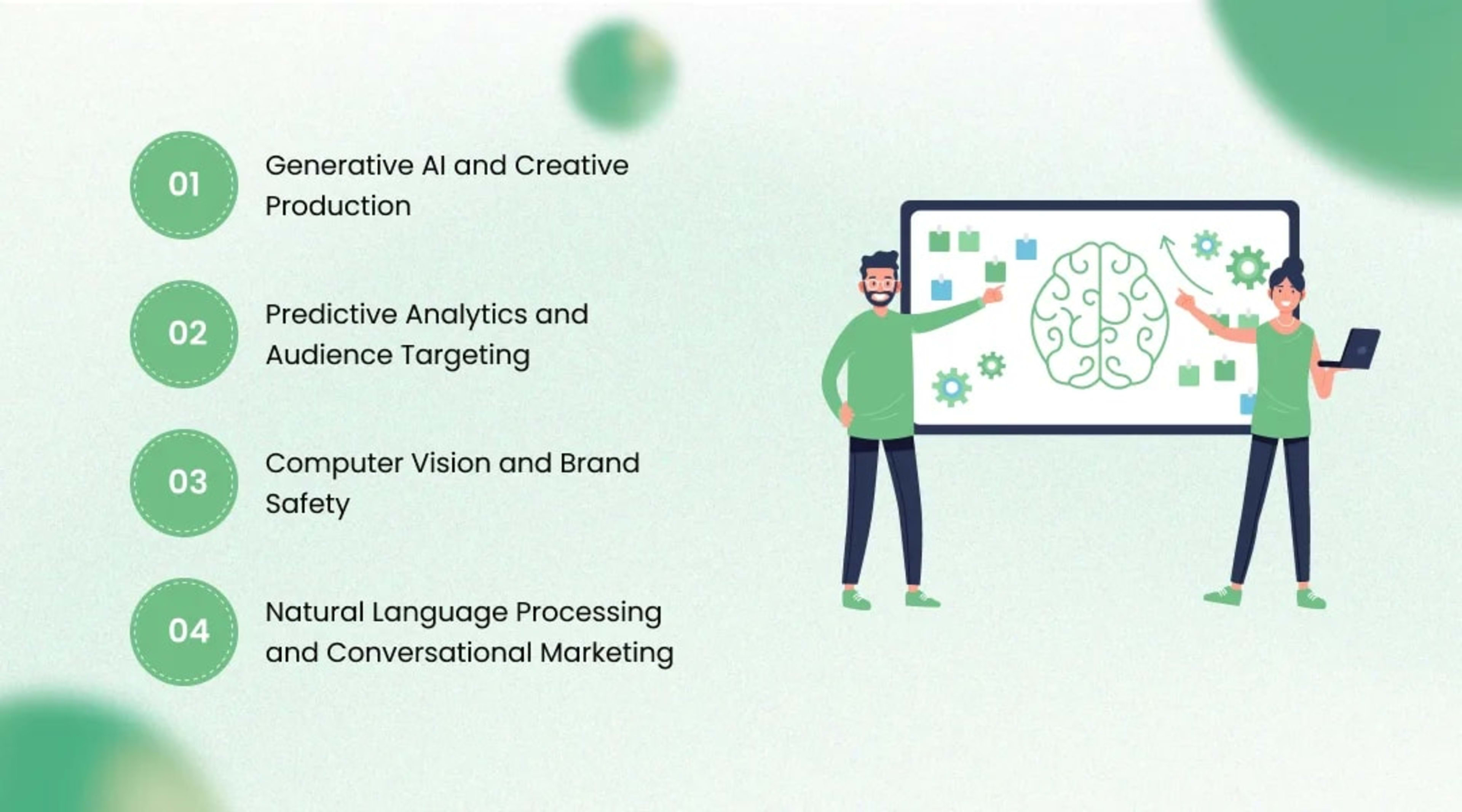
AI has moved into nearly every function inside a modern marketing department, but it is easiest to understand by looking at four specific technology categories and the exact problems each one solves. Generative AI, predictive analytics, computer vision, and natural language processing are not interchangeable tools. Each maps to a distinct part of the marketing workflow, from what gets created to who sees it to how performance gets measured afterward.
Generative AI and Creative Production
Generative AI in advertising is now responsible for producing early-stage copy, image concepts, and video drafts that used to take creative teams days to develop. Tools built on large language models can generate dozens of headline and body copy variations for a single campaign brief in minutes, which creative directors then edit and refine. Image generation models are being used for concept visualization and localization, where the same creative needs to be adapted for a dozen markets without reshooting anything. This does not eliminate the need for skilled copywriters and designers. It changes their job from producing every first draft to curating and elevating AI-generated options.
Predictive Analytics and Audience Targeting
Predictive analytics in marketing uses historical customer data to forecast which prospects are most likely to convert, churn, or respond to a specific offer, at a level of granularity manual segmentation never could reach. Instead of broad demographic buckets, predictive models score individual users based on behavior patterns, allowing budget to shift toward the segments most likely to produce a return. Media buyers are using these models to adjust bids close to real time, rather than waiting for a weekly report to make changes. Lifetime value prediction has also become far more accurate, which lets teams set acquisition budgets based on projected long-term value rather than guesswork.
Computer Vision and Brand Safety
Computer vision now plays a quieter but important role in brand safety and creative quality control. Automated systems scan video and image placements to confirm ads are appearing next to appropriate content, flagging anything that could damage brand reputation before a human has to review it manually. The same technology checks whether a brand's logo, colors, and layout guidelines are being followed correctly across hundreds of creative assets. For retail brands running thousands of product images, computer vision also automates tagging and categorization, once a slow manual process handled by junior staff.
Natural Language Processing and Conversational Marketing
Natural language processing powers the chatbots, virtual assistants, and sentiment analysis tools that now sit between brands and customers at nearly every touchpoint. Conversational AI handles a large share of routine customer inquiries, from order status to product recommendations, freeing human support and sales staff for higher-value conversations. NLP is also used to analyze social listening data and customer reviews at scale, giving marketing teams a real-time read on brand sentiment that used to require expensive manual research. Combined, these four technology categories, from generative AI versus traditional AI approaches to predictive analytics, computer vision, and NLP, are what people actually mean when they talk about AI in marketing and advertising, even though the phrase often gets used as a vague c catch-all
The Measurable Impact AI Is Already Delivering in Marketing
The return on AI investment in marketing and advertising is no longer theoretical, and companies that have moved past pilot programs are reporting results that are difficult to ignore. Marketing teams using AI-assisted content production report cutting first-draft creative turnaround time by roughly 40 to 60 percent, which translates directly into more creative testing within the same budget cycle. Performance marketing teams applying predictive analytics to bid management have reported cost per acquisition improvements in the range of 15 to 25 percent, largely because budget stops flowing toward audience segments that were never going to convert in the first place.
Personalization is where some of the most consistent gains show up. AI-powered marketing personalization, applied to email, on-site recommendations, and dynamic ad creative, has been associated with conversion rate increases in the 10 to 20 percent range across ee-commerceand subscription businesses. Customer service functions that deploy conversational AI for tier one support typically see support costs drop by 25 to 35 percent, while resolution times for routine queries fall from hours to under a minute. These are not marginal gains, and they compound across a fiscal year.
Several patterns show up consistently across companies that have adopted AI in marketing and advertising at a meaningful scale.
Content production speed typically improves by 40 to 60 percent once generative AI tools are integrated into creative workflows rather than used as standalone experiments.
Media buying efficiency, measured through cost per acquisition, tends to improve by 15 to 25 percent within the first two quarters of predictive analytics deployment, which reflects the growing role of data science in modern business strategy.
Personalized campaigns built on AI segmentation generally outperform static campaigns by 10 to 20 percent in conversion rate.
Customer service cost reductions of 25 to 35 percent are common where conversational AI handles a meaningful share of support volume.
These figures vary by company size and category, and any team should treat them as directional rather than guaranteed. What is consistent across nearly every credible report on this topic is the direction of the trend, with companies that integrate AI into core workflows pulling ahead on cost efficiency and campaign velocity at the same time.
How to Actually Implement AI in Marketing and Advertising
Most failed AI initiatives in marketing do not fail because the technology does not work. They fail because the organization tried to deploy a new capability on top of old processes, unclear ownership, and messy data. A disciplined rollout looks less like buying software and more like a structured change management project that happens to involve software.
Start with a readiness audit that maps existing data sources, tools, and workflows, since most marketing teams do not know how fragmented their customer data is until someone forces the inventory.
Identify one narrow, measurable use case for the first pilot, such as automating ffirst-draftad copy for a single product line, rather than overhauling the entire marketing function at once.
Assign clear ownership to a cross-functional lead who understands both the marketing objective and the mechanics of the AI tool being tested, since pilots without an accountable owner tend to stall.
Run the pilot for a defined period, typically eight to twelve weeks, with success metrics agreed in advance rather than judged retroactively.
Expand successful pilots to adjacent use cases and teams gradually, building internal case studies as you go, rather than jumping straight to an organization-wide rollout.
Establish governance guidelines covering data privacy, brand voice consistency, and human review checkpoints before scaling any generative AI tool that produces public-facing content.
Invest in training for the existing team rather than assuming new hires will solve the skills gap, since most marketers can learn to work with AI tools within a few weeks.
Companies like KriraAI, which build practical AI systems for enterprise marketing and operations teams rather than generic off-the-shelf software, tend to emphasize this staged approach because it reduces the risk of an expensive rollout that never gets adopted by the people meant to use it daily. A rollout that respects how marketing teams actually work will always outperform one that assumes total behavioral change overnight. That is why staged pilots, not sweeping mandates, tend to produce results that survive past the first budget review.
Common Mistakes and How to Avoid Them
The most common mistake is treating AI adoption as a tooling decision rather than a workflow redesign, which leads teams to buy several point solutions that never talk to each other. A second mistake is skipping the data quality step entirely, since even a sophisticated predictive model will produce unreliable results if trained on incomplete customer data. Teams also frequently underinvest in change management, rolling out a new tool without explaining to staff why it matters, which breeds quiet resistance that kills adoption months later.
Choose one integrated platform or a small number of tools that share data, rather than a dozen disconnected point solutions.
Clean and consolidate customer data before selecting a vendor, since quality problems will surface regardless of the tool chosen.
Communicate the reasoning behind the change to every affected team member, not just the leadership sponsoring the project.
The Real Limitations of AI Adoption in Marketing and Advertising
None of this should be read as an argument that AI adoption is simple or risk-free, because it is neither. Data quality remains the single biggest practical obstacle for most marketing organizations, since customer data is frequently scattered across a CRM, an e-commerce platform, an email tool, and several ad platforms that were never designed to share information cleanly. Predictive models and personalization engines are only as good as the data feeding them, and many companies discover this gap only after a pilot underperforms.
Talent is a real constraint as well. Marketing teams generally do not have staff who understand both marketing strategy and the mechanics of machine learning, which creates a dependency on external vendors that can slow decision-making. Regulatory exposure has also grown more serious, particularly around how customer data is collected and used to train models, with penalties under privacy laws in the United States and the European Union becoming more aggressively enforced. A marketing team that moves fast on personalization without a clear legal review process is taking on real financial and reputational risk.
Integration complexity is underestimated almost universally. Most marketing technology stacks were assembled over years by different teams with different priorities, and connecting a new AI layer to a decade of accumulated software choices is rarely as simple as a vendor demo suggests. Change management may be the hardest problem of all, since even a technically flawless rollout will fail if the people expected to use it daily do not trust the output. This is exactly where firms like KriraAI focus much of their consulting work, helping enterprise teams untangle legacy systems and build the internal buy-in that determines whether an AI initiative survives past its first budget review.
Where AI in Marketing and Advertising Is Headed Over the Next Five Years
Over the next three to five years, the marketing organizations that survive will look structurally different from the ones operating today. Agentic AI systems, capable of executing multi-step campaign tasks with minimal human intervention, are already moving from research demos into early commercial products. By the end of the decade, it is reasonable to expect these systems to handle entire campaign cycles, from audience selection through creative testing to budget reallocation, with marketers reviewing outcomes rather than executing every step manually.
Dynamic creative optimization will become the default rather than a premium feature, meaning ad creative will adjust in real time based on who is viewing it and where they are in the customer journey. Synthetic media, including AI-generated spokespeople and localized voiceovers, will likely become common for lower-budget campaigns, though premium brand campaigns will probably continue to rely on human talent for trust reasons. Search behavior is shifting too, as more consumers use conversational AI tools to research products, which means marketing teams will need to optimize for being cited inside AI-generated answers, not just ranking on a results page.
The competitive gap between companies that adopted AI early and those that waited is likely to widen rather than close, because early adopters are accumulating proprietary performance data that makes their models more accurate over time. Smaller and mid-sized companies that fail to adopt the core categories of AI in marketing and advertising will likely see rising acquisition costs relative to competitors who have already automated those functions. Agencies that do not evolve their service model around AI-assisted delivery may find themselves priced out by leaner competitors offering similar output at a lower cost.
Conclusion
Three things should be clear at this point. First, AI in marketing and advertising has moved from experimental novelty to operational necessity, embedded in how leading companies create content, target audiences, and measure results. Second, the measurable impact is real and significant, with companies reporting double-digit improvements in cost per acquisition, conversion rates, and content production speed once AI is integrated into core workflows rather than treated as a side project. Third, the risks and limitations, from data quality gaps to regulatory exposure to change management resistance, are genuine, but they are solvable with a disciplined, staged approach rather than a reason to avoid adoption altogether.
This is precisely the gap KriraAI was built to close. As a company focused on practical, enterprise-grade AI solutions rather than generic software, KriraAI works with marketing and advertising organizations to design implementation roadmaps that respect existing workflows, clean up the data foundations AI tools depend on, and scale pilots into durable, measurable capabilities rather than one-off experiments that fade after the initial excitement wears off. For companies still weighing whether to wait another budget cycle before acting, the honest answer is that the cost of waiting is no longer neutral, and it shows up in rising acquisition costs and a widening gap against competitors who already made the shift.
Marketing and advertising teams that want a clear, realistic path toward AI adoption, rather than another vague strategy deck, do not need to keep running isolated experiments that never scale past a single campaign. A short conversation is usually enough to identify where the highest impact starting point actually is for a specific team and budget. Reaching out to KriraAI is a practical next step for any marketing leader ready to move from cautious pilots to measurable, scaled results.
FAQs
AI in marketing and advertising is currently used across four main functions, which are content creation, audience targeting, customer service, and performance measurement. Generative AI tools draft ad copy, email subject lines, and image concepts that human teams then refine, cutting first-draft production time substantially. Predictive analytics models score individual customers based on their likelihood to convert or churn, allowing media budgets to shift toward the highest value segments in near real time. Conversational AI chatbots handle a large share of routine customer service interactions, while computer vision tools verify brand safety and creative compliance across large volumes of ad placements. Together, these applications touch nearly every stage of a modern marketing workflow.
The primary benefits of AI in advertising include faster creative production, more accurate audience targeting, lower customer acquisition costs, and better use of the marketing budget overall. Companies using AI-assisted creative workflows commonly report cutting content turnaround time by 40 to 60 percent, which allows more campaign variations to be tested within the same budget cycle. Predictive analytics typically improves cost per acquisition by 15 to 25 percent by directing spend toward audience segments most likely to convert. Personalization powered by AI has also been shown to lift conversion rates by 10 to 20 percent across e-commerce and subscription businesses, making it one of the more reliable near-term returns on AI investment in this industry.
AI is changing marketing and advertising jobs more than it is eliminating them outright, particularly for roles involving strategy, creative direction, and client relationships that require judgment AI cannot replicate. Entry-level and repetitive tasks, such as drafting first-pass copy or answering routine customer questions, are increasingly automated, which does reduce demand for some junior positions over time. At the same time, new roles are emerging around prompt engineering and marketing data science, and existing marketers who learn to direct and edit AI output tend to become more productive rather than obsolete. The net effect so far has been a shift in required skills rather than a wholesale disappearance of marketing employment, though the transition is genuinely disruptive for some workers.
Agencies and brands typically combine several categories of AI marketing tools rather than relying on a single platform for every task. Generative AI tools handle copywriting, image concepting, and video drafting, while predictive analytics platforms manage audience scoring, lifetime value forecasting, and media bid optimization. Customer data platforms increasingly include built-in AI features for segmentation and personalization, and conversational AI tools power chatbots across websites and customer service channels. Larger organizations often work with specialized implementation partners, such as KriraAI, to integrate these tools into one coherent workflow rather than a collection of disconnected point solutions.
Implementation costs for AI in marketing and advertising vary widely depending on company size and scope, ranging from a few thousand dollars a month for smaller businesses using off-the-shelf tools to six-figure annual investments for enterprises building custom predictive models. Most well-run pilots are structured to show measurable results within eight to twelve weeks, covering a narrow use case such as automated ad copy generation or predictive lead scoring for a single product line. Full organization-wide adoption, including workflow redesign, staff training, and governance policies, typically takes six to eighteen months, depending on how fragmented the existing marketing technology stack is.
Founder & CEO
Divyang Mandani is the CEO of KriraAI, driving innovative AI and IT solutions with a focus on transformative technology, ethical AI, and impactful digital strategies for businesses worldwide.