
AI in the Travel Industry: Conversational AI Use Cases and ROI for Airlines and Travel Brands
At 6:10 p.m. on a Friday, a line of thunderstorms shuts the hub of Coralwing Air, a fictional 38-aircraft regional carrier we will follow through this guide, and 14 departures are cancelled inside twenty minutes. About 1,900 passengers suddenly need a new seat, a hotel night or their money back, which is exactly the hour when AI voice agents for travel bookings either absorb the surge or expose the gaps in an airline's data. Spending on AI in travel industry service desks is usually justified with calm-day averages, yet the storm night is where the money is won or lost.
This guide is for the people who sign off on a budget like Coralwing's: airline customer service heads, OTA operations leads and the finance partners who rerun their numbers before each storm season. Across the sections below you will see which use cases to fund first, the plumbing that lets an agent rebook the Friday passengers instead of just apologizing to them, and an ROI model whose inputs you can swap for your own. The limitations get a full section too, because one bot that misstates a bereavement fare rule can cost more in a tribunal than it saves in a month.
Where AI in the Travel Industry Is Spending Its Money
Airline technology budgets reached record levels in 2025, generative AI sits near the top of the shopping list, and passengers are adopting AI planning tools even faster than carriers. The SITA 2025 Air Transport IT Insights report puts airline IT spending at 36 billion US dollars for 2025, roughly 3.6% of revenue, with generative AI and large language models listed among the three areas set to receive the biggest share of new investment. The same SITA study found that 63% of airlines already run AI inside operations control to manage disruption, so the back office is ahead of most contact centers.
Travelers have not waited for the industry. Almost half of respondents (49%) in the IATA Global Passenger Survey said they had used AI to plan a trip, and searching for flights to a particular destination was the most common job, reported by 21%. IATA's Nick Careen framed the task for airlines in two parts: make sure their offers show up inside AI tools, and build easy links that turn an AI conversation into an actual booking.
Trust in hands-off purchasing is far lower than trust in planning help. An Expedia Group survey covered by Skift in April 2026 found only 8% of travelers comfortable letting AI finish a booking without them. For Coralwing, that gap suggests a design rule: let the agent find, hold and explain the new seat, then ask the passenger to confirm before anything is ticketed.
Conversational AI, Explained Through One Rebooking Call
When a stranded Coralwing passenger explains her problem in plain words and the system checks her booking, applies the airline's rules and moves her to a new flight without a human typing anything, that is conversational AI at work. Picture a Coralwing passenger who says she was on the cancelled Friday evening flight, has a wedding on Saturday afternoon and needs anything that lands before noon. The system pulls her PNR (the passenger name record that holds her itinerary), finds two options, reads them back and moves her once she agrees.
The older alternative is the IVR, the interactive voice response menu that makes callers press 1 for baggage and 2 for bookings. The menu only decides which queue a Coralwing caller waits in, whereas the conversational agent can close the rebooking itself, and that gap is exactly what the cost model later puts a price on. Many systems now add agentic AI, meaning the model plans several steps and calls back-end tools on its own, such as checking seat inventory, rebooking and issuing a hotel voucher in one exchange.
Voice, Chat and Messaging Each Carry Different Coralwing Jobs
Which channel a Coralwing or Lanternway customer reaches for depends on their situation, so most conversational AI travel programs end up running more than one. A Coralwing passenger standing at a crowded gate with a dying phone battery will call, which makes voice the channel that decides disruption outcomes. A Lanternway customer comparing Bali and Hanoi packages on a Sunday morning prefers typing, which is where a travel chatbot on the website or in WhatsApp earns its place.
Messaging channels also suit tasks that span days, such as a visa document reminder that goes out a week before departure and waits for an upload. Voice suits urgency, while chat suits comparison and paperwork. A useful early exercise is to sort your top 30 contact reasons by which of those two moods the customer is usually in.
How a Voice or Chat Agent Moves From Question to Changed Booking
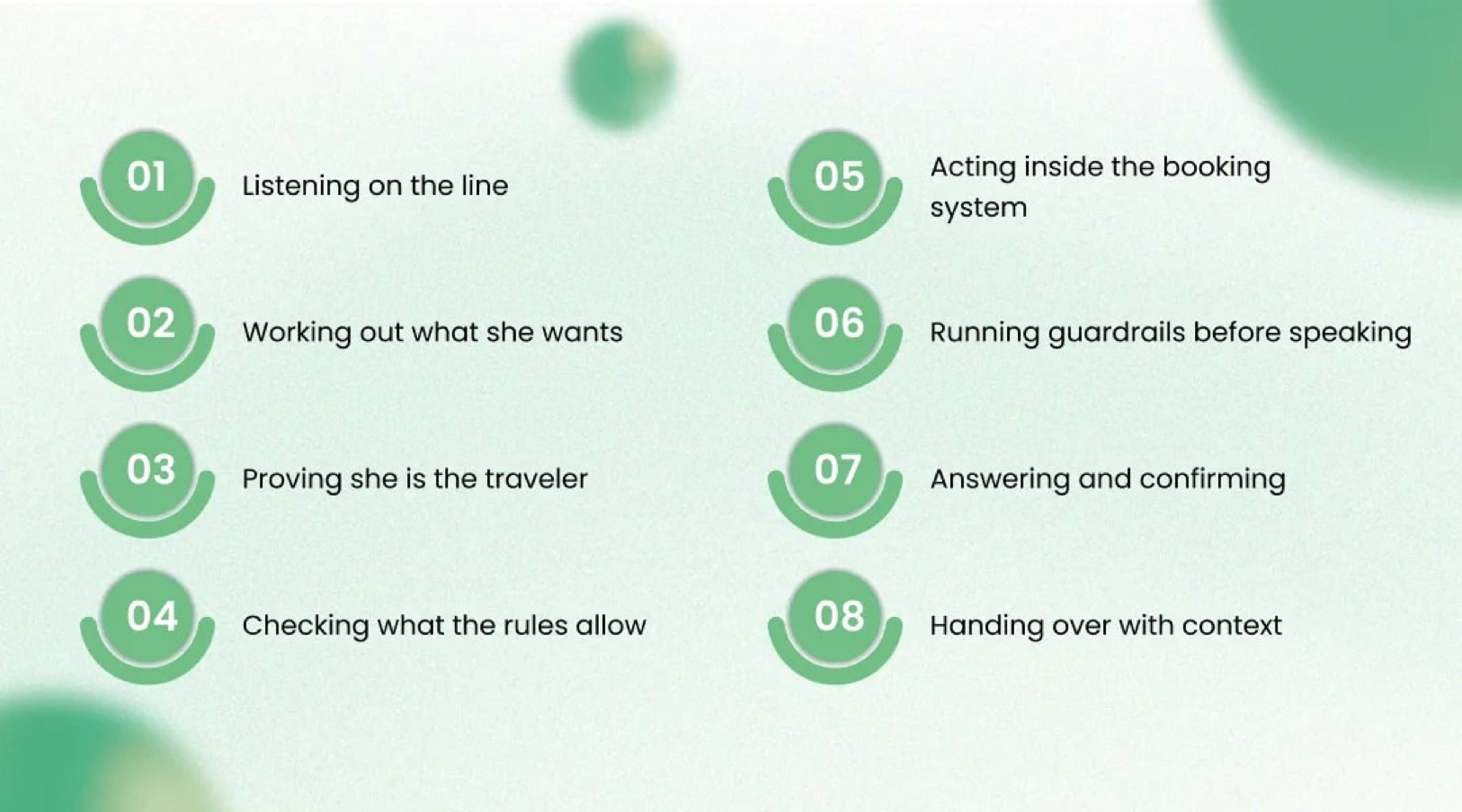
Behind the Saturday-wedding rebooking sits a chain of roughly eight components, and a weak link anywhere in that chain is what callers experience as a dumb bot. The sequence below follows her from her first sentence to her new boarding pass. Read it as a checklist for vendor demos, since each step is a place where a Coralwing-style pilot can quietly fail.
Listening on the line: speech-to-text converts her words into text as she speaks, and it has to cope with gate announcements, crying toddlers and accented English.
Working out what she wants: an intent and entity layer tags her request as a rebooking for one passenger with an arrival deadline of noon on Saturday.
Proving she is the traveler: the agent matches her booking reference and surname against the PNR before revealing any itinerary detail.
Checking what the rules allow: retrieval-augmented generation pulls the current disruption waiver and fare rules from a curated knowledge base, so the model answers from Coralwing's policy text instead of its own memory.
Acting inside the booking system: API calls to the passenger service system (PSS), the global distribution system (GDS) or an NDC order interface search inventory, hold the 7:05 a.m. seat and reissue her ticket.
Running guardrails before speaking: a policy layer blocks any promise the rules do not support, such as a cash refund on a fare that only allows credit.
Answering and confirming: text-to-speech reads back the 7:05 a.m. option, and nothing is ticketed until she says yes.
Handing over with context: if she asks for something outside policy, a warm transfer passes the full transcript and her noon Saturday deadline to a human, so she does not have to repeat herself.
Step five is where most of Coralwing's $400,000 integration budget would go. Read access to a PNR is usually easy to arrange, but write access that can reissue tickets and issue vouchers needs careful permission design. It also needs testing against half-finished transactions, such as a 7:05 a.m. seat released before the new ticket was confirmed.
Use Cases That Pay Back First for Airlines and OTAs
The quickest returns come from conversations like Coralwing's refund-status calls: high in volume, governed by rules, and already answered somewhere in a system that a human is slow to search. Disruption rebooking, refund status, baggage updates and booking changes fit that profile for carriers, while document checks and payment chasing fit it for online travel agencies. Creative trip inspiration, the most visible kind of AI in the travel industry, is the slowest to pay, because it is hard to measure and rarely replaces a paid human minute.
Airline Contact Center and Disruption Work
The strongest early case for AI for airlines sits in irregular operations, the industry's term for nights like Coralwing's Friday storm when the schedule breaks. On the storm night, an airline voice agent can phone all 1,900 Coralwing passengers in waves, offer the best two alternatives for each and leave the human queue for the medical, unaccompanied-minor and group bookings. The same flow can push hotel vouchers by text the moment a passenger accepts an overnight option.
Refund conversations need special care because the rules are legal, not just commercial. Under the US Department of Transportation automatic refund rule, in force since 28 October 2024, a flight change of more than three hours domestically or six hours internationally counts as significant, and the airline has to inform passengers that they are entitled to a refund before offering credits or vouchers instead. Any Coralwing flight touching the United States therefore needs a script where the refund option is spoken first, and the DOT rule also sets payment deadlines of seven business days for card purchases and 20 calendar days for other methods.
Calmer days at Coralwing bring their own volume: baggage allowance questions, seat changes, special meal requests and check-in help. A service call that ends well is also a sales moment, so a passenger who just fixed a seat problem can be offered extra legroom on the return leg. For a fuller look at airline-specific flows, our article on Voice AI for airline customer service covers flight assistance scenarios in more depth.
OTA, Tour Operator and Package Work
Online travel agencies face a different mix, dominated by visa paperwork, balance payments and supplier coordination. Take Lanternway Trips, a fictional mid-size OTA selling Bali and Hanoi packages, where a large share of inbound messages ask which documents a visa needs, whether the balance is due yet and whether the hotel has the late check-in note. A chat agent connected to the booking database answers all three from live data instead of from a generic FAQ page.
Outbound voice helps Lanternway as well, since the agency can let an agent call partner hotels in the local language to reconfirm room types for tomorrow's arrivals, then flag only the mismatches for staff. That one routine can free a reservations agent for most of a morning in peak season, although the exact saving depends on how many arrivals Lanternway handles each day. Payment reminders that speak the customer's name, Bali or Hanoi package and exact balance tend to collect faster than a generic email, although the size of that lift varies by market and is worth testing before you bank on it.
The Rest of the Travel AI Stack, Briefly
The voice agent that offers Coralwing's stranded passengers a 7:05 a.m. seat is only one layer of AI in travel industry operations, and the other layers decide how good its offer can be. Dynamic pricing engines adjust fares and package prices against demand, recommendation engines decide which Bali hotel or Coralwing seat upgrade to show, fraud detection screens risky card bookings and predictive maintenance flags aircraft components before they fail. When those layers disagree, for instance when pricing still shows a seat that inventory has already sold, the agent ends up apologizing for an error it did not make.
The practical point for a buyer like Coralwing is sequencing. If your fare and inventory data is messy, the agent will repeat that mess politely to 1,900 storm-night callers. Fixing data access first is less exciting than launching a voice agent, yet the SITA study also highlights data integration as the recurring obstacle to airline AI returns.
What Air India's AI.g Shows About Scale
Air India's AI.g is one of the clearest public records of AI in the travel industry working at airline scale. According to a Microsoft customer story published in 2026, AI.g handles about 40,000 customer queries a day across more than 1,300 question types, and it has resolved over 13 million conversations since launch with what the airline describes as a 97% success rate. The assistant went live in 2023 on Azure OpenAI models with retrieval over Air India's own policy content.
The more revealing figure is softer. The same Microsoft story notes that roughly half of Air India's customers now pick AI.g as their first contact point, while the other half still prefer a person. Read that as a planning input: even a mature deployment keeps a large human channel, so Coralwing's business case should shrink the queue rather than assume it disappears.
The 97% figure is also the airline's own measure rather than an audited industry benchmark. Before comparing any vendor's headline number with your pilot, ask exactly how a successful conversation was counted. Ask too whether passengers who called back the next day were treated as successes.
Building the ROI Case for Coralwing
A credible return model for Coralwing multiplies the agent minutes it removes by what those minutes cost, then subtracts every recurring cost the vendor quote leaves out. Labor is the dominant input, a point Gartner made in 2022 when it estimated that agent labor can represent up to 95% of contact center costs. The figures below are illustrative assumptions for Coralwing, built to show the arithmetic rather than to predict your result.
Model input
Calls Coralwing receives in a calm month
Coralwing illustrative value
60,000 calls, before any storm surge
Where your own figure should come from
Your telephony report for the last quarter, storm days included
Model input
Human cost of one Coralwing call
Coralwing illustrative value
$6.75, from 7.5 minutes at $0.90 per agent minute
Where your own figure should come from
Your fully loaded agent minute, replacing our $0.90 with supervisors and seats priced in
Model input
Coralwing calls the voice agent fully resolves
Coralwing illustrative value
30%, or 18,000 calls a month
Where your own figure should come from
Your pilot result after removing anyone who rang back within 72 hours
Model input
AI cost for each of those 18,000 calls
Coralwing illustrative value
$0.60, covering telephony, model and platform fees
Where your own figure should come from
The vendor quote at your real volume, checked against a 1,900-call storm hour
Model input
Coralwing upkeep outside the per-call price
Coralwing illustrative value
$30,000 a month for QA review, policy updates and monitoring
Where your own figure should come from
Your QA staffing plus the vendor support retainer, which the $0.60 rate leaves out
Model input
One-time integration and launch at Coralwing
Coralwing illustrative value
$400,000 for PSS access, testing and the first eight intents
Where your own figure should come from
The statement of work from your shortlisted partner, set beside the $400,000 here
Stress-Testing Coralwing's Payback Period
On those inputs, each resolved call saves $6.15, so 18,000 resolved calls remove about $110,700 of monthly cost, and subtracting upkeep leaves roughly $80,700. That pays back the $400,000 launch in about five months, before counting any storm night or ancillary sale. Now cut the resolution share to 15%, a plausible figure for a rushed launch: monthly net saving drops to about $25,350 and payback stretches past fifteen months.
That sensitivity is the whole lesson. Containment rate (in Coralwing's model, the 30% of calls that end without any agent touching them) moves the result far more than per-minute pricing does, so negotiate hard on integration quality and treat a cheaper per-call rate as secondary. Before you sign, it helps to see how another delivery team scoped a similar build, and the KriraAI travel AI case study walks through one travel and tourism AI project from brief to delivery.
Costs That Rarely Appear in the First Quote
Vendors price the conversation, while Coralwing pays for everything around it. Coralwing would need someone to rewrite policy text into clean knowledge base articles, a QA analyst sampling transcripts every week, telephony minutes for outbound waves and extra testing each time the fare rules change. Languages add cost as well, since each new language needs its own testing on accents, names of airports and local holiday dates.
Metrics to Watch in the First 90 Days
Measure each intent separately, because a blended average can hide a refund flow that fails one caller in five. For Coralwing, the useful dashboard tracks resolution rate by intent, repeat contacts within 72 hours, the share of transfers that arrive with full context, policy errors found in QA samples and customer satisfaction split by AI and human handling. A rising resolution rate paired with rising repeat contacts usually means the agent is closing conversations it did not actually solve.
Build, Buy or Partner: Choosing a Delivery Route
The right route for Coralwing or Lanternway depends on how deep the agent must reach into booking systems and how unusual each brand's policies are. A packaged platform could put a chat widget on Lanternway's site within weeks but may stop at reading data, while a custom build can write to Coralwing's PSS and follow its storm-night rules at a higher upfront cost. The table compares the three routes through the two example brands.
Route
Packaged chat platform bought off the shelf for Lanternway
Where it fits best
An OTA that mostly needs answers about visa documents and balances from its own booking data
Main trade-off to accept
Little control over how bookings change or how refund logic is enforced
Route
Custom build with a delivery partner, Coralwing's likely route
Where it fits best
A carrier that needs write access to its PSS and outbound calling on a storm night
Main trade-off to accept
Higher launch cost, near the $400,000 in our model, and a slower first live intent
Route
Fully in-house build, realistic only for groups far bigger than Coralwing
Where it fits best
Airline groups with ML engineers on staff and their own telephony, unlike a 38-aircraft carrier
Main trade-off to accept
Months of hiring before the first Friday-night test, plus ownership of each model and telephony upgrade
Teams on Coralwing's path usually want help with retrieval design, guardrails and model selection rather than with chat widgets. That work falls under Generative AI Development, which is the kind of engagement to scope when off-the-shelf tools cannot reach your booking logic. Whichever route you pick, keep ownership of the knowledge base and the storm-night transcripts in the contract so you can switch providers later.
Limitations: What Conversational AI Should Not Be Trusted With Yet
Conversational AI can still invent fare policy with total confidence, struggle on noisy gate calls and leave the travel brand legally liable for what it says, as one bereavement fare case showed. The clearest warning came from Canada in February 2024, when British Columbia's Civil Resolution Tribunal ordered Air Canada to pay C$812.02 after its website chatbot told a grieving passenger he could claim a bereavement fare after travel. The tribunal refused to treat the bot as a separate party and found the airline answerable for everything on its site, chatbot replies included.
That case is the extreme version of a broader problem. Several other limits matter for Coralwing and Lanternway alike. Each one below should shape the pilot scope rather than sit unread in a risk register.
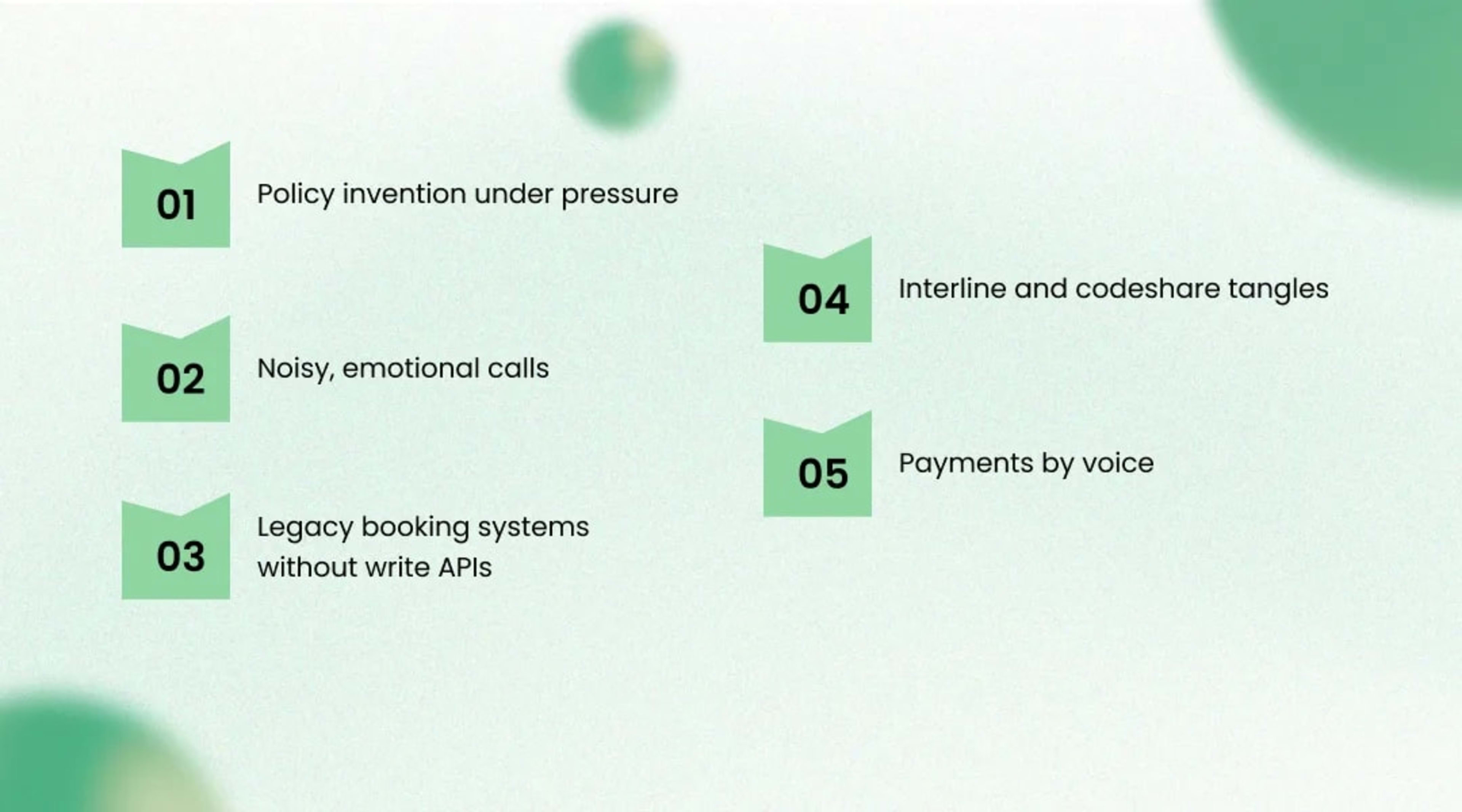
Policy invention under pressure: asked whether a Lanternway customer can swap one Bali night for a Hanoi night, a model may produce a plausible answer that no rule supports, which is why retrieval and guardrails sit before each reply.
Noisy, emotional calls: a Coralwing caller shouting over boarding announcements or describing a family death needs a human sooner, and many systems detect neither situation reliably.
Legacy booking systems without write APIs: where a host system only exposes screens, the agent may be limited to reading data and promising a callback.
Interline and codeshare tangles: a Coralwing passenger whose return leg is flown by a partner airline often needs manual handling that automation cannot finish on its own.
Payments by voice: a Lanternway customer reading out a card number on a recorded call creates PCI DSS exposure, so most deployments move that step to keypad entry or a payment link.
Regulation of AI in the travel industry is also catching up. Since 2 August 2026, Article 50(1) of the EU AI Act requires that people be told when they are interacting with an AI system, so Coralwing's agent should announce itself at the start of each call with a traveler in the EU. India's Digital Personal Data Protection Rules, notified in November 2025, bring their core consent, notice and breach duties into force after an 18-month window, around May 2027, which matters for any brand recording Indian travelers' calls.
Is Conversational AI Right for Your Operation?
Conversational AI fits operations like Coralwing's, with 60,000 repetitive calls a month and clean access to booking data, and it fits poorly where most conversations are bespoke. A carrier fielding tens of thousands of monthly calls about rebooking and baggage has an obvious case. A boutique tour operator selling twenty custom safaris a month probably does not, because its customers pay partly for the human planner and the volume is unlikely to cover integration costs.
If you do fit, a phased pilot keeps the risk small and the evidence clean. The plan below assumes read access to booking data already exists. Add four to six weeks if it does not.
Weeks one to three: pull six months of Coralwing's contact reasons, rank them by volume and by how rules-based the answer is, and choose three to five intents such as refund status.
Weeks four to eight: connect read access to the PSS first, rewrite the knowledge base from current fare and refund policy, and test the agent on internal staff calls only.
Weeks nine to twelve: open it to a small slice of live traffic, review transcripts daily and add write actions such as voucher issuing one intent at a time.
After launch: expand to storm-night outbound calling only after the agent has handled a few ordinary bad-weather days without policy errors.
Coralwing would start with flight status, baggage allowance and refund status, then add rebooking once the storm script has passed QA. Lanternway would start with visa document checklists and balance reminders. Neither brand should add outbound calling until inbound transcripts look clean for several weeks.
Planning Your First Pilot
A good first pilot looks like Coralwing's refund-status line: one contact reason, one channel and one clean data connection, earning the right to grow from there. For the next step, explore our Travel and tourism AI solutions and bring your top contact reasons to the scoping call. A storm-night test plan is the most useful thing to agree before anything goes live.
FAQs
A keypad menu can only send a Coralwing caller to the baggage queue or the bookings queue. A voice agent hears her full sentence about the cancelled Friday flight, opens the PNR and can finish the rebooking itself. Menus sort the 60,000 monthly calls, while agents remove handled minutes from them.
Depending on the provider and your access agreements, an agent can both read a PNR and reissue a ticket, but write access takes more work. Reading Coralwing's bookings is usually straightforward through existing APIs, while issuing a hotel voucher or new ticket needs scoped permissions and failure testing. Plan the pilot so read flows prove themselves first and write actions such as voucher issuing arrive one at a time.
Vendors commonly sell all three, often on top of a platform fee, and the cheapest-looking option depends on whether your calls average 7.5 minutes or three. Per-resolution pricing ties the vendor to outcomes like the 18,000 resolved calls in our model, but it needs a written definition of resolved that excludes callers who ring back. Price each option at a 1,900-call storm hour as well as a calm month before you compare.
Cloud voice platforms can run many calls at once, so on Coralwing's storm night the true ceiling is usually the booking system's API rate limit. If the PSS throttles rebooking requests, the 1,900 callers stack up behind it exactly as they would behind human agents. Load-test the whole chain with a simulated wave of 14 cancellations before the first real storm.
Legally, the brand usually owns the answer, as Air Canada learned when the 2024 bereavement fare ruling went against it. In practice Coralwing would need transcript logging, a weekly QA sample and a fast way to correct the knowledge base and contact each affected passenger. Confidence thresholds that send uncertain fare or refund answers to a human cut how often this happens.
It can start the payment, but a Lanternway customer should not read card digits into a recorded AI conversation. Most deployments switch the caller to keypad entry that skips the recording, or text a secure payment link for the Bali balance. Either approach keeps PCI DSS scope narrower for a mid-size OTA like Lanternway.
Yes, Article 50(1) of the EU AI Act has required that disclosure since 2 August 2026 whenever an AI system interacts with people. For Coralwing, an opening line in which the agent introduces itself as an automated assistant covers the spirit of the rule. Confirm the wording with counsel before launch, because Article 50 splits duties between the provider that builds the system and Coralwing as the deployer.
Brands with low contact volumes, highly bespoke products or no API access to booking data should wait, and a tour operator selling twenty custom safaris a month is a typical case. Their integration cost, closer to Coralwing's $400,000 than to a software subscription, is unlikely to be recovered. For these businesses, fixing data access often delivers more value than launching a voice agent before the next storm season.
Many pilots at a Coralwing-sized carrier reach limited live traffic in about twelve weeks when read access to booking data already exists, which matches the phased plan above. Write actions such as voucher issuing, extra languages and storm-night outbound calling usually come in later phases. Timelines stretch most when refund and fare policies are outdated and must be rewritten before the agent can use them.
Ridham Chovatiya is the COO at KriraAI, driving operational excellence and scalable AI solutions. He specialises in building high-performance teams and delivering impactful, customer-centric technology strategies.