The travel and tourism industry runs on timing, personalisation, and operational precision. When any one of those three breaks down, the consequences are immediate: abandoned bookings, negative reviews, revenue loss, and agents overwhelmed by queries they should never have needed to handle manually. Before KriraAI engaged with a leading travel enterprise operating across 38 destinations and processing over 2.4 million customer interactions annually, the company was caught in exactly this trap. Inventory was managed through spreadsheets reconciled every 48 hours. Customer queries were handled by a contact centre team of 340 agents working with disconnected CRM systems and no real-time access to availability or pricing context. Dynamic pricing models had not been updated in over three years and were entirely rule-based, unable to respond to demand signals, competitor pricing shifts, or seasonal volatility with anything approaching intelligence.
This blog covers the complete story of the AI solution for travel and tourism that KriraAI designed, engineered, and delivered for this client, from the operational problems that made the engagement necessary, through the architecture and technology choices that powered the solution, to the measurable outcomes achieved within six months of go-live.

Solution Architecture for an AI-Powered Travel and Tourism Platform To understand why the engagement began, it is necessary to understand the specific operational texture of the problem the client was living with every day. This was not a company that lacked data. The client had years of booking transactions, customer interaction logs, web session telemetry, third-party demand signals, partner API feeds from over 120 hotel and transport suppliers, and loyalty programme records spanning more than 850,000 members. The data existed. What the company lacked was any coherent infrastructure to make that data useful in real time.
The pricing team operated on a weekly cadence. Revenue managers would pull data from multiple supplier portals, consolidate it in Excel, apply manually configured markup rules, and publish updated rates to the booking engine on Monday mornings. By Tuesday afternoon those rates were already stale. Competitor price aggregators were updating their indices every four to six hours. OTA platforms like Booking.com and Expedia were adjusting their own promoted rates dynamically based on demand signals the client's team had no visibility into. The result was consistent revenue leakage. The company was regularly underselling high-demand inventory during peak windows and overselling discounted rates when full-price demand was available. Internal estimates put this pricing inefficiency at approximately 14% of potential annual yield.
The customer service operation carried its own category of dysfunction. Of the 2.4 million annual interactions, 61% were initiated through live chat or phone and involved queries that were fundamentally informational: booking modifications, cancellation policy clarifications, baggage allowance checks, visa requirement guidance, and itinerary customisation requests. These interactions averaged 8.4 minutes per contact. Each one required an agent to navigate between three separate systems, a legacy CRM, a booking database, and a policy document repository that was updated manually and inconsistently. Agent response quality varied significantly depending on experience level. New agents handling complex multi-leg itinerary queries produced incorrect or incomplete responses at a rate of approximately 23% before supervisor review.
The loyalty programme collected rich behavioural data across every booking transaction, but this data was siloed in a data warehouse that the marketing team accessed only for quarterly campaign analysis. Real-time personalisation at the booking interface was absent entirely. Every customer, regardless of travel history, booking frequency, destination preferences, or price sensitivity profile, received an identical homepage experience and identical promotional email cadences. Conversion rates on marketing emails had declined 31% over the prior two years as customer expectations for relevance matured and competitors with more sophisticated recommendation infrastructure began capturing share.
The final dimension of the problem was competitive urgency. Two direct competitors in the same mid-market travel segment had already begun deploying AI-assisted pricing and AI-powered chat interfaces. Customer satisfaction scores from the client's NPS programme showed a 12-point decline over 18 months that correlated directly with service speed and personalisation gaps. The board had committed to a digital transformation mandate with AI at its centre. The timeline for demonstrating results was 18 months. KriraAI entered the engagement with a clear brief: design and deliver an AI solution for travel and tourism that addresses pricing intelligence, customer interaction automation, and personalisation simultaneously, on a unified data and ML platform.
KriraAI designed and delivered the Intelligent Travel Operations Platform, a production AI system spanning three interconnected capability domains: real-time dynamic pricing intelligence, a conversational AI layer for customer interaction automation, and a personalisation engine powering the booking interface and CRM-triggered communications.
The pricing module ingests live demand signals from 14 external data sources, including competitor rate APIs, OTA demand indices, flight search volume telemetry, weather and event calendar feeds, and the client's own historical booking velocity data. A gradient-boosted ensemble model trained on 36 months of transaction history produces base demand forecasts at hourly granularity across all 38 destination corridors. These forecasts feed into a reinforcement learning pricing agent built on a Proximal Policy Optimisation architecture, trained in a simulated booking environment using historical conversion and revenue data as the reward signal. The agent updates recommended rates every 15 minutes and publishes them to the booking engine via a low-latency gRPC pricing service, replacing the previous weekly manual process entirely.
The conversational AI layer deploys a fine-tuned large language model as the primary interface for customer service interactions across web chat, mobile, and WhatsApp. The model is a transformer-based encoder-decoder architecture, specifically a fine-tuned variant of a 7 billion parameter instruction-tuned foundation model, adapted to the client's domain through supervised fine-tuning on 180,000 labelled historical agent conversations. The system is augmented with a retrieval augmented generation pipeline indexing the client's complete policy library, supplier terms, visa regulation databases, and real-time inventory state. Customer queries are handled end to end by the conversational AI for all intent classes with confidence above a calibrated threshold, while low-confidence and escalation-flagged interactions route to human agents with a full context summary pre-generated.
The personalisation engine operates on a dual-tower neural retrieval architecture. A user tower encodes customer profiles, incorporating booking history, browsing behaviour, loyalty tier, price sensitivity signals, and geographic origin into a dense embedding vector updated at each session event. An item tower encodes destination and package offerings, incorporating seasonal demand, margin profile, availability state, and content features. Approximate nearest-neighbour retrieval using HNSW indexing against a Pinecone vector database serves personalised ranked recommendations in under 40 milliseconds at the 95th percentile latency. The same user embeddings power the CRM segmentation layer, replacing static quarterly campaign lists with dynamically refreshed micro-segments updated daily.
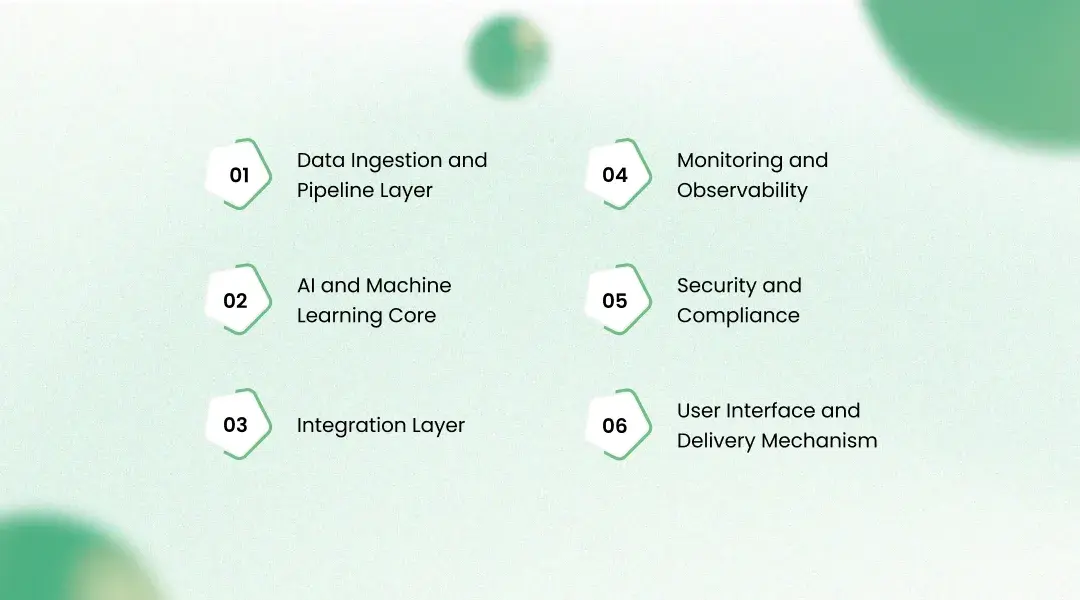
This is the technical centrepiece of what KriraAI engineered. The architecture is organised into six layers, each designed to operate independently while exposing well-defined interfaces to adjacent layers.
Data enters the platform through three primary ingestion paths. The first is change data capture from the client's operational PostgreSQL booking database and Oracle-based CRM, implemented using Debezium publishing to Apache Kafka topics with schema evolution managed through Confluent Schema Registry. The second is event streaming from the web and mobile booking interfaces, where clickstream events are instrumented via a custom analytics SDK publishing to the same Kafka broker cluster. The third is batch extraction from 14 external supplier and demand signal APIs, orchestrated by Apache Airflow DAGs running on a six-hour cadence for rate data and a 24-hour cadence for enrichment datasets including demographic and event calendar data.
Transformation logic runs on Apache Flink for stream processing workloads requiring sub-minute latency, specifically the real-time feature computation feeding the pricing agent and the session-level personalisation signals. Batch transformation jobs for model training feature pipelines run on Apache Spark on a managed Databricks cluster. Entity resolution across customer identifiers from web sessions, CRM records, and loyalty programme IDs is handled by a probabilistic matching pipeline using Splink, which reduced duplicate customer profile count by 38% during initial data quality remediation.
Feature materialisation follows an online-offline split. Offline features for model training are written to a Delta Lake feature store on Azure Data Lake Storage. Online features serving live inference requests are written to Redis with TTLs calibrated per feature freshness requirement, ranging from 60 seconds for pricing demand signals to 24 hours for customer preference embeddings.
The ML core hosts four model families. The demand forecasting ensemble combines LightGBM with temporal convolutional network components for sequential booking velocity patterns. The PPO-based pricing agent operates against a reward function balancing conversion probability and revenue per available unit. The conversational AI model is served from a dedicated inference cluster using vLLM with continuous batching, supporting up to 2,400 concurrent chat sessions with p99 latency under 1.8 seconds. The dual-tower personalisation model is trained on a weekly schedule using contrastive learning with in-batch negatives, with embeddings quantised to int8 precision using ONNX Runtime for efficient vector store writes.
Model training orchestration runs on MLflow with experiment tracking, artifact versioning, and model registry integration. Hyperparameter optimisation for the demand forecasting ensemble uses Optuna with a successive halving pruning strategy. All model artefacts are promoted through staging and production environments following automated evaluation gates defined against held-out validation sets.
The platform integrates with the client's existing booking engine, CRM, contact centre telephony, and WhatsApp Business API through a microservices integration mesh. Pricing recommendations are consumed by the booking engine via a synchronous gRPC service with circuit breaker and fallback logic ensuring degraded-mode pricing availability if the ML service is unreachable. The conversational AI layer connects to the contact centre platform via a webhook-based handoff protocol, delivering structured context payloads including intent classification, entity extraction results, and suggested resolution to agent desktops upon escalation. CRM campaign triggers consume dynamic segment membership updates via an event-driven architecture using Azure Service Bus, enabling near-real-time audience refresh without requiring ETL batch windows.
The MLOps monitoring layer tracks data drift, model performance, and infrastructure health as three independent signal planes. Data drift detection runs population stability index calculations hourly against reference distributions for all 47 input features feeding the pricing and personalisation models, alerting when PSI exceeds 0.2 for any feature. Model performance is tracked continuously against rolling held-out evaluation windows, with automated retraining triggers firing when revenue-per-recommendation degrades more than 3% below the 30-day trailing baseline. Latency percentiles at p50, p95, and p99 are tracked per endpoint using Prometheus and visualised in Grafana, with PagerDuty alerting on p99 breaches above defined SLOs. LLM-specific monitoring tracks response confidence scores, refusal rates, hallucination proxy metrics derived from retrieval grounding coverage, and escalation rate trends to detect conversational model degradation between retraining cycles.
The platform is deployed entirely within the client's private Azure Virtual Network with no public endpoints exposed. All inter-service communication is encrypted using mutual TLS. Customer personally identifiable information is masked at the feature store ingestion layer using attribute-level data masking, ensuring that raw PII never enters model training pipelines. Role-based access control governs all platform interfaces, with data science, engineering, and business analyst roles granted least-privilege access to specific dataset and model registry scopes. All model inference requests and responses are logged to an immutable append-only audit store on Azure Blob Storage with WORM retention policy, satisfying GDPR data processing audit requirements. Penetration testing was conducted prior to go-live by an independent security firm, with all critical and high findings remediated before production traffic was enabled.
Business users interact with the platform through a React-based operations dashboard providing real-time visibility into pricing recommendations, agent deflection rates, personalisation performance metrics, and model health indicators. Revenue managers can apply override rules with expiry timestamps, which propagate through the pricing service within one pricing cycle. The conversational AI is surfaced to customers through native web chat, a mobile SDK, and WhatsApp Business integration, all sharing the same underlying inference service and retrieval index.
Every component in the stack was selected based on the client's existing environment, the scale requirements, and the operational constraints of an enterprise travel business that could not afford extended downtime for platform changes.
Data Infrastructure: Apache Kafka was selected over alternatives like AWS Kinesis because the client required multi-region replication with deterministic ordering guarantees for the booking event stream. Databricks on Azure was chosen over standalone Spark because the client's data engineering team was already Azure-native and Databricks Unity Catalog provided the governance layer required for GDPR compliance without additional tooling. Apache Airflow managed batch pipeline DAGs because the existing data team had Airflow operational experience, reducing training overhead.
ML Infrastructure: vLLM was selected for LLM inference because its continuous batching implementation provided 3.4 times higher throughput than naive single-request serving at equivalent GPU memory utilisation, which was critical for achieving the cost-per-inference targets required to make the conversational AI economically viable at 2.4 million annual interactions. Pinecone was selected over self-hosted Weaviate for the vector database because managed infrastructure removed the operational burden from a client IT team not yet staffed for vector database operations.
Integration Infrastructure: Azure Service Bus over Apache Kafka for CRM event delivery was a deliberate choice. The CRM integration required exactly-once delivery semantics for campaign trigger events and Azure Service Bus provided this natively without requiring idempotency logic at the consumer layer. gRPC over REST for the pricing service was chosen because the booking engine makes pricing calls inthe critical path of every search result render, and gRPC's binary framing reduced per-request latency by 40% compared to equivalent JSON REST calls in load testing.
Monitoring: Prometheus and Grafana were selected because the client's infrastructure team already operated a Prometheus stack for application monitoring, enabling the ML observability layer to be integrated into existing alerting workflows and on-call rotations without additional tooling.
KriraAI structured the delivery across four phases spanning 14 months from initial discovery to full production go-live.
Phase 1: Discovery and Data Audit (Weeks 1 to 6) The engagement opened with a comprehensive data audit. KriraAI's data engineering team connected to the client's source systems and profiled every dataset that would feed the platform. The findings from this phase reshaped the initial architecture proposal significantly. The booking database contained 11 years of transaction history, but the first four years had schema inconsistencies from a legacy platform migration that made them unusable for training without extensive remediation. The CRM data had a customer identity fragmentation problem, with an estimated 22% of loyalty programme members having two or more duplicate profile records from multi-channel booking journeys. These findings were factual constraints, not discoveries to work around, and the data pipeline design was rebuilt to accommodate them from the start rather than treating them as out-of-scope cleanup.
Phase 2: Architecture Design and Proof of Concept (Weeks 7 to 16) KriraAI's ML architecture team designed the complete platform architecture in this phase and validated core assumptions through targeted proof-of-concept builds. The pricing agent's PPO training loop was prototyped against a simulated booking environment using three months of held-out historical data. Initial results showed the agent overfitting to seasonal patterns in the training window, producing pricing recommendations that maximised short-window conversion at the expense of yield. This required a reward function redesign that incorporated a rolling 14-day revenue-per-available-unit metric rather than a point-in-time conversion signal. After this redesign the agent achieved a simulated yield improvement of 11.3% against the held-out validation period.
Phase 3: Development and Integration (Weeks 17 to 40) Full platform development ran across three parallel engineering streams: data infrastructure, ML model development, and integration engineering. The most significant challenge in this phase was the booking engine integration. The client's booking engine was a third-party platform with a proprietary API that did not support the update frequency KriraAI's pricing service required. Rates could only be written to the engine in batches, not individually, and the batch write API had a 3.2-second execution time that introduced unacceptable latency for the real-time pricing loop. KriraAI's integration engineers resolved this by introducing a local rate cache layer within the booking engine's hosting environment, populated by the pricing service at 15-minute intervals, with the booking engine reading from the cache rather than calling the pricing API directly per request. This architecture decoupled the pricing update cadence from the per-request serving latency entirely.
Phase 4: Testing, Validation, and Go-Live (Weeks 41 to 56) A shadow deployment ran for six weeks before go-live, with the platform operating in parallel with the existing systems. Pricing recommendations from the AI system were logged but not applied, enabling comparison of AI-recommended rates against human-published rates against actual booking outcomes. This shadow period validated that the pricing agent was producing recommendations consistent with the proof-of-concept simulations in real production conditions. The conversational AI underwent a structured red-teaming exercise in which KriraAI's QA team and the client's contact centre supervisors submitted adversarial, ambiguous, and edge-case queries. Thirty-one query categories initially produced unsatisfactory responses, triggering targeted fine-tuning passes on each category before go-live sign-off.
Results were measured against a pre-defined baseline established during the discovery phase, covering the six-month period following full go-live.
Pricing and Revenue Impact: Pricing yield improved by 18.7% against the equivalent prior-year period after adjusting for broader market demand changes. The pricing team's weekly rate-setting process, which consumed approximately 340 person-hours per month across the revenue management function, was eliminated entirely. Revenue managers now spend their time on strategic override decisions and exception handling rather than data consolidation and manual rule application.
Customer Operations: Contact centre deflection reached 67% within three months of conversational AI go-live, meaning two thirds of inbound interactions were resolved entirely by the AI without agent involvement. Average handling time for the remaining 33% of human-handled interactions fell from 8.4 minutes to 5.1 minutes because agents received pre-generated context summaries and suggested resolutions at handoff. The contact centre team was reduced by 94 headcount through natural attrition over the six-month period rather than redundancy, with reallocation to higher-complexity customer relationship roles. First-contact resolution rate improved from 71% to 89%.
Personalisation and Conversion: Marketing email conversion rates recovered from their 31% decline and exceeded the previous baseline by 14%, attributed to the micro-segmentation model replacing static campaign lists. Homepage recommendation click-through rates increased by 22% within 60 days of personalisation engine deployment. Loyalty programme re-engagement, measured as inactive members making a booking within 90 days of a personalised trigger, increased from 4.2% to 11.6%.
Operational Efficiency: The platform processes approximately 6.8 million feature computations per day across all three capability domains with infrastructure costs that KriraAI's architecture optimisation brought to 34% below the initial cloud cost estimate developed during the design phase.
The platform KriraAI delivered was not designed for a fixed scope. Every layer was built with extension capacity that the client's AI roadmap is now beginning to activate.
The data infrastructure layer handles the current 6.8 million daily feature computations comfortably within 40% of provisioned Kafka partition capacity. When the client expands to 20 additional destination corridors over the next 18 months, the ingestion layer scales horizontally through partition rebalancing without architectural change. The feature store's online-offline separation means new feature families for new product lines, such as cruise itineraries or multi-destination packages currently being evaluated, can be added without affecting existing feature serving paths.
The ML core's model registry and evaluation gate infrastructure means the client's internal data science team, which KriraAI supported through a structured capability transfer programme, can develop and deploy new model versions independently. The MLOps pipeline supports continuous training workflows that will enable the personalisation model to move from weekly to daily retraining as the data science team's operational confidence grows.
The most strategically significant extension on the roadmap is a group travel AI planner, using the existing conversational AI infrastructure extended with multi-turn planning capabilities and a new retrieval index covering group accommodation and transport inventory. This capability will allow the client to address the group travel segment, currently handled entirely through a manual sales team, with an AI-assisted self-service flow that KriraAI estimates will serve approximately 30% of group enquiries without sales team involvement.
Other travel enterprises looking at this architecture should note that the platform's value is not in any single model but in the unified data foundation. Companies that have invested years in booking, CRM, and behavioural data without activating it in real time are sitting on the raw material for exactly this kind of platform. The integration patterns, the feature store design, and the model serving infrastructure described here are directly transferable to any mid-market or enterprise travel business with comparable data assets.
Three insights from this engagement stand out as broadly applicable to any AI transformation in travel and tourism. Technically, the most consequential architectural decision was the online-offline feature store split, which made it possible to serve real-time personalisation and pricing recommendations at enterprise scale without sacrificing model richness for latency. Operationally, the shadow deployment period before go-live was what gave the client's leadership the confidence to commit to full go-live without a rollback plan, because six weeks of parallel operation had already demonstrated real-world performance alignment with proof-of-concept results. Strategically, the decision to build on a unified data platform rather than deploy three independent point solutions meant that every new capability added to the platform inherits the full richness of the shared feature layer, compounding the value of the initial infrastructure investment over time.
KriraAI brings this same level of engineering rigour, architectural discipline, and delivery honesty to every client engagement. Every solution KriraAI delivers is designed to be a production system from day one, not a pilot dressed up as a platform, and every architecture decision is made with the explicit goal of creating a foundation that the client can extend and own long after the engagement closes.
If you are working through an AI transformation challenge in travel and tourism or any adjacent industry, bring it to KriraAI. The team is ready to engage.
An enterprise-grade AI solution for travel and tourism requires three foundational elements working in combination. First, a unified real-time data infrastructure that consolidates transactional, behavioural, and third-party demand signals into a single consistent feature layer, because AI models are only as good as the data they operate on, and most travel companies have years of valuable data siloed across disconnected systems. Second, a model serving infrastructure capable of handling peak booking traffic with latency guarantees, which typically means GPU-accelerated inference with continuous batching for language models and approximate nearest-neighbour retrieval for recommendation systems. Third, an MLOps layer that monitors model performance continuously and triggers retraining automatically when drift is detected, because travel demand patterns shift seasonally, and models trained on one demand environment will degrade in another without active maintenance. Companies that attempt AI deployment without investing in all three layers typically see initial results decay within six months.
A full-scale AI platform implementation for a travel enterprise with existing data infrastructure typically requires 12 to 18 months from discovery to production go-live, depending on data quality, integration complexity, and the number of capability domains in scope. The longest phase is usually not model development but data infrastructure remediation and system integration. In KriraAI's engagement with a leading travel enterprise, the data audit phase revealed significant customer identity fragmentation and historical schema inconsistencies that required six weeks of remediation before model training could begin. Companies that have already invested in modern data warehousing, event streaming, and API-first system architectures will move faster because the ingestion and integration layers require less custom engineering. Proof-of-concept validation for core model architectures can typically be completed within the first four months, allowing business stakeholders to see preliminary results before full production deployment.
Realistic ROI for AI implementation in travel and tourism depends on which capability domain is prioritised, but the most consistently high-return investment is dynamic pricing intelligence. A well-designed pricing AI operating on real-time demand signals typically improves yield by 12 to 20% over rule-based pricing systems, because it captures demand peaks and competitive positioning windows that human teams on weekly review cycles cannot respond to quickly enough. Conversational AI for contact centre deflection typically delivers cost savings equivalent to 20 to 40% of contact centre operating costs within 12 months of deployment, depending on the proportion of interactions that fall within automatable intent categories. For personalisation, the revenue impact is typically measured through conversion rate lift on recommendations and re-engagement improvement in loyalty programmes. Combined across all three domains, the leading travel enterprise that KriraAI served saw measurable impact within the first six months of go-live that justified the full platform investment, with the pricing yield improvement alone producing return on investment within the first operating year.
AI-powered dynamic pricing in travel operates on demand forecasting and competitive positioning logic, not arbitrary price increases designed to exploit individual customers. The system monitors aggregate demand signals, booking velocity, competitor rate positioning, and availability state to determine the market-clearing price for each inventory unit at each point in time. This is fundamentally the same logic that human revenue managers apply manually, but executed with far greater frequency, precision, and data depth. Customer perception concerns are managed through rate transparency, which means ensuring that the prices displayed are consistent across channels and that promotional rates are genuinely tied to advance booking or package bundling conditions rather than appearing arbitrary. The reinforcement learning pricing agent that KriraAI deployed optimised for a combined metric of conversion probability and revenue per available unit, which naturally prevents recommendations that maximise short-term price extraction at the expense of booking volume, because the reward function penalises conversion decline as directly as it rewards yield improvement.
Mid-market travel companies with annual booking volumes above approximately 50,000 transactions have sufficient data to support meaningful AI model training for demand forecasting and personalisation, and modern managed ML infrastructure has reduced the capital and operational cost of deployment significantly compared to five years ago. The architecture patterns that KriraAI used for a leading travel enterprise, including managed vector databases, serverless inference endpoints, and cloud-native feature stores, are available at fractional cost compared to the dedicated GPU cluster infrastructure that earlier-generation AI platforms required. The primary constraint for smaller travel businesses is not compute cost but data infrastructure maturity. Companies still operating on batch-reconciled inventory systems and siloed CRM databases need to invest in real-time data foundations before AI models can operate effectively. The sequence that KriraAI recommends is: invest in event streaming and unified customer identity infrastructure first, deploy AI models second, because the models require the data infrastructure to produce reliable results in production.
Founder & CEO
Divyang Mandani is the CEO of KriraAI, driving innovative AI and IT solutions with a focus on transformative technology, ethical AI, and impactful digital strategies for businesses worldwide.