International arrivals returned to roughly 1.4 billion in 2024, according to UN Tourism. Travel and tourism now account for close to one-tenth of global GDP. Demand has fully recovered. In many markets, it has overshot the 2019 peak. Yet operator margins have not recovered with it.
This is the uncomfortable shape of the current cycle. Volume is back, but profit per traveller is thinner than in 2019. Distribution costs are higher, labour is scarcer, and acquisition is more expensive. That gap is where AI in travel and tourism stops being a strategy deck exercise. It becomes an operating necessity instead.
The technology question is already settled. What is not settled is who deploys it well and who deploys it late. This blog makes a specific argument. Slow adoption is no longer the safe choice because the cost of waiting compounds faster than the cost of building. We will cover the real economics of the industry today. We will then examine the technologies now in production and the results operators report. Finally, we will set out a phased roadmap, the honest limitations, and the landscape by 2031.
Travel is one of the few industries where record demand coexists with deteriorating economics. Occupancy and load factors have normalised across most regions. Average daily rates have risen sharply in nominal terms. Underneath those numbers, the cost structure has shifted against operators, and it has shifted permanently.
Three forces are doing the damage: distribution, labour, and the collapse of any durable edge in acquisition. Every competitor now bids for the same intent signals in the same auctions. None of these problems was created by technology. None will be solved by working harder inside the existing model.
Online travel agencies typically take commissions of 15 to 25 percent on hotel bookings. Consider an independent property running a 20 percent operating margin. That single line item can consume the entire profit on an intermediated stay. Chains negotiate better terms, but the structural dependency remains.
The direct booking push of the last decade was an attempt to escape this. It has only partly worked, because direct is not free either. Paid search, metasearch bidding, retargeting, and loyalty discounting all carry real cost. Many operators found their blended cost per acquisition on direct channels approached what they paid in commission. They swapped a visible cost for a diffuse one. Without better conversion economics, the channel mix argument goes in circles.
Hospitality lost an enormous share of its workforce during the pandemic. A large portion never returned. Industry surveys through 2023 and 2024 consistently showed a majority of hotels reporting staffing shortages. Front-of-house and housekeeping roles were hardest to fill. Wages rose to compete, which helped recruitment but compressed margins further.
The operational consequence is subtle and expensive. Understaffed properties do not run leaner. They run worse. Response times lengthen, upselling stops, and review scores drift down. Rate power erodes six months later. The staffing gap becomes a revenue problem with a lag, which is why it gets misdiagnosed.
Airlines and tour operators face a parallel version of this. Contact centre volumes spike during disruption, precisely when staffing cannot flex. A single storm can generate a week of call backlog. The industry absorbs these costs as a fact of nature rather than a solvable systems problem.
AI in travel and tourism is no longer a category of experimentation. It is a set of specific technologies mapped to specific cost centres. Most have been in production at major operators for at least two years. The useful lens is not the algorithm. It is the problem each technique addresses.
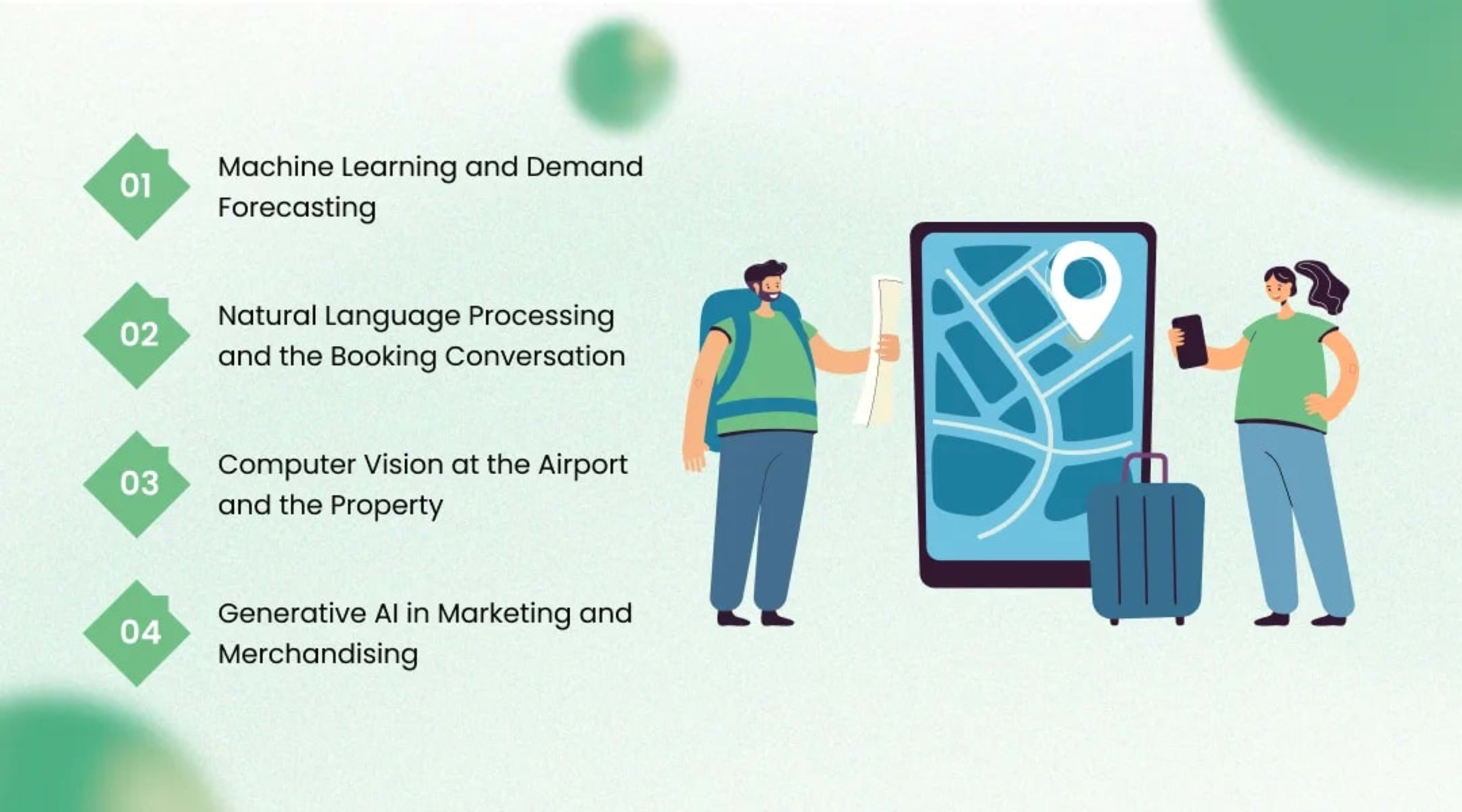
Revenue management has used statistical forecasting since the 1980s. What changed is the input surface. Modern models ingest search intent, competitor rates, event calendars, weather, and flight schedules. Those sit alongside historical booking curves. The forecast horizon extends further, and the error bands narrow.
This is the foundation of dynamic pricing as practised now in modern hospitality technology solutions. Rates update continuously rather than in a nightly batch. Length of stay controls, channel-level pricing, and overbooking limits adjust from the same forecast. Airlines run the same logic across fare classes and ancillary bundles. Hopper has publicly claimed roughly 95 percent accuracy on future airfare movement. That is the clearest consumer-facing proof that the underlying forecasting works.
Predictive analytics in tourism extends well beyond price. Destination management organisations forecast visitor flows and plan staffing at attractions. The same models help manage congestion at heritage sites. Cruise lines forecast onboard spend by itinerary and cabin category.
The booking funnel in travel is unusually conversational. Travellers ask compound questions that structured filters cannot answer. Consider a query about somewhere warm in March, direct flights only, good for a six-year-old. That defeats a traditional search index. It does not defeat a language model with access to inventory.
This is why AI chatbots for travel booking moved from deflection tools to revenue tools — though operators still need to understand how AI chatbots differ from AI voice agents for customer support before choosing which channel to build first. The first generation answered FAQs and reduced ticket volume. The current generation searches inventory, compares options, handles changes, and completes transactions. Expedia has shipped all conversational trip planning into its core products.
Named applications are already running in production across the sector. The five below are the most commercially significant. Each one is live at scale today, not in trial.
Conversational trip planning inside OTA apps, where the assistant proposes itineraries and books them in the same thread.
Disruption management for airlines, where systems proactively rebook affected passengers before they reach the gate.
Review summarisation at scale, turning thousands of unstructured guest comments into ranked operational issues by property.
Multilingual guest messaging lets a property serve inbound travellers in twenty languages without twenty staff members.
Voice agents handle inbound reservation calls, which remain a large share of bookings for resorts and independents, a pattern already documented in how AI voice agents power travel and hospitality use cases.
That last category is where KriraAI has concentrated much of its enterprise AI voice agent work. KriraAI builds production-grade AI voice and conversational systems for enterprises. That includes deployments where inbound reservation calls are answered, qualified, and converted without a queue. The engineering challenge is rarely the model. It is latency, telephony integration, and a clean handoff to a human when confidence drops.
Computer vision handles the physical layer. Biometric boarding is now deployed across major hubs. Automated bag drop and baggage tracking reduce mishandling rates. At properties, vision systems monitor queue length at reception and trigger staff redeployment before a line forms.
The less glamorous applications matter more financially. Vision-based inspection verifies housekeeping completion and room readiness. Damage detection on rental vehicles reduces disputed claims. Kitchen waste tracking identifies overproduction by station and shift, a highly controllable cost in resort food and beverage.
Travel marketing is a content problem at an absurd scale. A single OTA needs descriptions, translations, and imagery for millions of properties. Generative models now produce localised content, itineraries, and ad variants at a volume no team can match. The quality bar is set by structured inputs, not prompt cleverness.
AI travel personalization is the higher-value use of the same capability. Instead of one description for every traveller, the system assembles the version relevant to this traveller. A family sees the pool and the connecting rooms. A business traveller sees the desk, the wifi speed, and the transfer time. The inventory is identical. The merchandising is not.
The measurable results in travel cluster in four places. Those are pricing, service cost, conversion, and operational labour. The figures below reflect what operators and vendors report publicly. The ranges are wide because starting conditions vary enormously.
Revenue management is the most proven line. Hotels moving from manual pricing to a continuous model-driven pricing report have RevPAR gains of 5 to 12 percent. That is typically within the first year. The gain comes less from raising rates than from stopping two classic errors. Those errors are selling out too early on high-demand dates and discounting too late on soft ones.
Service cost is the second line, and it moves faster. Well-implemented conversational systems handle 60 to 80 percent of routine inbound contacts without human involvement. That covers booking status, changes, cancellations, directions, and policy questions. Apply that to a contact centre handling a million contacts a year. It is a structural cost reduction rather than an efficiency tweak.
Conversion is the third. Personalised merchandising and ranking consistently lift look-to-book ratios by mid-single-digit percentages. That sounds small until you apply it to gross bookings. A 4 percent conversion lift on a large booking base outweighs almost any cost saving elsewhere.
The fourth line is operational labour, and it is the most underrated. Automated review triage cuts the time to identify a recurring maintenance fault from weeks to days. Forecast-driven housekeeping scheduling reduces overtime. Disruption automation at airlines cuts rebooking handling time from tens of minutes to under two.
Three reference points are worth holding onto. Hopper has claimed roughly 95 percent accuracy on airfare price movement prediction. Biometric boarding has been reported to cut boarding times by up to 30 percent on large aircraft. Deflection rates above 70 percent are now routine in mature travel contact centre deployments.
The default posture in travel leadership is measured caution. Wait for the technology to mature. Watch the majors. In most cycles, that instinct is correct. In this one, it is expensive for reasons specific to travel economics.
Pricing advantage compounds. An operator running better forecasts prices better every day. Over a year, that is 365 compounding decisions against a rival making worse ones. The gap widens because better pricing produces better data, which produces better forecasts.
Data advantage compounds harder. Personalisation systems improve with interaction volume. An operator who started collecting structured data two years ago holds a training set that the late adopter cannot buy. Switching costs for travellers are near zero. That asymmetry decides who owns the relationship.
A third effect gets ignored. Traveller research increasingly starts inside a language model rather than a search engine. Operators whose inventory is not machine-readable are becoming invisible there. That is not a future risk. It is happening in the current booking cycle.
Most AI programmes in travel fail for organisational reasons, not technical ones. The model works in the demo. Then it dies in integration with a property management system built in 2004. A roadmap that ignores this reality produces slide decks rather than revenue.
The sequence below reflects how successful deployments actually run. Each phase has an exit condition. Skipping one guarantees rework later.
Data and systems audit, where you map every source of booking, guest, rate, and interaction data and grade it honestly.
Opportunity ranking, where candidate use cases are scored on financial impact, data readiness, and integration difficulty rather than novelty.
Constrained pilot, where one use case runs against one property or channel with a baseline agreed in advance.
Integration hardening, where the pilot connects to the property management system, the reservation system, and the CRM with error handling.
Staged rollout, where the system expands by cluster with a rollback path and an escalation route that is actually staffed.
Phase one is where most of the value is decided. Travel data is notoriously fragmented. It sits across property management systems, channel managers, loyalty databases, and contact centre logs. The same guest exists four times under three spellings. No model fixes that. Entity resolution and data plumbing do, and they are unglamorous works.
KriraAI approaches this ordering deliberately. The firm builds AI systems intended to run in production rather than to demonstrate well. That means a readiness assessment happens before model selection. The integration surface is scoped before anyone writes a prompt.
The failure patterns in travel are consistent enough to list. Each has a straightforward prevention. Each is routinely ignored anyway.
Starting with the most visible use case instead of the most tractable one, which guarantees a public failure first.
Running a pilot without a pre-agreed baseline, which makes the results unfalsifiable and the business case unwinnable.
Treating the model as the product, when integration, latency, and fallback logic decide whether anything reaches a guest.
Skipping the human escalation path, which turns one bad automated interaction into a review costing more than the automation saved.
Letting revenue and technology teams own separate versions of the truth, so nobody agrees on what the system achieved.
Buying a general-purpose tool for a workflow specific to your property type, region, or regulatory environment.
The prevention for all six is the same discipline. Define the measurable outcome. Instrument it before you start. Give one accountable owner the authority to stop the project. Operators who do this reach production in months. Operators who do not spend years in pilot purgatory.
The honest constraints in this industry are real. Pretending otherwise damages credibility. Data quality is the first and largest. Legacy property management systems were never designed as data platforms. Extracting clean, structured history from them is frequently the longest task in a deployment.
Regulation is the second. Travel operators handle passport data, payment credentials, and detailed movement histories across jurisdictions. GDPR obligations, sector rules on biometric processing, and localisation requirements in markets such as India all constrain architecture. Biometric boarding, in particular, sits under active regulatory scrutiny in several regions. Consent design is not optional.
The talent gap is the third and most persistent. Travel companies compete for machine learning engineers against technology firms paying substantially more. Very few operators will win that fight through hiring alone. The realistic answer is a mixed model. Internal domain expertise pairs with an external engineering partner. This is the gap KriraAI was built to fill. The firm supplies production engineering capability to enterprises holding deep domain knowledge but limited deployment capacity.
Integration complexity deserves its own warning. A conversational system may need to speak to a property management system, a channel manager, and a payment gateway. Several expose limited or brittle APIs. The estimate that assumed two weeks of integration has become two months.
Change management closes the list. Front-line staff who believe a system exists to eliminate their role will not report its failures. That silence is more dangerous than the failures themselves. Successful deployments are framed around removing the worst parts of the job. The framing has to be true.
The next five years will be defined by a shift from assistance to delegation. Today, a traveller asks a system for options and then executes the booking. By 2031, a meaningful share of trips will be booked by agents acting on standing instructions. The traveller approves rather than searches. That single change rewires distribution.
The consequence for operators is severe and specific. If a machine chooses between properties, brand advertising loses leverage. Machine-readable evidence gains it. Structured availability, verified attributes, real pricing, and clean policy data become the ranking factors. Operators whose inventory is legible only to humans will not be considered at all.
Three capabilities will become normal that are not normal today. The first is individualised pricing and packaging at the traveller level rather than the segment level. The second is autonomous disruption recovery. A cancelled flight would trigger a rebooked itinerary, an amended hotel reservation, and a notified transfer without human involvement. The third is predictive maintenance and energy optimisation across property portfolios, driven as much by emissions reporting as by cost.
The companies left behind will not be the ones that lacked capital. They will be the ones who treat AI in travel and tourism as a marketing layer over unchanged operations. The advantage accrues to operators who rebuilt their data foundation first. Every subsequent capability sits on it. That work takes two to three years, which is why starting in 2029 will not be an option.
Three points carry the argument. First, travel's margin problem is structural. It is driven by distribution costs, a labour gap that never closed, and punishing acquisition economics. Second, AI in travel and tourism already delivers measurable results in pricing, service cost, conversion, and operations. RevPAR gains of 5 to 12 percent and contact deflection above 70 percent are realistic benchmarks. Third, the advantage compounds, which is why late adoption is more expensive than early implementation, rather than safer.
The practical implication is about sequence, not ambition. The operators pulling ahead did not start with the most impressive use case. They started with a clear-eyed data audit and picked a tractable problem with a measurable baseline. They hardened the integration and only then expanded. Most of the difficultylies inn the plumbing between systems. That is where programmes either survive or quietly die.
This is the work KriraAI does. KriraAI builds and deploys production-grade AI systems for enterprises. That includes conversational and voice agents, predictive analytics in tourism, and the data engineering behind both. The emphasis is on solutions that are practical, measurable, and built to scale beyond one pilot property. If a pilot has stalled short of production, it is worth a conversation with the KriraAI team.
AI in travel and tourism is used across four main areas: pricing, customer service, personalisation, and operations. Machine learning models power revenue management and dynamic pricing in hospitality. Rates update continuously from demand signals, competitor pricing, local events, and weather. Natural language processing runs conversational booking assistants, multilingual guest messaging, and automated disruption rebooking for airlines. Computer vision supports biometric boarding, baggage tracking, and room readiness verification. Generative models drive AI travel personalization, producing localised content and merchandising at scale. Major operators, including Booking.com, Expedia, and Trip.com, run several of these systems concurrently.
AI is not replacing travel agents or hotel staff at scale, but it is changing what those roles do. Automation absorbs routine, repetitive contacts such as booking status checks, simple changes, cancellations, and policy questions. Those typically represent 60 to 80 percent of inbound volume in mature deployments. What remains is complex, high-value, or emotionally sensitive work. That is where human judgement produces better outcomes and higher revenue. The realistic effect in hospitality differs from replacement. The industry has faced persistent staffing shortages since 2020. Automation is mostly filling gaps operators could not staff anyway, rather than displacing existing employees.
The measurable benefits of AI in tourism cluster in four categories with reasonably consistent ranges. Hotels moving to continuous model-driven pricing commonly report RevPAR improvements of 5 to 12 percent within the first year. AI chatbots for travel booking handle 60 to 80 percent of routine inbound contacts unaided. That reduces contact centre costs structurally rather than marginally. Personalised ranking lifts look to book conversion by mid-single-digit percentages. That is significant against a large booking base. Biometric boarding has been reported to cut boarding times by up to 30 percent. Automated disruption handling reduces rebooking times from tens of minutes to under two.
Hotels use AI for dynamic pricing in hospitality by forecasting demand granularly. The system then adjusts rates, length-of-stay controls, and channel allocation continuously. The model ingests historical booking curves, current pace, competitor rates, and search intent. It also reads local event calendars, inbound flight schedules, and weather. It then produces a demand forecast per date, per room type, and per segment. Rates update throughout the day rather than in a nightly batch. The primary financial gain comes from avoiding two recurring errors. The first is selling out early on high-demand dates at rates that are too low. The second is discounting too late, once the booking window has already closed.
AI in travel and tourism can be operated safely, but it requires deliberate architecture rather than default configuration. Travel operators process passport details, payment credentials, biometric identifiers, and detailed movement histories. All of these attract strict regulatory treatment. GDPR governs European traveller data, and biometric processing carries extra sector rules in several jurisdictions. Markets such as India also impose data localisation requirements. Safe deployments therefore restrict what data reaches a model and keep sensitive processing inside controlled environments. They also log every automated decision for audit and design explicit consent flows for biometric use. The risk is real and manageable, but it must be addressed at design time rather than retrofitted after launch.
Founder & CEO
Divyang Mandani is the CEO of KriraAI, driving innovative AI and IT solutions with a focus on transformative technology, ethical AI, and impactful digital strategies for businesses worldwide.