Let me start with a question.
When a customer contacts your business… Do they prefer typing a message or speaking to someone?
Pause for a second and think about that.
Because that single preference often decides whether a business should deploy an AI chatbot for customer support or an AI voice agent for customer support.
I’ve worked with companies implementing AI customer support automation for years. And I’ve noticed something interesting.
Most businesses don’t fail because AI doesn’t work.
They fail because they choose the wrong type of conversational interface.
A chatbot was installed where customers wanted voice. A voice bot was deployed where customers preferred text.
Result?
Confusion. Frustration. And a support team is still drowning in tickets.
So let’s clear the air.
This guide will walk you through the real differences between AI chatbot vs AI voice agent, when each works best, and how businesses should decide between them.
An AI chatbot for customer support is a text-based software assistant that interacts with users through messaging interfaces like websites, apps, or social platforms.
Customers type questions. The chatbot responds instantly.
Simple idea. Powerful execution.
Modern chatbots use natural language processing and conversational AI for customer support, which allows them to understand user intent rather than just matching keywords.
At a basic level, an AI chatbot processes three things:
User input (text message)
Intent recognition using AI models
Automated response generation
For example:
Customer: "Where is my order?"
The chatbot detects the intent → order tracking request.
Then it retrieves order data and replies instantly.
No human agent required.
Businesses often use AI chatbot for business support in areas like:
Order tracking
FAQ automation
Refund policies
Product recommendations
Lead qualification
The best part?
A single chatbot can handle thousands of conversations at once.
Yes. Thousands.
Try doing that with a human team.
Now let’s talk about the other side of the comparison.
An AI voice agent for customer support is a conversational system that communicates through spoken language instead of text.
Customers talk. The system listens. AI generates a spoken reply.
This is often referred to as:
AI voice assistant for business
AI voice bot
voice AI automation
Same idea. Different labels.
A voice bot combines three major technologies:
Speech recognition – converts voice to text
AI language understanding – processes intent
Text-to-speech – converts response back into voice
The result?
A conversation that feels surprisingly human.
(And sometimes… slightly eerie. I’ve seen people ask voice bots how their day is going.)
Businesses typically use AI voice agents in environments like:
Call centers
Banking customer service
Appointment booking systems
Telecom support lines
Anywhere customers naturally pick up a phone instead of opening a chat window.
Now we reach the real comparison.
AI Chatbot vs AI Voice Agent isn’t about which technology is better.
It’s about which communication style your customers prefer.
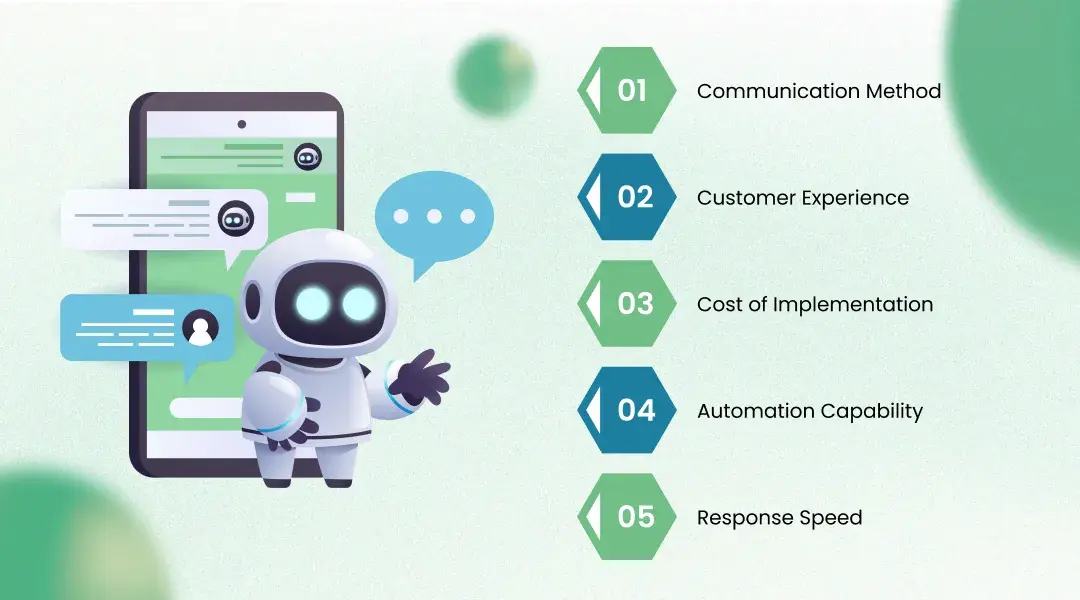
Chatbots operate through text messaging interfaces.
Voice agents operate through spoken conversations.
If your customers are already chatting on websites or apps, chatbots feel natural.
If they’re calling your support line, voice bots make more sense.
Text conversations are:
Quick
Quiet
Easy to review later
Voice interactions feel:
More human
Faster for complex explanations
More natural for some users
Different experiences. Different expectations.
Here’s something businesses rarely hear in marketing presentations.
Voice systems usually cost more.
Why?
They require additional technologies like speech processing and call infrastructure.
Chatbots are generally cheaper to deploy and maintain.
Both solutions support AI customer support automation.
But the complexity differs.
Chatbots work best with structured queries. Voice bots can handle longer conversations more naturally.
Chatbots respond instantly.
Voice bots respond quickly too, but there’s a tiny delay because speech must be processed.
It’s subtle. But noticeable.
Let’s start with the strengths of chatbots.
Customers don’t like waiting.
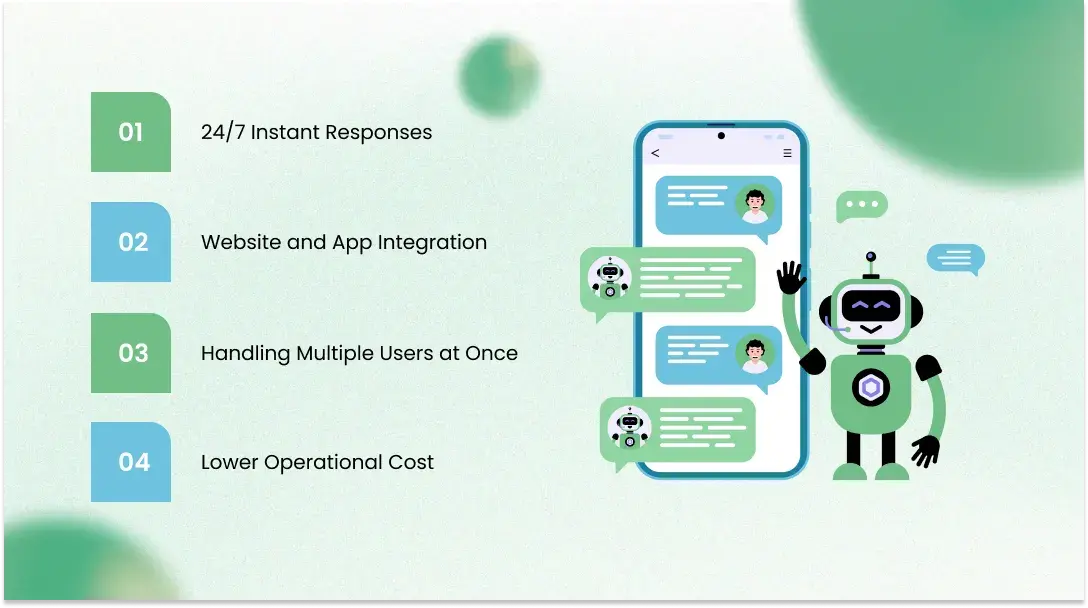
An AI chatbot for customer support answers questions instantly—even at 3 AM.
Chatbots can easily integrate with:
websites
mobile apps
messaging platforms
Which means businesses can support customers directly where they already are.
Human agents have limits.
Chatbots do not.
One chatbot can handle thousands of simultaneous conversations.
This is why many startups begin with chatbots.
They reduce support workload dramatically without requiring large call centers.
Now let’s talk about voice.
Voice creates a more personal experience.
Customers can simply speak their problem instead of typing.
If your business receives thousands of calls daily, AI voice agent for customer support can automate repetitive interactions like:
account verification
order status
appointment scheduling
For complicated issues, speaking is often faster than typing long explanations.
Voice removes friction.
Some industries—like healthcare or banking—see higher satisfaction when customers can speak naturally instead of navigating menus.
Chatbots are ideal when customer interactions are short, frequent, and text-friendly.
Examples include:
Visitors asking basic questions while browsing.
Customers checking:
delivery status
return policies
product details
Businesses can automate repetitive questions like:
shipping times
pricing plans
account setup
Lead Generation
Chatbots can collect visitor details and qualify leads automatically.
Voice agents shine in environments where phone conversations dominate.
Companies receiving thousands of support calls daily benefit from voice bots handling routine queries.
Clinics, salons, and service businesses often automate scheduling using voice agents.
Voice systems can guide customers through identity verification steps quickly.
Industries like telecom, banking, and logistics rely heavily on phone interactions.
That’s where AI voice bot vs chatbot decisions become obvious.
Here’s the honest answer.
Neither.
Seriously.
The better question is:
Which one fits your customers?
If customers contact you through websites → use AI chatbot for business support.
If customers call your support line → use AI voice assistant for business.
Startups and small businesses usually begin with chatbots because they are simpler and more affordable.
Larger companies often deploy both systems together.
Some industries lean strongly toward one option:
Chatbots dominate in:
SaaS platforms
E-commerce
digital services
Voice agents dominate in:
telecom
banking
Healthcare
logistics
At KriraAI, we often recommend a hybrid approach.
Many companies searching for the Best AI development Company want both text and voice automation integrated into one support ecosystem.
Customer support is evolving quickly.
And conversational AI is at the center of it.
Businesses are rapidly adopting conversational AI for customer support because it reduces response time and operational costs.
Customers now expect instant answers.
Waiting in a support queue feels outdated.
Voice AI is improving rapidly thanks to better speech recognition and language models.
In the next few years, voice agents will sound almost indistinguishable from human agents.
Yes. That future is closer than most people realize.
Forward-thinking companies are combining:
chatbots
voice agents
CRM systems
predictive analytics
The goal?
A support system that anticipates customer needs before they even ask.
Let’s bring this full circle.
Businesses often ask me:
"Should we build a chatbot or a voice agent?"
My answer is always the same.
It depends on how your customers prefer to communicate.
If they type, choose chatbots. If they call, choose voice agents.
And if your support ecosystem is large enough…
Use both.
Companies searching for the Best AI development Company often come to us with this exact challenge. The real value isn’t just building AI tools.
It’s designing the right support experience.
Technology matters.
But customer behavior matters more.
Always.
Both have advantages. Chatbots work best for website interactions and quick text queries, while voice agents are ideal for call centers and phone-based customer service.
AI chatbots provide instant responses, automate repetitive questions, and handle multiple conversations simultaneously, reducing support workload.
Industries like banking, healthcare, telecom, and logistics benefit most because customers often contact support through phone calls.
Yes. Many companies combine chatbots for website support with voice agents for call centers to create a complete AI customer support automation system.
Businesses should analyze customer communication behavior, support channels, and query types before deciding between chatbot vs voice bot solutions.
Founder & CEO
Divyang Mandani is the CEO of KriraAI, driving innovative AI and IT solutions with a focus on transformative technology, ethical AI, and impactful digital strategies for businesses worldwide.