The global sports technology market is projected to reach $55.14 billion by 2030, and a significant share of that growth is being driven by one force: artificial intelligence. From wearable sensors that read a runner's biomechanics in real time to algorithms that predict a basketball player's injury risk before symptoms appear, AI in sports and fitness has moved from experimental novelty to operational necessity. Teams, gyms, sports medicine clinics, and consumer fitness platforms that have not yet integrated AI are not just missing an efficiency gain - they are falling structurally behind competitors who are making faster, smarter, and more evidence-based decisions every single day.
This shift is not confined to elite professional sports. The democratization of AI tools means that a mid-market fitness chain in Pune or a college athletics program in the American Midwest now has access to the same class of predictive technology that NBA franchises were deploying exclusively just five years ago. The barriers of cost and technical complexity are dissolving rapidly, and the window for early-mover advantage is narrowing.
This blog will cover the current state of the sports and fitness industry, the specific AI technologies being applied across the value chain, the measurable business outcomes organizations are achieving, a practical implementation roadmap, the real challenges that cannot be ignored, and where this industry is headed over the next five years.
The sports and fitness industry sits at an unusual intersection of passion and pressure. On one side, consumer demand for personalized health experiences has never been stronger. On the other, the operational and competitive pressures facing clubs, gyms, sports franchises, and fitness technology companies are intensifying at a pace that traditional management practices cannot absorb.
Professional sports organizations face a relentless pressure to maximize return on investment in player talent, which represents by far their largest cost. The average salary in the NBA exceeded $9.7 million per player in the 2023 to 2024 season, making a single preventable injury not just a health issue but a financial catastrophe. Scouting and recruitment processes that rely primarily on subjective assessment and historical statistics leave significant value on the table, particularly in lower-profile leagues and collegiate sports where talent identification is inconsistent.
The commercial fitness sector faces a different but equally serious set of challenges. Member retention is structurally poor across the industry, with average gym membership churn rates hovering between 30 and 50 percent annually depending on the market segment. High churn is expensive because customer acquisition costs in fitness typically range from $100 to $400 per new member, and operators who cannot retain members are trapped in a costly acquisition loop. The inability to personalize the fitness experience at scale has been a core driver of this retention problem for decades.
Sports media and fan engagement represent another pressure point. Broadcast rights revenues are enormous, but sustaining viewer attention across fragmented streaming platforms and younger audiences who consume content in shorter, more interactive formats is a growing challenge. Traditional production models cannot keep up with the volume and specificity of content that modern fans expect.
Sports medicine and physical therapy practices face compounding challenges around volume, documentation burden, and outcomes tracking. Clinicians spend a disproportionate amount of time on administrative tasks and still struggle to generate the longitudinal data that would allow them to understand and improve patient outcomes systematically. Insurance reimbursement models continue to squeeze margins while demand for evidence-based rehabilitation grows.
Across all of these segments, data is simultaneously the greatest untapped asset and the greatest source of frustration. Organizations are collecting more data than ever from wearables, ticketing systems, training platforms, and electronic health records, but most of that data sits in silos that prevent meaningful analysis. The gap between data collection and data intelligence is where AI is now making its most decisive interventions.
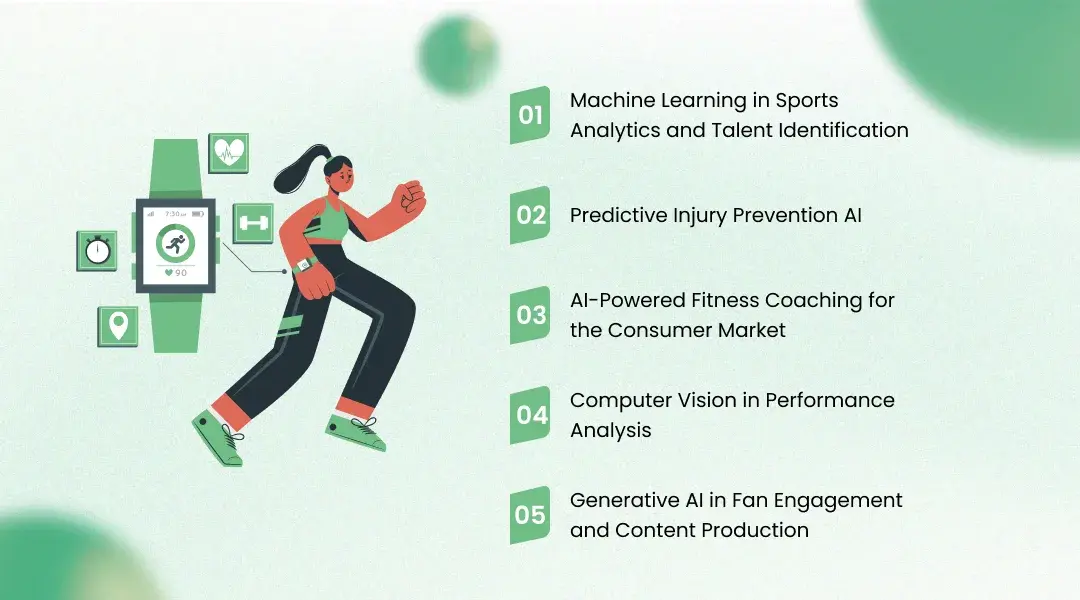
The transformation happening across sports and fitness is not driven by a single AI capability. It is the convergence of several distinct AI disciplines, each mapped to a specific operational problem, that is creating compounding competitive advantages for early adopters.
Machine learning in sports analytics has fundamentally changed how teams identify, evaluate, and develop talent. Platforms like StatsBomb and Catapult use supervised learning models trained on millions of historical player data points to surface non-obvious performance patterns that human scouts would never detect. These models can evaluate a midfielder's off-ball movement efficiency, a pitcher's micro-mechanical fatigue signatures, or a basketball player's defensive positioning tendencies across thousands of possessions simultaneously.
In talent recruitment, natural language processing is being used to parse scouting reports, social media sentiment, and interview transcripts to build multi-dimensional profiles of athletes that go beyond physical and statistical metrics. Psychological resilience indicators, coachability signals, and pressure-performance correlations are now being extracted from text data at scale and fed into draft and transfer decision models.
Predictive injury prevention AI is arguably the highest-value application in the entire industry. Using a combination of GPS tracking data, accelerometry from wearables, historical injury records, and biomechanical video analysis processed through computer vision models, these systems can calculate an athlete's injury probability with significantly greater accuracy than clinical intuition alone.
Catapult Sports and STATSports deploy chronic workload ratio models that flag athletes whose acute training loads are outpacing their baseline fitness adaptation, a leading indicator of soft tissue injuries. The Premier League, which has invested heavily in these systems, reported measurable reductions in hamstring injury rates at clubs that implemented structured load monitoring programs integrated with machine learning models.
Generative AI is now entering rehabilitation as well. Platforms are emerging that can generate individualized recovery protocols by synthesizing an athlete's injury history, biomechanical profile, psychological readiness data, and sport-specific return-to-play requirements into a dynamic, adaptive program that adjusts daily based on physiological feedback.
AI-powered fitness coaching has brought elite-level personalization to the consumer market at scale. Apps like Whoop, Future, and Vi Trainer use biometric data combined with machine learning models to generate training recommendations that adapt to sleep quality, heart rate variability, subjective wellbeing scores, and historical performance data in real time.
The personalization goes beyond workout prescriptions. Natural language processing powers conversational coaching interfaces that can identify when a user is experiencing motivation decline and shift the communication style accordingly, whether that means reducing friction in a session, introducing novelty, or adjusting goal framing to maintain adherence. This matters enormously in a market where behavioral dropout is the primary enemy of long-term health outcomes.
Computer vision systems are replacing manual video analysis workflows that used to require dozens of analyst hours per match. Tools like Hudl Sportscode and Second Spectrum deploy convolutional neural networks trained on annotated match footage to automatically tag events, track player movements, generate heat maps, and compute spatial metrics like expected goals, pressure indices, and defensive line heights.
For individual sports like tennis and golf, computer vision is enabling real-time biomechanical feedback that was previously only available in expensive motion capture lab environments. Camera-based systems can now analyze a golfer's swing plane, hip rotation timing, and grip pressure distribution from standard high-frame-rate video, providing coaching-grade feedback at a fraction of the historical cost.
Generative AI is transforming how sports organizations produce and distribute content. Automated highlight generation, personalized match recap videos, and AI-written statistical summaries are allowing media teams to produce content at a volume and personalization level that was previously impossible with human production workflows alone.
KriraAI, which builds practical AI solutions for enterprises across industries, has worked with sports media clients to deploy generative AI pipelines that reduce content production turnaround from 48 hours to under two hours while simultaneously enabling personalization at the individual fan level. This kind of infrastructure represents a genuine competitive capability, not just an efficiency gain.
The business case for AI in sports and fitness is no longer theoretical. Organizations across the industry are reporting specific, measurable outcomes that demonstrate clear return on investment.
In professional football, clubs that have implemented structured AI-driven load monitoring and predictive injury systems have reported injury incidence reductions of 20 to 30 percent in soft tissue categories. Given that a single significant injury to a marquee player can cost a club between $5 million and $25 million in combined medical costs, replacement player expenditure, and lost performance value, the financial return on a $500,000 AI system investment is achieved within weeks, not years.
The Golden State Warriors, an early adopter of advanced biometric monitoring, cited their injury management analytics infrastructure as a contributing factor during their dynasty period. While no single technology can be isolated as the sole cause, the directional correlation between AI investment in athlete monitoring and sustained roster availability is consistent across multiple organizations and leagues.
Fitness operators that have deployed AI-powered personalization and engagement systems are reporting member retention improvements of 15 to 25 percent compared to control groups using traditional management approaches. For a gym with 2,000 members and an average monthly revenue per member of $50, a 20 percent reduction in churn translates to an additional $240,000 in annual retained revenue. At scale, across a multi-location chain, this impact compounds significantly.
Predictive churn models that identify at-risk members 30 to 45 days before cancellation and trigger automated re-engagement sequences have demonstrated conversion rates of 18 to 32 percent in documented case studies from platforms like Glofox and Mindbody. This means operators are retaining roughly one in four members they would have lost without AI intervention.
Football clubs using machine learning in sports analytics for player recruitment report reducing their long-list evaluation time by up to 60 percent. The ability to programmatically screen thousands of players across lower leagues and international markets using objective performance models allows clubs to surface high-value targets that manual scouting networks would have missed entirely. Brentford FC's use of data-driven recruitment before their Premier League promotion became a widely cited model of competitive advantage derived from analytical capability rather than financial power.
High-performance training programs that have integrated AI-powered periodization and recovery optimization report measurable improvements in athlete output metrics. Swimmers using AI-optimized training plans at the Australian Institute of Sport recorded performance improvements averaging 1.8 percent across key metrics, a figure that translates to podium positions at the Olympic level where margins of victory are measured in hundredths of a second.
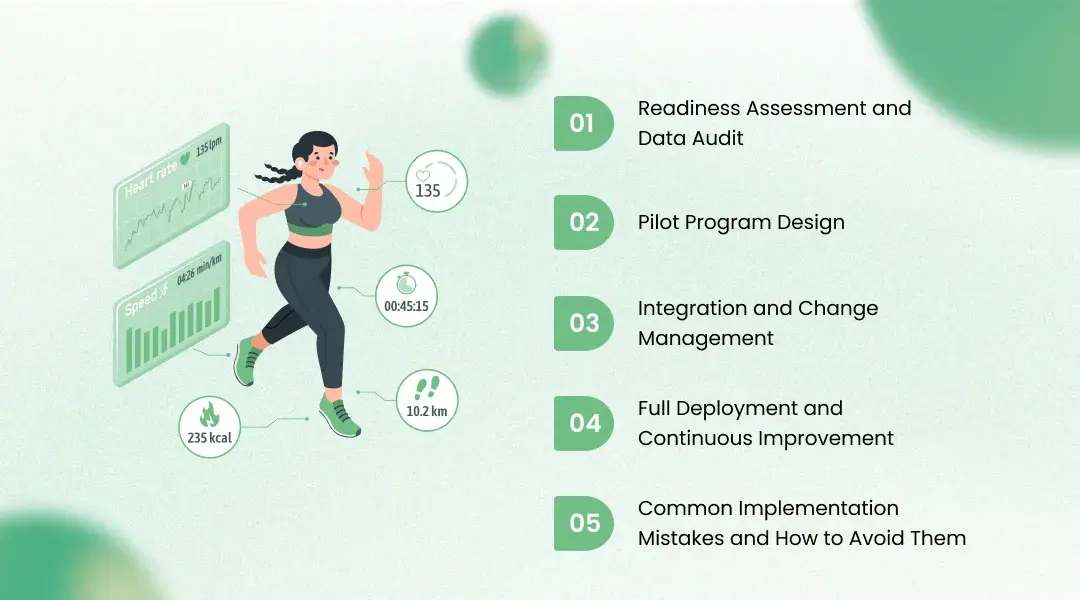
Effective AI implementation begins not with technology selection but with an honest audit of the organization's data infrastructure and strategic readiness. Organizations must answer several foundational questions before deploying any AI system.
The audit should cover:
What data is currently being collected and in what formats, such as wearable sensor data, video, ticketing, or health records.
Where data is stored and whether it is accessible programmatically through APIs or only through manual exports.
Whether data collection is consistent and longitudinal enough to train meaningful models, typically requiring a minimum of 12 to 24 months of structured historical records.
What internal technical capability exists to manage, interpret, and act on AI outputs.
Whether existing contracts, privacy policies, and regulatory frameworks permit the use of collected data for machine learning purposes.
This audit phase typically requires four to eight weeks and should result in a data readiness score and a gap analysis document that guides technology selection.
Organizations should resist the temptation to deploy AI across all functions simultaneously. A focused pilot in one high-impact area, such as injury risk monitoring for a first-team squad or a churn prediction model for a single gym location, allows the organization to develop internal capability, build trust in the outputs, and demonstrate ROI before scaling.
KriraAI's approach to pilot program design with enterprise clients involves defining success metrics before deployment, not after. This means establishing baseline measurements, agreeing on the minimum detectable effect size that would justify full deployment, and building a feedback loop that allows the model to improve during the pilot period.
The technical integration of AI systems into existing workflows is often easier than the organizational change management required to ensure those systems are actually used. Coaches who have spent decades trusting their instincts do not automatically defer to algorithmic recommendations. Medical staff who are trained in clinical frameworks may resist probabilistic risk models that cannot explain their predictions in physiological terms.
Successful deployment requires:
Training sessions that translate model outputs into the language and mental models of the end users.
Clear protocols for how AI recommendations should be weighted against professional judgment.
Feedback mechanisms that allow practitioners to flag when model outputs appear inconsistent with observed reality.
Leadership visibility and endorsement that signals organizational commitment to evidence-based decision making.
Full deployment marks the beginning of a continuous improvement cycle, not a finish line. Models trained on historical data drift over time as team compositions change, playing styles evolve, and new athlete cohorts enter the system with different profiles. Organizations must budget for ongoing model retraining, performance monitoring, and capability expansion as the AI infrastructure matures.
The most common failure mode in sports AI implementation is deploying a technically sophisticated system without securing practitioner buy-in. A second frequent mistake is treating AI as a replacement for human expertise rather than an amplifier of it. A third is underinvesting in data quality on the assumption that AI can handle messy, inconsistent inputs. It cannot. Garbage in, garbage out remains as true in deep learning as it was in early statistical modeling.
Honesty about the limitations of AI adoption in this industry is not pessimism. It is a precondition for making decisions that actually work.
Data quality is the foundational challenge. Many sports organizations, particularly at the semi-professional and amateur level, do not have structured, consistent historical data that can train meaningful predictive models. Wearable data is often incomplete due to athlete non-compliance. Video data is inconsistent in quality and camera angle across venues. Electronic health records in sports medicine are frequently fragmented across different practitioners and clinics. Building an AI system on low-quality data does not produce lower-quality predictions. It produces confidently wrong predictions, which are worse than having no model at all.
The talent gap is severe and widening. Sports organizations that want to deploy and maintain AI systems need personnel who understand both sports science or fitness operations and data science, a combination that is rare and expensive. Universities are beginning to produce sports analytics graduates, but demand is dramatically outpacing supply. Organizations that cannot hire are dependent on external vendors, which creates a different set of risks around vendor dependency and proprietary data exposure.
Regulatory constraints are emerging rapidly. In the European Union, the use of biometric data for AI-driven decision making is subject to GDPR provisions that require explicit consent and data minimization principles. In several athlete union agreements in North American professional sports, there are collectively bargained restrictions on how biometric data collected from players can be used by team management. Navigating these frameworks requires legal expertise that most sports organizations do not have in-house.
Integration complexity is routinely underestimated. Most sports organizations run a patchwork of legacy software systems, such as coaching platforms, medical record systems, ticketing databases, and social media management tools, that were never designed to share data. Building the data pipelines that connect these systems to a central AI platform requires significant engineering investment and ongoing maintenance.
Finally, the risk of over-reliance on algorithmic recommendations without appropriate human oversight is real. There have been documented cases in professional sports where training load models flagged a player as high-risk for injury but the recommendation was overridden by coaching staff under competitive pressure, resulting in the predicted injury. The technology was correct; the governance was absent.
Three to five years from now, the sports and fitness industry will look structurally different in ways that are already visible in early-stage technology development today.
Fully personalized, AI-generated training programs delivered through multimodal interfaces will become the standard for serious recreational athletes, not just professionals. As the cost of continuous biometric monitoring falls below $50 per person per year, the physiological data required to power genuinely individualized AI coaching will be universally accessible. The one-size-fits-all group fitness class model will face existential pressure from AI-powered adaptive training experiences that are demonstrably more effective.
In professional sports, the competitive moat will shift from having the best human scouts and coaches to having the best AI infrastructure that amplifies those humans. Organizations that have invested in building proprietary data assets and model development capability will have structural advantages that cannot be closed by signing a single star player. This mirrors what has already happened in financial markets, where quantitative funds with superior data infrastructure have generated persistent alpha over discretionary managers.
Generative AI will enable a new category of fan experience where content is not just personalized but co-created with each fan. Real-time narrative generation, AI-driven prediction games, and conversational interfaces that allow fans to query match statistics and player data in natural language will replace static broadcast experiences for a significant portion of the audience.
The companies that will be left behind are those that treat AI as a discrete IT project rather than an organizational capability. Sports organizations that do not begin building their data infrastructure, developing internal AI literacy, and establishing governance frameworks in the next 18 to 24 months will face a compounding capability deficit that becomes increasingly difficult to close. The window for catching up narrows with every competitive season that passes.
KriraAI's work with enterprise clients across industries confirms a consistent pattern: the organizations that achieve the highest long-term ROI from AI are those that invest in capability building and data infrastructure before deploying any models, not after.
The three most important things to understand about AI in sports and fitness are these. First, the technology has already progressed far beyond the pilot phase in elite sports and is rapidly becoming accessible and affordable across the entire industry. Second, the competitive advantage of AI adoption is not primarily about any single application but about the compounding effect of better decisions made faster across every function of the organization. Third, the greatest barrier to value creation is not technology availability but organizational readiness, including data infrastructure quality, practitioner buy-in, and governance clarity.
For sports organizations, fitness operators, and sports medicine practices that want to move from awareness to action, the question is not whether to adopt AI but how to do it in a way that is structured, measurable, and sustainable. This is precisely the challenge that KriraAI was built to address. KriraAI helps sports and fitness enterprises deploy AI solutions that are grounded in their actual data reality, designed around their specific operational workflows, and built to generate measurable ROI at each stage of implementation rather than at some indefinite future point. Whether the objective is reducing injury rates in a professional squad, improving retention at a commercial gym network, or building a data-driven talent identification system, KriraAI's approach treats AI as a practical tool for solving real business problems rather than as a technology showcase.
If your organization is ready to explore what a structured, evidence-based AI implementation would look like in practice, the team at KriraAI welcomes that conversation.
The most impactful use of AI in sports and fitness today is predictive injury prevention. By combining GPS tracking, accelerometry, heart rate variability data, and historical injury records, machine learning models can calculate an athlete's probability of sustaining a specific type of injury before any clinical symptoms appear. Research across multiple professional sports leagues has demonstrated that organizations implementing structured AI-driven load monitoring and injury risk models have achieved soft tissue injury reductions of 20 to 30 percent. Given that a single significant injury to a professional athlete can cost a club millions of dollars in lost performance value and medical expenditure, this application generates a return on investment that is difficult for any other technology category to match. The practical implication is that AI-powered injury prevention is no longer a luxury reserved for elite professional clubs. Platforms built on cloud infrastructure have brought this capability within reach of collegiate programs, national federations, and even well-resourced amateur organizations.
AI-powered fitness coaching differs from traditional personal training in its ability to process continuous, multi-dimensional biometric data and adapt recommendations in real time based on that data. A human personal trainer can observe a client two to four hours per week and make adjustments based on perceived exertion, form, and self-reported recovery. An AI coaching system monitors the same client 24 hours a day through wearable sensors, tracking sleep quality, heart rate variability, activity levels, and recovery metrics to build a continuously updated physiological model. This allows the system to modify training volume, intensity, and exercise selection on a daily basis in response to the athlete's actual readiness state, not a pre-planned periodization schedule. Multiple platforms using this approach have reported statistically significant improvements in adherence, performance outcome metrics, and user satisfaction scores compared to standardized training programs. The technology does not eliminate the value of human coaching. It amplifies it by giving coaches access to a richer and more continuous stream of information than observation alone can provide.
Machine learning in sports analytics is being used in team decision-making across three primary domains: player recruitment, in-game tactical analysis, and performance management. In recruitment, supervised learning models trained on large historical datasets of player statistics, biomechanical profiles, and contextual performance metrics can identify undervalued talent by finding players whose objective performance data suggests higher quality than their current reputation or market price would indicate. In tactical analysis, computer vision models process match footage at scale to extract spatial and temporal metrics that reveal defensive vulnerabilities, set-piece tendencies, and pressing intensity patterns in opposition teams. In performance management, predictive models synthesize training load, recovery data, and match performance to generate personalized recommendations for each athlete's preparation and recovery schedule. Organizations like Brentford FC became widely studied cases of how a data-driven recruitment model powered by machine learning can generate results that significantly outperform spending-adjusted expectations, demonstrating that analytical capability can substitute partially for financial power in talent markets.
Implementing AI effectively in a fitness business requires several categories of data, each serving a different function. Member demographic and behavioral data, including visit frequency, class booking patterns, session duration, and engagement with app features, forms the foundation for churn prediction and personalization models. Biometric data from wearables or in-gym assessments, including body composition measurements, strength benchmarks, cardiovascular fitness scores, and heart rate data, enables AI-powered fitness coaching and progress tracking. Transaction data covering membership types, purchase history, and promotional responsiveness supports revenue optimization and offer personalization. Communication data, such as email open rates, app notification responses, and support ticket content, provides signals for engagement scoring models. The minimum viable dataset for a meaningful churn prediction model typically requires 12 months of longitudinal member behavior data across at least 500 active members. Fitness businesses with fewer members or shorter data histories can still benefit from AI through industry-trained models that use transfer learning to compensate for limited proprietary data, though the accuracy and specificity of recommendations will be lower than models trained on large organizational datasets.
The biggest risks of adopting AI in sports organizations fall into four categories: data quality risk, governance risk, over-reliance risk, and regulatory risk. Data quality risk refers to the danger of deploying models trained on incomplete, inconsistent, or biased historical data, which can generate confident but incorrect predictions that lead to poor decisions. Governance risk arises when organizations deploy AI systems without clear protocols for how algorithmic recommendations should interact with human professional judgment, leading either to rejection of valuable model outputs or uncritical acceptance of erroneous ones. Over-reliance risk occurs when practitioners stop exercising independent professional judgment because they have become habituated to following algorithmic recommendations, a failure mode that becomes most costly when the model encounters a situation that falls outside its training distribution. Regulatory risk is growing rapidly, particularly in Europe where GDPR and emerging AI regulations impose specific requirements on the use of biometric data for automated decision-making. Sports organizations that fail to audit their AI deployments for regulatory compliance before problems are identified by regulators face significant financial and reputational exposure. Mitigating these risks requires investment in governance frameworks, practitioner education, and legal review that most sports organizations have not historically prioritized.
Founder & CEO
Divyang Mandani is the CEO of KriraAI, driving innovative AI and IT solutions with a focus on transformative technology, ethical AI, and impactful digital strategies for businesses worldwide.