
How AI in Logistics Is Reshaping Supply Chains in 2026
AI in logistics is no longer a future-state ambition sitting in a strategy deck. It is operational infrastructure, and the companies treating it as anything less are already losing ground. According to McKinsey, AI-enabled supply chain management has helped early adopters reduce logistics costs by up to 15 percent, improve inventory levels by 35 percent, and increase service levels by up to 65 percent compared to slower-moving competitors. These are not marginal improvements. They are structural competitive advantages that compound over time.
The logistics industry has long operated at the intersection of extreme complexity and razor-thin margins. A single misrouted shipment, an undetected demand spike, or an unplanned warehouse outage can cascade into delays affecting thousands of customers and millions of dollars in penalties. What AI changes is the industry's ability to see these disruptions before they happen, respond faster than any human team could coordinate, and continuously learn from every data point the operation generates.
This blog covers the specific AI technologies transforming logistics today, the quantified business results companies are achieving, a practical implementation roadmap for operations teams, the honest challenges that slow adoption, and a projection of where the industry will be in the next three to five years. If you are a logistics leader, a supply chain director, or an operator responsible for moving goods efficiently, this is the analysis you need.
The State of Logistics Before AI: A System Under Pressure
The logistics industry is one of the most operationally intensive sectors in the global economy, and it has been showing structural stress for years. Demand volatility has become the baseline condition rather than the exception. The COVID-19 pandemic exposed how brittle globally extended supply chains were when consumer behavior shifted overnight, port congestion became chronic, and carrier capacity evaporated. The industry has not fully recovered its confidence in traditional planning methods since.
Margins in logistics are exceptionally tight. Third-party logistics providers (3PLs) routinely operate on net margins between 2 and 5 percent. For freight brokers and trucking companies, any increase in fuel costs, driver wages, or dwell times at facilities translates almost immediately into negative operating leverage. The labor market has made this worse. The American Trucking Associations estimated a driver shortage of 80,000 in 2021, a number projected to exceed 160,000 by 2031. Warehouse labor costs have risen sharply in parallel, with picking and packing labor accounting for 50 to 65 percent of total warehouse operating expenses at most facilities.
Data is abundant in logistics, and yet actionable insight has historically been rare. A mid-size distribution center might generate hundreds of thousands of data points daily from sensors, scanners, transportation management systems, warehouse management systems, and customer order platforms. The problem is that these systems rarely talk to each other in real time, and most analysis happens in batch cycles that are already out of date by the time a manager reads the report.
Customer expectations have also moved in one direction: upward. Next-day and same-day delivery, once Amazon exclusives, are now table stakes for e-commerce. B2B customers expect live shipment visibility, automated exception notifications, and proactive ETAs. The infrastructure to deliver this consistently does not come from adding more staff. It requires intelligence embedded in the operation itself.
Regulatory complexity adds another layer of operational burden. Customs compliance across international lanes, Hours of Service regulations for drivers, environmental reporting requirements, and evolving data privacy laws across markets all create compliance workloads that traditional operations teams absorb manually. Each manual touchpoint is both a cost and a risk.
The picture, taken together, is of an industry where volume is growing, margins are shrinking, labor is scarce and expensive, customer expectations are rising, and the data available to manage all of it is locked in disconnected systems. This is precisely the environment where AI delivers its most transformative value.
How AI in Logistics Is Transforming Operations: Technology Mapped to Real Problems
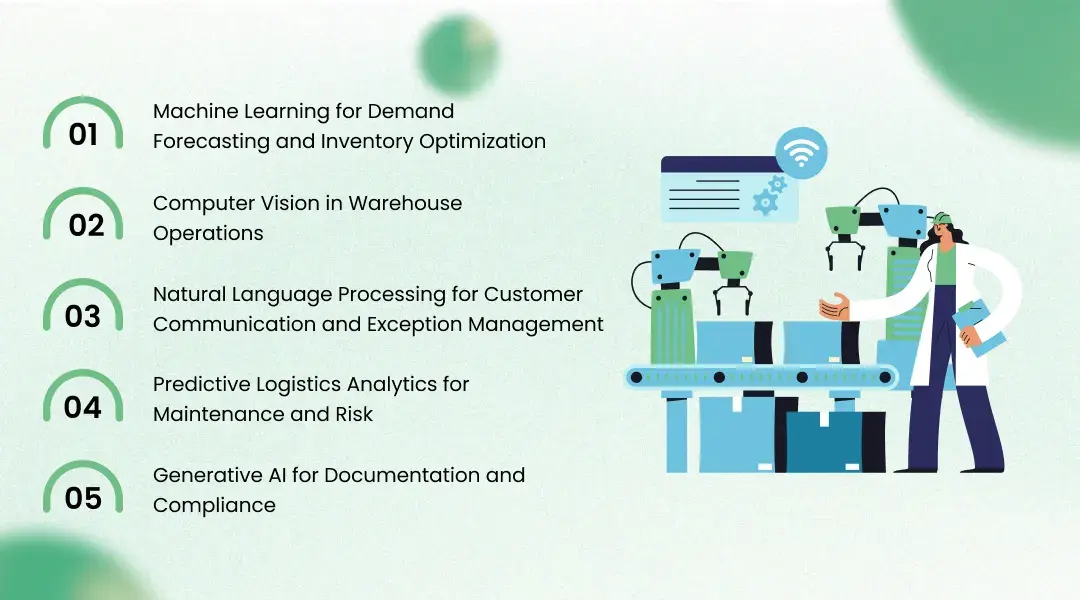
AI in logistics is not a single technology. It is a collection of distinct capabilities, each addressing specific operational failures that have plagued the industry for decades. Understanding which technology addresses which problem is essential for any logistics leader evaluating where to invest first.
Machine Learning for Demand Forecasting and Inventory Optimization
Traditional demand forecasting in logistics relied on historical averages, seasonal adjustments, and planner intuition. Machine learning models replace this with dynamic, multi-variable prediction engines that ingest hundreds of data signals simultaneously, including point-of-sale data, weather patterns, promotional calendars, macroeconomic indicators, social sentiment, and carrier capacity signals.
The result is a forecast that continuously updates rather than being fixed at a planning cycle. When a weather event is detected heading toward a major distribution corridor, a machine learning model can automatically recommend pre-positioning inventory, adjusting inbound shipments, and rerouting outbound loads, before a single planner has opened their laptop.
Companies like Amazon and Walmart have used ML-driven inventory positioning for years, and mid-market logistics operators now have access to similar capabilities through cloud-based platforms. The measurable impact is significant: companies using ML for demand forecasting typically reduce excess inventory by 20 to 30 percent while simultaneously reducing stockout rates by up to 50 percent.
Computer Vision in Warehouse Operations
Warehouse AI technology built on computer vision is solving problems that were previously either too expensive or too slow to address manually. Computer vision systems mounted on cameras throughout a facility can:
Detect mis-picks in real time before a package is sealed, reducing return rates caused by incorrect shipments.
Verify label accuracy and readability at scan points, catching errors that cause carrier delays.
Monitor worker safety compliance, identifying instances where personal protective equipment is missing or unsafe behavior is occurring.
Track inventory movement through a facility without requiring every item to be scanned at every stage.
Assess damage to inbound freight during unloading, creating a timestamped visual record that supports carrier claims.
These applications collectively reduce the error rates that create downstream costs. A single mis-pick in a pharmaceutical distribution center can result in a regulatory incident. A single damaged freight claim that goes undocumented costs the operator money with no recourse.
Natural Language Processing for Customer Communication and Exception Management
Supply chain automation powered by natural language processing (NLP) is changing how logistics companies handle the volume of customer inquiries, carrier communications, and exception notifications that flow through their operations daily. NLP-driven systems can parse unstructured emails from carriers, extract shipment status updates, and automatically update transportation management systems without human intervention.
On the customer-facing side, NLP-powered conversational tools can handle shipment status inquiries, provide proactive delay notifications with rebooked ETAs, and escalate only the genuinely complex exceptions to human agents. Companies deploying these systems report customer inquiry handle time dropping by 40 to 60 percent while customer satisfaction scores improve because response speed increases dramatically.
Predictive Logistics Analytics for Maintenance and Risk
Predictive logistics analytics applied to fleet maintenance is one of the highest-ROI use cases in the industry. Telematics data from vehicles, combined with maintenance history and environmental factors, allows AI models to predict component failure before it occurs. A fleet operator who knows three days in advance that a specific truck is likely to experience a brake system issue can schedule maintenance proactively, avoiding both roadside breakdowns and costly emergency repairs.
The same predictive framework applies to route risk assessment. AI models can evaluate road conditions, traffic patterns, weather forecasts, border crossing wait times, and historical delivery performance to recommend the optimal route for each shipment at the moment of dispatch, not the route that was optimal last Tuesday.
Generative AI for Documentation and Compliance
Generative AI is beginning to reshape back-office logistics functions. Customs documentation, bills of lading, commercial invoices, and compliance certificates require precise, consistent language across multiple jurisdictions. Generative AI systems trained on trade compliance requirements can draft these documents at scale, flag potential compliance issues before submission, and reduce the customs delay rate that costs international shippers significant time and money at borders.
KriraAI, which builds practical AI solutions for enterprise logistics operations, has developed implementations in this space that combine generative AI with structured compliance rule sets, ensuring that the speed of AI output does not come at the cost of regulatory accuracy. The integration of generative AI with existing ERP and TMS platforms is a key differentiator in how KriraAI approaches logistics automation.
Implementation Roadmap: From Assessment to Operational AI
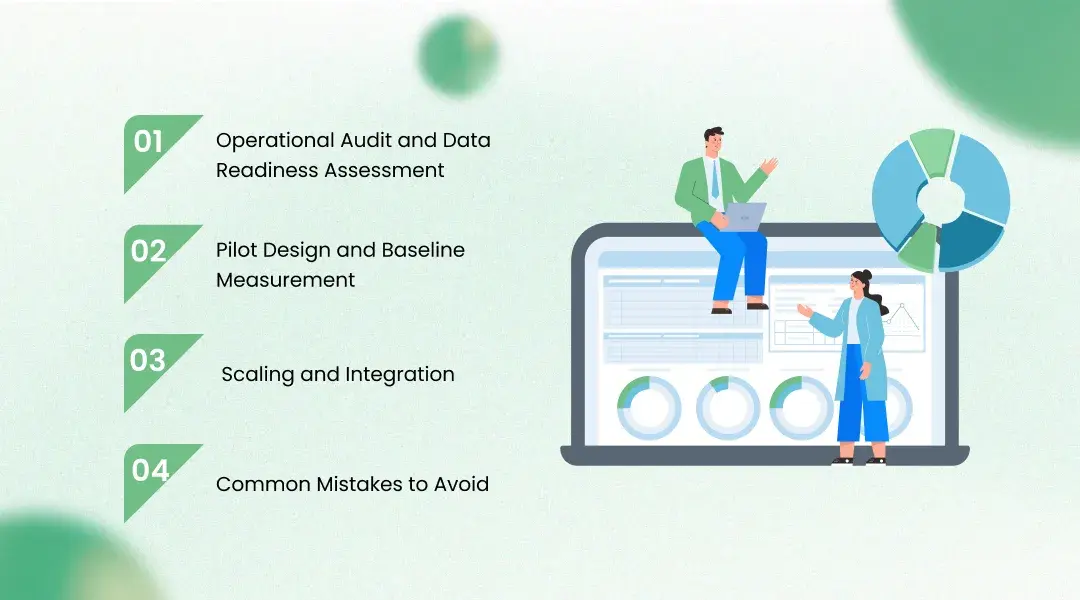
Implementing AI in logistics follows a sequence that, when executed correctly, produces measurable results within 90 to 120 days of starting a pilot. The companies that fail at AI implementation almost universally skip steps in this sequence or underestimate the data preparation phase.
Stage 1: Operational Audit and Data Readiness Assessment
The first stage is an honest evaluation of what data exists, where it lives, and how clean it is. AI systems are only as good as the data they train on. A logistics operation that has been running a warehouse management system for five years has enormous data, but if that data has inconsistent location codes, unmapped SKU hierarchies, or uncoded exception types, a machine learning model trained on it will produce unreliable outputs.
The audit should answer four questions:
What operational decisions are currently made based on incomplete or delayed information?
Which of those decisions, if made faster and more accurately, would produce the most significant financial impact?
What data exists to support AI models in those decision areas, and what is its quality?
What integrations are required to connect AI outputs to the systems where decisions are actually acted upon?
This stage typically takes four to six weeks for a mid-size logistics operation and should involve both operational leaders and IT stakeholders.
Stage 2: Pilot Design and Baseline Measurement
A well-designed pilot is time-bounded, geographically or functionally contained, and built against a documented baseline. If you are piloting AI route optimization for a regional fleet, you need to know the current miles per stop, fuel cost per mile, on-time delivery rate, and driver overtime hours before the pilot starts. Without that baseline, you cannot demonstrate ROI, and without demonstrated ROI, scaling investment becomes a political battle rather than a business decision.
KriraAI's approach to logistics AI pilots is structured around 60-day sprint cycles with defined success metrics agreed before deployment begins. This prevents the common failure mode where a pilot drifts without clear measurement and produces an ambiguous result that neither confirms nor disproves the technology's value.
Stage 3: Scaling and Integration
Once a pilot has demonstrated measurable results against baseline, the scaling phase begins. This is where most AI implementations encounter their most significant technical friction, because scaling requires connecting AI systems to production infrastructure across multiple sites, carrier networks, and customer-facing platforms.
Common Mistakes to Avoid
These are the implementation errors that consistently derail logistics AI projects:
Buying AI software without first resolving data integration gaps, resulting in a system that cannot access the data it needs to function.
Setting success metrics that are too broad or too long-term, making it impossible to evaluate pilot performance within a reasonable timeframe.
Failing to include frontline operations staff in the implementation process, resulting in user adoption resistance that undermines system performance.
Underestimating change management requirements, particularly for route optimization and workforce scheduling tools that directly change how drivers and warehouse staff do their daily work.
Attempting to automate too many processes simultaneously in the first phase, spreading implementation resources too thin and producing partial results across multiple areas rather than strong results in one.
Challenges and Limitations: The Honest Picture
AI in logistics is genuinely transformative, but the path to transformation is neither smooth nor guaranteed. Any logistics leader planning an AI investment needs a clear-eyed view of the obstacles that will arise.
Data quality is the most common and most underestimated challenge. Logistics operations accumulate data across systems that were built at different times by different vendors for different purposes. A transportation management system from one vendor, a warehouse management system from another, a customer portal from a third, and a carrier API integration built in-house: these systems rarely share data models, and the work required to harmonize them is substantial. Companies frequently discover during implementation that the data they believed was clean and usable requires months of remediation before it can support reliable AI outputs.
Talent gaps are significant and real. Building internal AI capability requires data scientists, machine learning engineers, and MLOps professionals who understand both the technology and the logistics domain. This combination is genuinely scarce in the talent market. Most logistics companies do not have the employer brand or compensation structure to attract this talent in competition with technology companies. This is one of the most compelling arguments for working with a specialist partner like KriraAI, which brings both the technical capability and the logistics domain expertise that internal teams typically cannot assemble quickly enough to stay competitive.
Regulatory constraints vary by geography and by cargo type. AI systems used for customs classification must comply with trade regulations that differ across jurisdictions. AI systems used for driver scheduling must account for Hours of Service regulations. AI systems that process shipment data across borders must comply with data privacy regulations including GDPR in Europe and sector-specific requirements in markets like Brazil and China. Compliance requirements must be built into AI systems from the architecture phase, not added as an afterthought.
Integration complexity with legacy systems is a consistent barrier. Many logistics companies operate on TMS and WMS platforms that are five to fifteen years old, built on architectures that did not anticipate real-time API connectivity. Connecting modern AI systems to these platforms requires either significant middleware development or planned platform migration, both of which add cost and timeline to implementation.
Change management is routinely the most human and most undervalued challenge. Route optimization systems that recommend different patterns than experienced drivers are accustomed to will face resistance. Warehouse AI systems that change picking workflows will encounter pushback from operators who have developed their own efficient shortcuts over years. The technology is the easier part of any AI deployment. The organizational change required to make that technology perform at its potential is harder work.
The Future of AI in Logistics: A Three to Five Year Projection
The trajectory of AI in logistics over the next three to five years points toward a fundamental restructuring of how competitive advantage is created and sustained in the industry.
Autonomous vehicles and robotics will move from pilot programs to operational scale during this period. Autonomous trucking on highway routes is already in commercial testing with companies including Waymo Via, Aurora, and Kodiak. Within three years, short-haul autonomous freight on defined corridors will be commercially viable for early-adopter fleets. The unit economics are compelling: a fully loaded Class 8 truck driven autonomously has no driver cost, no Hours of Service limit, and no safety risk from fatigue. For logistics companies with predictable lane structures, this will produce cost-per-mile reductions that manual operations simply cannot match.
Warehouse robotics will reach a tipping point where the cost of deploying autonomous mobile robots (AMRs) and goods-to-person systems becomes lower than the cost of staffing an equivalent manual operation. This crossover is already happening in high-wage markets. Within five years, it will reach mid-market logistics operators globally.
Predictive logistics analytics will evolve from reactive prediction to proactive network orchestration. Rather than predicting a disruption and alerting a human to decide, future AI systems will autonomously reroute shipments, reassign carrier capacity, and adjust customer ETAs in real time without human intervention. The human role in operations will shift from decision-maker to decision-reviewer, focusing attention on exceptions that genuinely require judgment rather than on the high-volume, rules-based decisions that AI handles faster and more consistently.
The companies that will be left behind in this transition are those that treat AI as a technology project rather than an operational strategy. Organizations that invest in data infrastructure, develop internal AI literacy among operations leaders, and build partnerships with specialized implementation firms now will have a compounding advantage as these technologies mature. Those that wait for AI to become "more proven" will find that their competitors have already restructured their cost bases around capabilities they cannot replicate quickly.
Conclusion
Three conclusions emerge clearly from this analysis. First, AI in logistics has crossed the threshold from emerging technology to operational necessity. The performance gaps between AI-enabled logistics operators and those running on traditional planning and execution systems are now large enough to affect contract competitiveness, customer retention, and margin sustainability. Second, the implementation path is known and navigable for companies willing to invest in data readiness and change management alongside the technology itself. Third, the window for achieving first-mover advantage in AI-enabled logistics is narrowing as adoption accelerates across the industry.
The companies that will define the next decade of logistics excellence are not waiting to see how the technology matures. They are building the data infrastructure, the operational AI literacy, and the implementation partnerships needed to deploy at scale now.
This is where KriraAI plays a direct and practical role. KriraAI builds AI solutions for enterprise logistics operations with a focus on measurable outcomes, not technology demonstrations. From predictive logistics analytics and supply chain automation to warehouse AI technology and last-mile delivery optimization, KriraAI's implementations are designed to connect to existing operational infrastructure, produce results within a defined pilot cycle, and scale without requiring logistics companies to rebuild their technology stacks from scratch. For logistics leaders who are serious about competitive positioning, KriraAI offers both the technical depth and the operational understanding to make AI investment produce real returns.
If you are evaluating where AI fits in your logistics strategy or you are ready to move from evaluation to deployment, reach out to KriraAI to explore what a structured, results-focused implementation looks like for your operation.
FAQs
AI in logistics refers to the application of machine learning, computer vision, natural language processing, and predictive analytics to logistics and supply chain operations. It differs from traditional automation in a critical way: traditional automation executes predefined rules, while AI systems learn from data and improve their outputs over time. A traditional warehouse conveyor system follows fixed routing logic regardless of conditions. An AI-powered warehouse management system adjusts pick paths, staffing recommendations, and inventory positioning in real time based on current order patterns, worker performance data, and incoming shipment schedules. This adaptive intelligence is what makes AI genuinely transformative rather than simply faster rule execution. The distinction matters for investment decisions because AI systems become more valuable as they accumulate operational data, creating a compounding improvement curve that static automation does not produce.
The timeline for implementing AI in a logistics operation depends on the scope of the use case, the state of existing data infrastructure, and the degree of system integration required. For a focused first deployment, such as route optimization for a regional fleet or demand forecasting for a distribution center, a pilot can be designed and producing results within 60 to 90 days if the underlying data is clean and accessible. Full-scale deployment across a multi-site logistics network typically takes 9 to 18 months, with the majority of that time consumed by data integration, system connectivity, and change management rather than the AI technology itself. Companies that conduct a thorough data readiness assessment before beginning implementation consistently achieve faster results because they resolve integration barriers before they become project delays.
The return on investment from AI in logistics varies by use case, but established benchmarks from deployed systems provide reliable reference points. Route optimization typically delivers 8 to 15 percent reductions in miles driven per delivery and 10 to 20 percentage point improvements in on-time delivery rates. AI-driven demand forecasting reduces excess inventory carrying costs by 20 to 30 percent while simultaneously reducing stockout rates. Predictive maintenance programs for fleets reduce unplanned downtime by 15 to 30 percent and maintenance costs by 10 to 25 percent. Across a mid-size logistics operation running 50 million dollars in annual operating costs, these improvements, achieved together over a 24-month implementation cycle, can produce annual savings of 5 to 10 million dollars, representing a payback period of 12 to 24 months on a typical AI investment.
The biggest risks in logistics AI implementation are data quality failures, integration complexity with legacy systems, talent gaps that slow deployment, and change management resistance from frontline operations staff. Data quality is the most common failure point: AI systems trained on inconsistent or incomplete operational data produce unreliable outputs, which erodes trust in the technology and stalls further adoption. Integration complexity becomes critical when AI systems need to connect to transportation management systems, warehouse management systems, and carrier APIs that were built on older architectures without real-time connectivity in mind. Change management risk is highest for use cases that directly affect how drivers and warehouse workers perform their daily tasks, because resistance from frontline staff can prevent an otherwise technically sound system from reaching its performance potential.
Choosing the right first AI use case in logistics requires evaluating three factors simultaneously: the financial impact of the problem being solved, the quality and availability of data required for the AI system, and the operational complexity of implementing the solution. A high-impact use case built on poor-quality data will fail. A data-rich use case that addresses a minor operational inefficiency will not produce the ROI needed to justify further investment. The most reliable approach is to start with a use case where the financial upside is significant, data quality is confirmed during a readiness assessment, and the operational change required is manageable within the organization's current capacity for change. Demand forecasting and route optimization both frequently meet these criteria for logistics companies early in their AI journey, which is why they are the most common first deployments.
Founder & CEO
Divyang Mandani is the CEO of KriraAI, driving innovative AI and IT solutions with a focus on transformative technology, ethical AI, and impactful digital strategies for businesses worldwide.