
AI in Healthcare Is Transforming How Hospitals Operate in 2026
The global healthcare system is under pressure that legacy operations were never designed to absorb. A McKinsey Global Institute analysis estimates that AI applications in healthcare could generate up to $100 billion in annual value for the US health system alone through improvements in clinical operations, diagnostics, and care management. AI in healthcare has already moved from proof-of-concept demonstrations into live clinical environments at leading health systems worldwide, compressing what once looked like a fifteen-year adoption cycle into a three-to-five-year competitive window. Radiology departments are using computer vision to detect tumors in imaging scans. Emergency departments are using real-time risk models to triage patients before clinical deterioration becomes visible to the care team. Revenue cycle teams are using natural language processing to close billing gaps that once required entire administrative departments to manage manually.
The question facing health system leaders is no longer whether AI will reshape healthcare delivery. It is whether their organization builds AI infrastructure now or spends the next decade competing against those that already have. This blog covers how specific AI technologies map to defined clinical and operational problems, what measurable results early adopters are documenting, how to implement AI through a structured and realistic roadmap, and what genuine challenges still stand between planning and impact.
The State of Healthcare That Made AI Inevitable
Healthcare is one of the most resource-intensive industries in the world, and the pressures now converging on it are unlike anything legacy systems were built to absorb at the pace and scale they are arriving. In the United States, national health expenditure reached $4.5 trillion in 2022, representing 17.3 percent of GDP. Despite this scale of investment, clinical outcomes across many care categories still lag behind countries that spend substantially less per capita. The system is not failing from a shortage of resources. It is failing from a structural inability to convert those resources into consistent, efficient, and equitable care delivery at scale.
Hospital operating margins have compressed to between 1 and 3 percent at many health systems, leaving almost no room for infrastructure investment without corresponding cost reduction elsewhere. Labor costs and workforce availability represent the most acute pressure point facing operational leaders. The US healthcare workforce shortage is projected to reach 3.2 million unfilled positions by 2026, driven by retiring clinicians, accelerating burnout among nurses and physicians, and the rising complexity of managing chronic disease across an aging patient population without proportional increases in clinical staffing.
Administrative overhead compounds the structural problem at every level of the organization. Healthcare administration accounts for approximately 34 percent of total US healthcare expenditure, a proportion that is among the highest of any country in the world. The average physician spends an estimated 15.6 hours per week on administrative tasks including documentation, prior authorization, and billing reconciliation. This is time that generates no direct patient value and contributes significantly to the burnout that drives clinical attrition across every specialty.
Interoperability gaps mean that most health systems operate across fragmented technology stacks where electronic health records, imaging platforms, laboratory systems, and billing software share data poorly or not at all. Clinicians frequently make care decisions with incomplete patient information because records from outside facilities are inaccessible during the encounter. This fragmentation drives duplicate testing, medication errors, and avoidable treatment delays across virtually every care setting in the country.
How AI in Healthcare Is Transforming Clinical and Operational Workflows

The transformation enabled by AI in healthcare is not a single technology story. It is a convergence of distinct AI capabilities, each solving a specific category of problem that has resisted earlier technical approaches. Understanding which technology addresses which operational or clinical problem is the foundation of every serious healthcare AI implementation plan, and separating genuine application from vendor hype is the first analytical challenge any health system must navigate before committing budget and organizational capacity.
AI Medical Diagnosis and Imaging Analysis
Computer vision and deep learning models have achieved diagnostic accuracy in radiology and pathology that matches specialist performance on defined imaging task sets. FDA-cleared tools from companies like Aidoc and Viz.ai analyze CT scans in real time, flagging critical findings including pulmonary embolism, intracranial hemorrhage, and aortic dissection for immediate radiologist review. In mammography screening, AI medical diagnosis systems have demonstrated 5 to 9 percent improvements in cancer detection rates compared to single-reader interpretation. These are not incremental gains. They represent the difference between a malignancy caught at a treatable stage and one that advances undetected through months of missed imaging windows.
AI medical diagnosis also extends beyond imaging into clinical decision support at the point of care. Natural language processing models analyze structured and unstructured data from the electronic health record to surface diagnostic considerations, flag missed findings, and identify rare conditions that match a patient's documented symptom profile. These tools operate continuously in the background of clinical workflows, augmenting physician judgment without interrupting the care encounter or adding documentation burden to an already overloaded clinical day.
Predictive Analytics in Healthcare
Predictive analytics in healthcare has emerged as one of the highest-value AI applications because it converts historical patient data into forward-looking risk signals that change clinical behavior before a crisis develops. Sepsis prediction models deployed within EHR platforms can identify patients who will develop sepsis six to twelve hours before clinical deterioration becomes visible, giving care teams time to begin intervention protocols when those interventions are most effective. Early sepsis intervention can reduce mortality by up to 30 percent, which is both a life saved and a substantial reduction in ICU resource consumption per episode.
Readmission prediction models analyze discharge summaries, medication histories, and social determinants of health to flag patients at high risk of returning within 30 days. Predictive analytics in healthcare also addresses operational challenges with no direct patient contact, including emergency department surge forecasting, supply chain demand modeling, and staff scheduling optimization. Patient flow prediction tools enable capacity adjustments hours before overcrowding becomes a patient safety issue, giving operational teams time to act proactively rather than react to conditions already in progress.
AI Clinical Documentation
Ambient AI clinical documentation uses automatic speech recognition combined with large language model processing to listen to patient encounters and generate structured clinical notes in real time, without requiring physicians to dictate or type after the visit has concluded. Tools including Nuance DAX Copilot, Abridge, and Nabla are deployed at major US health systems integrated with Epic and other leading EHR platforms. AI clinical documentation tools reduce after-hours documentation time by an average of 3 hours per physician per day, directly freeing clinical capacity and reducing the administrative burden most responsible for physician burnout and voluntary departure from practice.
Revenue Cycle Automation and Patient Engagement
AI models trained on millions of clinical documents and billing codes assign ICD-10 and CPT codes with accuracy matching experienced human coders in a fraction of the processing time. Combined with prior authorization automation that handles submission and follow-up workflows without manual touchpoints, health systems can reduce claim denial rates by 15 to 25 percent and accelerate time-to-reimbursement by several weeks per encounter. Generative AI-powered virtual health assistants handle appointment scheduling, medication reminders, and post-discharge follow-up through conversational interfaces, reducing no-show rates and enabling earlier identification of complications before they escalate to emergency care.
Quantified Business Impact from Early AI Adopters
The business case for AI in healthcare has moved from projection to documented result. Early adopters that have passed the pilot stage are publishing performance data that has shifted how hospital boards and chief financial officers evaluate AI investment, and the numbers are compelling enough to have changed the internal conversation from whether to invest to how fast to scale. What follows represents the most consistently verified impact categories across multiple health systems, not single-site outlier findings.
Operational efficiency improvements are the most consistently documented category. Health systems using AI-powered patient flow tools have reported 20 to 35 percent reductions in emergency department wait times. When patients wait less, more complete their care episode rather than leaving before treatment, improving revenue capture and reducing liability exposure. Length of stay reductions from AI-assisted clinical decision support average 0.5 to 1.5 days per inpatient admission, directly freeing bed capacity without adding infrastructure.
Clinical impact translates into financial performance through high-cost condition management. Sepsis is the most expensive hospital-acquired condition in the United States, with average excess care costs of $22,000 per case. A health system treating 400 sepsis cases annually that achieves a 20 percent reduction in average case cost through AI early detection captures more than $1.7 million in annual savings from that single condition category. When combined with reductions in ICU days per sepsis episode, the total financial return from AI early detection in this one area justifies the investment for most mid-sized health systems.
Revenue cycle impact from AI clinical documentation and coding automation is directly quantifiable from early deployment data. Physicians using ambient documentation tools report a 40 percent average reduction in documentation time per encounter. A primary care clinic that converts even a portion of that recovered time into additional patient visits can generate hundreds of thousands of dollars in incremental annual revenue without increasing clinical headcount, at a cost of deployment that most enterprise AI subscriptions recover within the first operating quarter.
Staffing economics represent some of the largest and least-discussed financial returns from healthcare AI. Hospital turnover costs an average of $56,000 per nurse and more than $200,000 per physician to address through recruitment, credentialing, onboarding, and productivity ramp. Health systems deploying AI scheduling tools that improve shift equity and reduce mandatory overtime have reported 15 to 20 percent improvements in staff satisfaction scores in post-implementation surveys. Preventing ten nurse departures annually at a mid-sized hospital produces cost avoidance that substantially exceeds the annual subscription cost of most enterprise AI platforms.
A Practical Roadmap for Healthcare AI Implementation
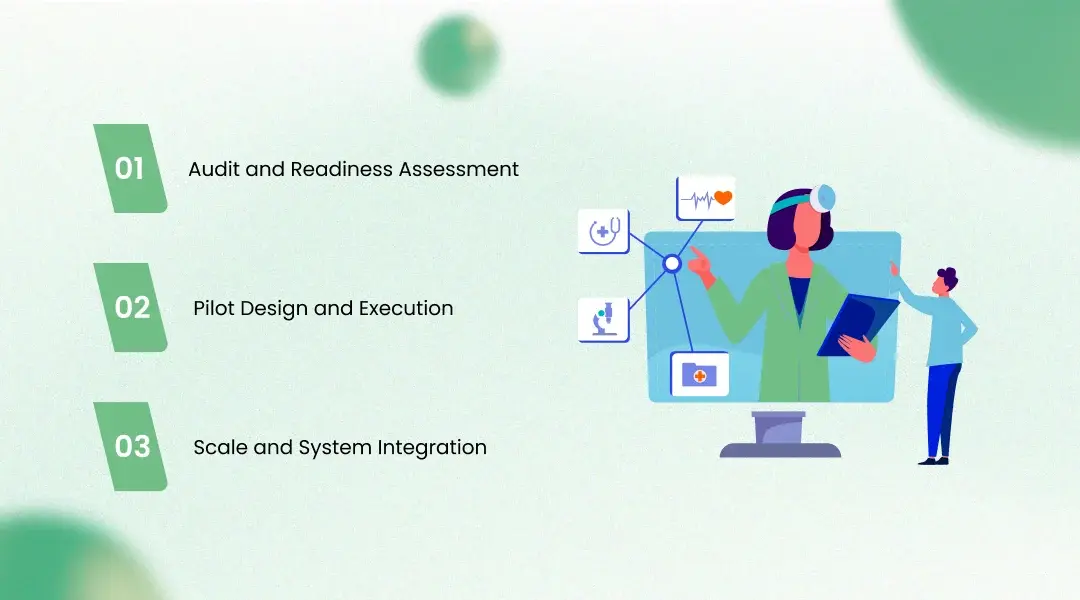
Healthcare AI implementation is not a technology deployment. It is an organizational transformation initiative that requires technology, governance, clinical engagement, and change management working in parallel from the first planning meeting through full production operation. Health systems that treat AI adoption as an IT project consistently underperform against organizations that position it as a clinical and operational strategy with executive accountability, defined outcome targets, and weekly performance measurement from the day the first pilot goes live.
Phase 1: Audit and Readiness Assessment
The foundation of every successful healthcare AI implementation is a clear-eyed assessment of the data environment, technical infrastructure, and organizational readiness before any tool is selected or procurement begins. A comprehensive readiness assessment should examine the following dimensions:
Data completeness and label quality across clinical domains including inpatient, outpatient, imaging, pharmacy, and laboratory systems
Interoperability of existing platforms and availability of FHIR-compliant APIs at planned integration points
Governance structures covering data access controls, HIPAA compliance, and clinical AI review and approval authority
Current workflow documentation across the departments targeted for initial AI deployment
Stakeholder readiness among clinical leadership, IT teams, and frontline clinical staff in the target areas
This assessment phase typically requires four to eight weeks at a mid-sized health system. KriraAI, which builds practical AI solutions for enterprise healthcare organizations, treats the readiness assessment as the single highest-leverage investment in a long-term AI program because identifying data and workflow gaps before tool selection prevents the costly deployment restarts that surface when mismatches are discovered after procurement is complete.
Phase 2: Pilot Design and Execution
The pilot phase is where healthcare AI implementation theory meets operational reality. The most important pilot selection criterion is the intersection of organizational pain and data readiness. Launching a pilot in a department where data quality is poor or clinical engagement is low will produce results that do not reflect actual system capability, regardless of how compelling the technology appeared during a vendor demonstration.
A well-structured pilot defines success metrics before launch, runs for a minimum of 90 days to capture statistically meaningful utilization data, and includes a structured feedback mechanism for frontline clinical users throughout the deployment period. High-value pilot use cases with proven results in early-adopter health systems include ambient AI documentation in primary care clinics, sepsis prediction models in a defined ICU cohort, and prior authorization automation in high-volume specialty departments. The readiness assessment phase should identify which of these options best matches the organization's current data quality and clinical engagement profile before pilot selection is finalized.
Phase 3: Scale and System Integration
Moving from a successful pilot to enterprise deployment requires full EHR integration, expanded governance and training programs for new user cohorts, and active management of the adoption resistance that is predictable among clinical staff who were not part of the original pilot. The financial returns projected from pilot performance will only materialize at scale if adoption behavior among the expanded user population matches that of the pilot group. Closing this gap is a structured change management challenge as much as a technical integration task, and it requires communication plans, training programs, and clinical champion networks that most technology procurement plans do not include in their initial scope.
Common Mistakes and How to Avoid Them
Healthcare AI implementation failures cluster around a predictable set of organizational and technical errors. Recognizing these patterns before deployment begins is the most efficient form of risk management available. Most of these errors share a common root cause: the underestimation of organizational complexity relative to the technical complexity of the AI system being deployed.
Choosing use cases based on technology interest rather than operational pain: AI tools that attract attention at industry conferences may not address the workflows costing your organization the most money and time. Start with problems and work backward to the technology.
Underestimating data preparation requirements: Most health systems need three to six months of data preparation before AI models can be integrated reliably. Procurement plans that allocate six weeks for this phase will consistently fall short and delay deployment timelines.
Embedding AI into broken workflows: AI applied to a flawed process makes that process faster without making it better. Workflow redesign should precede or accompany tool deployment, not follow it as an afterthought once performance problems become visible.
Measuring adoption activity rather than clinical outcomes: Physician login counts and feature utilization rates are not success metrics. Define clinical and financial outcome measures before the pilot begins and track them from the first week of live operation.
Failing to engage physician skeptics early: Clinicians who feel a tool was selected without their input will discourage adoption among colleagues after launch. Involving clinical skeptics in pilot design improves both tool configuration and the post-launch adoption trajectory.
Challenges and Limitations You Cannot Ignore
Honest evaluation of AI in healthcare requires examining the gap between what AI systems produce in controlled research environments and what they reliably deliver in live clinical settings. That gap is real and meaningful. The health systems that take AI limitations seriously during the planning phase are consistently those whose deployed tools perform reliably in production and earn sustained clinical adoption.
Data quality is the most fundamental barrier to effective AI deployment. AI models are only as accurate as the training data they learn from, and most health system EHRs contain years of inconsistent documentation practices, varying coding conventions across departments, and heterogeneous laboratory reference ranges that differ by equipment vendor and testing protocol. Building a training dataset that is complete, consistently labeled, and representative of the actual patient population requires significantly more time and investment than most AI procurement plans account for. Organizations that do not budget honestly for data preparation consistently deploy models that underperform against the vendor benchmarks cited during procurement conversations.
Regulatory complexity adds meaningful friction to every clinical AI project. Tools that support or inform clinical decisions are regulated as software as a medical device in the United States, with FDA clearance requirements, post-market surveillance obligations, and labeling constraints that govern what claims can be made about model outputs. HIPAA compliance introduces additional requirements around data access controls, model output logging, and de-identification standards that require legal and compliance expertise most health IT teams do not maintain internally or budget for in AI project plans.
Algorithmic bias is an underexamined clinical risk with direct patient safety implications. AI models trained on data that over-represents a specific demographic group may perform measurably worse on patients from different backgrounds. A sepsis prediction model built primarily on one population sample may miss early deterioration signals in patients whose physiological baseline differs from the training data. Health systems that deploy AI without auditing for demographic performance disparities accept clinical risk that may not become visible until it has already contributed to an adverse patient outcome that carries both human and institutional cost.
Physician adoption remains the most immediate practical barrier at the point of care. Clinicians who do not understand or trust an AI tool will not use it consistently, and adoption gaps directly undermine the financial returns projected during procurement and planning. Explainability in clinical AI, meaning the ability to understand why a model produced a specific output for a specific patient, is a precondition for clinical trust rather than an optional design feature enhancement, and most commercially deployed tools still have significant room to improve in this dimension.
The Future of AI in Healthcare Over the Next Five Years
Looking three to five years forward, AI in healthcare will no longer function as a collection of point solutions embedded within existing clinical workflows. It will operate as a continuously active intelligence layer spanning every dimension of care delivery, from the first patient contact through post-discharge monitoring and long-term chronic disease management across large populations. The infrastructure that leading health systems are building today is the foundation for that capability.
The near-term trajectory points clearly toward AI agents capable of executing multi-step clinical and administrative workflows with limited human intervention at each individual decision point. Today, most clinical AI tools are advisory: they surface recommendations that clinicians accept or reject. Within three years, agentic AI systems will manage complete referral routing cycles, prior authorization submissions, care gap closure programs, and chronic disease monitoring workflows, escalating to human review only when exceptions fall outside defined clinical parameters or regulatory boundaries.
Predictive analytics in healthcare will evolve from population-level risk scoring toward individualized care pathway optimization. Rather than flagging a patient as high-risk for a specific outcome, AI systems will generate specific, evidence-based intervention sequences calibrated to that individual's clinical history, medication profile, wearable device data, and social context. The precision of these recommendations will increase substantially as genomic data and real-world evidence streams become standard inputs in clinical AI model training at enterprise scale.
The competitive divide between early AI adopters and late movers in healthcare will become measurable within two to three years. Organizations that have deployed AI across multiple clinical and operational domains will carry structural cost advantages that are genuinely difficult to close through conventional efficiency programs. They will operate with lower administrative overhead, higher clinician retention, faster patient throughput, and demonstrably better clinical outcomes per episode of care. KriraAI, which partners with healthcare enterprises to design and deploy AI systems that scale beyond the pilot stage, anticipates that organizations investing in AI infrastructure and governance today are establishing the competitive positions that will define market dynamics in healthcare for the following decade.
Conclusion
AI in healthcare is not a coming transformation. It is a present-day operational reality at the health systems that have moved deliberately from interest to implementation. Three conclusions from this analysis are most important for healthcare leaders to act on now.
First, the value of AI in healthcare concentrates in specific, well-defined use cases where clean data, clinical engagement, and organizational pain intersect. Broad simultaneous deployment consistently underperforms against focused, sequenced implementation with defined outcome targets at each stage. Second, the implementation roadmap matters as much as the technology selection. Data readiness, workflow redesign, and clinical trust determine whether pilot results translate into production returns or stall at the boundary of the pilot department. Third, the window for sustainable first-mover advantage is narrowing. The structural cost and capability advantages that early adopters are building today will be genuinely difficult to replicate through accelerated catch-up investment in three to five years.
KriraAI partners with healthcare enterprises to design and implement AI solutions that are practical, measurable, and built to scale beyond a single use case or department. From readiness assessments that identify the highest-value starting points to production deployments that generate documented clinical and financial returns, KriraAI brings domain expertise and structured implementation methodology that health system leaders need to move from planning to impact. If your organization is evaluating where to begin or how to accelerate an existing AI initiative in healthcare, contact KriraAI to build a roadmap grounded in your specific data environment, clinical workflows, and organizational priorities.
FAQs
AI in healthcare is currently deployed across four major problem categories: clinical decision support, administrative automation, operational efficiency, and patient engagement. In clinical settings, AI tools analyze medical images for early disease detection, generate real-time risk scores for patients at risk of deterioration, and surface diagnostic considerations from electronic health record data during active care encounters. On the administrative side, AI clinical documentation tools generate structured notes from patient encounters automatically, while AI coding and billing tools reduce claim denial rates and accelerate revenue cycle performance. Operationally, AI models predict patient flow patterns, supply chain demand, and staffing needs in ways that reduce waste and improve resource allocation across high-volume inpatient settings. The most effective implementations target a specific organizational pain point with a defined outcome measure, rather than pursuing AI adoption as a broad initiative without clear performance targets established from the outset.
The measurable benefits of AI in healthcare for hospital systems fall into three primary categories: clinical outcomes, operational efficiency, and financial performance. AI sepsis detection models have produced 18 to 30 percent reductions in sepsis-related mortality at adopting hospitals, and AI radiology tools have improved mammography cancer detection rates by 5 to 9 percent compared to single-reader interpretation. Operationally, AI patient flow tools have reduced emergency department wait times by 20 to 35 percent, and AI scheduling tools have generated 15 to 20 percent improvements in staff satisfaction scores at health systems that have moved past the pilot stage. Financially, ambient AI documentation tools recover an average of 40 percent of per-encounter physician documentation time, capacity that can be redirected toward additional patient visits. Revenue cycle AI cuts claim denial rates by 15 to 25 percent, improving realized revenue without adding headcount.
Successful healthcare AI implementation requires four elements working in parallel: strong data foundations, executive sponsorship, clinical engagement, and outcome-based performance measurement. The data foundation means relevant patient data is accessible, consistently labeled, and HIPAA-compliant before any tool is deployed. Executive sponsorship means AI is positioned as a strategic organizational initiative, not an IT infrastructure project assigned without clinical accountability at the leadership level. Clinical engagement means physicians and nurses participate in tool selection, pilot design, and ongoing feedback so that AI systems reflect actual workflow requirements rather than vendor assumptions. Outcome measurement means specific clinical and financial metrics are defined before each pilot begins and tracked from the first day of live deployment. Organizations that omit any of these elements consistently produce pilots that perform in demonstration and underperform in production, which is the most common pattern in healthcare AI programs that do not achieve projected returns.
AI improves patient outcomes through two primary mechanisms: earlier detection of deteriorating conditions and more precise clinical decision support at the point of care. In sepsis management, AI risk models that identify high-risk patients six to twelve hours before visible clinical deterioration allow care teams to begin intervention protocols at the moment they are most effective, which is the primary determinant of sepsis survival at the population level. In oncology, AI medical diagnosis tools applied to radiology and pathology imaging detect cancers at earlier stages when curative treatment options remain available and are less resource-intensive. In primary care, predictive analytics models identify patients with rising chronic disease risk and prompt outreach for preventive intervention before acute exacerbations occur. Each mechanism generates measurable outcome improvements that compound over time as health systems accumulate longitudinal patient data and refine model performance through continuous monitoring and retraining.
The biggest challenges in adopting AI in healthcare cluster around four domains that most organizations underestimate during planning. First, data quality: AI models trained on incomplete or inconsistently labeled clinical data produce unreliable outputs in production, and most health system datasets require substantial preparation before supporting reliable model performance in live clinical environments. Second, regulatory complexity: clinical AI tools are regulated as software as a medical device in the United States, with FDA clearance requirements and HIPAA data governance constraints that require legal and compliance expertise most health IT teams do not maintain internally. Third, physician adoption: clinicians who do not trust an AI tool will not use it consistently, directly undermining the financial returns projected during planning and procurement. Fourth, change management: deploying AI requires redesigning existing clinical workflows rather than simply overlaying technology on current processes. Organizations that plan explicitly for all four of these challenges before deployment begins significantly outperform those that encounter them as unexpected obstacles after procurement is complete.
Founder & CEO
Divyang Mandani is the CEO of KriraAI, driving innovative AI and IT solutions with a focus on transformative technology, ethical AI, and impactful digital strategies for businesses worldwide.