Physicians at this leading multi-hospital health system were drowning in paperwork. They spent roughly two hours inside the electronic health record for every hour of direct patient care. That ratio is the quiet crisis behind most modern hospitals. This AI in healthcare case study traces what happened when KriraAI was brought in to fix it.
The documentation burden was never just an inconvenience. It was a revenue problem, a retention problem, and a patient access problem at once. The health system carried an 11.3 percent claim denial rate. Coding queues regularly stretched four to five days, and clinician attrition climbed every quarter.
KriraAI engaged as the AI engineering partner to design and deliver a production AI clinical documentation system, not a throwaway pilot. Every delayed note pushed cash further out the door. Every miscoded encounter leaked margin our client could never recover. This case study walks through the problem, the system we built, the full architecture, the delivery journey, and the measurable results.
The health system ran eleven hospitals and more than ninety outpatient clinics across two states. Its revenue cycle and clinical workflows had grown faster than the technology meant to support them. Clinicians documented encounters by typing into rigid EHR templates late into the night. Coders then re-read those notes days later and translated them into billing codes by hand.
This workflow was slow, expensive, and structurally fragile. The data already existed inside the system, but almost none of it was used intelligently. Encounter audio, structured vitals, prior diagnoses, and payer rules all lived in separate silos. Nothing connected the clinical narrative to the codes that determined reimbursement.
The financial consequences compounded month after month. An 11.3 percent denial rate meant more than one in nine claims came back unpaid on first submission. Each denied claim triggered manual rework that cost an estimated 25 dollars to touch again. Days in accounts receivable sat at 54, well above the regional benchmark.
The breakdowns were specific and repeatable rather than random. We saw the same failure points described in revenue integrity reviews across the industry. The patterns below defined the daily reality our client lived before the engagement began.
Clinicians wrote notes after hours, producing rushed documentation that omitted billable detail and clinical specificity.
Coders worked from incomplete narratives, so they downcoded defensively to avoid audit risk and left earned revenue uncaptured.
Payer policy changes arrived faster than human teams could absorb, so claims failed against rules nobody had read yet.
Denials were worked reactively after rejection, instead of being predicted and corrected before submission.
The status quo had become unsustainable for reasons beyond cost. Larger systems in the same markets were already deploying ambient documentation tools. Our client was losing clinicians partly because the documentation experience was so punishing. Patient access suffered too, because slow coding delayed billing and strained clinicians limited the appointment slots they could safely carry.
Leadership understood that a faster, more accurate documentation and coding engine would protect both revenue and the workforce. They needed a system that worked inside their existing EHR rather than beside it. They needed outputs clinicians would trust and auditors would accept. That recognition is what brought KriraAI into the first discovery session.
KriraAI designed and delivered a unified AI clinical documentation system that also drives coding and denial prevention. The platform listens to the encounter, drafts a structured note, suggests defensible codes, and scores every claim for denial risk before submission. It augments clinicians and coders rather than replacing their judgment. Every clinical output still passes through a human sign off step.
The system works end to end across three coordinated model families. First, a streaming speech recognition layer transcribes the clinician and patient conversation in real time. Second, a fine tuned large language model converts that transcript into a structured SOAP note grounded in the patient record. Third, a retrieval augmented generation layer maps the finished note to ICD-10-CM and CPT codes with cited evidence.
The denial prediction model sits at the end of this chain. It scores each prepared claim against historical denial patterns and current payer policy. High risk claims are flagged with the specific reason and routed for correction before submission. This closes the loop between how care is documented and whether it gets paid.
Data moves through the platform in a deliberate, observable sequence. The flow was engineered so every output traces back to a verifiable source. The pipeline never lets a generated statement float free of its evidence.
Encounter audio streams from a mobile capture app into the ingestion layer within milliseconds of being spoken.
The transcript is diarized by speaker, then aligned against structured EHR context such as active medications and prior problems.
The language model drafts the note, citing the transcript spans and record elements that support each clinical statement.
The RAG medical coding pipeline retrieves candidate codes, ranks them, and attaches the documentary evidence a coder needs to confirm them.
The denial model scores the assembled claim, and only clean claims flow to the billing system through the integration layer.
This design solved the core failure our client lived with. The clinical narrative and the billing code were finally connected by a single, auditable thread. KriraAI built the platform so no code could be suggested without supporting text in the note. That grounding discipline is what makes the AI clinical documentation system trustworthy in a regulated setting. The platform replaced three disconnected manual steps with one continuous flow, and it gave the revenue team a predictive safety net before any claim left the building.
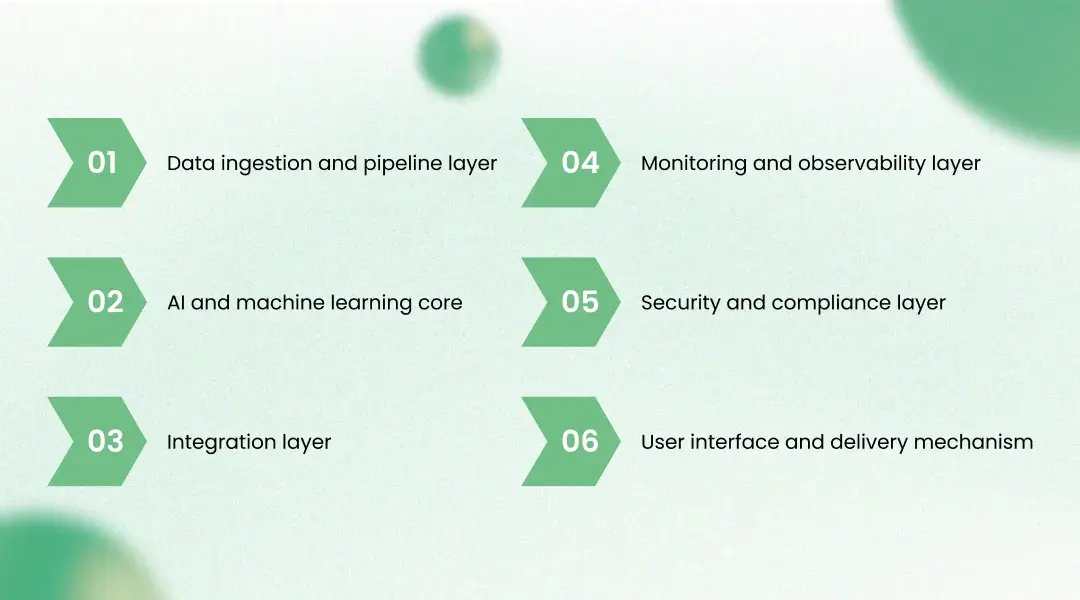
The architecture was designed as six connected layers, each with a clear engineering rationale. KriraAI built it for a hardened production environment serving thousands of daily encounters. Nothing in this AI in healthcare case study was a proof of concept. Every layer had to survive real clinical load, strict latency budgets, and HIPAA scrutiny.
The ingestion layer combined three patterns to capture every relevant signal. Encounter audio arrived as a real time stream over WebRTC into Apache Kafka topics. Clinical context came through FHIR R4 APIs and change data capture on the EHR database using Debezium. Historical claims arrived as nightly batch extracts of 837 and 835 EDI files.
Apache Flink handled streaming transforms, while Apache Airflow orchestrated batch DAGs. At ingestion we normalized everything to a FHIR aligned schema and ran entity resolution across sources. We de-identified protected health information at the edge using Microsoft Presidio and a custom clinical NER model. A Feast feature store then served features through online Redis and offline Delta Lake paths.
The core was a coordinated set of specialized models rather than one monolith. The speech layer used a Whisper large v3 encoder fine tuned on de-identified medical audio. We added pyannote diarization and served it with CTranslate2 for streaming throughput. This held word error rate on clinical speech near 6 percent.
The note model was a transformer based large language model in the mixture of experts family. KriraAI applied supervised fine tuning on a de-identified corpus of physician notes. We then used direct preference optimization to reduce fabrication and enforce SOAP structure. It was served with vLLM and AWQ quantization, with TensorRT-LLM kernels holding tail latency in check. The RAG medical coding pipeline paired a contrastively trained embedding model, a Qdrant HNSW index, and a cross encoder reranker. The denial model was a calibrated LightGBM classifier, with SHAP values exposing every score.
The integration layer connected AI outputs to the systems clinicians and billers already used. KriraAI built it on an event driven backbone so no component blocked another. Kafka carried events between services, and gRPC handled low latency internal model calls. External contracts were exposed as versioned REST and FHIR APIs.
The clinician facing surface was a SMART on FHIR application embedded in the EHR. Finished notes were written back as FHIR DocumentReference resources, and suggestions surfaced through CDS Hooks. Webhooks pushed scored claims into the revenue cycle platform automatically. The AI lived inside existing workflows rather than asking staff to switch tools.
Observability was treated as a first class requirement, not an afterthought. We measured input drift using population stability index and KL divergence on feature distributions. Model quality was scored continuously against a clinically validated gold set. Latency was tracked at p50, p95, and p99 across the live streaming path.
Prometheus collected metrics, Grafana visualized them, and Evidently flagged distribution shift. MLflow served as experiment tracker and model registry for every release. When gold set accuracy crossed a defined threshold, Airflow triggered an automated retraining run. This let the platform defend its own accuracy over time.
Security was engineered to satisfy HIPAA and the client's own audit teams. The entire platform ran inside a private VPC with no public endpoints. All inputs and outputs were encrypted in transit with TLS 1.3 and at rest with AES-256. Role based access control enforced attribute level masking so each user saw only permitted fields.
Every prediction, edit, and access event was written to an immutable append only audit store. That ledger let compliance teams reconstruct any clinical decision the AI touched. KriraAI delivered the platform under a signed business associate agreement, aligned with SOC 2 Type II and HITRUST expectations.
The delivery layer met clinicians and coders where they already worked. Clinicians used a mobile ambient capture app and the embedded SMART on FHIR review panel. Coders worked in a React console showing each suggested code beside its supporting evidence. Revenue cycle leaders watched denial risk and throughput on live dashboards.
Every AI output was presented as a draft requiring human confirmation. This kept clinicians and coders in control of the final record, with the evidence one click away. That transparency is what earned clinical trust during rollout.
Every technology in this stack was chosen against the client's real environment and constraints. The health system ran a major commercial EHR, so FHIR and SMART on FHIR were mandatory rather than optional. The choices below reflect deliberate trade offs, not defaults.
Apache Kafka and Apache Flink were selected for streaming because encounter audio and EHR events needed durable, ordered, real time handling at hospital scale.
Debezium change data capture was chosen over polling because it captured EHR changes without adding load to the production clinical database.
Whisper large v3 with CTranslate2 was selected because it gave clinical grade transcription while meeting the streaming latency budget on available GPUs.
A mixture of experts language model was chosen so we could deliver strong note quality while keeping inference cost controlled per active expert.
vLLM with AWQ quantization was selected because it maximized GPU throughput and held p99 latency under two seconds during peak clinic hours.
Qdrant with HNSW indexing was chosen for the RAG medical coding pipeline because it balanced recall and query speed across the large coding corpus.
LightGBM was selected for denial prediction because it trained fast on wide tabular claim data and paired cleanly with SHAP for required explainability.
Feast, MLflow, Prometheus, and Grafana formed the operational backbone because the client needed open, auditable tooling they could own after handover.
This stack was assembled so the health system would not be locked into any single vendor. KriraAI deliberately favored open standards and portable components. That choice protected the client's long term flexibility while still delivering production performance from launch.
The healthcare AI implementation ran across six disciplined phases over roughly nine months. KriraAI treated delivery as an engineering program, not a demo. Each phase had explicit exit criteria the client signed off before we moved forward.
The first phase was discovery and requirements, which took six weeks. We mapped clinical workflows, sampled real notes, and audited two years of denied claims. This phase revealed how inconsistent the documentation templates actually were. That early finding shaped every model decision that followed.
The second phase was architecture design and security review. We finalized the six layer design and ran it past compliance and infrastructure teams. The private VPC topology and audit logging approach were approved here, which prevented expensive rework later.
The third phase was data pipeline and de-identification engineering. This is where the first serious challenge surfaced. The HL7 feeds were messier than the documentation suggested, with malformed segments and missing identifiers. We resolved it with stronger schema normalization and a probabilistic entity resolution step that recovered patient matches the raw feed had lost.
The fourth phase was model development, and it produced the hardest problem of the project. Early versions of the note model occasionally fabricated plausible but unsupported clinical statements. In a healthcare setting, that risk was unacceptable. We responded with three concrete fixes rather than one.
We added strict evidence grounding so every generated statement had to cite a transcript span or record element.
We applied direct preference optimization using coder and clinician corrections as the preference signal.
We introduced constrained decoding and a mandatory human sign off gate before any note entered the record.
These changes cut the clinician edit rate below 10 percent within two development cycles. The coding model needed its own correction. Early suggestions missed payer specific rules, so we added live payer policy retrieval and the cross encoder reranker. First pass coding acceptance climbed steadily after that change.
The fifth phase was testing and validation in shadow mode. The platform ran silently alongside live operations for eight weeks. It generated notes and codes that humans reviewed but did not yet act on. This let us measure real accuracy without any patient or revenue risk.
Deployment was deliberately phased rather than switched on at once. We launched in a single specialty service line first, then expanded hospital by hospital. The final phase was handover, where KriraAI trained the client's own MLOps team to operate the retraining pipelines. We left the system fully observable and owned by the people running it every day.
The results were measured over the twelve months following go live. The platform moved the metrics that mattered most to both finance and clinicians. The before and after gap was clear and durable, not a launch week spike. Each figure below was validated against the system's own reporting.
The denial rate fell from 11.3 percent to 4.1 percent, a 63 percent reduction. This shows how the health system was able to reduce claim denials with AI that scored every claim before submission. Days in accounts receivable dropped by 9 days, from 54 to 45. The combined revenue cycle gains delivered an estimated 14.2 million dollars in annualized net revenue improvement.
The documentation results were just as meaningful for the workforce. Clinicians reclaimed an average of 90 minutes per day previously lost to after hours charting. Coding turnaround fell from 4.5 days to under one day, a 78 percent improvement. First pass coding acceptance reached 96 percent against the validated review set.
Quality and trust metrics held up under real load. The clinician edit rate on generated notes stayed below 10 percent across all rolled out service lines. Transcription word error rate held near 6 percent, and live inference latency stayed under two seconds at p99. Clinician attrition in the rolled out lines slowed within two quarters. Coder rework on rejected claims dropped sharply, freeing that team for complex, high value cases. These results reflect a completed production engagement, not a contained pilot.
The platform was deliberately engineered to grow without being rebuilt. Because the design separates ingestion, models, and serving, each layer scales on its own. When encounter volume grows, the Kafka and Flink streaming tier scales horizontally. When a new model is needed, it plugs into the existing feature store and serving fabric.
New use cases can be added on the same foundation with minimal new infrastructure. The same RAG medical coding pipeline that maps notes to codes can be extended to prior authorization. The same evidence grounding pattern can support discharge summaries and quality measure abstraction. KriraAI built the platform so these additions reuse the existing data and security layers rather than starting over. This is what separates a durable platform from a single use model.
The client's two to three year AI roadmap now builds directly on this base. Planned extensions include ambient documentation for nursing, predictive scheduling, and automated payer appeals. Each reuses components already hardened in production. That reuse is the real return on a well designed healthcare AI implementation.
Other health systems can apply the same architectural principles to their own situations. Connect the clinical narrative to the billing outcome with an auditable, evidence grounded thread. Treat monitoring and security as first class layers rather than additions. Build on open standards so the system stays portable and owned. Start with one high value workflow, prove it in shadow mode, then expand carefully.
Three insights stand out from this engagement above the rest. The technical insight is that grounding every AI output in cited evidence is what makes clinical AI trustworthy. The operational insight is that connecting the clinical narrative directly to the billing outcome removes the most expensive failure in the revenue cycle. The strategic insight is that a well designed platform pays off repeatedly, because new use cases reuse the same hardened foundation rather than starting from zero.
This AI in healthcare case study reflects how KriraAI approaches every engagement. We build production systems with real monitoring, security, and ownership, not demos that stall after launch. KriraAI brings principal level engineering depth and disciplined delivery to each project, because that is what enterprise AI in a regulated industry actually requires. The result here was a 63 percent denial reduction, 90 minutes returned to clinicians daily, and a platform the client now owns and extends.
If your organization is facing a costly, data rich problem that AI should be solving, bring it to KriraAI. We will design the architecture, deliver the system, and leave you in control of it.
AI is used in clinical documentation to convert a spoken patient encounter into a structured clinical note automatically. In the platform KriraAI built, a streaming speech model transcribes the conversation, and a fine tuned large language model drafts a SOAP note grounded in the patient record. Every generated statement must cite a transcript span or a record element, which prevents the model from inventing clinical detail. The clinician then reviews and signs the draft before it enters the record. In this engagement the approach reclaimed roughly 90 minutes of charting time per clinician each day.
Yes, AI can reduce claim denials by scoring each claim against historical denial patterns and current payer policy before submission. In this AI in healthcare case study, KriraAI deployed a calibrated LightGBM model that flagged high risk claims and gave the specific reason for each flag, so teams could fix issues before sending them. Because the denial model sat at the end of an evidence grounded documentation and coding chain, the codes were better supported from the start. The health system used this approach to reduce claim denials with AI from an 11.3 percent rate to 4.1 percent over twelve months.
AI can be HIPAA compliant when it is engineered with the right controls from the beginning, not added afterward. The platform KriraAI delivered ran entirely inside a private VPC with no public endpoints, encrypted all data in transit with TLS 1.3 and at rest with AES-256, and enforced role based access control with attribute level masking. Protected health information was de-identified at ingestion, and every access, prediction, and edit was written to an immutable append only audit store. The system was delivered under a signed business associate agreement and aligned with SOC 2 Type II and HITRUST control expectations.
AI medical coding accuracy depends heavily on whether the model retrieves the right reference rules and grounds its suggestions in real documentation. KriraAI built a RAG medical coding pipeline that retrieved candidate ICD-10-CM and CPT codes from a vector index, reranked them with a cross encoder, and attached the supporting note evidence to each suggestion. Adding live payer policy retrieval closed the gap where early versions missed payer specific rules. In production this approach reached 96 percent first pass coding acceptance against a clinically validated review set. The model never finalized a code alone, so a human coder always confirmed each suggestion before billing.
A production grade hospital AI implementation typically takes several months when it is done as real engineering rather than a quick pilot. The healthcare AI implementation described here ran across six disciplined phases over roughly nine months, covering discovery, architecture and security review, data pipeline engineering, model development, validation, and phased deployment. The platform also ran in shadow mode for eight weeks, generating outputs that humans reviewed but did not act on, which let the team measure real accuracy without patient or revenue risk. KriraAI then trained the client's own MLOps team during handover. Timelines vary with data quality, EHR complexity, and compliance scope.
Founder & CEO
Divyang Mandani is the CEO of KriraAI, driving innovative AI and IT solutions with a focus on transformative technology, ethical AI, and impactful digital strategies for businesses worldwide.