Researchers at McKinsey and Harvard estimate that AI in healthcare could save the United States between $200 billion and $360 billion every year. That figure is not a distant forecast. It reflects technologies that already exist and could scale within five years. Yet most health systems have barely started.
National spending tells the rest of the story. The United States spent roughly $4.9 trillion on healthcare in 2023. About a quarter of that money funds administrative work rather than care. Inefficiency at this scale is no longer a back office problem. It has become a clinical and financial emergency.
This article makes a direct argument for healthcare leaders. The biggest risk today is not adopting AI too quickly. It is adopting it too slowly while competitors pull ahead. We will cover the true state of the industry, the technologies that matter, the measurable returns, a practical roadmap, the honest limitations, and what the next five years will demand of every provider.
Healthcare entered this decade under severe strain. Costs climb faster than general inflation almost every year. Operating margins at many hospitals sit in the low single digits. Some systems run at a sustained loss. The pressure is structural, not temporary.
The strain is not caused by one factor. Several forces compress providers at the same time. Each one alone would be difficult. Together they create a system that struggles to fund the care it is meant to deliver.
An aging population is driving demand for chronic and complex care that the current workforce cannot fully absorb.
A shrinking clinical workforce means fewer nurses and physicians are available, while burnout pushes experienced staff toward early exits.
Administrative complexity forces clinicians to spend hours on documentation, prior authorization, and billing instead of patient care.
Reimbursement pressure from payers continues to tighten, even as the cost of labor, drugs, and supplies keeps rising.
These pressures do not stay in the finance department. They reach the bedside. When a hospital cannot staff a unit, patients wait longer. When clinicians spend evenings on paperwork, they burn out and leave. The result is a quiet erosion of both quality and capacity.
Competition is also changing shape. Retail clinics, telehealth platforms, and well funded entrants now court the same patients. They compete on speed, convenience, and price transparency. Traditional providers cannot match that experience on legacy systems alone. The ground is shifting beneath an industry that historically moved slowly.
Financial fragility compounds every other problem. Many systems carry thin reserves and aging facilities. A single difficult quarter can force service cuts or hiring freezes. Workforce shortages then deepen, since stressed teams leave faster. The system has very little slack left to absorb new shocks.
The core promise of AI in healthcare is precision applied at scale. The technology does not replace the clinical judgment of doctors and nurses. It augments that judgment by processing data no human could review in real time. The best results come from matching a specific technology to a specific problem.
This is where careful implementation matters more than hype. KriraAI works with enterprises to map each AI capability to a concrete workflow problem rather than chasing trends. The technologies below are already in clinical use today. Each one targets a distinct failure point in the current system.
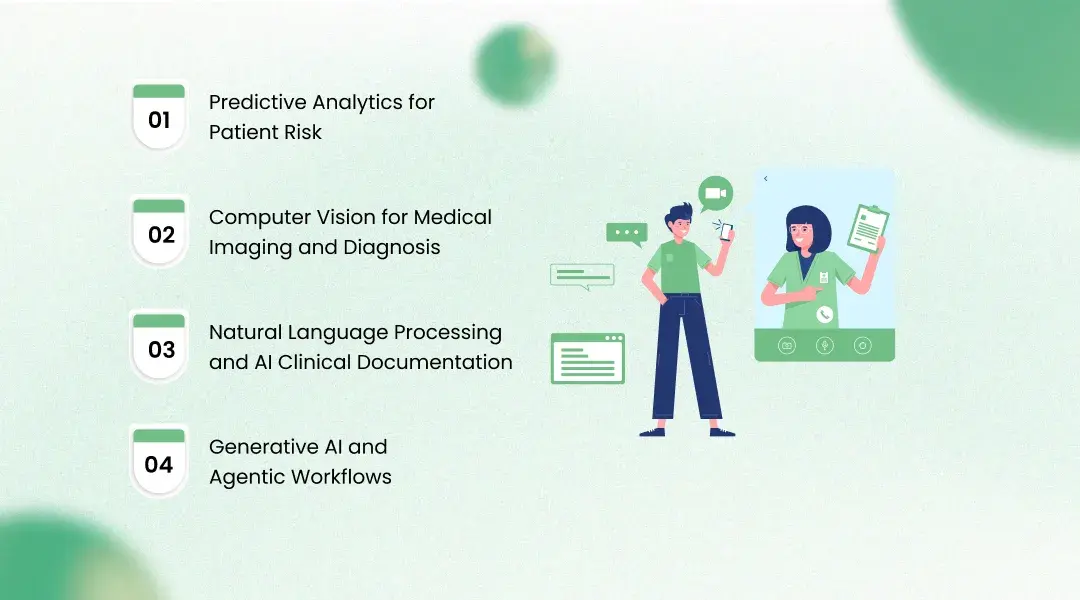
Predictive analytics in healthcare uses machine learning to flag risk before it becomes a crisis. Sepsis is the clearest example. Models scan vital signs, lab values, and notes continuously. They alert clinicians hours before traditional signs appear. Early warning buys time, and in sepsis time saves lives.
The same approach reduces avoidable readmissions. Algorithms score which discharged patients are most likely to return. Care teams then target follow up resources where they matter most. Hospitals also use predictive analytics in healthcare to forecast admissions and staff accordingly. This turns reactive scheduling into proactive planning.
AI medical diagnosis has advanced furthest in medical imaging. Computer vision models analyze radiographs, CT scans, and MRIs at high speed. They flag suspicious findings and prioritize urgent cases for radiologists. This triage shortens the time between scan and treatment.
Regulators have taken notice of this progress. The FDA has now authorized more than 1,240 AI enabled medical devices. The majority received clearance in just the past three years. In February 2025, Aidoc's CARE1 became the first foundation model clinical AI cleared by the agency. AI medical diagnosis tools now support stroke detection, diabetic eye screening, and lung nodule analysis in routine practice.
AI clinical documentation may be the fastest spreading application in hospitals today. Ambient tools listen to a visit and draft a clinical note. The clinician reviews and approves the draft before it enters the record. This removes one of the heaviest burdens in modern medicine.
Natural language processing extends well beyond note taking. It reads unstructured records to surface relevant history. It automates medical coding from physician language. It also drafts responses to the flood of patient messages. AI clinical documentation gives clinicians back the most valuable thing they have lost, which is attention for the patient in front of them.
Generative AI is now moving from drafting text to taking action. Agentic systems can work through multi step administrative tasks with limited supervision. The revenue cycle is the prime target. Health systems spend more than $140 billion a year on revenue cycle work, much of it manual.
The named use cases for generative and agentic AI are expanding quickly:
Automated prior authorization that assembles and submits payer requests without manual data entry.
Patient facing assistants that answer routine questions and schedule appointments around the clock.
Coding and claims agents that reduce denials by catching errors before submission.
Discharge summary drafting that compresses a tedious task into a quick review step.
The shift from suggestion to action is significant. Earlier tools only summarized or recommended for a human. Agentic systems now complete defined tasks from start to finish. They still operate inside strict guardrails and human review. But they move AI from advice into measurable operational work.
The returns from AI in healthcare are now measurable rather than theoretical. The McKinsey and Harvard analysis breaks the opportunity down by stakeholder. Each segment shows a credible path to savings using current technology. These are not speculative gains.
The savings concentrate in three groups. Hospitals could capture $60 billion to $120 billion through better clinical operations and patient flow. Physician groups could save $20 billion to $60 billion through workflow and care management gains. Private payers hold the largest single opportunity, at $80 billion to $110 billion, driven by claims automation and fraud detection.
Clinician wellbeing shows some of the strongest evidence. A 2025 study in JAMA Network Open surveyed physicians across six health systems using ambient tools. Self reported burnout fell from roughly 52% to 39%. At Mass General Brigham, burnout dropped by 21.2 percentage points among users. The program there grew from 18 physicians in 2023 to over 3,000 by April 2025.
Time savings translate directly into capacity. Research at UChicago Medicine found ambient AI users spent 8.5% less total time in the electronic record. They cut time composing notes by more than 15%. Recovered minutes add up across thousands of daily visits. That capacity can be redirected toward patients or toward reducing the clinical backlog.
These gains scale with volume. A clinic running thousands of visits a week recovers meaningful staff hours. Those hours reduce overtime, backlog, and the cost of temporary labor. Small percentage improvements become large dollar figures across a full system. This is why operational AI often pays back faster than clinical AI.
Adoption itself is accelerating sharply. Consumer use of AI in healthcare rose from about 3% in 2023 to roughly 22% by 2025. Analysts now value the AI in healthcare market in the tens of billions of dollars for 2025 alone. Most forecasts project a path toward several hundred billion dollars within the next decade. The direction of travel is no longer in question.
Successful AI healthcare implementation follows a disciplined sequence. Skipping steps is the most common reason pilots fail. The goal is not to deploy the most advanced model. The goal is to solve a measurable problem and prove value before scaling.
The roadmap below reflects how mature health systems actually move. Each stage builds on the last. Rushing past readiness almost always produces expensive disappointment later.
Run a readiness and data audit to assess data quality, infrastructure, governance, and the appetite for change across teams.
Select one high value, low risk use case where the problem is clear and the outcome is easy to measure.
Launch a tightly scoped pilot with defined success metrics, a fixed timeline, and clinician involvement from day one.
Validate results against a baseline so you can prove the pilot improved a real metric rather than a vanity number.
Integrate the proven tool into existing workflows and the electronic record so adoption feels natural, not bolted on.
Scale deliberately across departments while monitoring performance, bias, and clinician feedback at every step.
This is the stage where many organizations need a partner. KriraAI helps enterprises move from a single pilot to durable AI healthcare implementation that holds up under real conditions. The emphasis stays on measurable outcomes, clean integration, and governance that satisfies both clinicians and regulators. A roadmap only works when execution matches the plan.
Most AI failures in healthcare are not technical. They are organizational. Leaders chase the wrong goals or skip the unglamorous groundwork. Avoiding a handful of predictable mistakes dramatically improves the odds of success.
Starting with the most complex use case instead of an early win that builds trust and momentum.
Treating AI as an IT project and excluding the clinicians who must use the tool every day.
Ignoring data quality, since a model trained on messy records will produce unreliable results at scale.
Measuring activity rather than outcomes, which hides whether the tool actually improved care or cost.
Deploying without a governance plan for monitoring drift, bias, and safety once the model is live.
The fix for each mistake is the same principle. Treat AI healthcare implementation as a change management effort first and a technology effort second. The tool is only as good as the workflow it lives inside. Sustained value comes from people and process, not from the algorithm alone.
AI in healthcare is powerful, but it is not magic. The barriers are real and deserve honest attention. Leaders who pretend otherwise set their programs up to fail. A clear view of the limitations is the foundation of responsible adoption.
Data quality is the first and largest obstacle. Clinical data is often fragmented, inconsistent, and trapped in incompatible systems. A model is only as reliable as the data behind it. Poor inputs produce confident but dangerous outputs. Cleaning and connecting that data is slow, unglamorous work.
The talent gap is equally severe. Most hospitals lack in house data scientists and AI engineers. Clinical informatics expertise is scarce and expensive. This shortage forces many systems to rely on outside partners for model validation and integration. KriraAI exists in part to close this gap with practical engineering support.
Regulation and safety add further weight. AI tools that affect diagnosis or treatment face strict oversight. Bias is a constant danger, since a model can quietly underperform for groups it saw less during training. Integration with legacy electronic records is technically painful and rarely cheap.
Finally, there is the human factor. Clinicians are right to be cautious about tools they did not design. Trust must be earned through transparency and reliable performance. Change management is often harder than the engineering. None of these challenges is a reason to wait, but each is a reason to plan carefully.
Over the next three to five years, AI in healthcare will shift from assistant to infrastructure. Today these tools sit alongside the workflow. Soon they will be woven into the core of how care is delivered. The change will be felt by patients, not just IT teams.
Several developments look highly likely. Ambient documentation will become standard rather than a pilot. Agentic systems will quietly run large parts of the revenue cycle. Predictive models will move upstream into prevention. The line between a clinical system and an AI system will blur until it disappears.
Patients will notice the difference first. Waiting times for results should shorten as triage improves. Routine questions will receive instant and reliable answers. Care will feel more proactive and less reactive. These experience gains will quietly reshape where patients choose to go.
The competitive landscape will split sharply. Systems that built clean data foundations early will compound their advantage. They will deploy new models faster because the groundwork is done. Their clinicians will be less burned out and more productive. Their costs will fall while quality rises.
The laggards face a harder future. Organizations that delayed will find the gap difficult to close. Talent will concentrate where the tools are best. Patients will gravitate toward providers who offer faster, smoother experiences. Falling behind on AI in healthcare will increasingly mean falling behind on margin, staffing, and reputation at the same time.
Three points should stay with every healthcare leader. First, AI in healthcare is no longer experimental, and the savings of $200 billion to $360 billion a year rest on technology that already works. Second, the strongest returns come from disciplined implementation, not from chasing the most advanced model. Third, the real risk now is moving too slowly while early adopters compound their lead.
The systems that win will not be those with the biggest budgets. They will be those that match the right AI capability to the right problem and execute with care. This is where an experienced partner changes the outcome. KriraAI builds practical AI solutions for enterprises that are measurable, integrated, and ready to scale, with a focus on real workflows rather than demos. The aim is to help providers capture value without compromising safety or trust.
If your organization is ready to move from interest to results, the next step is a focused conversation about where AI can deliver the most value first. Explore how KriraAI approaches AI healthcare implementation and start with a use case you can measure. The cost of waiting is rising every quarter, and the providers who act now will define the next decade of care.
AI in healthcare is used across diagnosis, documentation, prediction, and administration. In imaging, computer vision models analyze scans and flag urgent cases for radiologists. In documentation, ambient tools draft clinical notes from a recorded visit for the clinician to approve. Predictive analytics identifies patients at risk of sepsis, deterioration, or readmission before a crisis develops. On the operational side, AI automates tasks like prior authorization, medical coding, and claims processing. The FDA has now authorized more than 1,240 AI enabled medical devices, with most cleared in the past three years, which shows how broadly these tools have entered routine clinical practice.
The main benefits of AI in healthcare are lower costs, better outcomes, and reduced clinician burnout. McKinsey and Harvard researchers estimate that wider adoption could save the United States $200 billion to $360 billion each year, equal to 5% to 10% of total spending. Clinically, AI improves early detection in conditions like sepsis and supports faster, more accurate imaging diagnosis. Operationally, it removes administrative burden so clinicians spend more time with patients. A 2025 study in JAMA Network Open found that ambient documentation tools cut self reported clinician burnout from roughly 52% to 39% across six participating health systems.
AI will not replace doctors, but doctors who use AI will likely outperform those who do not. Current AI in healthcare augments clinical judgment rather than replacing it. Imaging tools flag findings, yet a radiologist confirms the diagnosis and decides on care. Ambient tools draft notes, yet the physician reviews and approves every record. The technology handles pattern recognition and repetitive tasks at scale, freeing clinicians for complex reasoning, empathy, and decisions that require human accountability. Regulators also require human oversight for tools that affect diagnosis or treatment, which keeps the clinician firmly in control of patient care.
The biggest risks of AI in healthcare are poor data quality, hidden bias, and weak oversight. A model trained on incomplete or inconsistent clinical data can produce confident but unreliable results. Bias is a serious danger, because a tool may underperform for groups it saw less often during training, which can widen health disparities. Integration with legacy electronic records is complex and error prone. Without strong governance, models can drift in performance over time and go unnoticed. These risks are manageable through careful validation, continuous monitoring, clinician involvement, and clear accountability, but they cannot be ignored during AI healthcare implementation.
AI could save the United States healthcare system between $200 billion and $360 billion each year, according to analysis from McKinsey and Harvard researchers. That equals roughly 5% to 10% of national health spending, which reached about $4.9 trillion in 2023. The savings split across stakeholders, with hospitals positioned to capture $60 billion to $120 billion, physician groups $20 billion to $60 billion, and private payers $80 billion to $110 billion. These estimates assume only technologies that already exist and adoption that is realistic within five years. Much of the value comes from cutting administrative waste, which makes up about a quarter of total spending.
Krushang Mandani is the CTO at KriraAI, driving innovation in AI-powered voice and automation solutions. He shares practical insights on conversational AI, business automation, and scalable tech strategies.