Three months into a project, a hospital showed me their numbers.
Patient wait times? Down by 38%. Diagnosis speed? Faster. Staff workload? Noticeably lighter.
But what struck me wasn’t the metrics.
It was what a senior doctor said quietly after the meeting:
"I finally feel like I can focus on patients again… not paperwork."
That’s when it clicked.
AI in healthcare isn’t about technology. It’s about giving time and clarity back to humans.
And in 2026, that shift is accelerating.
Let me strip away the buzzwords.
Artificial intelligence in healthcare simply means using machines to analyze medical data and assist in decision-making. Not replace doctors. Assist them.
That distinction matters.
Think of AI as a very fast, very precise assistant that never gets tired. It studies patient data, identifies patterns, and helps doctors make better calls.
Not magic. Just math. Very good math.
At its core, AI in healthcare industry relies on three things:
Data (patient records, scans, reports)
Algorithms (models trained on that data)
Predictions or recommendations
For example: A system reviews thousands of X-rays… learns patterns… then flags anomalies faster than a human can.
Not instead of the doctor. Before the doctor.
Let me ask you something.
How do you manage millions of patient records… rising demand… and limited doctors?
You don’t. Not manually.
That’s why AI healthcare solutions are no longer optional, they’re becoming infrastructure
More patients. More chronic conditions. More expectations.
Healthcare systems are under pressure.
AI helps absorb that pressure.
I’ve worked with doctors who spend 40% of their time on admin work.
Forty.
That’s not why they became doctors.
AI in patient care reduces repetitive tasks, freeing doctors to do what matters.
In healthcare, delay isn’t just inconvenient.
It’s dangerous.
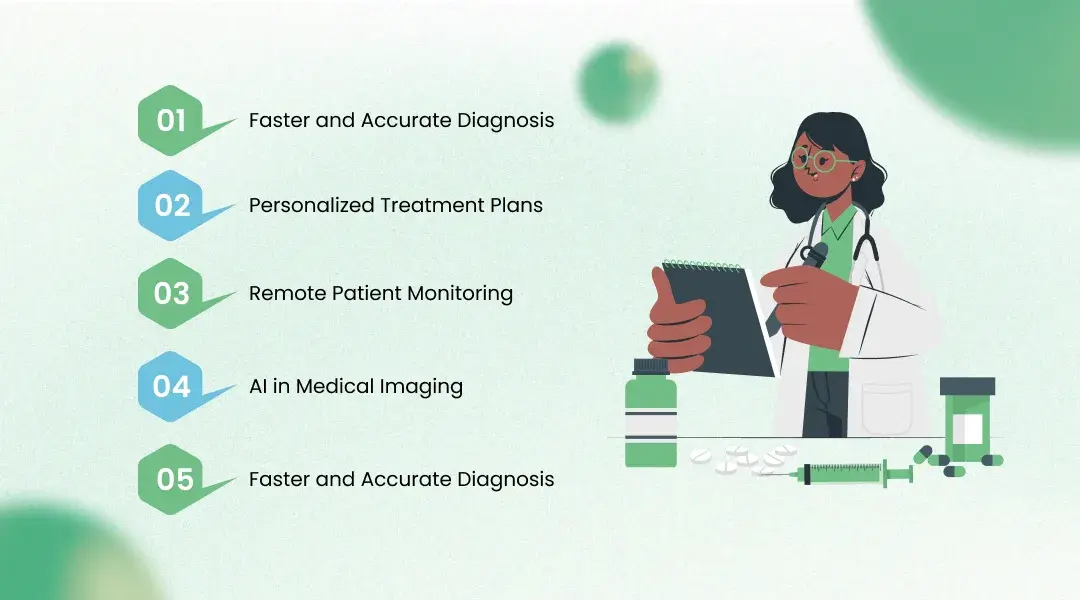
AI speeds up diagnosis and reduces human error.
Hospitals are drowning in data.
Patient history. Lab reports. Imaging. Wearables.
Without AI, it’s noise.
With AI, it becomes insight.
I’ve seen AI systems detect early-stage diseases that humans missed.
Not because doctors aren’t skilled—but because machines don’t get tired or distracted.
AI can scan thousands of data points in seconds.
And sometimes… that speed saves lives.
Every patient is different.
Yet traditional treatment often follows standard protocols.
AI changes that.
It analyzes patient history, genetics, lifestyle and suggests tailored treatments.
More precision. Less guesswork.
This one is quietly revolutionary.
Wearables + AI = continuous monitoring.
Heart rate. Glucose levels. Sleep patterns.
Doctors don’t have to wait for symptoms anymore.
They get alerts before things go wrong.
Let’s talk about scans.
X-rays. MRIs. CT scans.
These are complex. Time-consuming.
AI processes them faster—and highlights abnormalities instantly.
It’s like giving radiologists a second pair of eyes.
A very sharp pair.
Traditionally, drug development takes years.
Sometimes decades.
AI reduces that timeline by analyzing chemical patterns and predicting outcomes faster.
This is where AI in healthcare 2026 is making a serious impact.
Let’s keep this simple.
No jargon. Just reality.
AI chatbots for patient support: Patients ask questions. Get instant responses. No waiting on calls.
AI in cancer detection: Systems detect tumors earlier using imaging analysis.
Virtual health assistants: AI tools remind patients to take medication, track symptoms, and alert doctors if needed.
I’ve personally seen hospitals reduce patient support workload by half using these systems.
Half.
Let’s break it down.
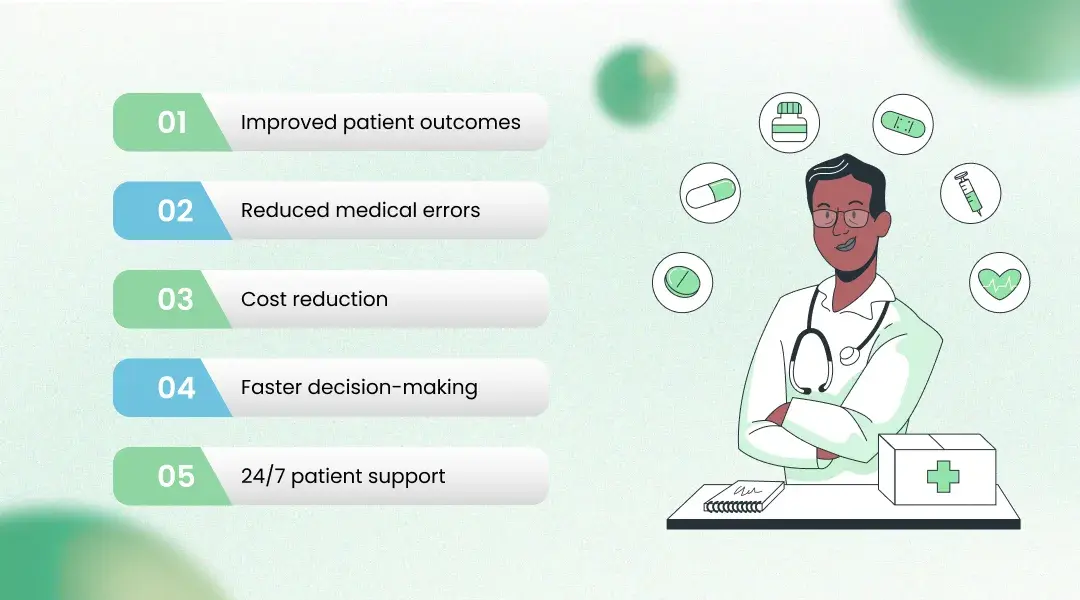
Better diagnosis → Better treatment → Better recovery.
Simple chain.
AI doesn’t rely on memory. It relies on data.
That reduces mistakes.
Fewer errors. Faster processes. Less manual work.
Costs drop over time.
Doctors get insights instantly.
Not after hours of analysis.
AI doesn’t sleep.
Patients get support anytime.
Now let’s be honest.
This isn’t perfect.
Healthcare data is sensitive.
Any AI system must be secure. Non-negotiable.
AI isn’t cheap upfront.
But here’s the reality, manual inefficiency is more expensive long-term.
Some doctors resist AI.
Understandably.
Trust builds with results, not promises.
AI systems need experts to build and maintain them.
That talent gap is real.
Let me paint a picture.
A patient walks into a hospital.
No paperwork. No waiting.
AI already knows their history. Symptoms. Risk factors.
Doctors walk in with insights, not questions.
That’s where we’re heading.
AI will predict diseases before symptoms appear.
Prevention becomes the focus.
Not replacing humans, but reducing friction everywhere.
Assistants, not replacements.
Let’s be clear on that.
Doctors get live recommendations during treatment.
No delays.
Let me be blunt.
AI in healthcare is not a trend. It’s a correction.
A correction to overloaded systems. A correction to delayed decisions. A correction to human limitations.
But here’s the part most companies get wrong.
They chase technology… instead of solving problems.
At KriraAI, we’ve built systems for healthcare businesses that actually work in real environments, not just demos.
Because being the Best AI development Company isn’t about fancy models.
It’s about outcomes.
Real ones.
AI helps doctors diagnose faster, reduce errors, and monitor patients continuously, leading to better treatment outcomes.
Examples include AI chatbots, cancer detection systems, virtual assistants, and remote patient monitoring tools.
Yes, when built properly with secure data practices, AI can be highly reliable and accurate in supporting medical decisions.
Costs vary based on complexity, but long-term savings from efficiency and reduced errors often outweigh initial investment.
Yes. Scalable AI healthcare solutions allow even small clinics to automate tasks and improve patient care.
Founder & CEO
Divyang Mandani is the CEO of KriraAI, driving innovative AI and IT solutions with a focus on transformative technology, ethical AI, and impactful digital strategies for businesses worldwide.