
AI in Healthcare: How KriraAI Transformed Clinical Operations
Every day, physicians in large hospital systems spend an average of 49 minutes on documentation for every hour of direct patient care. That number is not a minor inconvenience. It is a systemic crisis quietly draining clinical capacity, accelerating physician burnout, introducing transcription errors into patient records, and degrading the quality of care that millions of people depend on. When a leading healthcare enterprise came to KriraAI with this problem, the operational picture behind that statistic was even more alarming than the number itself suggested. This blog covers exactly what we found, what we built, how we built it, and what changed for the organisation when a production-grade AI in healthcare system went live across their clinical network.
The Problem KriraAI Was Called In To Solve
The healthcare enterprise operates a network of acute care hospitals, outpatient clinics, and specialist centres serving a patient population of over 2.3 million people across multiple regions. Their clinical staff interact with a legacy Electronic Health Record system that was implemented almost a decade ago and has since accumulated layers of workarounds, custom templates, and department-specific documentation protocols that no single team fully understands end to end.
The core dysfunction was documentation. Clinicians were expected to produce structured clinical notes, discharge summaries, referral letters, and procedure reports that were simultaneously accurate enough for billing compliance, detailed enough for continuity of care, and fast enough to complete between patient encounters. In practice, none of those three requirements were being fully met. Physicians were dictating rough notes into voice memo tools, delegating transcription to administrative staff with no clinical training, and then reviewing and correcting those transcriptions hours later, sometimes days later, from memory. The error rate in transcribed notes was measured at 11.3% across a sample audit of 4,200 records, and the majority of those errors were clinically meaningful, involving medication dosages, allergy flags, and procedural details.
The downstream consequences were severe. Coding and billing teams were returning 18% of submitted records for rework because documentation was insufficient to support the billed procedure codes. Each rework cycle cost an average of 37 minutes of skilled staff time and introduced delays of up to 14 days in revenue recognition. The revenue integrity team estimated the total annual cost of documentation-related billing rework at approximately 4.1 million dollars, and that figure excluded the harder-to-quantify cost of physician time lost to after-hours charting.
Beyond billing, the inconsistency of clinical documentation was creating patient safety risks. Referral letters sent to specialist providers were frequently missing relevant history that existed in the EHR but had never been structured or surfaced. When patients transferred between facilities within the network, care teams were routinely reconstructing treatment timelines manually, a process that took between 25 and 90 minutes depending on record complexity. In a 60-bed intensive care unit, that reconstruction delay was associated with measurable increases in treatment decision latency.
The organisation had attempted two prior remediation efforts. The first was a structured template mandate that forced clinicians to complete predefined fields before closing an encounter. Compliance collapsed within six weeks because the templates were too rigid to accommodate clinical variation, and physicians began writing free-text notes into single comment fields to avoid the overhead. The second attempt involved a commercial voice-to-text product that offered basic transcription. It improved raw transcription throughput but produced unstructured output that billing and coding teams could not use without extensive manual extraction, compounding rather than solving the downstream problem.
The organisation needed something fundamentally different. They needed a system that could understand clinical language in context, extract structured information from unstructured or semi-structured inputs, map that extracted information to specific documentation schemas, generate compliant clinical notes, and integrate directly into the EHR workflow without adding friction to the physician experience. That is the brief KriraAI received.
What KriraAI Built
KriraAI designed and delivered a multi-layer clinical AI platform that converts unstructured clinical input, including ambient voice capture during encounters, physician dictation, and existing free-text notes, into structured, compliant, context-aware clinical documentation. The system operates in real time during encounters and in near-real time for post-encounter completion, and it integrates bidirectionally with the client's existing EHR through FHIR R4-compliant APIs.
At the core of the platform is a domain-adapted clinical language model built on a transformer-based encoder-decoder architecture. We started with a biomedical language model pre-trained on PubMed abstracts and clinical notes from MIMIC-IV as a base, then applied supervised fine-tuning using 340,000 de-identified encounter transcripts and clinical note pairs sourced from the client's own historical EHR data under a business associate agreement. The fine-tuning objective was sequence-to-sequence generation of structured SOAP notes from conversational clinical input, with an additional span extraction head trained to identify and classify clinical entities including diagnoses, medications, dosages, allergies, procedures, and follow-up instructions.
The entity extraction layer uses a named entity recognition model trained with contrastive learning to align clinical concept embeddings with the SNOMED CT and RxNorm ontologies. This alignment means that when a physician says "the patient's metformin dose was bumped to a gram and a half," the system maps that to the correct RxNorm concept, standardises the dosage representation to 1500mg, and writes it to the medication record in the EHR schema without requiring the physician to interact with a dropdown or coding interface.
On top of entity extraction and note generation, the platform includes a compliance verification module that evaluates generated notes against CPT and ICD-10 documentation requirements before submission. This module was implemented as a rule-augmented classifier, combining a fine-tuned BERT variant with a deterministic rule engine encoding payer-specific documentation guidelines. When the classifier identifies a documentation gap, it generates a targeted natural language prompt asking the physician to confirm or add the missing information, presented inline in the EHR interface without interrupting the clinical workflow.
The system replaced the previous voice-to-text transcription tool entirely and augmented the structured template system by making template completion automatic rather than manual. Physicians now speak or dictate in natural clinical language, and the platform handles the transformation, structure, coding, and compliance checking behind the scenes. The physician's final interaction is a review and confirmation step that takes an average of 4.2 minutes per encounter, down from an average of 23.7 minutes under the previous workflow.
Solution Architecture for AI in Healthcare at Enterprise Scale
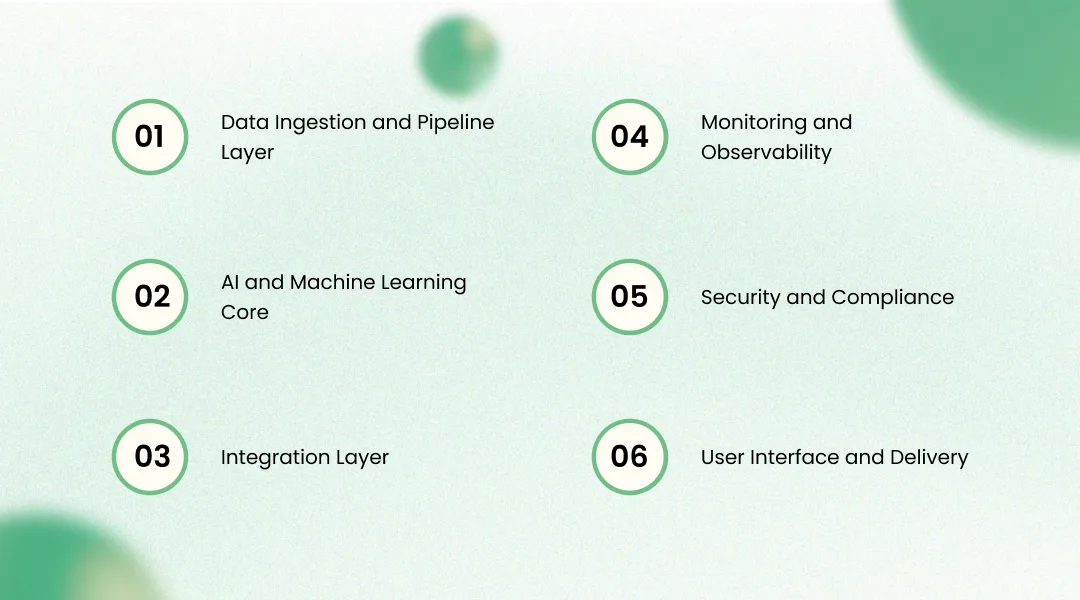
Data Ingestion and Pipeline Layer
The data ingestion layer handles four primary input streams: real-time audio from encounter rooms via secure ambient microphones, physician dictation from mobile and desktop devices, free-text notes entered directly into the EHR, and historical record data pulled from the EHR for context enrichment during active encounters.
Audio streams are processed through a custom acoustic model pipeline. Raw audio is ingested over encrypted WebSocket connections into a streaming ingestion service running on Apache Kafka, with partitioning by facility and department to support isolated scaling. The audio is then processed by a Whisper-based automatic speech recognition model that we fine-tuned on a clinical speech corpus to improve accuracy on medical terminology, drug names, and clinician-specific pronunciation patterns. Word error rate on the fine-tuned model on held-out clinical audio measured at 4.1%, compared to 12.8% on the base Whisper model for the same evaluation set.
Text inputs from dictation and EHR free-text fields are ingested via change data capture from the client's Oracle Health EHR database using Debezium, with events streamed to Kafka topics and consumed by downstream NLP processing services. Historical context for active encounters is retrieved at encounter open time through a batch enrichment job orchestrated by Apache Airflow, which pulls the patient's last 24 months of encounter summaries, active medications, problem list, and allergy record, processes them through an embedding pipeline using a bi-encoder fine-tuned with contrastive learning, and indexes the resulting vectors into a Pinecone vector store with HNSW indexing for sub-millisecond approximate nearest neighbour retrieval.
Schema normalisation and entity resolution are handled in a Flink streaming job that consumes the raw NLP output events, applies temporal feature engineering to construct encounter timelines, and resolves entity references across the patient record using a lightweight graph-based entity resolution model that links mentions of the same concept across different note fragments. The enriched, structured events are written to a feature store built on Redis for online serving and Parquet on Amazon S3 for the offline training path.
AI and Machine Learning Core
The ML core consists of three deployed models running in a multi-tenant, multi-GPU serving environment managed by vLLM for the large language model components and TensorRT-optimised engines for the lighter classification and extraction models.
The primary clinical language model runs as a 7-billion parameter model quantised to 8-bit precision using GPTQ, served behind an internal API gateway that enforces per-department rate limits and routes requests to appropriate model replicas based on encounter type, since surgical and emergency encounters require lower latency budgets than elective outpatient documentation. The model produces SOAP note drafts, referral letter drafts, and discharge summary drafts depending on the encounter classification provided by a lightweight encounter type classifier.
The compliance verification module runs as a separate BERT-based model fine-tuned on documentation requirement annotations, deployed with TensorRT for sub-100ms inference latency. This model evaluates the generated note against a documentation sufficiency rubric and returns a structured JSON object identifying compliant and non-compliant sections with natural language explanations of any gaps.
Retrieval augmented generation is used for context injection. At inference time, the encounter transcript and patient context are used to retrieve the three most semantically similar historical encounters from the patient's record and from an anonymised population of similar encounters. The retrieved context is prepended to the generation prompt using a structured prompt template, and the model is constrained via guided decoding to produce output that conforms to the target documentation schema.
Integration Layer
The integration layer connects the AI platform to the client's EHR system, billing platform, and downstream clinical communication tools using a combination of FHIR R4 REST APIs for structured data exchange, HL7 v2 interfaces for legacy system compatibility, and an event-driven architecture based on Apache Kafka for asynchronous updates. All FHIR interactions are versioned and contract-tested using Pact, ensuring that EHR system upgrades do not silently break integration contracts.
For the physician-facing interface, outputs are delivered through a React-based embedded application that renders inside the EHR as a native panel, communicating with the AI platform backend over gRPC for low-latency streaming of draft content as it is generated. The streaming delivery means physicians see the clinical note being composed in real time rather than waiting for a complete batch response, which user testing showed improved perceived responsiveness and increased the rate of review completion within the encounter session.
Monitoring and Observability
Production monitoring is handled by a stack built on Prometheus for metrics collection, Grafana for dashboarding, and a custom drift detection service that runs hourly population stability index calculations across key feature distributions, including entity extraction confidence scores, note length distributions, and per-department documentation completion rates. When PSI exceeds 0.2 for any monitored feature, an automated alert triggers a Slack notification to the MLOps team and schedules an offline evaluation run against the held-out test set.
Latency is tracked at p50, p95, and p99 for each model serving endpoint, with a p95 SLA of 800ms for note generation and 100ms for compliance checking. Model performance is continuously evaluated against a rolling 14-day sample of physician-reviewed and corrected notes, using ROUGE-L and clinical entity F1 as primary evaluation metrics. When either metric degrades by more than 3% relative to the baseline, an automated retraining pipeline triggers, pulling the most recent approved training data from the feature store offline path and initiating a fine-tuning run on the training cluster.
Security and Compliance
The platform was designed from the ground up for HIPAA compliance. All patient data is encrypted at rest using AES-256 and in transit using TLS 1.3. The entire system runs within the client's private VPC with no public endpoints, accessed only through the client's existing zero-trust network access layer. Role-based access control is enforced at the application layer with attribute-level data masking, ensuring that administrative staff can access documentation workflow metrics without exposure to patient-identifiable content. Audit logging is written to an immutable append-only store using AWS QLDB, providing a complete tamper-evident record of every model inference, every data access event, and every note modification. De-identification of training data was performed using a custom NER-based de-identification pipeline validated against the Safe Harbor standard before any patient data was used in model fine-tuning.
User Interface and Delivery
The physician interface was built as a lightweight React application embedded within the EHR using an OAuth 2.0-authenticated iframe-based integration. It presents the generated note draft, highlights entities extracted from the encounter, and surfaces compliance alerts as inline annotations. Physicians can accept the generated note, edit inline, or flag sections for async review. All interactions are captured as implicit feedback signals and fed back into the training pipeline as preference data for future reinforcement learning from human feedback fine-tuning cycles.
Technology Stack
The technology choices across this engagement were deliberate at every layer, driven by the specific constraints of a HIPAA-regulated, latency-sensitive, high-availability clinical environment.
Model Layer
Base model: BioMedLM and ClinicalT5 as starting points for domain-adapted fine-tuning, trained on de-identified MIMIC-IV and client-provided corpora
Serving: vLLM for the primary generation model, TensorRT for classification models
Quantisation: GPTQ 8-bit to reduce GPU memory footprint and improve inference throughput without meaningful accuracy degradation at clinical task benchmarks
Data and Pipeline Layer
Stream ingestion: Apache Kafka with MSK managed service on AWS
Stream processing: Apache Flink for stateful stream transformations and entity resolution
Batch orchestration: Apache Airflow for scheduled enrichment jobs and training pipeline triggers
Change data capture: Debezium for Oracle Health EHR event streaming
Vector store: Pinecone with HNSW indexing for patient context retrieval
Feature store: Redis online store, S3 with Parquet offline store
Integration Layer
EHR integration: FHIR R4 REST APIs, HL7 v2 for legacy interfaces
Internal service communication: gRPC for model serving endpoints
Contract testing: Pact for FHIR API versioning safety
Physician UI: React embedded panel within EHR session
Infrastructure and Operations
Cloud: AWS, with all compute within client VPC
Container orchestration: Amazon EKS with Karpenter for GPU node autoscaling
Monitoring: Prometheus, Grafana, custom PSI drift detection service
Security: AES-256 encryption, TLS 1.3, AWS QLDB audit logging, RBAC with attribute masking
We evaluated Azure OpenAI Service as an alternative for the generation layer but ruled it out because data residency requirements and fine-tuning on client-specific clinical corpora made self-hosted model serving the only compliant option. Pinecone was selected over Elasticsearch for vector retrieval because the managed HNSW index delivered significantly better recall within the latency budgets required for real-time encounter assistance, without adding infrastructure management burden to the client's internal team.
How We Delivered It: The Implementation Journey
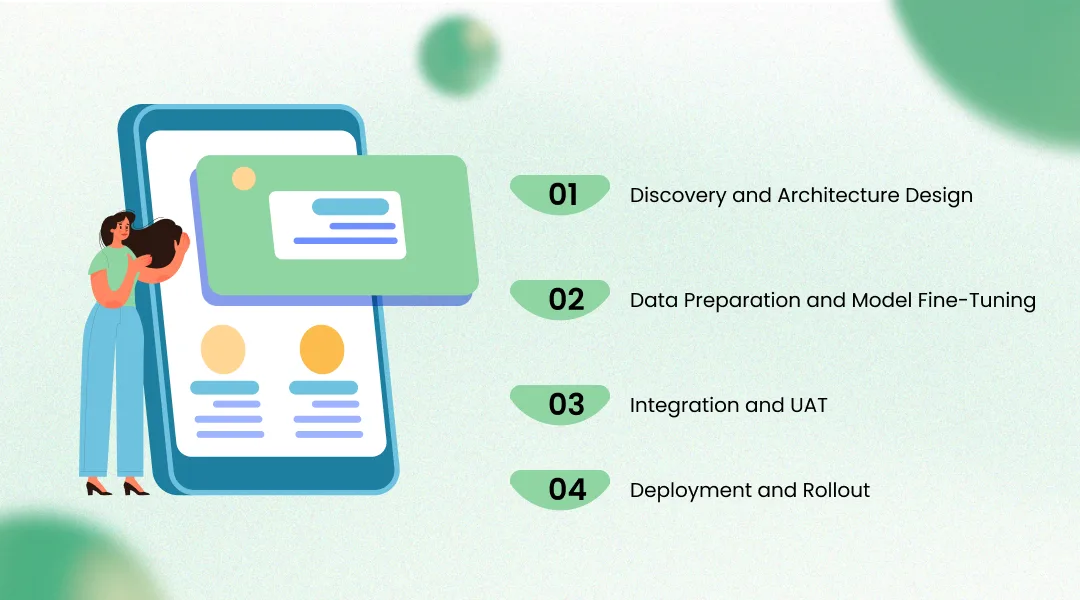
Discovery and Architecture Design
The engagement opened with a four-week discovery phase. KriraAI embedded a solutions architect and a clinical informatics consultant with the client's clinical informatics team, EHR administrators, physician champions, and revenue integrity leads. The goal was to trace actual workflows end to end, watching physicians document across different encounter types and identifying the precise decision points where documentation broke down.
One finding that reshaped the architecture significantly was the degree of variation in clinical language between departments. Emergency physicians and internists use sufficiently different vocabulary, abbreviation conventions, and note structures that a single fine-tuned model would perform unevenly across specialties. This led to the decision to implement department-aware routing at the inference layer, with specialty-specific prompt templates and a fine-tuning strategy using specialty-stratified training batches.
Data Preparation and Model Fine-Tuning
The data preparation phase was the most time-intensive part of the project. The client's historical EHR data required extensive preprocessing before it could be used as training data. Free-text notes were inconsistently structured, with some departments using templated formats and others writing entirely in prose. De-identification was validated by a clinical reviewer sampling 500 records at random from each department, and two rounds of de-identification model retraining were required before the clinical reviewer approved the dataset for use.
A significant challenge arose during early fine-tuning evaluation. The model was generating fluent, plausible-sounding clinical notes that contained factual errors, specifically hallucinating medication details that did not appear in the encounter transcript. This is a well-documented failure mode for generative models in clinical contexts. KriraAI addressed this by implementing a constrained decoding approach using a clinical fact verification module that cross-referenced generated content against the retrieved EHR context at generation time. Any generated claim involving medications, dosages, or diagnoses that could not be grounded in the retrieved context triggered a confidence flag, causing the system to either omit the claim or surface it as requiring physician confirmation rather than presenting it as a fact.
Integration and UAT
The EHR integration phase surfaced compatibility issues with the legacy HL7 v2 interfaces used by two of the client's facilities that had not yet migrated to the FHIR-based integration layer. KriraAI built a transformation service that normalised HL7 v2 message formats to a canonical internal schema, allowing the AI platform to operate consistently across all facilities without requiring the client to accelerate their EHR migration timeline.
User acceptance testing was conducted over six weeks with a pilot group of 47 physicians across three departments. Feedback from the first two weeks of UAT identified two UX issues, the compliance alert presentation was interrupting clinical focus at the wrong moment in the workflow, and the streaming note generation was sometimes producing visible artefacts when the connection experienced brief latency. Both issues were resolved in the third week of UAT through UI timing adjustments and a buffered streaming approach that batches output to sentence boundaries before rendering.
Deployment and Rollout
Production rollout was phased by facility over eight weeks, beginning with the pilot departments and expanding department by department with a 48-hour stabilisation period after each expansion. The MLOps team monitored drift metrics continuously during rollout, and three minor retraining events were triggered in the first four weeks as the model encountered documentation patterns from newly onboarded departments that differed from the training distribution. All three retraining cycles completed within 18 hours using the automated pipeline.
Results the Client Achieved
The results below were measured at the 90-day mark following full production rollout across all facilities.
Documentation Efficiency
Average time spent on documentation per encounter fell from 23.7 minutes to 6.1 minutes, representing a 74% reduction in physician documentation burden. Across the physician population of 312 clinical staff, this translated to approximately 5,400 recovered physician hours per month, the equivalent of roughly 2.3 full-time equivalent physicians in recovered clinical capacity.
Billing and Revenue Integrity
The billing rework rate fell from 18% to 3.2% of submitted records, representing an 82% reduction in documentation-related claim returns. Revenue recognition cycle time improved by an average of 11 days as documentation quality at submission became sufficient to support billed codes without rework. The finance team reported annualised revenue cycle improvement of approximately 3.8 million dollars attributable to documentation quality gains, and the revenue integrity team was redeployed from rework processing to prospective quality auditing.
Clinical Documentation Quality
Clinical entity extraction accuracy, measured as F1 score against a physician-annotated evaluation set of 1,200 encounters, reached 94.7% at 90 days post-launch. The transcription error rate in medication and allergy documentation fell from 11.3% to 0.8%. Referral letters generated by the system were rated as clinically complete and accurate by receiving specialist providers in 97.3% of cases, measured through a structured feedback survey during the evaluation period.
Physician Experience
Post-implementation survey of pilot physicians showed 81% reporting reduced administrative burden as a significant positive change. After-hours charting time, measured through EHR access logs outside scheduled shift hours, fell by 68% in the pilot cohort.
What This Architecture Makes Possible Next
The production architecture KriraAI delivered was designed not for a single use case but as a composable clinical AI foundation that the organisation can extend without rebuilding. The vector retrieval infrastructure, the FHIR integration layer, the fine-tuned clinical language model, and the drift-aware MLOps pipeline are all reusable components that support a growing portfolio of AI use cases on the same foundation.
In the near term, the client is extending the platform to support prior authorisation automation, where the clinical language model generates insurer-required clinical justification narratives directly from the encounter record and diagnosis codes, routing them for physician review before submission. Early piloting showed a 66% reduction in prior authorisation preparation time in the pilot group.
Over the 24-month roadmap, the organisation is activating predictive risk stratification as an additional model layer. The feature store already captures temporal clinical features at a granularity sufficient to train readmission risk and care escalation models. The streaming pipeline that today delivers note drafts to physicians will, in its next configuration, deliver risk alerts to care coordinators when model inference identifies a patient whose feature trajectory crosses a pre-defined threshold.
For other healthcare organisations evaluating similar investments, the most important architectural lesson from this engagement is the primacy of the data pipeline. Organisations that invest seriously in clinical data structuring, de-identification, and feature engineering before selecting a model will consistently outperform organisations that start with a model selection decision and try to fit data preparation around it afterward.
Conclusion
Three insights from this engagement stand out as universally applicable to any organisation building production AI in healthcare environments. The first is technical: generative clinical AI must be grounded in retrieval at inference time. Hallucination is not a theoretical risk in clinical AI, it is a production failure mode, and the only reliable mitigation is constraining generation to content that can be verified against the patient record in real time. The second is operational: physician workflow integration determines adoption. The best model in the world will be ignored if it adds friction to an already overloaded clinical day. Every design decision from UI rendering latency to alert timing must be evaluated against its effect on physician cognitive load during an active encounter. The third is strategic: the data pipeline is the competitive moat, not the model. Organisations that build robust clinical data infrastructure, covering ingestion, de-identification, entity resolution, and feature engineering, create a compounding advantage that generic AI vendors cannot replicate with a general-purpose model.
KriraAI brings this same level of engineering rigour and delivery discipline to every client engagement. Our approach to AI in healthcare combines deep clinical domain understanding with the production ML engineering practices that distinguish a hardened enterprise system from a proof of concept that cannot survive first contact with real-world data. We do not deliver pilots. We deliver systems that run, that scale, and that continue to improve after go-live through the monitoring and retraining infrastructure we build into every deployment.
If your organisation is facing a clinical operations challenge that you believe AI could address, bring it to KriraAI. We will tell you honestly what is possible, what it will take, and what it will deliver.
FAQs
AI in healthcare improves clinical documentation accuracy by combining domain-adapted language models with structured clinical ontologies and real-time context retrieval from the patient record. Rather than simply transcribing what a physician says, a properly designed clinical AI system extracts named entities such as diagnoses, medications, dosages, and procedures, maps them to standardised terminologies including SNOMED CT and RxNorm, and generates structured documentation that satisfies both clinical and billing compliance requirements. In the engagement KriraAI delivered, this approach reduced medication and allergy transcription error rates from 11.3% to 0.8%, demonstrating that accuracy gains of this magnitude are achievable in production environments with correctly designed fine-tuning and retrieval-grounded generation pipelines.
The ROI timeline for a healthcare AI implementation depends heavily on the use case, the quality of existing clinical data, and the degree of workflow integration achieved. For clinical documentation automation at the scale of the engagement KriraAI delivered, revenue cycle improvements become measurable within 60 to 90 days of full production rollout, as documentation quality changes affect the very next billing cycle after go-live. The leading healthcare enterprise in this case study reported annualised revenue cycle improvement of approximately 3.8 million dollars and recovered 5,400 physician hours per month at the 90-day mark. Organisations with larger physician populations or higher documentation error rates at baseline will typically see proportionally larger returns over the same timeframe.
Healthcare AI systems integrate with existing EHR platforms primarily through FHIR R4-compliant APIs for modern EHR systems and HL7 v2 interfaces for legacy installations. A production-grade integration uses bidirectional data exchange, where the AI platform reads patient context from the EHR at encounter open time and writes structured outputs back to the EHR on completion, maintaining referential integrity with the EHR data model throughout. KriraAI implemented contract testing using Pact to ensure that EHR version updates did not silently break integration contracts, and built a canonical schema transformation service to handle the data format differences between facilities that were at different stages of their FHIR migration. The physician-facing UI was embedded directly within the EHR session using an OAuth 2.0-authenticated integration to eliminate context switching.
AI systems handling patient data in the United States must comply with HIPAA, which requires administrative, physical, and technical safeguards for all protected health information. From a technical standpoint, this means end-to-end encryption of all patient data in transit and at rest, role-based access control with minimum necessary access principles, comprehensive audit logging that captures every data access event, and business associate agreements with all third-party vendors. The AI platform KriraAI built for the leading healthcare enterprise runs entirely within the client's private VPC with no public endpoints, uses AES-256 encryption at rest and TLS 1.3 in transit, enforces attribute-level data masking so administrative users cannot access patient-identifiable information, and writes all audit events to an immutable append-only store using AWS QLDB. De-identification of all training data was validated against the HIPAA Safe Harbor standard before any model fine-tuning began.
Model drift in healthcare AI systems occurs when the statistical distribution of incoming clinical language, encounter characteristics, or documentation patterns changes relative to the distribution on which the model was trained, causing performance to degrade in ways that may not be immediately visible to end users. This is a particular risk in healthcare environments where seasonal patterns, new treatment protocols, formulary changes, and staff turnover all introduce distribution shifts continuously. KriraAI manages drift in the clinical documentation platform through hourly population stability index calculations across key feature distributions, with automated alerts when PSI exceeds 0.2. Model performance is evaluated continuously against a rolling 14-day sample of physician-corrected notes, and an automated retraining pipeline triggers when ROUGE-L or clinical entity F1 scores degrade by more than 3% relative to the established baseline, completing a full retraining cycle within 18 hours.
Ridham Chovatiya is the COO at KriraAI, driving operational excellence and scalable AI solutions. He specialises in building high-performance teams and delivering impactful, customer-centric technology strategies.