
How AI in Government and Public Sector Is Reshaping Public Services
Governments around the world collectively spend over $1 trillion annually on information technology, yet a 2023 McKinsey analysis found that public sector organizations capture less than 30% of the potential efficiency gains that technology investments are designed to deliver. That gap is not a budgetary problem. It is an execution problem, and AI in government and public sector is rapidly becoming the mechanism through which forward-thinking administrations are beginning to close it. From automating benefit eligibility reviews to predicting infrastructure failures before they occur, artificial intelligence is moving from pilot experiment to operational backbone in agencies that once moved at the speed of paper.
What makes this moment different from previous waves of government technology modernization is the specificity of the value being generated. This is not about deploying software for its own sake. It is about applying machine learning, natural language processing, and predictive analytics to problems that have resisted solution for decades: fraud in welfare systems, chronic delays in permit approvals, inequitable distribution of public resources, and the quiet collapse of aging infrastructure. The pressure is real, the tools are mature, and the agencies that fail to act are already beginning to feel the competitive disadvantage in their own procurement rankings, citizen satisfaction scores, and budget reviews.
This blog will walk through the current state of the public sector, map specific AI technologies to specific government problems, present quantified evidence of impact, outline a practical implementation roadmap, and honestly assess the challenges that stand between intention and execution.
The Current State of Government: Structural Inefficiency at Scale
The public sector operates under a set of constraints that make transformation simultaneously more necessary and more difficult than in any comparable private industry. Unlike corporations that can absorb short-term losses to fund long-term transformation, government agencies are subject to annual budget cycles, mandatory procurement rules, political continuity risks, and a level of public scrutiny that makes failure extraordinarily costly, not just financially but reputationally.
Consider the baseline conditions that most government agencies are managing today. Legacy IT systems remain the dominant infrastructure in most national and regional governments. In the United States, the Government Accountability Office has repeatedly flagged that some federal agencies still operate systems built in the 1970s and 1980s, running COBOL and assembler code that cannot be easily integrated with modern software. Across the European Union, similar legacy dependencies create data silos that prevent cross-agency coordination even when policy mandates it.
The workforce challenge compounds the technology problem. Public sector talent acquisition has fallen structurally behind private sector compensation in most economies, which means the agencies that most need skilled engineers, data scientists, and systems architects are precisely the organizations least able to attract and retain them. A 2022 Deloitte survey of public sector CIOs found that 67% identified talent shortage as the primary barrier to digital progress, ahead of budget constraints, which ranked second.
Service delivery is where these structural failures become most visible. Citizens waiting weeks for document processing, businesses unable to obtain permits within planning timelines, healthcare patients falling through eligibility cracks in benefits systems, and infrastructure failing because maintenance schedules were built on fixed intervals rather than actual asset condition. The cost of these inefficiencies is not abstract. The OECD estimates that inefficient government service delivery costs member economies between 3% and 5% of GDP annually in lost productivity and misallocated resources.
The competitive dimension of this challenge is also intensifying. As some governments modernize faster than others, the gap in citizen trust and economic attractiveness between high-performing and low-performing administrations is widening. Countries and states that can offer faster permits, more accurate benefits, and better infrastructure reliability are attracting more business investment and retaining more skilled residents. The public sector is not immune to competitive pressure. It simply experiences that pressure through a different set of consequences.
How AI Is Transforming the Public Sector: Technologies Mapped to Problems
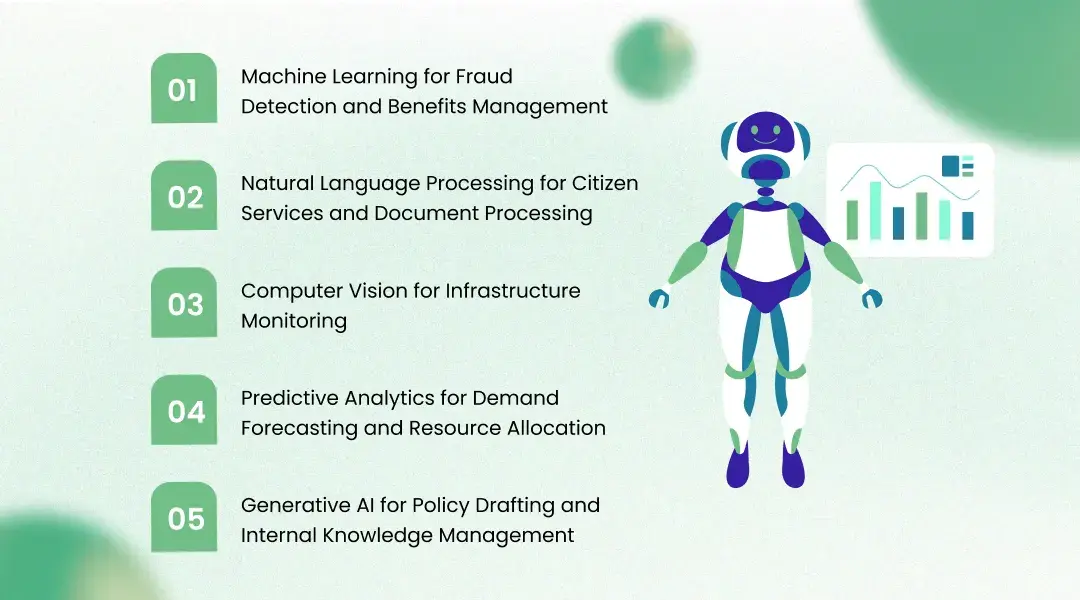
AI in government and public sector is not a monolithic deployment. It is a collection of distinct technologies, each matched to a different category of government problem. Understanding this mapping is essential to moving from aspiration to action.
Machine Learning for Fraud Detection and Benefits Management
Machine learning models trained on historical claims data are now being deployed by social welfare agencies to identify anomalous patterns in real time. The UK's Department for Work and Pensions has used machine learning to cross-reference benefit claims against employment records, tax filings, and housing data, flagging inconsistencies that manual auditors would take months to identify. The system does not make final decisions. It prioritizes which cases human investigators should examine first. This distinction matters enormously for regulatory compliance and fairness.
In the United States, the Centers for Medicare and Medicaid Services has deployed predictive analytics models that identify potentially fraudulent billing patterns among healthcare providers with substantially greater accuracy than the rule-based systems that preceded them. The model learns continuously, adjusting its fraud signatures as bad actors change their behavior.
Natural Language Processing for Citizen Services and Document Processing
Natural language processing is being applied to two distinct government problems: citizen-facing communication and internal document management. On the citizen-facing side, AI-powered virtual assistants are now handling routine queries on government portals in Singapore, Estonia, and several Australian state governments. These systems can interpret queries in natural language, navigate policy databases, and provide accurate, personalized responses without human intervention for the majority of common inquiries.
On the internal side, NLP models are being trained to extract structured information from unstructured government documents, including planning applications, legal submissions, contracts, and medical records. What previously required a trained administrator three hours to process can now be pre-processed in seconds, with the extracted data pre-populating structured review forms for final human sign-off.
Computer Vision for Infrastructure Monitoring
Computer vision models deployed through drone fleets and fixed camera networks are transforming infrastructure inspection across road networks, bridges, pipelines, and public buildings. Rather than sending physical inspection teams on fixed-schedule visits, agencies can now analyze image streams continuously, detecting early signs of cracking, corrosion, water ingress, or structural deformation before they reach critical thresholds.
Japan's Ministry of Land, Infrastructure, Transport and Tourism has been piloting AI-powered bridge inspection systems that reduce the time required for a full bridge survey by approximately 75% while detecting surface defects that human inspectors routinely miss under normal lighting and access conditions.
Predictive Analytics for Demand Forecasting and Resource Allocation
Predictive analytics in government is being applied to forecast demand across healthcare systems, public transport, emergency services, and social care. By modeling historical usage patterns against demographic variables, weather data, event calendars, and economic indicators, agencies can anticipate demand spikes and pre-position resources accordingly.
Emergency services in several US cities have implemented predictive dispatch optimization systems that reduce average response times by improving the positioning of ambulances and fire units based on predicted call volumes across different geographic zones throughout the day.
Generative AI for Policy Drafting and Internal Knowledge Management
Generative AI tools are entering government workflows primarily through internal productivity applications. Policy teams are using large language model-powered tools to draft initial policy documents, summarize consultation responses, generate meeting minutes, and search complex regulatory archives. These tools are being deployed in sandboxed, air-gapped environments to address data security requirements, and several governments including Canada and the UK have issued formal guidance on responsible use of generative AI in civil service roles.
Quantified Business Impact: What AI Is Actually Delivering
The question every government decision-maker asks before committing to AI investment is whether the impact is real and measurable. The evidence is now substantial enough to answer that question with confidence.
AI-powered fraud detection systems across welfare and tax agencies have demonstrated consistent results. The Australian Taxation Office reported that its AI-enhanced compliance program identified an additional AUD 4.3 billion in previously undetected tax liabilities over a three-year period. The UK government's fraud analytics program targeting universal credit claims identified overpayments and fraudulent applications worth approximately GBP 1.6 billion in a single financial year, with the cost of the AI system representing less than 2% of the value recovered.
Document processing automation is delivering time reductions that compound significantly at scale. Singapore's Immigration and Checkpoints Authority implemented an AI document verification system that reduced processing time for work pass applications by 60%, bringing the average decision time from 15 working days to under 6. For a country whose economic competitiveness depends partly on its ability to attract international talent quickly, this improvement translates directly into measurable economic value.
In infrastructure maintenance, the shift from scheduled to predictive maintenance is delivering cost reductions in the range of 20% to 35% in documented government deployments. The key driver is not simply doing fewer inspections. It is concentrating repair interventions at the precise moment when the cost of fixing an asset is still low, before the defect has cascaded into a more expensive structural failure.
Public-sector AI adoption in healthcare triage and resource allocation is showing similarly strong returns. NHS England's pilot of an AI triage support tool in selected urgent care settings reduced unnecessary emergency department attendances by approximately 18% in the pilot cohort by directing lower-acuity patients to more appropriate care pathways. The downstream cost saving per avoided emergency attendance exceeded the per-case cost of running the AI system by a ratio of approximately 12 to 1.
Government digital transformation projects supported by AI have also delivered measurable gains in citizen satisfaction. Estonia, consistently ranked as the world's most digitally advanced government, reports that 99% of public services are available digitally, and the average time to complete a government interaction online is under five minutes. While Estonia's digital infrastructure predates modern AI, its integration of AI-powered services into that infrastructure has compressed service times further and improved the accuracy of automated decisions.
KriraAI, which builds practical AI solutions for enterprises and government agencies, has consistently found in its client engagements that the agencies achieving the highest ROI from AI deployment are those that begin with a narrow, high-volume, well-defined process rather than attempting broad digital transformation in a single initiative. The specificity of the starting point determines the clarity of the result.
Implementation Roadmap: How Government Agencies Should Deploy AI
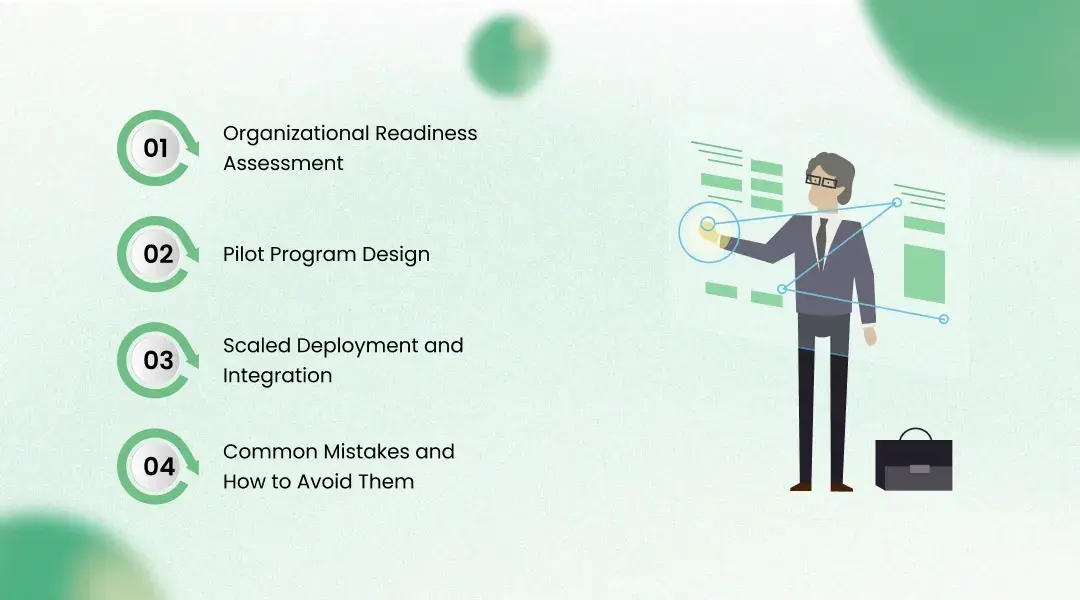
Stage One: Organizational Readiness Assessment
The first question any government agency must answer before deploying AI is not which technology to choose. It is whether the underlying data infrastructure can support the technology being considered. AI systems are only as good as the data they learn from, and most public sector organizations have significant data quality, data governance, and data access issues that must be addressed before any meaningful AI deployment can succeed.
A readiness assessment should cover the following areas:
Data inventory: Identify which datasets exist, where they are stored, how they are structured, and whether they are complete enough to train or run an AI model.
Data governance: Establish who owns each dataset, what sharing permissions exist between agencies, and what legal constraints apply to using citizen data in automated systems.
Infrastructure audit: Determine whether current IT infrastructure can support the processing and storage requirements of the AI application being considered.
Regulatory mapping: Identify all relevant legal frameworks governing automated decision-making, data privacy, and algorithmic accountability in your jurisdiction.
Stakeholder mapping: Identify which staff groups will be affected by the AI deployment and begin planning the change management process.
Stage Two: Pilot Program Design
A well-designed pilot is not a small version of the full deployment. It is a structured experiment designed to generate specific evidence about system performance, user behavior, and operational integration. Government pilots should be designed around a specific, measurable problem with a defined success metric, a control condition against which to measure improvement, a fixed timeline of no more than six months, and a clear escalation path if the pilot raises unforeseen risks.
KriraAI's experience working with public sector clients shows that pilots fail most often not because the technology underperforms but because the success metrics were not defined precisely enough before the pilot began. Without a clear baseline, it is impossible to demonstrate improvement, and without demonstrated improvement, budget committee approval for full deployment rarely follows.
Stage Three: Scaled Deployment and Integration
Moving from a successful pilot to full deployment requires solving three problems that the pilot typically does not encounter: integration with existing systems at scale, change management across a larger workforce, and governance structures for ongoing monitoring and accountability. Each of these deserves a dedicated workstream led by a named internal owner.
Common Mistakes and How to Avoid Them
The most consistently observed mistakes in public sector AI deployments fall into a recognizable pattern:
Choosing the wrong starting process: Agencies often select high-profile, politically visible processes for their first AI deployment rather than selecting the process most suited to AI. The best first deployment is high-volume, well-documented, repetitive, and low-stakes enough to tolerate imperfect early performance.
Underinvesting in change management: Technology that staff distrust or circumvent delivers none of its potential value. Invest in training, communication, and feedback loops from the very beginning.
Treating the pilot as the endpoint: Pilots generate evidence. Deployment generates value. Agencies that run excellent pilots but lack the internal champion and budget pathway to scale them are making an expensive mistake.
Ignoring explainability requirements: In public sector contexts, automated decisions affecting citizens must be explainable and contestable. Build this requirement into the system design from the start, not as an afterthought.
Challenges and Limitations: The Honest Picture
Public sector AI adoption faces a set of challenges that are genuinely difficult and should not be minimized. Anyone telling government leaders that AI deployment is straightforward is either selling something or has not worked closely with the operational realities of public administration.
Data quality is the most fundamental challenge. Government data is often fragmented across legacy systems that do not share common identifiers, structured in formats that reflect administrative conventions rather than analytical utility, and inconsistently maintained across the agencies that contribute to it. Building a machine learning model on this data without first investing heavily in data cleaning, reconciliation, and normalization will produce a system that performs well in the lab and fails in the field.
The talent gap is structural and is not closing quickly enough to keep pace with the ambition of government AI strategies. Most civil service salary structures cannot compete with private sector compensation for experienced AI engineers and data scientists. Governments are addressing this through partnerships with universities, secondment programs with technology companies, and upskilling programs for existing civil servants, but these approaches take years to produce results, and years is not a timeline that political cycles accommodate comfortably.
Regulatory constraints create genuine complexity. In the European Union, the AI Act classifies many government applications as high-risk AI systems, which triggers mandatory requirements around transparency, human oversight, data governance, and conformity assessment. Compliance with these requirements adds cost and time to deployments. Agencies operating without a clear understanding of their regulatory obligations risk deploying systems that will face legal challenge after the fact.
Integration complexity is consistently underestimated. Connecting a modern AI system to a 1980s mainframe is not a software problem. It is an architectural challenge that requires careful engineering, significant testing, and often a middleware layer that itself becomes a maintenance burden. The integration cost frequently exceeds the cost of the AI system itself.
Finally, public trust is both a challenge and a precondition. Citizens whose benefits, permits, tax assessments, or parole decisions are affected by automated systems have a legitimate interest in understanding how those systems work and how they can be challenged. Governments that deploy AI without clear public communication, robust appeal mechanisms, and independent audit processes will face justified backlash that sets the cause of government AI adoption back by years.
The Future of AI in Government: A Three-to-Five Year Projection
Looking three to five years forward, the trajectory of government digital transformation points toward a fundamental restructuring of how public services are designed, delivered, and monitored. The agencies that are deploying AI today as a tool for efficiency will, by 2028, begin deploying it as a tool for systemic intelligence, moving from automating existing processes to redesigning those processes around AI capabilities from the ground up.
Predictive analytics in government will evolve from reactive fraud detection and demand forecasting into proactive policy modeling. Governments will run large-scale simulations of proposed policy changes before implementation, testing their likely impact on different demographic groups, economic sectors, and geographic regions. This capability exists in embryonic form today in a small number of well-resourced national statistics agencies, but it will become a mainstream policy development tool within the next five years.
AI-powered citizen services will shift from portal-based interactions toward ambient, proactive government, where the agency reaches out to citizens with relevant offers, deadlines, and entitlements before the citizen knows to ask. Estonia's digital ID infrastructure already enables this to a degree, but the integration of predictive modeling with proactive service delivery will create a qualitatively different government-citizen relationship.
The competitive gap between digitally advanced and digitally lagging governments will widen substantially. Countries that have invested in foundational data infrastructure, built AI-ready procurement frameworks, and cultivated internal AI capability will be able to deliver services, attract investment, and manage public finances with a structural advantage over those still debating whether to modernize. This is not a soft cultural difference. It will show up in credit ratings, GDP per capita, and international competitiveness indices.
KriraAI's view, informed by its work building AI solutions for enterprises operating in regulated industries, is that the governments most likely to succeed over this horizon are not necessarily the ones with the largest AI budgets. They are the ones that have done the foundational work of organizing their data, training their people, and building the governance structures that allow AI systems to be deployed responsibly and at scale.
Conclusion
Three points from this analysis deserve to be carried forward as organizing principles for any government leader approaching AI strategy. First, the technology is sufficiently mature that the primary constraint on public sector AI adoption is no longer technical readiness but organizational will, data infrastructure, and governance design. Second, the financial returns from well-targeted AI deployments are large enough and well-documented enough that the investment case no longer requires faith, only rigorous program design. Third, the competitive gap between governments that act now and those that continue deliberating will become structurally significant within the next three to five years, affecting everything from citizen trust to international competitiveness.
For government agencies that are ready to move from strategy to execution, the practical challenge is finding an implementation partner that understands both the technology and the unique operating environment of the public sector. KriraAI builds practical AI solutions for enterprises and government agencies, with a specific focus on making AI deployable in regulated, high-accountability environments where explainability, data governance, and measurable outcomes are not optional features but foundational requirements. KriraAI's approach begins where the impact is most concentrated: identifying the highest-volume, clearest-ROI process within an agency's existing operations and building from there into a scalable AI program.
If your agency is ready to move from digital transformation ambition to operational AI capability, explore what KriraAI can build with you or reach out to discuss your specific context.
FAQs
AI in government and public sector is delivering its highest measurable impact in five primary application areas. Fraud detection and benefits verification systems using machine learning are recovering billions in misallocated public funds annually across welfare, tax, and healthcare systems. Natural language processing tools are automating document review and citizen query resolution, reducing processing times by 50% to 70% in documented deployments. Computer vision systems are enabling continuous infrastructure monitoring, replacing fixed-schedule inspections with condition-based maintenance. Predictive analytics models are optimizing the deployment of emergency services and healthcare resources based on demand forecasting. Generative AI tools are accelerating internal policy drafting and knowledge management in civil service teams. Each of these applications addresses a documented, chronic inefficiency in public administration, which is why they are attracting investment and producing results that justify continued scaling.
The realistic timeline for implementing AI in a government agency from initial assessment to full operational deployment depends on the scope and complexity of the application, but most structured deployments follow a pattern of three to six months for readiness assessment and data preparation, two to four months for pilot design and execution, and six to twelve months for scaled deployment and integration. The total timeline from first decision to full operation is typically 12 to 24 months for a single-process deployment, and longer for multi-agency or cross-system integrations. The most common cause of timeline overrun is not the AI technology itself but the underlying data preparation and legacy system integration work, which consistently takes longer than initial estimates. Agencies that begin with a thorough data audit before selecting technology reduce their overall implementation timeline significantly.
Government agencies operating within the European Union are subject to the EU AI Act, which came into force in 2024 and classifies many public sector AI applications as high-risk systems. High-risk classification applies to AI systems used in critical infrastructure management, education and vocational training, employment and worker management, access to essential private services, law enforcement, migration and border control, administration of justice, and democratic processes. For systems in these categories, the AI Act mandates conformity assessment before deployment, registration in an EU-wide database, ongoing human oversight mechanisms, transparent communication to affected individuals, and robust technical documentation. Agencies that do not comply with these requirements face fines and mandatory withdrawal of the system. Non-EU governments should be aware that the AI Act has extraterritorial reach when the affected individuals are located in the EU.
Government agencies can address data quality systematically by following a four-stage approach. First, conduct a data inventory across all relevant systems, cataloguing what data exists, where it resides, how it is structured, what its completeness rate is, and what its update frequency is. Second, establish a data governance framework that defines ownership, stewardship responsibilities, and quality standards for each dataset. Third, implement data cleaning and normalization pipelines that standardize identifiers, resolve duplicates, fill gaps through imputation where appropriate, and flag records that fall below quality thresholds. Fourth, create ongoing data quality monitoring that alerts data owners when quality metrics deteriorate below defined thresholds. This investment typically takes six to twelve months for a mid-sized agency, but it is not optional. AI systems trained on poor-quality data will produce poor-quality outputs, and in a public sector context those outputs affect citizens' lives.
This distinction is critically important in the public sector context. AI automation refers to systems that make decisions and take actions without human review at the point of each individual case. AI-assisted decision making refers to systems that generate a recommendation, score, or flag that a human decision-maker then reviews before a final decision is made. In most government contexts affecting individual citizens, AI-assisted decision making is the legally required and ethically appropriate model, because it preserves human accountability and the citizen's right to have their case considered by a responsible official. Full AI automation is appropriate in government primarily for low-stakes, high-volume administrative tasks such as routing documents, scheduling inspections, or generating draft correspondence, where errors are easily detected and corrected and no individual rights are at immediate risk. The EU AI Act, the UK AI Governance Framework, and most comparable national frameworks all require meaningful human oversight for high-risk AI applications in government.
Founder & CEO
Divyang Mandani is the CEO of KriraAI, driving innovative AI and IT solutions with a focus on transformative technology, ethical AI, and impactful digital strategies for businesses worldwide.