A 2025 Citizens Bank survey found that 82% of midsize companies plan to increase their AI investments over the next five years, up from 58% in 2023. That acceleration is remarkable, but it hides a more telling number: only 17% of finance teams are actively using AI in their core workflows, according to CFO Connect's 2026 State of AI in Finance report. The gap between intent and execution is widest in the mid market, where companies have outgrown spreadsheet workarounds but cannot justify the seven-figure budgets that enterprise AI transformation demands. If your finance team has between fifty and five hundred employees and you are trying to figure out where AI fits without blowing your budget or overwhelming your staff, this blog was written specifically for you, and KriraAI's can help you narrow the first use case.
Mid market finance leaders face a paradox that neither startups nor Fortune 500 companies encounter. You process enough volume to feel the pain of manual work, but you lack the dedicated data science teams and vendor leverage that large institutions use to deploy AI at scale. Meanwhile, the small business tools designed for five-person teams cannot handle the multi-entity consolidations and regulatory complexity your business requires. This guide walks through the practical reality of AI adoption for mid market finance operations, covering which applications deliver the fastest return, what implementation looks like with your resources, and how to avoid the mistakes that companies your size make most often.
Understanding why AI adoption looks different at this scale requires an honest look at how mid market finance teams actually operate day to day. A typical mid market finance department has between eight and thirty staff members, split across accounts payable, accounts receivable, financial planning and analysis, treasury, and compliance. The CFO often wears multiple hats, serving as the de facto head of IT procurement, risk management, and strategic planning. There is usually one controller, a small FP&A team of two to four analysts, and a handful of AP/AR clerks handling transaction volume that would have been unthinkable a decade ago.
The technology stack in most mid-market finance operations sits in an awkward middle ground. The company typically runs a mid tier ERP like NetSuite, Sage Intacct, or Microsoft Dynamics 365, and the finance industry usually depends on that stack plus a few point solutions to keep reporting and compliance moving. There are usually two to four additional point solutions for expense management, budgeting, or billing. Spreadsheets still serve as the connective tissue between systems, with manual exports, pivot tables, and emailed workbooks filling the gaps that the ERP does not cover. The median mid market company has 3.2 finance tools per finance employee, and that tool sprawl creates data silos that make AI adoption harder than it needs to be.
Budget constraints define the mid market experience. While enterprises may allocate millions to AI transformation programs, mid market CFOs typically work with technology budgets of $200,000 to $800,000 annually for their entire finance stack. That budget has to cover ERP licensing, existing tools, and now AI, all while delivering measurable ROI within a fiscal year. There is no room for eighteen-month pilot programs or speculative R&D investments. Every dollar spent on AI is a dollar not spent on hiring, and CFOs at this scale feel that trade-off acutely.
One characteristic that separates mid market companies from larger enterprises is decision-making velocity. A mid market CFO can evaluate, approve, and deploy a new tool in weeks, not the months or quarters that enterprise procurement cycles demand. This speed becomes a genuine competitive advantage in AI adoption, because the companies that move first at this scale establish compounding benefits that late movers struggle to match. KriraAI has observed that mid-market finance teams that act decisively on AI adoption in 2026 are already pulling ahead of competitors who are still forming committees to evaluate options.
The AI advice flooding the market falls into two camps, and neither one is written for you. Enterprise content assumes unlimited budget, dedicated AI centers of excellence, and multi-year transformation roadmaps. Small business content recommends consumer-grade chatbots and basic automation that cannot handle the complexity of multi-entity financial operations. Mid market finance teams need a fundamentally different approach, and understanding exactly how yours differs is the first step toward getting it right.
Budget allocation at mid market scale means choosing two or three high-impact AI applications rather than building a comprehensive AI ecosystem. Enterprise firms might deploy AI across twenty finance workflows simultaneously. A mid market team needs to identify the three workflows where AI delivers the highest return and sequence them over twelve to eighteen months. This focused approach actually produces faster ROI than the enterprise method, because it concentrates resources and allows the team to build competency incrementally.
Implementation complexity at mid-market scale occupies a challenging middle zone. Your ERP is sophisticated enough to have complex data structures and custom fields, but it may lack the robust API infrastructure that enterprise systems provide for AI integration. You need AI tools that offer native connectors to mid-tier ERPs, not tools that require custom middleware. The vendor landscape for AI in finance for mid market companies has matured significantly through 2025 and 2026, with platforms building specifically for this segment.
The internal talent question is where mid-market companies diverge most sharply from enterprises. You almost certainly do not have a data scientist on staff, and hiring one would cost $150,000 to $200,000 annually before they deliver any value. Mid market AI adoption succeeds when it relies on tools that finance professionals can configure without writing code. The ideal mid market AI solution requires an FP&A analyst or controller to spend ten to twenty hours on initial setup, not a six-month implementation with an external systems integrator. KriraAI designs its solutions with exactly this constraint in mind, building AI tools that finance professionals can deploy without needing to become technologists.
The timeline to see returns also differs by company size. Enterprise AI projects often require twelve to twenty-four months before delivering measurable outcomes. Mid market finance teams can achieve breakeven within four to eight months. Invoice processing automation typically pays for itself in sixty to ninety days for teams processing more than 500 invoices monthly.
Not every AI application makes sense at mid market scale. The most advanced algorithmic trading models, the complex portfolio rebalancing systems, and the real-time market surveillance tools belong in enterprise deployments with dedicated infrastructure. Mid market finance teams should focus on applications where the return is immediate, the implementation is manageable, and the risk is low.
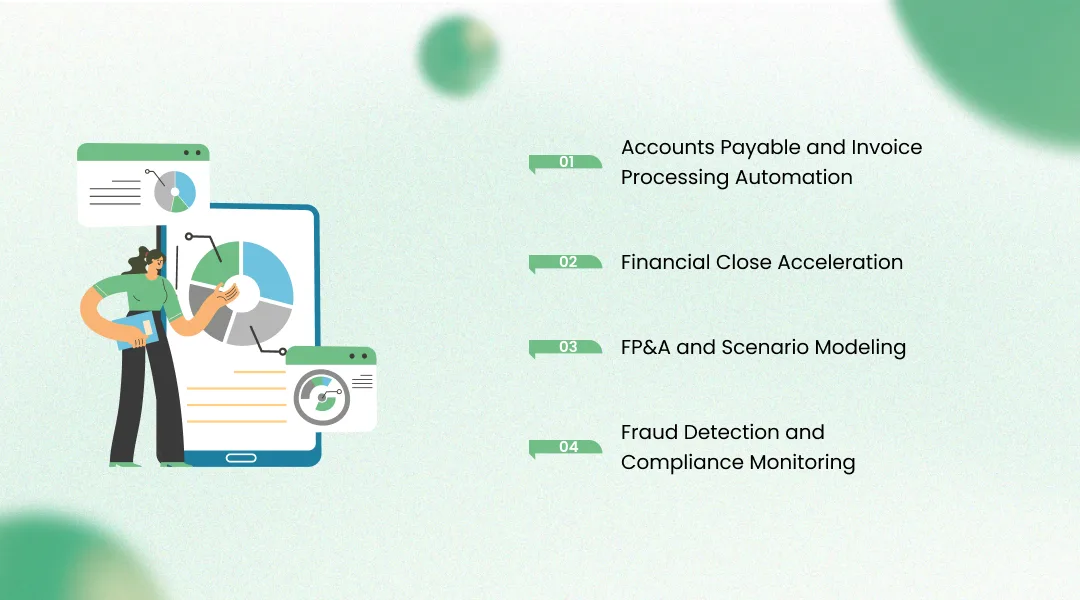
AP automation is the single fastest path to AI ROI for mid market finance teams. A finance team processing 500 to 5,000 invoices monthly spends significant manual hours on data entry, three-way matching, and exception handling. AI-driven invoice processing automates 85% to 92% of standard three-way matching, reducing human review time from eight minutes per invoice to under sixty seconds for exceptions. At mid market scale, this translates to direct labor savings of $260,000 to $390,000 annually, plus the elimination of duplicate payment errors that cost an average of $8,000 per occurrence.
The monthly close cycle is where mid-market finance teams lose the most strategic capacity. Traditional closes consume five to ten days of intensive effort each month. AI-driven close automation compresses this from an average of 8.5 days to three to four days through continuous reconciliation that eliminates month-end backlogs, automated consolidation across entities, real-time variance detection, and instant report generation. The direct time savings matter, but the strategic benefit matters more: faster close means the CFO reports results sooner, the FP&A team starts planning earlier, and issues surface before they compound.
AI transforms FP&A from a backward looking reporting function into a forward looking strategic partner, and our blog on AI implementation in financial services explains what actually works in production environments. At mid market scale, the most impactful AI applications in FP&A include automated variance commentary that saves analysts six to twelve hours per cycle, cash flow forecasting that learns from historical patterns, scenario modeling that runs dozens of what-if analyses in minutes, and budget versus actual analysis with automatic narrative generation. A 2025 McKinsey survey of 102 CFOs found that 44% were using generative AI for more than five use cases in finance, with FP&A among the most commonly cited.
Even at mid-market scale, fraud exposure is significant. AI-based fraud detection analyzes transaction patterns in real time, identifying anomalies that rule-based systems miss. For mid market companies, the practical entry points are transaction monitoring integrated with existing banking systems, vendor master data validation to prevent fictitious vendor fraud, expense report analysis flagging patterns invisible to human reviewers, and compliance monitoring that tracks regulatory changes. AI-driven financial operations in compliance can reduce manual reporting time by up to 60%.
The numbers tell a compelling story when calibrated to mid market reality. A mid market company with $150 million in revenue, two ERP integrations, and a five-person finance team typically sees an ROI multiple of 2.8x to 4.2x in the first twelve months of AI deployment.
Direct labor savings from automation represent the most visible category, typically amounting to $550,000 to $900,000 annually across AP, close, and FP&A workflows. Error cost reduction, including prevented duplicate payments and eliminated rework from manual data entry mistakes, saves mid-market companies $120,000 to $400,000 annually. Cycle time value captures the financial impact of compressing the close from eight-plus days to under four, delivering faster reporting and faster covenant compliance confirmation.
The most overlooked category is strategic reallocation value. When AI handles the 58% of finance task volume that constitutes manual processing (according to 2026 benchmarks), it frees experienced analysts to focus on strategic work. A 2026 Citizens Bank survey found that mid-market companies reported an average 35% ROI on AI investments, approaching the 41% threshold they defined as success. Furthermore, 61% of midsize company CFOs agreed that AI has made financial processes easier, up from just 38% in 2024.
Implementing AI in a mid-market finance organization follows a different path than enterprise transformation. The key principles are sequencing by impact, minimizing disruption to ongoing operations, and building internal competency progressively rather than all at once.
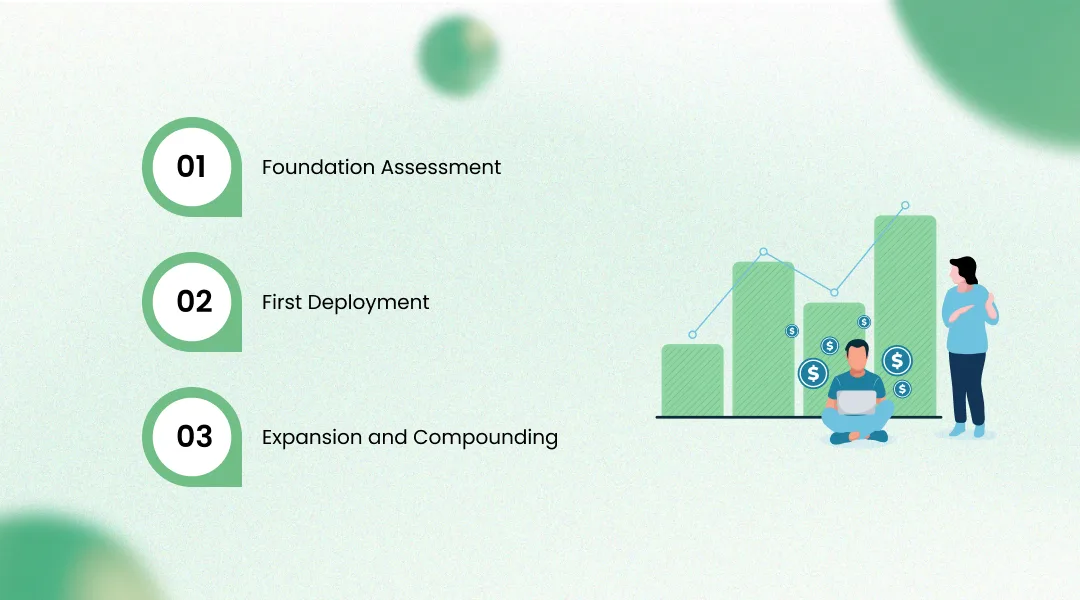
Begin with a focused audit of your current state. A mid-market finance team can complete this assessment in four weeks by addressing three questions. First, where does your team spend the most manual hours? Map every recurring task in your close cycle, AP workflow, and FP&A reporting process. Second, what is the quality of your ERP data? Assess your GL coding consistency, vendor master data completeness, and chart of accounts accuracy. Data quality is the single strongest predictor of AI payback period; deployments with clean ERP data achieve breakeven 40% to 60% faster. Third, which AI mid market financial AI tools integrate natively with your ERP? Eliminate any vendor that requires custom middleware.
Deploy your first AI application in the highest volume, most rule-based workflow. For most mid-market teams, this means AP invoice processing. The selection criteria should include native integration with your ERP, implementation timeline under sixty days, no requirement for internal data science resources, clear pricing within existing budget, and documented ROI benchmarks from companies of similar size. Start with a controlled pilot using one month of transaction data, validate accuracy, then expand to full production.
After establishing the first deployment and confirming ROI, expand to close automation and FP&A in sequence. Each successive deployment becomes faster because the data foundations are already in place and the team has built familiarity with AI-assisted workflows. KriraAI recommends that mid-market clients space their AI deployments approximately eight to twelve weeks apart, allowing each one to stabilize before adding the next layer.
The first and most damaging mistake is deploying AI before fixing data quality issues. In a 2025 survey of 150 CFOs whose AI implementations underperformed, 67% cited deploying AI before addressing underlying data quality problems as the primary cause. Budget 20% to 30% of your total project cost for data preparation before deployment.
The second mistake is choosing tools designed for enterprise or startup segments, which is why our guide on how to choose the best AI company for business growth in 2026 is worth reading before you sign a contract. Enterprise AI platforms bring complexity and timelines that mid-market teams cannot absorb. Startup-focused tools lack the multi-entity and compliance capabilities mid-market operations require. The right AI implementation for finance teams at this scale comes from vendors who build specifically for this segment.
The third mistake is measuring success only by hours saved. CFOs who only track direct labor savings are understating their AI returns and underbuilding their business cases. Measure across all four ROI categories from the beginning.
Mid market finance teams face friction points that neither small businesses nor enterprises encounter. The most significant is the integration complexity gap. Your ERP is sophisticated enough to have custom workflows, but it may not have the enterprise-grade API infrastructure that makes AI integration seamless. Your AI vendor selection must prioritize native connector availability over feature richness.
Talent competition presents another unique challenge. You cannot afford a dedicated AI team, but you also cannot rely on consumer-grade tools. The solution is selecting AI platforms designed for finance professionals while investing modestly in upskilling your existing team. A controller who understands how to configure AI rules and validate outputs is far more valuable than a data scientist who does not understand financial workflows.
Regulatory complexity at mid-market scale is often underestimated. The EU AI Act classifies AI credit scoring and fraud detection as high-risk systems requiring transparency documentation. Your AI vendor must provide explainability features and audit trails as part of the platform, not as add-on services.
Change management is the final challenge worth addressing directly. Finance teams are inherently conservative, and mid-market teams often have long-tenured staff. AI adoption succeeds only when the team understands that automation frees them for strategic work rather than threatening their positions.
By 2027, the competitive landscape in mid-market financial services will clearly reflect which companies acted on AI in 2025 and 2026 and which delayed. The compounding nature of AI benefits means that companies deploying today will have systems that have learned from eighteen to thirty months of their specific transaction data by the time competitors begin evaluating vendors.
The operational divide will manifest in three ways. First, AI adopters will operate with close cycles under four days while laggards still spend eight to ten days on manual reconciliation. Second, AI-adopting mid-market companies will reallocate 30% to 40% of their finance team capacity from processing to strategic analysis, making better capital allocation decisions and identifying revenue opportunities faster. Third, AI-driven mid-market finance teams will become more attractive acquisition targets. Private equity firms are actively seeking AI-optimized companies; a 2026 survey found that 95% of PE firms have either begun or plan to implement agentic AI. Companies demonstrating AI-driven efficiency command higher valuations. KriraAI works with mid-market firms specifically to build this kind of demonstrable AI maturity, creating a competitive moat that strengthens with each quarter of deployment.
Three insights from this guide matter most for mid market finance leaders considering AI adoption. First, your company size is an advantage, not a limitation. The decision-making speed and organizational agility that define mid-market operations enable faster AI deployment and faster ROI than enterprise competitors can achieve. Second, sequencing matters more than scale. Starting with AP automation, expanding to close acceleration, and building toward FP&A augmentation creates compounding returns that grow stronger with each deployment. Third, measuring the full spectrum of AI value, including error prevention, cycle time compression, and strategic reallocation alongside direct labor savings, is what separates top-quartile results from disappointing implementations.
KriraAI partners with mid market finance organizations to deliver AI solutions built for the operational reality described throughout this guide, and KriraAI can help you turn that plan into an implementation roadmap. Rather than offering enterprise platforms requiring months of customization or startup tools that cannot handle multi-entity complexity, KriraAI builds practical implementations calibrated to mid-market budgets and growth trajectories. The technology exists, the ROI is documented, and the competitive window for early mover advantage is narrowing. If your finance team is ready to move from evaluation to implementation, exploring what KriraAI offers for mid-market finance is a practical next step.
The optimal timing for an AI voice agent to initiate a cart recovery call is between 5 and 30 minutes after the abandonment event. Calling within this window catches the shopper while they still have active purchase intent and can recall the specific items they were considering. Research on sales response timing consistently shows that contact within the first five minutes produces the highest conversion rates, but the practical sweet spot for cart recovery is typically 15 to 20 minutes, which allows enough time for the shopper to have genuinely abandoned rather than simply pausing during checkout. Calling too quickly, within one to two minutes, can feel intrusive and suggests surveillance. Calling too late, after several hours or the next day, produces results only marginally better than email. AI voice agent platforms like OnDial allow businesses to configure precise timing rules based on their customer behaviour data, including different timing for different cart values, product categories, or customer segments.
Customer reception of AI cart recovery calls depends entirely on execution quality. Poorly designed calls with robotic voices, aggressive scripts, or irrelevant offers do generate negative reactions and can damage brand perception. However, well-designed AI voice interactions that sound natural, reference the specific products the customer was considering, and offer genuine value such as addressing a concern or providing a relevant incentive are received positively by the majority of shoppers. Studies on consumer attitudes toward proactive customer service consistently show that 60% to 70% of consumers appreciate follow-up contact from brands they were actively shopping with, provided the contact is timely, relevant, and respectful. The key factors are voice quality, conversation naturalness, the ability to handle "not interested" gracefully, and compliance with calling regulations and consent requirements. OnDial's platform is built with GDPR and CCPA compliance as foundational requirements, ensuring that all recovery calls meet regulatory standards for consent and data handling.
E-commerce businesses deploying AI voice agents for cart recovery can realistically expect to recover between 15% and 25% of abandoned carts, depending on factors including product category, average order value, conversation design quality, call timing, and whether incentives such as discounts or free shipping are offered during the recovery call. This compares favourably to email recovery rates of 5% to 10% and SMS recovery rates of 10% to 15%. Higher-value carts tend to show higher recovery rates because customers who have invested more time in product selection are more receptive to a conversation that addresses their specific hesitation. The first month of deployment typically shows recovery rates at the lower end of this range as the conversation flows are optimised, with performance improving steadily as the AI agent's objection handling is refined based on real call data and sentiment analysis.
Yes, modern AI voice agent platforms support multilingual cart recovery, which is essential for e-commerce businesses serving diverse markets. The AI agent can detect the customer's preferred language based on their profile data, browser language settings, or previous interaction history, and conduct the entire recovery conversation in that language. This capability is particularly important for e-commerce businesses operating in multilingual markets such as India, where a single store might serve customers who prefer Hindi, Tamil, Bengali, Telugu, or English. OnDial supports over 100 languages and offers more than 80 Indian voice variations across 9 Indian languages, enabling e-commerce businesses to deploy recovery agents that communicate fluently in the customer's native language without maintaining separate agent teams for each language.
AI voice agents for abandoned cart recovery work most effectively as part of an orchestrated multi-channel recovery strategy rather than as a replacement for email and SMS. The recommended approach is to position the AI voice call as the first recovery touchpoint, initiated within 15 to 30 minutes of abandonment, followed by email and SMS sequences for carts that the voice agent did not recover. This sequencing leverages the voice channel's higher conversion rate for the initial, highest-intent window while using email and SMS as lower-cost follow-up channels for shoppers who were unreachable by phone or who need more time to decide. The integration requires coordination between the AI voice platform and the e-commerce platform's marketing automation system, typically managed through shared cart status data that prevents a shopper from receiving a recovery email for a cart that was already recovered via a voice call. OnDial's API integration enables this orchestration by updating cart and customer status in real time as recovery calls are completed.
Ridham Chovatiya is the COO at KriraAI, driving operational excellence and scalable AI solutions. He specialises in building high-performance teams and delivering impactful, customer-centric technology strategies.