The average enterprise contact center spends between $6 and $12 per handled call when fully loaded labor, infrastructure, and quality assurance costs are factored together. For an operation handling 500,000 calls per year, that translates to $3 million to $6 million in annual telephony spend before accounting for training, attrition, and schedule management overhead. The AI call agent exists to compress that cost structure while simultaneously removing the capacity ceiling that human staffing imposes on call handling. Unlike the menu-driven IVR systems that have frustrated callers for decades, a modern AI call agent conducts a genuine spoken conversation, understanding natural language in real time, reasoning about context, retrieving data from backend systems mid-call, and responding with natural synthesized speech that sounds close to a human operator.
This blog is a complete guide to AI call agents written for the teams evaluating, building, or buying them. It covers the full production architecture from automatic speech recognition through telephony integration, the critical design decisions that separate reliable call agents from fragile demos, the implementation journey from pilot to scale, the realistic business case with honest numbers, and the operational practices that keep a deployed AI call agent performing well over time. Whether you are a technical architect designing the pipeline or a VP of operations building the business case, every section is written to give you information you can act on immediately.
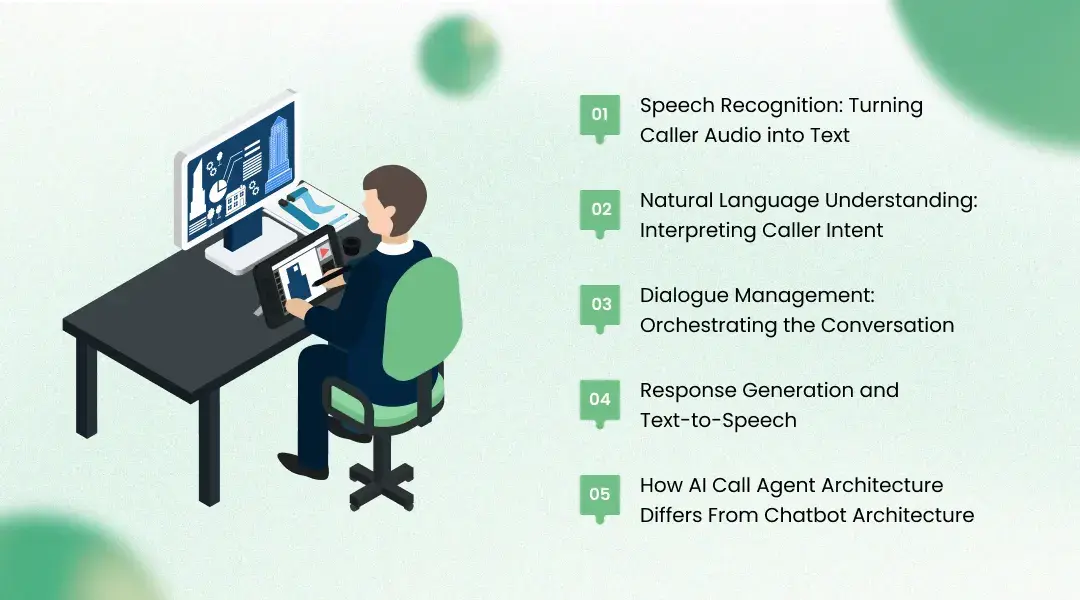
A production AI call agent is not a single model. It is an orchestrated pipeline of specialized components, each optimized for a specific function, connected through low-latency interfaces designed to sustain the real-time demands of a live telephone conversation. Understanding this architecture is essential for anyone evaluating vendor solutions or planning an in-house build because every design tradeoff in the pipeline affects call quality, latency, reliability, and cost.
The automatic speech recognition layer is the front door of the entire system. In production telephony environments, the ASR must handle 8kHz narrowband audio from PSTN lines, which carries significantly less spectral information than the 16kHz or 48kHz wideband audio that most ASR benchmarks use. This gap is critical because word error rates that look impressive on podcast-quality audio can degrade by 15 to 30 percent on actual telephone audio with background noise, codec compression artifacts, and speaker variability.
Production AI call agents typically use streaming ASR architectures built on Conformer-based models or RNN-Transducer (RNN-T) architectures that emit partial transcriptions as the caller speaks, rather than waiting for a complete utterance. This streaming behavior is essential for maintaining conversational responsiveness. Systems built on Whisper variants can achieve strong accuracy but often require batched processing that introduces 500ms to 2 second delays before transcription is available, making them unsuitable as the primary real-time ASR unless heavily modified with chunked inference and speculative decoding. Teams at KriraAI typically architect the ASR layer with a streaming primary model for real-time conversation flow and a more accurate batch model for post-call transcription and analytics, ensuring both conversational responsiveness and transcript fidelity.
Domain adaptation is the second critical factor. A call agent handling insurance claims needs to reliably recognize terms like "subrogation," "deductible," and policy number formats. A medical office agent needs to recognize drug names and procedure codes. Production ASR systems achieve this through either fine-tuning on domain-specific audio data or through hot-word boosting and custom vocabulary injection at inference time, which raises recognition confidence for specified terms without requiring full model retraining.
Once the ASR layer produces a transcription, the NLU layer must determine what the caller wants. In production AI call agent systems, this is not a simple single-label classification task. Callers frequently express multiple intents in a single utterance, provide partial information, change their mind mid-sentence, and use indirect language that requires pragmatic inference rather than keyword matching.
The architecture choices here fall into three categories. Fine-tuned classification models using BERT or RoBERTa variants offer fast inference (under 20ms) and high accuracy on well-defined intent taxonomies but require retraining when new intents are added. Zero-shot LLM-based classifiers using models like GPT-4o or Claude can handle open-ended intents without retraining but introduce 200ms to 800ms of inference latency and higher per-call compute cost. The hybrid approach, which KriraAI deploys in most production systems, uses a fine-tuned classifier for high-frequency known intents and falls back to an LLM for ambiguous or novel utterances, balancing speed and flexibility.
Entity extraction runs alongside intent classification, pulling structured data from the caller's speech: dates, account numbers, names, addresses, monetary amounts, and domain-specific values. In telephony contexts, entity extraction must handle the way people naturally speak numbers and dates aloud, which differs substantially from written formats. "January twenty-third" must map to 2026-01-23. "My account is three four seven, nine nine two" must concatenate correctly. Production systems use rule-based normalization layers downstream of the ASR to handle these transformations reliably.
The dialogue manager is the brain of the AI call agent, deciding what to say next based on the current conversation state, the caller's latest input, the data retrieved from backend systems, and the business rules governing the interaction. This is where the largest architectural divergence exists across production systems.
Finite state machine (FSM) approaches define every possible conversation path as a graph of states and transitions. They are deterministic, testable, and predictable, which makes them attractive for compliance-sensitive use cases. However, they become unmanageable when the conversation space is large, and they handle unexpected caller inputs poorly because every deviation must be explicitly programmed.
Frame-based dialogue managers track a set of required slots for a given task and use flexible strategies to fill them in any order the caller provides information. They handle natural conversation flow better than FSMs and remain relatively transparent in their decision-making. Most production AI call agents for structured tasks like appointment scheduling, order tracking, and account inquiries use frame-based systems.
LLM-based dialogue management uses a large language model with carefully engineered system prompts and retrieval-augmented context to manage the conversation. This approach handles open-ended conversations well and adapts to unexpected inputs gracefully, but it introduces challenges around response consistency, hallucination risk, and latency. Production deployments using LLM-based dialogue management require extensive guardrailing: output validation, factual grounding against retrieved data, response length constraints, and fallback logic that escalates to a human when the LLM's confidence drops.
After the dialogue manager determines what the agent should say, the response must be synthesized into speech quickly enough that the caller perceives a natural conversational pace. Human conversational turn-taking typically expects a response within 300 to 700 milliseconds after the end of an utterance. Exceeding this window creates an unnatural pause that callers perceive as system lag or confusion.
Response generation itself must balance quality and speed. Template-based responses are fastest (near-zero generation latency) and most controllable but sound rigid across varied conversations. LLM-generated responses sound natural and contextually appropriate but add 200 to 600ms of generation latency before TTS even begins. Production systems often use a hybrid: templates for predictable utterances like greetings, confirmations, and structured data readbacks, with LLM generation reserved for open-ended responses where natural phrasing matters.
The TTS layer converts text responses to audio. Neural TTS systems based on architectures like VITS, or proprietary engines from providers like ElevenLabs, Play.ht, or cloud-native options from Google and Amazon, produce highly natural speech. Streaming TTS is essential for production AI call agents because it begins audio playback before the entire utterance is synthesized, reducing perceived latency by 100 to 300ms. Voice persona design also matters operationally: the agent's voice should match the brand context, and production systems allow configuration of speaking rate, pitch, and emotional tone per use case.
Teams that have built text-based chatbots sometimes assume that adding speech recognition and synthesis to an existing chatbot creates a viable AI call agent. This assumption leads to poor call quality and caller frustration because the constraints of spoken conversation differ fundamentally from text-based interaction in several critical dimensions.
Latency tolerance is the most significant difference. In text chat, a 2 to 3 second response time is acceptable. In a phone call, anything beyond 700ms feels broken. This means the entire pipeline from ASR output to TTS audio output must complete within a much tighter window, which constrains model sizes, inference strategies, and architectural choices throughout the stack. Every additional 100ms of latency in any component degrades the caller experience perceptibly.
Turn-taking dynamics in speech lack the clear delimiters that text provides. In text chat, the user sends a message and waits. In spoken conversation, callers pause mid-thought, interject while the agent is speaking, and use filler words like "um" and "well" that carry no semantic content but signal cognitive processing. A production AI call agent must implement endpointing logic that distinguishes a mid-thought pause from a completed utterance, and barge-in detection that allows the caller to interrupt the agent's speech when they have additional information to provide.
Error recovery in speech is also fundamentally different. In text, a misunderstood input can be re-read. In speech, the audio is transient. If the ASR misrecognizes a critical entity like a phone number or account number, the agent must implement confirmation loops that are natural and efficient rather than repetitive and frustrating. The best production systems track ASR confidence scores per entity and only trigger confirmation for low-confidence recognitions, rather than confirming everything.
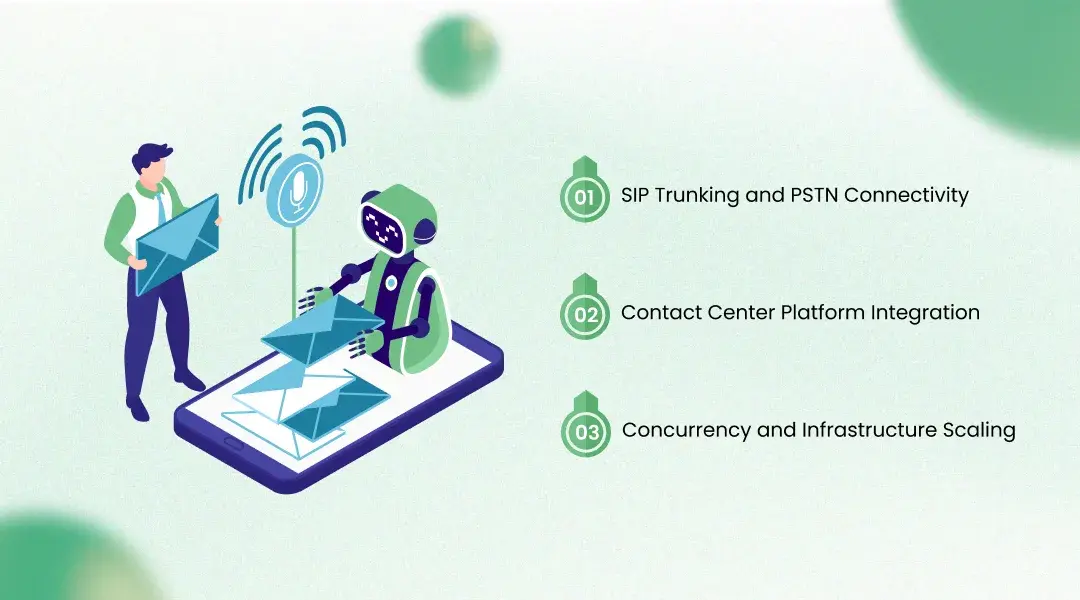
The telephony integration layer is where AI call agent architecture intersects with traditional telecommunications infrastructure, and it is the layer most frequently underestimated by teams approaching voice AI from a software-first background.
Production AI call agents connect to the public switched telephone network (PSTN) through SIP (Session Initiation Protocol) trunks provided by carriers like Twilio, Vonage, Bandwidth, or Telnyx. The SIP trunk handles call setup and teardown signaling, while the actual audio stream flows over RTP (Real-time Transport Protocol). The AI system must implement a SIP user agent that manages call lifecycle events: INVITE for incoming calls, 200 OK for call acceptance, BYE for termination, and REFER for call transfer to human agents.
Audio codec selection matters for ASR accuracy. Most PSTN traffic uses G.711 (PCMU or PCMA) at 8kHz, but some SIP providers support wideband codecs like G.722 or Opus that deliver higher audio fidelity. Production systems should negotiate the highest quality codec the carrier supports, as every improvement in audio quality directly improves ASR accuracy and downstream conversation quality.
Enterprise deployments typically require integration with existing contact center platforms like Genesys Cloud, Amazon Connect, NICE CXone, or Five9. These integrations serve two purposes: routing calls to the AI agent through the existing call distribution infrastructure, and enabling seamless escalation from the AI agent to a human agent when the conversation requires it. The escalation handoff must include full conversation context, the transcript so far, extracted entities, and the reason for escalation, so the human agent can continue without asking the caller to repeat information. KriraAI engineers these handoff integrations as a core part of every deployment because a poorly implemented escalation path destroys caller trust faster than any other failure mode.
A single AI call agent instance handles one call at a time, but production deployments must handle hundreds or thousands of concurrent calls. This requires horizontal scaling of every pipeline component: multiple ASR inference instances, multiple LLM inference instances if using LLM-based dialogue, multiple TTS synthesis instances, and a media server layer that manages RTP streams for all concurrent calls. Infrastructure planning must account for peak call volumes, which in most contact centers can reach 3 to 5 times average volume during spikes. Auto-scaling with warm instance pools is the standard approach, maintaining a base capacity with pre-warmed instances that can absorb traffic spikes within seconds rather than the minutes required for cold starts.
Production AI call agents fail in ways that are different from text-based systems, and the consequences of failure are more immediate because the caller is waiting in real time with no visual interface to fall back on. Robust design requires anticipating and mitigating every common failure mode.
ASR failures are the most frequent. Background noise, heavy accents, poor cellular connections, and overlapping speech all degrade recognition accuracy. Production systems implement confidence-based fallback strategies: when the ASR confidence score drops below a configurable threshold (typically 0.4 to 0.6 depending on the domain), the agent asks the caller to repeat rather than acting on a likely-incorrect transcription. For critical entities like account numbers and dates, dual-pass confirmation is standard: the agent reads the value back to the caller and asks for explicit confirmation before proceeding.
NLU failures occur when the caller's request falls outside the agent's trained intent taxonomy. A well-designed system detects this through low classification confidence scores and routes to a graceful catch-all flow that either attempts to rephrase and retry or offers escalation to a human agent. The worst failure mode is a false-positive intent classification with high confidence, where the agent confidently takes the wrong action. Production quality monitoring must track these through post-call analysis and human review of flagged conversations.
Infrastructure failures, including ASR service timeouts, TTS synthesis failures, or backend API unavailability, must be handled with circuit-breaker patterns and graceful degradation. If the TTS service fails, the system should play a pre-recorded apology message and transfer to a human agent rather than dropping the call silently. Every component in the pipeline should have a timeout, a retry policy, and a fallback behavior that maintains the caller's experience even during partial system failures.
Deploying an AI call agent in a production environment follows a phased journey that typically spans 12 to 20 weeks from kickoff to initial production deployment, with ongoing optimization continuing indefinitely. Understanding this journey helps organizations plan resources, set expectations, and avoid common missteps.
The first phase covers discovery and conversation design, typically lasting 3 to 4 weeks. This involves analyzing existing call recordings and transcripts to understand the actual conversations callers have, mapping the intent taxonomy, identifying the most common call flows, and designing the conversational logic the agent will follow. This phase is where the most consequential design decisions are made. The quality of conversation design directly determines whether the deployed agent handles 40 percent or 80 percent of calls successfully.
The second phase covers development and integration, typically lasting 5 to 8 weeks. This involves building the ASR pipeline with domain adaptation, implementing the NLU and dialogue management logic, integrating with backend systems for data retrieval and actions, configuring TTS with the selected voice persona, and building the telephony integration with SIP trunking and call routing. Teams that underestimate the integration work, particularly CRM integration and contact center platform integration, consistently overrun their timelines.
The third phase covers testing and validation, lasting 2 to 3 weeks. This goes beyond unit testing of individual components to include end-to-end conversation testing with synthetic and real callers, load testing at target concurrency levels, failover testing of every fallback path, and latency profiling of the complete pipeline. KriraAI runs structured adversarial testing during this phase, where testers deliberately attempt to break the agent through edge-case inputs, topic switching, and ambiguous requests, because production callers will do all of these things from day one.
The fourth phase is controlled production deployment, where the agent handles a subset of live calls (typically 10 to 20 percent of traffic for the target call type) while metrics are closely monitored. This phase lasts 2 to 4 weeks and is where the system encounters the distribution shift between test data and real caller behavior. Expect intent recognition accuracy to drop 5 to 10 percentage points compared to test performance during initial production exposure, then recover as the system is tuned based on real call data.
The business case for AI call agents rests on measurable cost reduction, capacity expansion, and quality improvement. Building a credible ROI model requires understanding the real cost structure on both sides of the equation and being honest about what AI call agents can and cannot do today.
The fully loaded cost of a human agent handling calls includes direct compensation ($15 to $25 per hour for US-based agents, $8 to $15 for nearshore, $4 to $8 for offshore), benefits and overhead (adding 25 to 40 percent to base compensation), technology and facilities costs, training costs (averaging $5,000 to $7,000 per new agent including ramp time), and quality assurance and management overhead. When all factors are included, the average cost per handled call ranges from $5 to $12 depending on geography and call complexity.
An AI call agent's cost per handled call includes compute infrastructure (ASR, NLU/LLM, TTS inference), telephony costs (SIP trunk minutes, typically $0.005 to $0.02 per minute), and platform or vendor licensing. At production scale, the fully loaded cost per AI-handled call typically falls between $0.30 and $1.50, depending on the complexity of the conversation and the compute intensity of the pipeline. This represents a 70 to 90 percent cost reduction per call for conversations the AI handles successfully.
The containment rate, defined as the percentage of calls the AI agent resolves without human escalation, is the single most important metric determining ROI. A 60 percent containment rate on a 500,000 annual call volume with $8 average cost per human-handled call and $0.80 average cost per AI-handled call yields annual savings of approximately $2.16 million. A 40 percent containment rate on the same volume yields approximately $1.44 million. The difference between mediocre and excellent conversation design is often the difference between these two outcomes.
Voice AI call automation delivers benefits beyond direct cost reduction. AI call agents maintain consistent quality on every call regardless of time of day, call volume, or agent fatigue. They provide 24/7 availability without shift management. They eliminate hold times during volume spikes because compute scales horizontally while human staffing does not. Production deployments consistently show average handle time reductions of 20 to 35 percent for AI-handled calls compared to human-handled calls for the same transaction types, because the AI agent does not need to search for information or navigate screens while the caller waits.
Deploying an AI call agent is not a one-time project. Production performance degrades over time if the system is not actively monitored and improved. Caller language shifts, new products and services change the intent distribution, backend systems change their APIs, and edge cases accumulate as more diverse callers interact with the system.
A production monitoring framework for a conversational AI phone agent should track ASR word error rate on production audio, sampled and measured weekly. It should track intent classification accuracy measured through human review of a random sample of calls (typically 2 to 5 percent of volume). It should track containment rate, escalation rate, and escalation reasons categorized by type. It should track end-to-end latency percentiles (p50, p95, and p99) measured at the caller-perceived level. It should track caller satisfaction scores derived from post-call surveys or inferred from conversation signals like caller tone and call completion.
KriraAI builds automated alerting on these metrics into every deployment, with thresholds configured per client based on baseline performance. When intent accuracy drops below the established baseline by more than 3 percentage points, or when escalation rate rises above the target threshold, the system triggers a review cycle that identifies the root cause (new caller intents, ASR degradation on a specific audio condition, backend integration failures) and drives targeted improvements. This closed-loop improvement process is what separates a production-grade AI call agent from a demo that impresses in a conference room but deteriorates in the real world.
Three core insights define the AI call agent opportunity for enterprise organizations today. First, the technology stack is mature enough for production deployment, but only when each layer is architected correctly for the specific demands of real-time telephone conversation, from streaming ASR on narrowband audio to sub-700ms total pipeline latency. Second, the business case is compelling and measurable: organizations achieving 60 percent or higher containment rates realize 70 to 90 percent cost reduction on AI-handled calls while simultaneously eliminating capacity constraints and maintaining consistent service quality around the clock. Third, sustained production performance requires continuous monitoring and improvement because real caller behavior constantly evolves and a static system degrades over time.
KriraAI designs and deploys production-grade AI call agent systems with the engineering depth required to deliver reliable voice automation across complex enterprise environments. From ASR pipeline optimization and dialogue architecture to telephony integration and post-deployment continuous improvement, KriraAI brings the technical expertise and operational discipline that separate systems which perform in demos from systems that perform under real production load. If your organization is evaluating AI call agents for your contact center operations, connect with the KriraAI team to discuss your requirements, your call data, and the architecture that will deliver measurable results in your environment.
The optimal timing for an AI voice agent to initiate a cart recovery call is between 5 and 30 minutes after the abandonment event. Calling within this window catches the shopper while they still have active purchase intent and can recall the specific items they were considering. Research on sales response timing consistently shows that contact within the first five minutes produces the highest conversion rates, but the practical sweet spot for cart recovery is typically 15 to 20 minutes, which allows enough time for the shopper to have genuinely abandoned rather than simply pausing during checkout. Calling too quickly, within one to two minutes, can feel intrusive and suggests surveillance. Calling too late, after several hours or the next day, produces results only marginally better than email. AI voice agent platforms like OnDial allow businesses to configure precise timing rules based on their customer behaviour data, including different timing for different cart values, product categories, or customer segments.
Customer reception of AI cart recovery calls depends entirely on execution quality. Poorly designed calls with robotic voices, aggressive scripts, or irrelevant offers do generate negative reactions and can damage brand perception. However, well-designed AI voice interactions that sound natural, reference the specific products the customer was considering, and offer genuine value such as addressing a concern or providing a relevant incentive are received positively by the majority of shoppers. Studies on consumer attitudes toward proactive customer service consistently show that 60% to 70% of consumers appreciate follow-up contact from brands they were actively shopping with, provided the contact is timely, relevant, and respectful. The key factors are voice quality, conversation naturalness, the ability to handle "not interested" gracefully, and compliance with calling regulations and consent requirements. OnDial's platform is built with GDPR and CCPA compliance as foundational requirements, ensuring that all recovery calls meet regulatory standards for consent and data handling.
E-commerce businesses deploying AI voice agents for cart recovery can realistically expect to recover between 15% and 25% of abandoned carts, depending on factors including product category, average order value, conversation design quality, call timing, and whether incentives such as discounts or free shipping are offered during the recovery call. This compares favourably to email recovery rates of 5% to 10% and SMS recovery rates of 10% to 15%. Higher-value carts tend to show higher recovery rates because customers who have invested more time in product selection are more receptive to a conversation that addresses their specific hesitation. The first month of deployment typically shows recovery rates at the lower end of this range as the conversation flows are optimised, with performance improving steadily as the AI agent's objection handling is refined based on real call data and sentiment analysis.
Yes, modern AI voice agent platforms support multilingual cart recovery, which is essential for e-commerce businesses serving diverse markets. The AI agent can detect the customer's preferred language based on their profile data, browser language settings, or previous interaction history, and conduct the entire recovery conversation in that language. This capability is particularly important for e-commerce businesses operating in multilingual markets such as India, where a single store might serve customers who prefer Hindi, Tamil, Bengali, Telugu, or English. OnDial supports over 100 languages and offers more than 80 Indian voice variations across 9 Indian languages, enabling e-commerce businesses to deploy recovery agents that communicate fluently in the customer's native language without maintaining separate agent teams for each language.
AI voice agents for abandoned cart recovery work most effectively as part of an orchestrated multi-channel recovery strategy rather than as a replacement for email and SMS. The recommended approach is to position the AI voice call as the first recovery touchpoint, initiated within 15 to 30 minutes of abandonment, followed by email and SMS sequences for carts that the voice agent did not recover. This sequencing leverages the voice channel's higher conversion rate for the initial, highest-intent window while using email and SMS as lower-cost follow-up channels for shoppers who were unreachable by phone or who need more time to decide. The integration requires coordination between the AI voice platform and the e-commerce platform's marketing automation system, typically managed through shared cart status data that prevents a shopper from receiving a recovery email for a cart that was already recovered via a voice call. OnDial's API integration enables this orchestration by updating cart and customer status in real time as recovery calls are completed.
Founder & CEO
Divyang Mandani is the CEO of KriraAI, driving innovative AI and IT solutions with a focus on transformative technology, ethical AI, and impactful digital strategies for businesses worldwide.