The global energy sector loses an estimated $50 billion annually to unplanned equipment downtime, inefficient grid management, and suboptimal resource allocation. That figure, drawn from industry analyses of operational waste across utilities, oil and gas producers, and renewable operators, represents a problem that traditional engineering and manual oversight can no longer solve at scale. has shifted from a speculative technology to an operational necessity, with over 70% of major energy companies now running at least one AI pilot program, according to recent industry surveys. The complexity of modern energy systems, spanning distributed generation, fluctuating renewable inputs, aging infrastructure, and volatile commodity markets, has outpaced the capacity of human operators and legacy software to manage effectively.
What was once a controlled, centralized system of power generation and distribution has become a dynamic, decentralized web of inputs, outputs, and variables that change by the second. The companies that recognized this shift early are already capturing measurable advantages in reliability, cost efficiency, and safety. Those still relying on traditional approaches are falling behind at an accelerating rate. This blog examines the specific ways artificial intelligence energy management is transforming the sector, the quantified results companies are achieving, a practical implementation roadmap for energy enterprises, and the honest challenges that remain. Whether you operate a utility, manage a renewable energy portfolio, or lead an oil and gas enterprise, this analysis will give you a concrete understanding of where AI creates value and how to capture it.
The energy industry in 2026 operates under a level of complexity and pressure that would have been unimaginable two decades ago. Utilities face aging infrastructure, with the average age of power transformers in many developed nations exceeding 40 years. Maintenance costs are climbing, outage risks are rising, and the cost of replacing equipment at scale is prohibitive without better ways to prioritize spending. At the same time, regulatory pressure to decarbonize is intensifying, with governments worldwide setting aggressive net zero targets that demand fundamental changes to how energy is generated, transmitted, and consumed.
The integration of renewable energy sources has created an entirely new category of operational challenges. Solar and wind generation are inherently variable, producing power based on weather conditions rather than demand schedules. Grid operators must balance these fluctuating inputs against steady baseload demand, managing frequency and voltage stability across networks that were designed for one directional power flow. Energy storage technologies are improving but remain expensive and limited in capacity, meaning that grid balancing still relies heavily on real time decision making and forecasting accuracy.
On the commercial side, energy markets have become more volatile and fragmented. Natural gas prices swing on geopolitical events. Carbon pricing mechanisms add layers of cost uncertainty. Distributed energy resources, including rooftop solar, behind the meter batteries, and electric vehicle charging loads, are turning consumers into producers, further complicating demand forecasting and grid planning. The result is an industry where the margin for operational error has narrowed dramatically while the number of variables to manage has multiplied.
Workforce challenges compound these issues significantly. The energy sector faces a generational talent gap as experienced engineers and operators retire faster than replacements can be trained. A 2024 report from the International Energy Agency noted that the global energy workforce needs to grow by approximately 14 million workers by 2030 to meet transition targets, yet recruitment pipelines remain constrained by specialized skill requirements. This combination of infrastructure age, renewable integration complexity, market volatility, and talent scarcity creates the exact conditions where intelligent automation and data driven decision support become essential rather than optional.
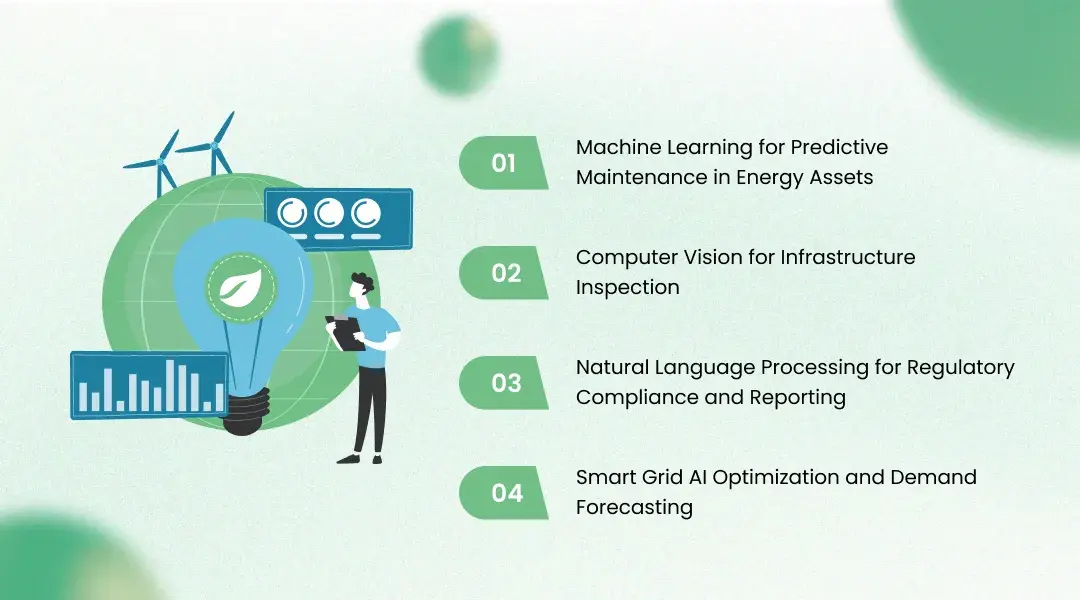
The application of artificial intelligence in the energy sector is not a single technology solving a single problem. It is a portfolio of capabilities addressing different challenges at every stage of the energy value chain, from resource exploration and power generation through transmission, distribution, and end use consumption. Understanding these applications requires mapping specific AI technologies to the concrete problems they solve.
Predictive maintenance energy sector applications represent one of the most mature and highest return uses of AI in the industry. Traditional maintenance follows either a reactive approach, fixing equipment after it fails, or a time based schedule, servicing assets at fixed intervals regardless of actual condition. Both approaches are wasteful. Reactive maintenance causes unplanned downtime that can cost a large power plant between $500,000 and $2 million per day. Scheduled maintenance often replaces components that still have years of useful life remaining.
Machine learning models trained on sensor data from turbines, transformers, generators, compressors, and other critical equipment can identify subtle patterns that precede failures, often weeks or months before a human operator would notice any anomaly. These models ingest vibration data, temperature readings, pressure measurements, oil analysis results, and acoustic signatures to build a continuously updated picture of equipment health. When the model detects a deviation from normal operating patterns, it generates an alert with a diagnosis and recommended action, allowing maintenance teams to schedule repairs during planned outages rather than responding to emergencies.
KriraAI has developed predictive maintenance frameworks for energy clients that integrate sensor data across asset fleets, enabling operators to move from calendar based maintenance to condition based strategies that reduce maintenance costs by 25% to 40% while simultaneously improving asset availability. The practical advantage is not just cost savings but the ability to extend equipment life and allocate scarce maintenance resources where they will have the greatest impact.
Physical inspection of energy infrastructure, including transmission lines, pipelines, offshore platforms, wind turbines, and solar panels, has historically required human inspectors working in hazardous conditions. Computer vision powered by deep learning is transforming this process through drone based and satellite based inspection systems that can scan thousands of assets in a fraction of the time required for manual inspection. These systems detect corrosion, cracking, vegetation encroachment, insulator damage, and panel soiling with accuracy rates that match or exceed trained human inspectors.
For wind energy operators, AI powered blade inspection systems can identify surface cracks as small as one millimeter from drone imagery, categorize the severity of damage, and prioritize repairs across an entire fleet of turbines. For solar farm operators, thermal imaging combined with computer vision algorithms detects hotspots and cell degradation across panels, enabling targeted cleaning and replacement that maintains generation efficiency.
Energy companies operate under some of the most complex regulatory frameworks of any industry. Environmental reporting, safety compliance, emissions tracking, and permit management generate enormous volumes of documentation that must be accurate, consistent, and timely. Natural language processing applications are automating the extraction of relevant data from regulatory filings, the generation of compliance reports, and the monitoring of changing regulatory requirements across jurisdictions. This reduces the administrative burden on compliance teams and decreases the risk of costly violations that can result in fines, operational shutdowns, or reputational damage.
Smart grid AI optimization represents the most transformative application of artificial intelligence in the power sector. Modern AI systems can forecast electricity demand with accuracy rates exceeding 97% at the day ahead horizon, incorporating weather data, historical consumption patterns, economic indicators, and even social media signals that correlate with unusual demand events. These forecasts enable grid operators to optimize generation scheduling, reduce spinning reserve requirements, and minimize the curtailment of renewable energy.
On the distribution side, AI algorithms manage voltage regulation, fault detection, and load balancing across networks with thousands of nodes, making real time adjustments that keep power quality within acceptable parameters even as distributed energy resources create bidirectional power flows. Advanced reinforcement learning models are being deployed to manage battery storage dispatch, determining the optimal times to charge and discharge grid scale batteries based on price signals, renewable generation forecasts, and grid stability requirements.
The business case for AI in energy is no longer theoretical. Companies across the sector are reporting specific, measurable improvements that justify continued and expanded investment. These results span operational efficiency, financial performance, safety metrics, and environmental outcomes.
In power generation, AI driven optimization of gas turbine operations has demonstrated fuel efficiency improvements of 2% to 5%. While those percentages may seem modest, for a large combined cycle gas turbine plant consuming millions of dollars in fuel annually, a 3% efficiency gain translates to savings of $3 million to $8 million per year. When applied across a fleet of generating assets, the cumulative impact becomes substantial. AI energy cost reduction in generation operations is consistently delivering payback periods of 12 to 18 months on initial technology investments.
Predictive maintenance applications in the oil and gas sector have reduced unplanned downtime by 30% to 50% across early adopters, according to multiple case studies published between 2023 and 2025. One major North Sea offshore operator reported that implementing machine learning based equipment monitoring across its platform fleet reduced maintenance costs by 37% in the first two years while improving equipment availability from 91% to 97%. The financial impact exceeded $120 million annually across the operator's portfolio.
In renewable energy, AI powered forecasting and dispatch optimization have increased the effective capacity factor of wind farms by 3% to 7%, meaning more energy is captured from the same physical assets. For a 200 megawatt wind farm operating at a baseline capacity factor of 35%, a 5% improvement represents approximately $4 million in additional annual revenue at typical wholesale electricity prices. Solar operators using AI for predictive cleaning and fault detection report generation efficiency improvements of 2% to 4% compared to operators using traditional maintenance approaches.
Grid operators implementing smart grid AI optimization report transmission and distribution loss reductions of 5% to 15%, depending on the baseline condition of the network and the extent of AI deployment. Given that global transmission and distribution losses amount to approximately 8% of total electricity generated, even modest improvements at scale represent billions of dollars in recovered energy value. One European distribution network operator published results showing that AI based voltage optimization alone reduced energy losses by 6.2% across its network, saving 340 gigawatt hours of electricity annually.
KriraAI works with energy enterprises to build analytics platforms that track these improvements in real time, connecting AI model outputs to financial and operational KPIs so that decision makers can see precisely where AI is delivering value and where further optimization is possible. This measurement infrastructure is critical because it transforms AI from a technology experiment into a managed business capability with clear accountability.
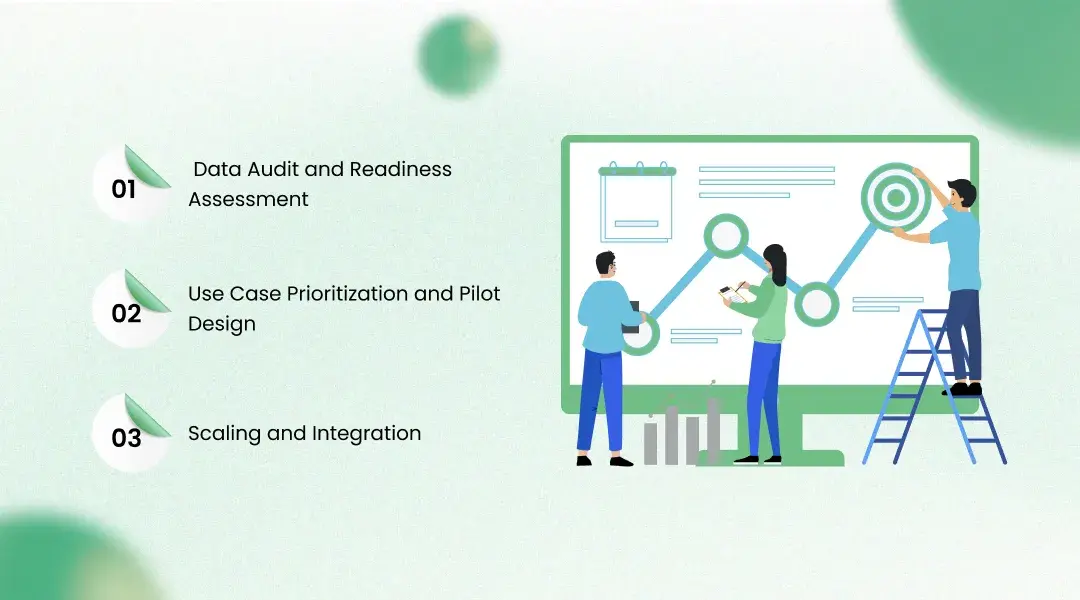
Implementing AI in energy operations is not a matter of purchasing software and switching it on. It requires a structured approach that accounts for data readiness, organizational capacity, technical integration, and change management. Companies that skip steps in this process consistently underperform, wasting investment and eroding internal confidence in AI initiatives. The following roadmap reflects the approach that successful energy companies have followed.
Every AI implementation begins with data. The first phase involves a comprehensive audit of existing data assets, including what data is being collected, where it is stored, how it is structured, and what gaps exist. Energy companies typically discover that they have enormous volumes of data but that much of it is siloed across different systems, inconsistently formatted, or lacking the quality and completeness needed for machine learning applications.
This phase should produce a detailed data inventory, a gap analysis identifying what additional data collection is needed, and a data architecture plan that describes how data will flow from source systems into AI platforms. Companies should budget four to eight weeks for this phase depending on organizational complexity. The key deliverable is a realistic assessment of what AI applications are feasible with existing data and what preparatory work is required.
Not all AI applications deliver equal value, and attempting too many simultaneously is a common cause of failure. The second phase involves scoring potential use cases against criteria including expected business impact, data readiness, technical feasibility, and organizational alignment. The goal is to select two or three pilot use cases that have a high probability of success and a clear connection to business outcomes that leadership cares about.
Pilot programs should be designed with specific success metrics defined in advance, a realistic timeline of three to six months, and a dedicated team that includes both data scientists and domain experts from the relevant business unit. The pilot should be structured to produce a clear go or no go decision for broader deployment based on measurable results.
Successful pilots must be scaled thoughtfully. This phase involves hardening the technical infrastructure, integrating AI outputs into operational workflows and decision making processes, training end users, and establishing ongoing monitoring and model maintenance protocols. Scaling is where many energy companies struggle because it requires changes to existing processes and systems that have organizational inertia behind them.
The scaling phase should include the development of MLOps capabilities, which are the operational practices for deploying, monitoring, retraining, and versioning machine learning models in production environments. Without these capabilities, models degrade over time as the data they were trained on becomes less representative of current conditions. Energy assets operate in changing environments, and models must adapt continuously.
The most frequent implementation mistakes in AI energy projects fall into predictable categories that experienced organizations have learned to avoid.
Starting with technology instead of business problems leads to solutions that are technically impressive but operationally irrelevant. Always begin with a specific business problem that has a quantifiable cost.
Underinvesting in data engineering relative to model development creates situations where brilliant algorithms cannot function because they lack clean, reliable input data. Expect to spend 60% to 70% of project effort on data preparation.
Failing to involve frontline operators in the design process produces tools that technical teams love but operations teams reject. Operators must trust the AI outputs enough to act on them, and that trust is built through involvement, not instruction.
Treating AI as a one time project rather than a continuous capability results in models that work well initially but degrade within 12 to 18 months as operating conditions change. Plan for ongoing model monitoring, retraining, and improvement from the start.
Neglecting change management causes organizational resistance that can stall or kill technically successful projects. Communicate clearly about what AI will and will not change about people's roles, and invest in training that builds confidence rather than anxiety.
Any responsible discussion of AI in energy must acknowledge the real difficulties that companies face in adoption. The technology is powerful but not without significant constraints, and overselling its capabilities does a disservice to organizations trying to make informed investment decisions.
Data quality remains the single largest barrier to successful AI implementation in the energy sector. Many energy companies operate equipment installed decades ago that was never designed to generate the volume or quality of data that modern AI requires. Retrofitting sensors to legacy equipment is expensive and technically challenging. Even where data exists, it is often trapped in proprietary SCADA systems, stored in incompatible formats, or corrupted by sensor malfunctions that went undetected for months. Cleaning and harmonizing this data requires substantial effort before any AI model can be trained.
The talent gap presents another formidable challenge. Energy companies need people who understand both AI and energy systems, a combination that is extremely rare in the current labor market. Data scientists without energy domain knowledge build models that fail in real operating conditions. Energy engineers without AI literacy cannot effectively collaborate with data teams or evaluate AI outputs critically. Building internal AI capability requires sustained investment in hiring, training, and retention, and many energy companies are competing for the same limited talent pool as technology companies that can offer higher compensation.
Regulatory uncertainty complicates AI deployment in several dimensions. Grid operations in most jurisdictions are subject to strict reliability standards, and regulators are still developing frameworks for how AI driven decision making fits within existing compliance requirements. Questions about liability when an AI system makes an error that causes equipment damage or service interruption remain largely unresolved. In the oil and gas sector, safety critical applications of AI face appropriately rigorous scrutiny that extends development and deployment timelines.
Cybersecurity concerns are particularly acute in the energy sector because of the critical infrastructure implications of a successful attack. AI systems that connect to operational technology networks create potential new attack vectors that must be secured. The integration of AI with grid management systems requires cybersecurity protocols that are more stringent than typical enterprise IT environments, adding cost and complexity to deployments.
The energy sector stands at an inflection point where the capabilities of artificial intelligence energy management systems are advancing rapidly while the complexity of the problems they need to solve is also increasing. Looking forward to 2030, several trends will define how AI reshapes the competitive landscape.
Autonomous grid management will become a reality in progressive jurisdictions within the next three to five years. Current AI systems primarily support human operators with recommendations and alerts. The next generation will manage routine grid operations autonomously, with human oversight focused on exception handling and strategic decisions. This shift will be driven by necessity as the penetration of variable renewable energy exceeds 50% in many markets, creating operational complexity that exceeds the capacity of human operators working with conventional tools.
Digital twins of entire energy systems, from individual generating units to national transmission networks, will become standard planning and operational tools. These virtual replicas, powered by AI models trained on real time operational data, will enable operators to simulate scenarios, test responses to contingencies, and optimize operations in a risk free virtual environment before implementing changes in the physical system. KriraAI is already building digital twin capabilities for energy clients, integrating real time sensor data with physics based models and machine learning to create virtual environments where operators can explore scenarios that would be too costly or risky to test on live systems.
Generative AI will transform how energy companies interact with their data. Instead of requiring specialized analysts to query databases and build reports, operators and managers will ask questions in natural language and receive instant analysis. A plant manager will be able to ask the system why turbine efficiency dropped last Tuesday and receive a synthesized explanation drawing on sensor data, maintenance logs, weather records, and operational parameters. This democratization of data access will accelerate the speed at which insights are identified and acted upon across organizations.
The companies that will be left behind are those that view AI as a future consideration rather than a present imperative. The gap between AI leaders and laggards in the energy sector is widening, and it is compounding. Organizations with mature AI capabilities are accumulating data advantages, operational insights, and organizational competencies that become increasingly difficult for competitors to replicate. By 2030, AI maturity will be as fundamental to energy company competitiveness as financial discipline or operational excellence.
The transformation of the energy sector through artificial intelligence is not a future scenario. It is happening now, and it is accelerating. Three points stand out from this analysis as essential for any energy leader to internalize. First, AI in energy delivers measurable, quantified business impact across generation, transmission, distribution, and end use applications, with documented ROI ranging from predictive maintenance savings of 25% to 40% to generation efficiency gains worth millions in annual revenue. Second, successful implementation requires a disciplined, phased approach that prioritizes data readiness, stakeholder involvement, and change management alongside technical development. Third, the competitive gap between AI adopters and laggards is widening, and waiting to act increases both the cost and difficulty of catching up.
KriraAI helps energy companies navigate this transformation by building practical AI solutions that connect directly to operational and financial outcomes. From predictive maintenance platforms that reduce unplanned downtime to smart grid optimization systems that improve reliability and reduce losses, KriraAI's approach is grounded in the understanding that AI must solve real business problems to justify investment. The company works with utilities, renewable energy operators, and oil and gas enterprises to design, pilot, and scale AI capabilities that are built for the specific demands of energy operations. If your organization is ready to move beyond experimentation and build AI into the foundation of how you operate, explore what KriraAI can deliver for your business.
The optimal timing for an AI voice agent to initiate a cart recovery call is between 5 and 30 minutes after the abandonment event. Calling within this window catches the shopper while they still have active purchase intent and can recall the specific items they were considering. Research on sales response timing consistently shows that contact within the first five minutes produces the highest conversion rates, but the practical sweet spot for cart recovery is typically 15 to 20 minutes, which allows enough time for the shopper to have genuinely abandoned rather than simply pausing during checkout. Calling too quickly, within one to two minutes, can feel intrusive and suggests surveillance. Calling too late, after several hours or the next day, produces results only marginally better than email. AI voice agent platforms like OnDial allow businesses to configure precise timing rules based on their customer behaviour data, including different timing for different cart values, product categories, or customer segments.
Customer reception of AI cart recovery calls depends entirely on execution quality. Poorly designed calls with robotic voices, aggressive scripts, or irrelevant offers do generate negative reactions and can damage brand perception. However, well-designed AI voice interactions that sound natural, reference the specific products the customer was considering, and offer genuine value such as addressing a concern or providing a relevant incentive are received positively by the majority of shoppers. Studies on consumer attitudes toward proactive customer service consistently show that 60% to 70% of consumers appreciate follow-up contact from brands they were actively shopping with, provided the contact is timely, relevant, and respectful. The key factors are voice quality, conversation naturalness, the ability to handle "not interested" gracefully, and compliance with calling regulations and consent requirements. OnDial's platform is built with GDPR and CCPA compliance as foundational requirements, ensuring that all recovery calls meet regulatory standards for consent and data handling.
E-commerce businesses deploying AI voice agents for cart recovery can realistically expect to recover between 15% and 25% of abandoned carts, depending on factors including product category, average order value, conversation design quality, call timing, and whether incentives such as discounts or free shipping are offered during the recovery call. This compares favourably to email recovery rates of 5% to 10% and SMS recovery rates of 10% to 15%. Higher-value carts tend to show higher recovery rates because customers who have invested more time in product selection are more receptive to a conversation that addresses their specific hesitation. The first month of deployment typically shows recovery rates at the lower end of this range as the conversation flows are optimised, with performance improving steadily as the AI agent's objection handling is refined based on real call data and sentiment analysis.
Yes, modern AI voice agent platforms support multilingual cart recovery, which is essential for e-commerce businesses serving diverse markets. The AI agent can detect the customer's preferred language based on their profile data, browser language settings, or previous interaction history, and conduct the entire recovery conversation in that language. This capability is particularly important for e-commerce businesses operating in multilingual markets such as India, where a single store might serve customers who prefer Hindi, Tamil, Bengali, Telugu, or English. OnDial supports over 100 languages and offers more than 80 Indian voice variations across 9 Indian languages, enabling e-commerce businesses to deploy recovery agents that communicate fluently in the customer's native language without maintaining separate agent teams for each language.
AI voice agents for abandoned cart recovery work most effectively as part of an orchestrated multi-channel recovery strategy rather than as a replacement for email and SMS. The recommended approach is to position the AI voice call as the first recovery touchpoint, initiated within 15 to 30 minutes of abandonment, followed by email and SMS sequences for carts that the voice agent did not recover. This sequencing leverages the voice channel's higher conversion rate for the initial, highest-intent window while using email and SMS as lower-cost follow-up channels for shoppers who were unreachable by phone or who need more time to decide. The integration requires coordination between the AI voice platform and the e-commerce platform's marketing automation system, typically managed through shared cart status data that prevents a shopper from receiving a recovery email for a cart that was already recovered via a voice call. OnDial's API integration enables this orchestration by updating cart and customer status in real time as recovery calls are completed.
Founder & CEO
Divyang Mandani is the CEO of KriraAI, driving innovative AI and IT solutions with a focus on transformative technology, ethical AI, and impactful digital strategies for businesses worldwide.