How AI in Education Is Quietly Rebuilding the Classroom
In 1984, the educational psychologist Benjamin Bloom published a finding that has haunted the sector ever since. Students who received one to one tutoring performed two standard deviations better than peers in a standard classroom. In plain terms, an average tutored student outscored 98 percent of conventionally taught students. The problem was never that we did not know what worked. The problem was that personal attention at that scale was impossible to afford. This is exactly why AI in education has stopped being a futurist talking point and become an operational decision. For the first time, the most effective teaching model in the research can be approximated for millions of learners at once. This blog examines where that promise is real, where it is exaggerated, and what serious institutions are doing about it. It covers the technologies in play, the measurable results so far, a practical adoption roadmap, the honest limitations, and what the next five years will likely bring.
The State of Education Today: A System Under Strain
Education is one of the largest sectors on earth, yet it runs on stretched margins and aging methods. Most classrooms still operate on a model designed for the industrial era. One teacher addresses thirty or more students moving at a single fixed pace. The fast learners disengage from boredom, and the slower learners fall quietly behind. This structural mismatch is the root cause of much of what we call underperformance.
The economics make the strain worse. Teacher shortages are now chronic across many countries, including India, the United States, and the United Kingdom. Public funding rarely keeps pace with enrolment growth or inflation. Institutions are asked to improve outcomes while their cost per student keeps rising. That pressure pushes class sizes up and individual attention down.
The Workload Crisis Behind the Lectern
The people inside the system are exhausted, and that is not a soft observation. Teachers routinely spend close to half their working hours on tasks that are not teaching. Grading, attendance, lesson admin, and reporting consume time that should go to students. Burnout and attrition follow, which deepens the shortage that started the cycle. A profession losing its best people cannot improve outcomes by willpower alone.
The One Size Fits All Problem
The deeper inefficiency is pedagogical, not just financial. A single lesson plan cannot match thirty different prior knowledge levels at once. Some students need three explanations, while others need a harder challenge. Standardised testing then measures the gap it helped create. Decision makers across the education industry have known this for decades. What they lacked was an affordable mechanism to act on it at scale.
How AI in Education Is Transforming Learning
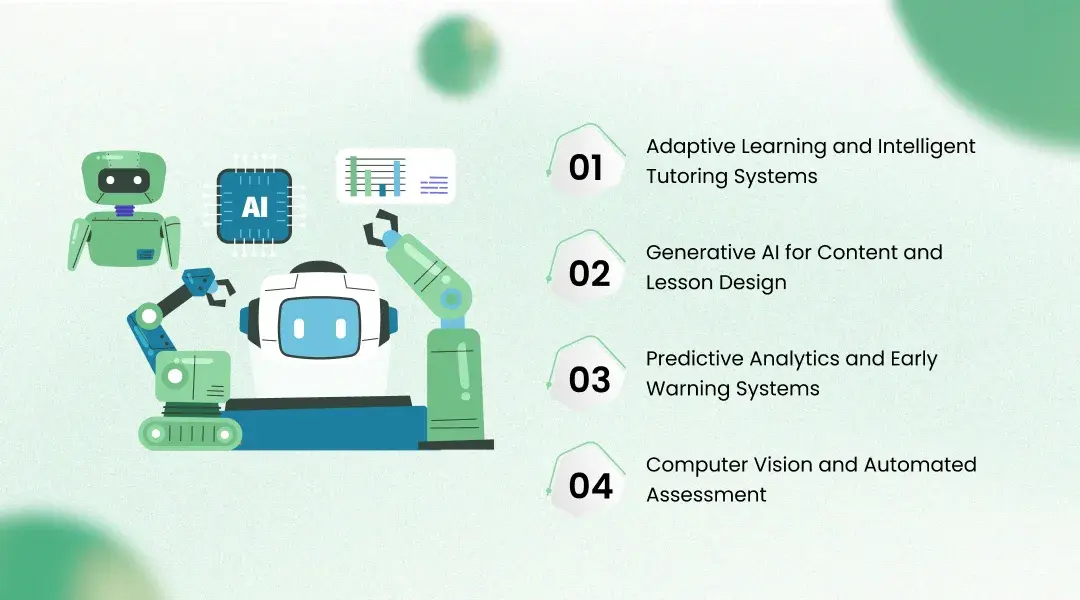
AI in education works by attacking the specific bottlenecks described above, not by replacing the teacher. The most useful way to understand it is to map each technology to a concrete problem. When you do that, the abstract word AI dissolves into a set of distinct tools with distinct jobs. KriraAI builds these systems for institutions by starting from the bottleneck, not the buzzword, which is how adoption avoids becoming expensive theatre.
The four technology families below cover the vast majority of real deployments today. Each one targets a problem that the previous section made painfully clear.
Adaptive Learning and Intelligent Tutoring Systems
Adaptive learning is the direct answer to Bloom's tutoring problem. These systems use machine learning to model what each student knows in real time. The platform then adjusts the next question, hint, or explanation to that exact level. A struggling student gets scaffolding, while an advanced one gets acceleration. This is personalized learning delivered continuously rather than during a rare one to one session.
Intelligent tutoring systems go a step further than simple branching quizzes. They infer why a student got something wrong, not just that they did. A maths engine can detect a recurring sign error versus a conceptual gap. That distinction changes the feedback the student receives next. The result is closer to a patient human tutor than to a textbook.
Generative AI for Content and Lesson Design
Generative AI in education has become the fastest spreading category by far. Teachers now use it to draft lesson plans, quizzes, and differentiated worksheets in minutes. A single prompt can produce a reading at three different complexity levels. This is where AI tools for teachers deliver the most immediate relief. The hours saved go back into actual instruction and student contact.
Generative models also power conversational study companions for students. A learner can ask a concept to be re explained as a story or an analogy. Used with guardrails, this extends help far beyond office hours. The risk of shallow answers is real, which is why curation matters. KriraAI typically grounds these assistants in approved curriculum content to prevent the model from inventing facts.
Predictive Analytics and Early Warning Systems
Predictive analytics is the least visible yet most institutionally valuable application. Universities and schools sit on years of attendance, grade, and engagement data. Machine learning can read those patterns to flag students at risk of dropping out. The system surfaces a warning weeks before a human would notice. That window lets an advisor intervene while intervention still helps.
These models do not predict destiny, and framing them that way is dangerous. They estimate probability so that scarce human attention goes where it counts. A counsellor with five hundred students cannot watch everyone closely. The model effectively hands them a prioritised list each morning. This is augmentation of judgement, not automation of it.
Computer Vision and Automated Assessment
Computer vision and natural language processing handle the grading bottleneck. NLP models can score short answers and essays against a rubric with growing reliability. Computer vision can digitise handwritten exam scripts for faster processing. Proctoring tools can flag anomalies during remote tests, though this area raises real privacy concerns. Used carefully, these tools return enormous amounts of teacher time to teaching.
The Quantified Business Impact
The case for AI in the education industry now rests on numbers, not promises. The market itself signals where institutional money is moving. Analysts project the AI in education market to grow past 30 billion dollars by 2030, expanding at a compound annual rate well above 30 percent. Capital does not flow at that velocity toward a fad. It follows demonstrated returns inside real institutions.
The operational gains are where the story becomes concrete. The figures below come from the patterns reported across early adopter deployments.
Teachers using AI tools for lesson planning and grading commonly report saving six to eight hours per week. That single change directly reduces the burnout driving attrition.
Adaptive learning platforms have shown measurable gains in test scores, with several studies reporting double digit percentage improvements in mastery rates.
Predictive early warning systems have helped some universities cut dropout rates by ten to twenty percent within two academic years.
Automated assessment can reduce essay grading turnaround from days to hours, which speeds the feedback loop students depend on.
Administrative chatbots routinely deflect a large share of routine enquiries, freeing front office staff during admissions season.
Why Speed of Feedback Drives the Returns
The biggest lever is faster feedback, and the reason is well established in learning science. Students learn fastest when correction arrives close to the mistake. Traditional grading delays that correction by days or weeks. AI compresses the loop to minutes in many tasks. That compression compounds across an entire term.
There is also a hard financial return that boards understand. Lower dropout rates directly protect tuition revenue and funding tied to completion. Reduced teacher attrition cuts recruitment and training costs. These savings often fund the AI investment within a single year. That payback profile is why pilots are turning into budget lines.
An Implementation Roadmap for Education Institutions
Adopting AI in education fails most often from poor sequencing, not bad technology. Institutions that rush to buy a flashy platform usually stall within months. The disciplined path moves through clear stages, and skipping stages is the classic mistake. KriraAI guides education clients through a staged rollout because measurable scale is impossible without it. The roadmap below reflects how successful deployments actually unfold.
Run a readiness and data audit first. Catalogue what student data exists, where it lives, and how clean it is. Most institutions discover their data is fragmented before they discover anything else.
Define one painful, measurable problem to solve. Pick something specific like essay grading time or first year dropout. A narrow target makes success and failure easy to judge.
Launch a small pilot with willing teachers. Choose a few departments rather than the whole institution at once. Volunteers give honest feedback and become internal advocates.
Measure against the baseline you captured in the audit. Compare hours saved or score gains to the pre pilot numbers. Without a baseline, you cannot prove anything to a board.
Train the humans before scaling the software. A tool no one trusts or understands sits unused. Adoption is a change management problem far more than a technical one.
Scale the proven use case across more departments. Expand only what the pilot actually validated. Resist the urge to bolt on unproven features during the rollout.
Common Mistakes and How to Avoid Them
The first mistake is buying technology before defining the problem. Leaders see a demo, feel pressure to act, and purchase a solution looking for a question. The fix is to write the problem statement before evaluating any vendor. A clear metric protects the budget from hype.
The second mistake is ignoring the teachers entirely. Tools imposed from the top without consultation are quietly abandoned. The classroom staff know which frictions actually hurt. Involving them early turns potential resistance into ownership. This is the single biggest predictor of whether a rollout survives its first year.
The third mistake is treating data privacy as an afterthought. Student data is sensitive and heavily regulated in most regions. Bolting on compliance late is expensive and sometimes impossible. Privacy by design must sit at the start of the roadmap, not the end.
The Challenges and Limitations Nobody Should Ignore
Honesty about the difficulties is what separates a real strategy from a sales pitch. The barriers below are serious and none of them are fully solved. Pretending otherwise sets institutions up for an expensive disappointment.
Data quality is the first and most underestimated wall. Most AI in education systems are only as good as the records feeding them. Many institutions hold messy, incomplete, or siloed student data. A predictive model trained on bad data produces confident nonsense. Cleaning that foundation is unglamorous but unavoidable.
Algorithmic bias is a deeper ethical risk in this sector specifically. A model trained on historical outcomes can absorb historical inequities. It might flag students from a particular background as high risk unfairly. That can become a self fulfilling prophecy if acted on blindly. KriraAI treats fairness auditing as a core build requirement, not an optional extra, because the cost of getting this wrong falls on children.
The Human and Regulatory Limits
The talent gap inside institutions is a quieter constraint. Schools rarely employ machine learning engineers or data scientists. They depend on vendors and partners to bridge that gap responsibly. Without internal understanding, institutions cannot evaluate what they are buying. This dependency is a real strategic vulnerability.
Regulation adds another layer that varies sharply by region. Data protection laws like the DPDP Act in India shape what is permissible. Rules around minors raise the bar even higher. Integration with legacy student information systems is also genuinely hard. None of these problems are reasons to avoid AI, but all of them are reasons to plan carefully.
The Future of AI in Education
Over the next three to five years, the role of AI in education will shift from tool to infrastructure. Personalized learning will stop being a premium feature and become a baseline expectation. Students will move through material on individual mastery paths rather than fixed calendars. The class will still meet, but the pace will quietly individualise underneath it. Teachers will spend far more time on mentorship and far less on logistics.
Generative AI in education will mature past today's clever but unreliable assistants. The next wave will be tightly grounded in verified curriculum sources. Hallucination, the headline risk of current tools, will fall sharply as a result. AI tutors will hold context across a full term, remembering each student's history. That continuity is what makes them feel genuinely personal.
The competitive landscape will split along a clear line. Institutions that treated AI as a strategic capability will pull ahead on outcomes and cost. Those that waited for perfect certainty will find themselves competing on price alone. The slow adopters will not be replaced by robots. They will be outcompeted by peers who learned to use the tools well. The risk was never moving too fast, it was standing still while the affordable tutoring problem finally got solved.
The Bottom Line on AI in Education
Three conclusions matter most from everything above. First, the value of AI in education comes from solving the affordable tutoring problem that Bloom identified four decades ago. Second, the returns are now measurable, from hours saved each week to double digit gains in mastery and retention. Third, success depends on disciplined implementation, honest attention to bias and privacy, and treating teachers as partners rather than obstacles.
This is precisely the work KriraAI does for institutions in the education industry. KriraAI builds practical, production grade AI systems that start from a real bottleneck and prove their value against a measured baseline. The focus is on solutions that are practical, measurable, and built to scale across departments, not flashy pilots that stall. If your institution is ready to move past the debate and adopt AI in education the right way, explore KriraAI's solutions or reach out to discuss where to begin. The tutoring problem finally has an affordable answer, and the institutions acting on that now are the ones who will define the next decade of learning.
FAQs
AI in education is used in four main ways across schools and universities right now. First, adaptive learning platforms personalise the pace and difficulty of material for each student. Second, generative AI helps teachers create lesson plans, quizzes, and differentiated worksheets in a fraction of the usual time. Third, predictive analytics scan student data to flag who is at risk of falling behind or dropping out. Fourth, natural language processing automates the grading of short answers and essays against a rubric. In practice these tools augment teachers rather than replace them, returning hours of administrative time back to actual instruction and student support.
No, AI will not replace teachers, and the evidence strongly supports this conclusion. The core value a teacher provides is human judgement, mentorship, motivation, and emotional support, none of which AI can authentically supply. What AI replaces is specific repetitive tasks, such as first pass grading, attendance logging, and routine lesson admin. By removing that workload, AI gives teachers more time for the relational work that actually drives learning. The realistic future is a teacher empowered by AI tools for teachers, not a classroom run by software. Institutions that frame AI as augmentation see far higher adoption and far better outcomes than those that frame it as substitution.
The main benefits of AI in education are personalised pacing, time savings, and earlier intervention. Personalized learning lets each student progress at their own mastery level instead of a fixed class pace, which research links to meaningful score gains. Teachers commonly save six to eight hours a week once AI handles grading and lesson preparation. Predictive systems identify struggling students weeks earlier than a human could, which has helped some institutions reduce dropout rates by ten to twenty percent. Administrative chatbots also handle routine enquiries at scale. Together these benefits improve outcomes while easing the cost and workload pressures that strain the education industry.
AI is good or bad for students depending almost entirely on how it is implemented, not on the technology itself. Used well, it provides patient, personalised support that an overstretched teacher cannot always offer, and it gives faster feedback that accelerates learning. Used poorly, it can encourage shallow shortcuts, expose sensitive student data, or embed unfair bias from flawed training data. The deciding factors are curriculum grounding, privacy by design, and clear academic integrity rules. When an institution sets those guardrails first, AI becomes a genuine learning aid. The technology is a tool, and the surrounding policy determines whether students benefit or suffer.
In the next five years, AI in education will move from an add on tool to core infrastructure inside most institutions. Personalized learning paths will become a baseline expectation rather than a premium offering. Generative AI tutors will be tightly grounded in verified curriculum, sharply reducing today's accuracy problems, and they will remember each student's history across a full term. Teachers will shift toward mentorship as routine admin gets automated. The competitive gap will widen between institutions that adopted AI strategically and those that delayed. The slow movers will not vanish overnight, but they will steadily lose ground on both student outcomes and operating cost.
Founder & CEO
Divyang Mandani is the CEO of KriraAI, driving innovative AI and IT solutions with a focus on transformative technology, ethical AI, and impactful digital strategies for businesses worldwide.