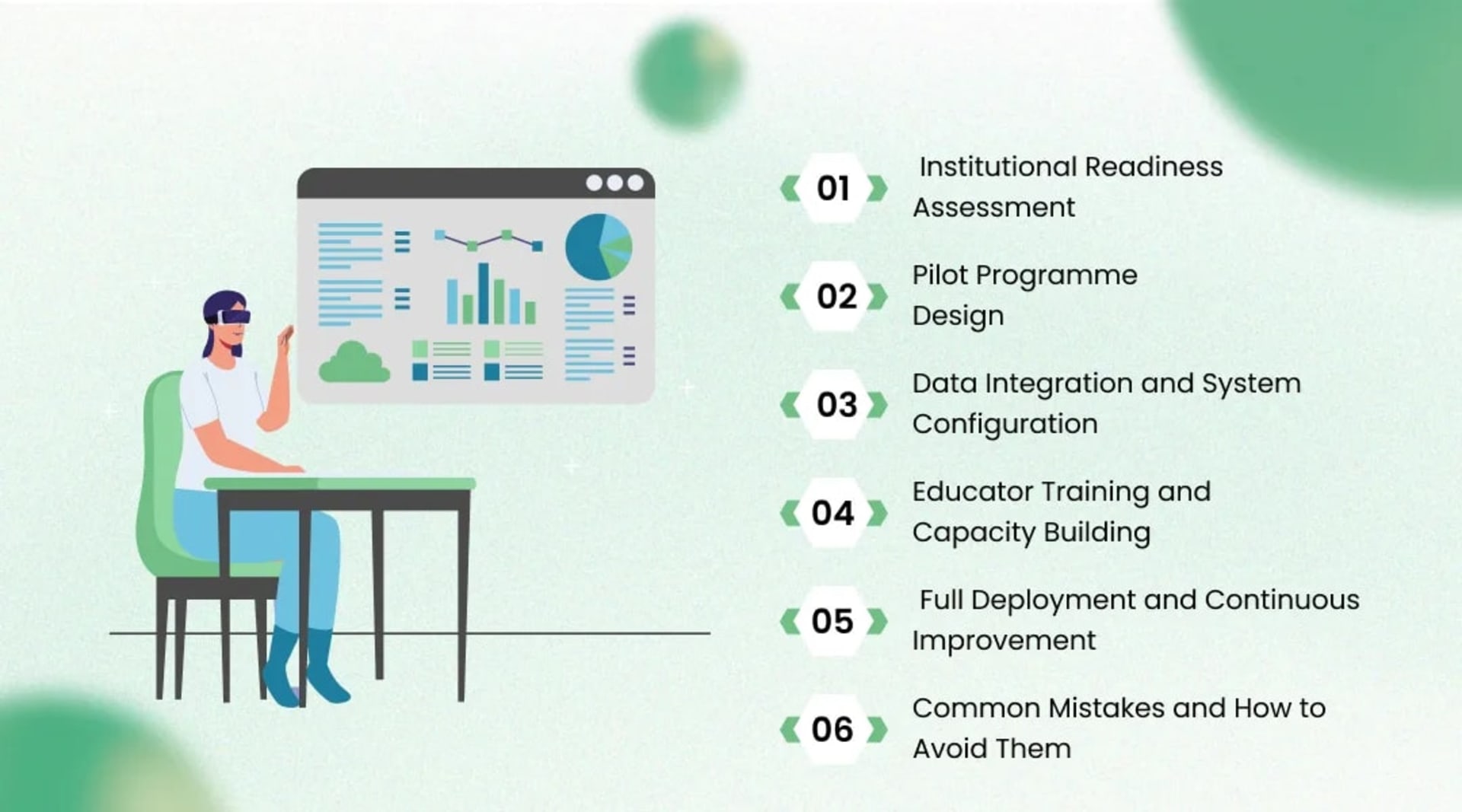
AI in education is not a future-facing promise, it is an operational reality reshaping how more than 1.5 billion students worldwide learn, how teachers instruct, and how institutions compete for enrollment and funding. According to HolonIQ, the global AI in education market was valued at approximately $4 billion in 2022 and is projected to surpass $30 billion by 2032, representing a compound annual growth rate of over 22 percent. That is not a marginal technology trend. That is a structural transformation happening inside every classroom, every learning management system, and every admissions office on the planet.
What makes this moment different from previous waves of EdTech enthusiasm is precision. Earlier digital tools - video lectures, PDF course packs, online quizzes, digitised the existing model without changing it. AI changes the underlying logic of instruction itself. It enables systems that learn about the learner, adapt in real time, and surface insights that no human teacher could generate at scale across a cohort of hundreds or thousands of students simultaneously.
This blog will cover the current state of the education industry and its structural inefficiencies, the specific AI technologies being applied to solve real pedagogical and operational problems, the measurable business and learning impact companies and institutions are already achieving, a practical implementation roadmap for education leaders, the honest challenges that AI adoption brings, and where the competitive landscape is heading over the next three to five years.
The education sector is one of the oldest institutions in human civilisation, and in many ways its core delivery model has not changed substantially since the 19th century. A teacher stands before a class, delivers content at a fixed pace, assesses all students with identical instruments, and moves on regardless of who understood and who did not. This is not a criticism of educators — it is a recognition of a structural constraint. A single teacher managing thirty students cannot practically differentiate instruction thirty different ways simultaneously.
The financial pressure facing educational institutions has intensified sharply. In higher education, enrolment in the United States has declined by more than 1.3 million students since 2020, according to the National Student Clearinghouse Research Center. Institutions are competing aggressively for a shrinking pool of traditional-age students while simultaneously trying to attract non-traditional learners, international students, and working professionals. This has driven up marketing and recruitment costs at the same time that operational budgets are being cut.
At the K-12 level, the picture is equally challenging. Teacher attrition rates are at multi-decade highs across the United Kingdom, Australia, and much of North America. Classrooms in under-resourced districts are being taught by teachers who are out-of-field — meaning they are instructing subjects they were not trained in. In the United States, the Learning Policy Institute estimates that nearly one in four secondary students is taught by an out-of-field teacher in at least one core subject. The consequences for learning outcomes are measurable and serious.
Learning loss from the COVID-19 pandemic compounded pre-existing inequities in ways that standardised curricula cannot address. Studies from McKinsey indicate that students in lower-income communities fell behind by an average of five additional months in mathematics compared to their higher-income peers during the pandemic period. Closing that gap through conventional instruction alone — adding tutoring hours, reducing class sizes, extending school years — is prohibitively expensive and logistically impossible for most systems to sustain.
Corporate training and professional development face a parallel set of inefficiencies. The average organisation spends roughly $1,200 per employee per year on training, according to the Association for Talent Development, yet studies consistently show that learners retain less than 10 percent of training content within one week unless it is reinforced through spaced repetition and contextualised application. The mismatch between investment and retention is a systemic failure that conventional instructional design cannot resolve without enormous additional cost.
The common thread across all of these challenges is scale. Education has always struggled with the tension between quality and scale. High-quality instruction is expensive and relationship-dependent. Mass instruction is cheap but shallow. This is precisely the problem that artificial intelligence is structurally positioned to solve.
AI in education is not a single technology. It is a constellation of machine learning, natural language processing, computer vision, predictive analytics, and generative AI being applied to specific, well-defined problems across the instructional and operational lifecycle of educational institutions.
The most consequential application of AI in education is the personalised learning AI engine — a system that continuously models each student's knowledge state, learning velocity, error patterns, and engagement signals to dynamically adjust the difficulty, format, and sequence of instructional content. Companies like Knewton, Carnegie Learning, and DreamBox have built these systems at scale. The underlying technology is Bayesian knowledge tracing combined with reinforcement learning, which allows the platform to make probabilistic assessments of what a student knows, what they are ready to learn next, and what instructional format — visual, worked example, practice problem, or conceptual explanation — is most likely to produce durable understanding for that individual.
The practical result of AI-powered adaptive learning is that a student who demonstrates mastery of a prerequisite concept advances immediately, while a student who is struggling receives targeted remediation before moving forward. This breaks the industrial-era assumption that all students in a cohort are at the same point at the same time — which is almost never true.
Natural language processing is transforming both formative feedback and high-stakes assessment. Automated essay scoring systems now operate at the level of trained human raters on many dimensions of writing quality, including coherence, argument structure, vocabulary range, and grammatical accuracy. Tools like Turnitin's Revision Assistant and ETS's e-rater have been in deployment for years, but the arrival of large language models has dramatically expanded what is possible. Students can now receive paragraph-level feedback within seconds of submission — not a grade, but specific, actionable guidance that mirrors what an expert writing instructor would provide.
For language learning specifically, NLP-powered conversational practice tools allow students to have extended spoken or written interactions in a target language with real-time error correction and pronunciation feedback. This addresses one of the core bottlenecks in language acquisition, which is the lack of sufficient practice opportunities with a fluent interlocutor.
Artificial intelligence in higher education is proving its value as a retention and early intervention tool. Institutions including Georgia State University and Arizona State University have deployed predictive analytics platforms that ingest data from learning management systems, attendance records, financial aid status, and academic history to generate at-risk scores for individual students. When a student's score crosses a defined threshold, an advisor is automatically alerted to make proactive contact.
Georgia State University, which used to lose roughly 20 percent of students who stopped out for financial reasons, reduced summer melt by 22 percent after deploying an AI-driven financial aid nudging system. That is a measurable, institution-level impact on both student outcomes and revenue.
Generative AI is accelerating the production of learning materials at a rate that would have been unimaginable three years ago. Instructional designers at corporate training departments are using large language models to draft course outlines, generate practice scenarios, produce assessment items, and localise content for different audience levels — tasks that previously took weeks now take hours. This does not eliminate the role of the instructional designer; it elevates it. Designers spend less time on content production and more time on learning architecture, assessment validity, and learner experience design.
Computer vision is a less-discussed but rapidly advancing application in physical classrooms. Engagement detection systems — which analyse facial expression, posture, and gaze direction to infer attention and confusion states — are being piloted in several Asian markets, particularly China and South Korea, as classroom management and instructional feedback tools. While these applications raise legitimate ethical questions, they also represent a frontier where AI is extending beyond the screen into the physical environment of learning.
The business case for AI in education is no longer theoretical. Across K-12, higher education, and corporate learning, organisations that have made deliberate, well-structured AI investments are reporting results that justify the capital and change management costs involved.
Adaptive learning platforms in mathematics instruction have demonstrated particularly strong outcomes. A 2022 meta-analysis published in the Review of Educational Research examined 34 randomised controlled trials of AI-powered adaptive learning systems and found an average effect size of 0.31 standard deviations on mathematics achievement — equivalent to roughly two to three additional months of learning in a school year. For a school district serving 50,000 students, that represents an enormous aggregate improvement in human capital development.
In corporate learning, the return on investment calculations are more direct. IBM reported that its AI-powered learning platform reduced training time by approximately 40 percent while improving learner performance scores by 10 percent. That combination — less time and better outcomes — is the productivity equation that makes CFOs willing to fund EdTech investments.
Cost reduction is another area where the numbers are compelling. Automated grading and assessment tools reduce teacher workload on evaluation tasks by an average of 30 to 50 percent, according to studies from the RAND Corporation. For institutions that are managing teacher shortages, this is not a marginal efficiency gain — it is a structural response to a workforce crisis. Time saved on grading is time that can be redirected toward relationship-building, small-group instruction, and the high-cognition work that only humans can do.
Student retention improvements have a direct financial value that institutions can calculate precisely. In higher education, the average annual tuition revenue per student in the United States is approximately $9,700. Retaining one additional student for a four-year programme is worth roughly $38,800 in tuition revenue before any accommodation or ancillary spending is accounted for. Predictive analytics platforms that improve retention rates by even two percentage points generate returns that far exceed their implementation costs at any institution with more than 5,000 enrolments.
Enrolment marketing and admissions is another area where AI-powered personalisation is generating measurable lift. Chatbot-driven admissions communication platforms — which respond to prospective student inquiries 24 hours a day, personalise follow-up sequences based on inquiry type, and route complex questions to human counsellors — have been shown to increase application completion rates by 15 to 25 percent at institutions that have deployed them thoughtfully. Georgia State's Pounce chatbot is one of the most cited examples, having handled over 200,000 student messages and demonstrating a statistically significant improvement in enrolled student yield.
Companies like KriraAI, which builds practical AI solutions for enterprise and institutional clients, have worked across education verticals to help organisations move from isolated AI pilots to integrated systems that deliver this kind of compounding value. The distinction KriraAI consistently emphasises is between AI tools that improve individual experiences and AI architecture that improves institutional performance — and in education, both matter.
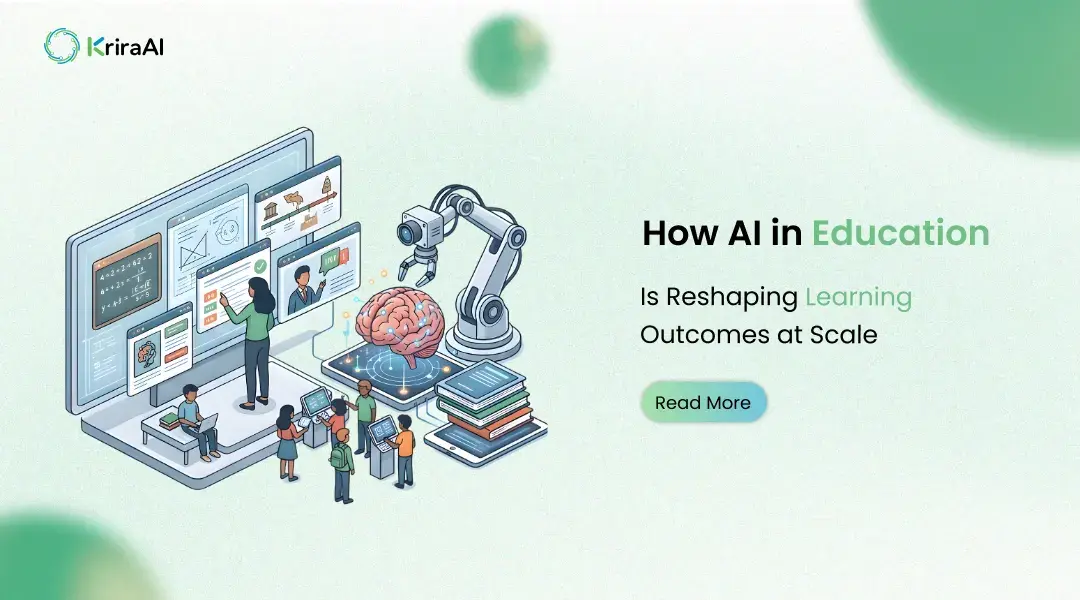
Implementing AI in education successfully requires a structured approach that accounts for institutional readiness, data infrastructure, educator capacity, and change management. The organisations that fail at AI adoption typically skip one or more of these foundational stages.
Before any AI platform is selected or purchased, an institution needs to conduct an honest audit of its data infrastructure. Most learning management systems collect enormous amounts of data — click streams, time on task, assessment results, communication logs — but that data is rarely clean, consistently structured, or centrally accessible. An AI system is only as good as the data it is trained on or operates against. Institutions should inventory their data assets, identify gaps, and establish data governance policies before signing a vendor contract.
This stage should also include a stakeholder mapping exercise. Faculty and instructional staff are the most important change agents in any educational AI deployment. If they are not included in the selection and design process, adoption rates will be low regardless of how good the technology is.
The most effective AI implementations in education begin with a focused, bounded pilot in one subject area, one department, or one programme. The pilot should have a defined hypothesis — for example, "students using the adaptive platform will score higher on end-of-unit assessments than the control group" — and a measurement plan that was established before the pilot began, not after results are visible.
Pilot duration matters. Most learning interventions require at least one full academic term to show meaningful results. Pilots that are terminated after six weeks are unlikely to generate valid data because the system has not had time to personalise its models to individual learners.
Once a pilot has demonstrated positive results, the next stage involves integrating the AI system with existing institutional infrastructure — the student information system, the learning management system, the library system, and wherever possible, financial aid and advising platforms. This integration is where most implementations run into delays, because legacy systems in higher education are often decades old and were not designed with API interoperability in mind.
AI tools do not replace educator judgment — they inform it. Teachers and instructors need structured training not just on how to operate the platform, but on how to interpret AI-generated insights and translate them into instructional decisions. An alert that flags a student as at-risk is only valuable if the educator who receives it knows what to do next.
Full deployment should be accompanied by a continuous improvement cycle — quarterly reviews of key metrics, regular feedback loops with educators and students, and a willingness to adjust configuration parameters as the system learns and as institutional needs evolve.
Purchasing AI tools before establishing data governance: This is the single most common and costly error. Institutions should spend at least 60 days on data readiness before evaluating vendors.
Treating AI implementation as an IT project rather than a pedagogical one: Technology deployment without instructional design integration produces systems that are used once and abandoned.
Setting unrealistic timelines: Most full-scale AI deployments in education require 18 to 24 months from pilot to institution-wide operation. Planning for 6 months leads to shortcuts that undermine long-term value.
Neglecting student privacy and consent frameworks: FERPA in the United States, GDPR in Europe, and equivalent frameworks in other jurisdictions create specific obligations around how student data can be used for AI training and inference. These must be designed into the system from the beginning, not retrofitted.
KriraAI's enterprise AI implementation methodology includes a dedicated readiness assessment phase that helps education clients identify these risks before they become expensive problems — a step that consistently reduces implementation timelines and improves adoption rates across client deployments.
Honest assessment of AI in education requires acknowledging that the technology introduces as many complications as it resolves. Leaders who enter AI implementations with unrealistic expectations are more likely to declare failure prematurely or, worse, to deploy systems that cause harm through bias or misuse.
Data quality is the foundational challenge. Educational institutions — particularly those that have operated for decades — have data spread across incompatible systems, recorded in inconsistent formats, and riddled with missing values. AI systems trained or operating on this data will produce unreliable outputs. Garbage in, garbage out is not a metaphor in this context; it is a precise description of what happens when a predictive analytics model is built on incomplete attendance records or incorrectly coded assessment results.
Algorithmic bias is a serious and documented concern in EdTech AI. Several studies, including notable work from researchers at Carnegie Mellon University, have shown that automated essay scoring systems perform with lower accuracy for non-native English speakers, students from low-income backgrounds, and students who write in non-dominant rhetorical styles. Predictive at-risk models have been shown to correlate race and socioeconomic status with risk scores in ways that can cause advisors to over-surveil minority students and under-resource majority students who are quietly struggling. These are not hypothetical harms — they are real ones that have occurred in deployed systems.
The talent gap in educational AI is acute. Institutions need people who understand both data science and education — a rare combination. Most universities do not have a chief data officer, let alone a team of machine learning engineers who understand instructional design. This means that most institutions are dependent on vendors for technical expertise, which creates concentration risk and limits institutional capacity to evaluate AI outputs critically.
Regulatory constraints are becoming more complex, not less. The European Union's AI Act, which came into force in 2024, classifies certain AI applications in education — including AI systems used for student assessment, selection, or placement — as high-risk, requiring conformity assessments, human oversight mechanisms, and transparency documentation. Institutions operating in multiple jurisdictions must navigate a patchwork of requirements that continues to evolve.
Change management deserves more attention than it typically receives in AI implementation discussions. Faculty resistance to AI tools is often characterised as technophobia, but in many cases it reflects legitimate concerns about academic integrity, pedagogical autonomy, and the risk that AI-mediated instruction will reduce the relational quality of education that research consistently identifies as the strongest predictor of student persistence and wellbeing.
The trajectory of AI in education over the next three to five years will be defined by three converging forces: increasing model capability, decreasing cost of inference, and growing institutional data maturity. Together, these forces will make possible things that are currently out of reach.
Truly conversational AI tutors — capable of sustaining a Socratic dialogue across an entire curriculum, adjusting their pedagogical approach based on student emotional state and prior misconception patterns — are approximately two to three years away from being deployable at meaningful quality levels. The current generation of large language model-based tutors is impressive but inconsistent. Within three years, consistency and subject-area depth will be sufficient for these systems to function as reliable supplementary instructors across most STEM subjects at the secondary and introductory higher education levels.
Credential verification and AI-assessed competency frameworks will begin to replace traditional examination formats in specific professional and vocational contexts. Rather than sitting a three-hour written exam, a learner will complete a series of AI-evaluated performance tasks that assess competency across multiple dimensions in a dynamic, adaptive format. This will not eliminate examinations, but it will erode the monopoly that point-in-time testing currently holds over credentialing.
The competitive landscape in higher education will stratify sharply. Institutions that have invested in AI-powered student success infrastructure - predictive advising, adaptive learning pathways, intelligent scheduling and intervention systems - will be able to demonstrate materially better graduation rates, time-to-degree metrics, and post-graduation employment outcomes than institutions that have not. In a market where prospective students are making $100,000-plus financial decisions based on outcomes data, that differentiation will drive enrollment in one direction and away from the other.
Institutions that delay AI adoption beyond 2027 will face a structural disadvantage that will be very difficult to close. The first-mover advantage in AI is not the technology itself, which is accessible to all institutions at increasingly affordable price points. The advantage is data. Institutions that begin collecting structured learning data now will have training sets in 2028 that late adopters cannot replicate quickly. This is the argument that companies like KriraAI — which helps enterprises and educational institutions build AI infrastructure designed for long-term data compounding, not just short-term feature deployment — make to education leaders who are still in a wait-and-see posture.
Corporate and continuing education will be fully transformed within five years. The corporate learning and development function as it currently exists — periodic workshops, static e-learning modules, annual compliance training — will be replaced by continuous, AI-orchestrated learning pathways that are embedded in workflow, personalised to role and career stage, and measured against business performance metrics rather than completion rates.
Three points from this analysis are worth carrying forward. First, the structural challenges facing educational institutions - rising costs, declining enrolments, teacher shortages, persistent learning gaps - are not temporary disruptions but systemic pressures that conventional approaches cannot resolve at the required scale. Second, AI is not a single solution but a toolkit of specific technologies that, when mapped to specific problems with appropriate data infrastructure and change management, deliver measurable and compounding returns in both learning outcomes and institutional performance. Third, the competitive advantage of early AI adoption in education is not primarily technological - it is the data asset that accumulates over time, which means the window for building a defensible position is open now and will begin to close within the next two to three years.
For education leaders who understand these dynamics and are ready to move from strategic awareness to operational action, the critical next step is finding implementation partners who understand both the technical complexity of AI deployment and the institutional realities of education. KriraAI builds practical AI solutions for enterprises and educational institutions - not off-the-shelf tools, but architected systems designed to integrate with existing infrastructure, improve over time as data accumulates, and deliver outcomes that are measurable from the first semester of deployment. KriraAI's work in education has consistently focused on the gap between AI capability and institutional readiness, helping clients build the data foundations, governance frameworks, and educator capacity that make the difference between an AI investment that transforms an institution and one that becomes an expensive shelf product.
If your institution or organisation is ready to have a specific, honest conversation about where AI can deliver the most value in your context, we invite you to reach out to the KriraAI team and explore what a tailored AI strategy would look like for your goals.
AI in education refers to the application of machine learning, natural language processing, predictive analytics, and generative AI to automate, personalise, and improve teaching, learning, and institutional operations. In practice, this means systems that track individual student progress in real time and adjust the difficulty or format of instructional content accordingly, platforms that generate and score assessments automatically, tools that predict which students are at risk of dropping out before they show visible signs of struggling, and administrative systems that streamline scheduling, advising, and enrolment management. These systems work by ingesting data from learning management systems, student information systems, and other institutional sources, then applying statistical and machine learning models to generate predictions or personalised outputs. The most effective implementations combine AI insights with human educator judgment rather than replacing one with the other.
Personalised learning AI improves student outcomes by solving the core inefficiency of conventional instruction: the assumption that all students in a cohort learn at the same pace and in the same way. When an AI engine continuously models each student's knowledge state — tracking which concepts they have mastered, which they are struggling with, and what learning patterns produce the best retention for them individually — it can present content, practice problems, and feedback in formats and at levels calibrated to that specific student. Research evidence supports this approach: a 2022 meta-analysis of 34 randomised controlled trials found that adaptive learning systems produced an average improvement equivalent to two to three additional months of learning in a school year compared to conventional instruction. The mechanism is not magic — it is the application of individualised instruction, which master teachers have always provided in small-group settings, at a scale that was previously impossible without AI.
The biggest challenges of implementing AI in higher education are data infrastructure readiness, faculty and staff adoption, algorithmic bias, regulatory compliance, and talent availability. Most universities have decades of student data distributed across incompatible legacy systems, which makes it difficult to build the clean, integrated data pipelines that AI systems require. Faculty resistance is common and often reflects legitimate concerns about pedagogical autonomy and academic integrity rather than simple technophobia, which means change management requires genuine engagement with instructional staff rather than top-down mandates. Algorithmic bias in AI assessment and at-risk identification tools has been documented across multiple deployed systems and requires ongoing auditing to prevent disproportionate impact on minority or non-traditional learner populations. Regulatory frameworks, particularly the EU AI Act for institutions operating in European markets, add compliance layers that require institutional legal and technical resources. Finally, very few institutions have staff with the combined data science and educational expertise needed to evaluate AI tools critically and configure them effectively for specific instructional contexts.
AI EdTech implementation costs vary significantly depending on the scope of deployment, the existing state of institutional data infrastructure, and whether the institution is purchasing commercial platforms or building custom systems. For a mid-size higher education institution deploying a commercial predictive analytics and student success platform, total first-year costs including licensing, integration, staff training, and change management typically range from $150,000 to $500,000. Adaptive learning platform deployments for a single department or subject area can range from $50,000 to $200,000 annually at enterprise licensing rates. Custom AI system development - which is relevant for large systems with unique data architectures or specialised instructional requirements - requires larger investments but produces systems that are integrated more deeply with institutional workflows and generate superior long-term data assets. The most important cost consideration is not the licensing fee but the total cost of adoption, which includes the staff time required for implementation, training, and ongoing administration, as well as the cost of data remediation if the institution's existing data infrastructure requires significant cleaning or restructuring before AI systems can operate reliably.
AI will not replace teachers and educators in any meaningful time horizon, but it will substantially change what teachers do and which skills define teaching excellence. The evidence from every field where AI has been deployed at scale is that automation replaces tasks, not roles, and that the tasks most resistant to automation are those requiring deep relationship knowledge, emotional responsiveness, ethical judgment, and creative improvisation — which are precisely the tasks that define the most important dimensions of teaching. What AI will eliminate are the high-volume, low-cognition tasks that currently consume enormous amounts of educator time: grading routine assessments, tracking completion metrics, generating standard reports, identifying students who may need support. As these tasks are automated, the professional identity of teaching will shift toward mentorship, facilitation, curriculum architecture, and relationship-based coaching — dimensions that AI can inform but cannot replace. This transition will require significant investment in professional development and a redesign of teacher training programmes to emphasise the distinctly human competencies that will define teaching value in an AI-integrated education system.
Founder & CEO
Divyang Mandani is the CEO of KriraAI, driving innovative AI and IT solutions with a focus on transformative technology, ethical AI, and impactful digital strategies for businesses worldwide.