Data scientists spend up to 80 percent of their working time on cleaning and preparing data. Only the remaining fraction goes to the modeling that actually creates value. This single imbalance explains why AI in data science services has become unavoidable. Projects run slow, budgets bloat, and the rare skilled analyst burns out on repetitive work. Enterprises can no longer treat analytics as a craft built by hand on every engagement. Competitors using automation now ship insights in days that once took months. They price work lower because their delivery costs are structurally smaller. Falling behind here means losing both margin and speed at the same time. This blog examines why data science work is so expensive and slow today. It then maps the specific AI technologies that compress that cost and time. It quantifies the measurable savings real teams report, and walks through a practical adoption roadmap. Finally, it covers the honest limitations and where the field is heading next.
Data science services sit under constant pressure to deliver faster for less money. Clients expect insights in weeks, not the quarters that earlier projects consumed. Yet the underlying work remains stubbornly manual at most firms. Skilled analysts spend their days wrangling messy spreadsheets and reconciling broken data sources. The economics of this model are quietly breaking down.
The core problem is that data science is labor heavy and talent scarce. A single project may need a data engineer, an analyst, and a domain expert. Each of these roles is expensive and difficult to hire. When demand spikes, firms cannot simply add capacity overnight. This bottleneck caps how many engagements a team can run at once.
Cost pressure makes the math even harder. Clients increasingly question why analytics costs so much for results they cannot always use. Many delivered reports end up ignored because they arrive too late to matter. The value of an insight decays quickly once the business moment passes. Slow delivery therefore destroys value even when the analysis is technically sound.
The hidden cost of data science is the time lost before any modeling begins. Teams spend the majority of a project simply finding, cleaning, and joining data. This work is invisible to clients but consumes most of the budget. It is repetitive, error prone, and rarely reused across projects. Every new engagement seems to start the same painful cleanup from scratch.
Talent bottlenecks slow data analytics services more than any technical limit. Senior data scientists are expensive and in short supply globally. They often get pulled into routine tasks that junior tools could handle. This misuse of rare skill is a major source of delay. The result is long queues, missed deadlines, and rising delivery costs across the firm.
[IMAGE PLACEHOLDER: chart showing how data science project time splits between preparation, modeling, and delivery]
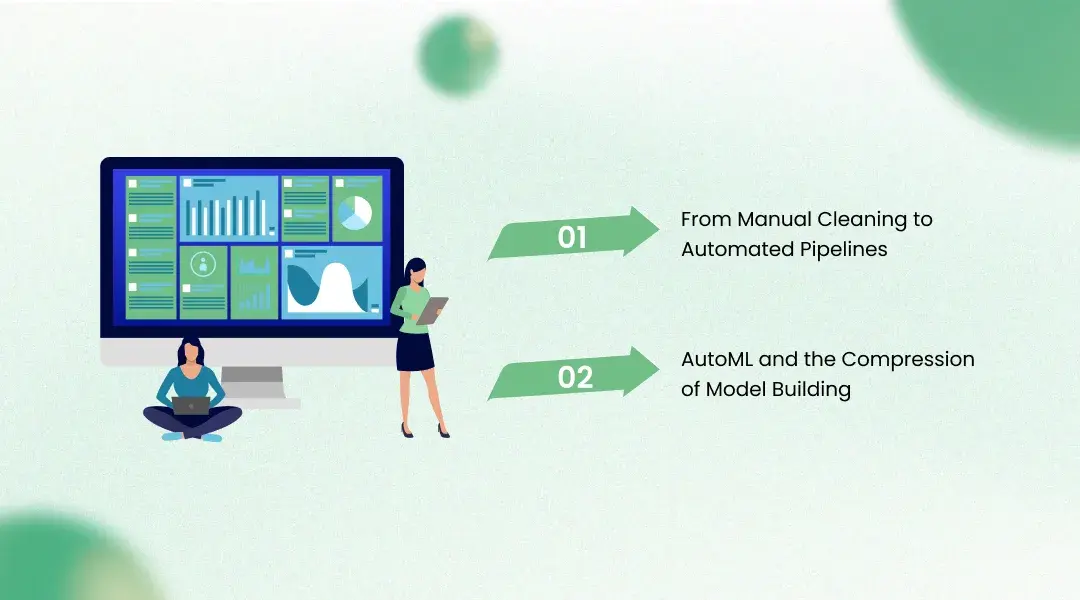
AI in data science services attacks the exact bottlenecks that make the work slow and costly. The shift is not about replacing analysts with magic. It is about automating the repetitive layers so skilled people focus on judgment. Several distinct technologies map directly to the problems described above. Each one targets a specific source of cost or delay.
The first is automated machine learning, often called AutoML. These systems test many model types and settings without a human tuning each by hand. They handle feature selection, model choice, and hyperparameter search automatically. A task that once took a senior analyst weeks now runs in hours. This directly compresses the most expensive part of any modeling project.
The second is generative AI applied to code and analysis. Large language models now write data cleaning scripts and exploratory queries on request. An analyst can describe a transformation in plain language and receive working code. This collapses the tedious scripting work that eats into project timelines. KriraAI builds these assisted analytics workflows so that client teams move from question to result far faster.
The biggest transformation is in data preparation, where most time is lost. Machine learning models can now detect anomalies, fill gaps, and flag inconsistent records automatically. Pattern based tools identify duplicate entries and mismatched formats without manual rules. This is the heart of data science automation as a discipline. It turns the dreaded cleanup phase from weeks into a supervised, rapid process.
Automated pipelines also make the work repeatable across many projects. A cleaning routine built once can run on new data with little change. Validation checks catch errors before they reach the model. This reliability is what lets a small team handle far more engagements. The reuse of pipelines is a quiet but powerful cost reducer.
Automated machine learning compresses the modeling stage from weeks to a single day in many cases. Instead of an analyst trying ideas one at a time, the system explores many in parallel. It ranks candidate models by accuracy and other metrics automatically. The human role shifts from builder to reviewer of strong options. This is the most direct example of how AI in data science services saves both time and money.
Beyond modeling, several named applications are now common in mature firms. Natural language interfaces let business users ask questions of data directly. Computer vision automates the reading of documents, images, and scanned forms. Predictive analytics forecasts demand, churn, and risk with steadily improving accuracy. Each application maps to a concrete business problem rather than an abstract promise. Together they form the modern toolkit behind effective data science consulting.
AI in data science earns its budget only when results show up in time and money. Vague claims about efficiency do not survive a finance review. The firms winning here track precise gains against a clear baseline. The figures below reflect what mature programs commonly report.
Automated data preparation tools cut cleaning time by 60 to 70 percent on typical projects. Work that once filled three weeks can shrink to a few days. This single change frees the largest block of wasted hours in any engagement. Faster preparation means projects start delivering insight far sooner. The compounding effect across many projects is enormous.
Automated machine learning delivers some of the clearest speed gains available. Model development cycles often shrink by 50 to 80 percent once AutoML is adopted. A senior analyst who built three models a month can now oversee far more. This raises the output of a fixed team without new hires. The cost per delivered model drops sharply as a direct result.
The financial impact stacks across the whole delivery chain. Firms applying data science automation commonly report 30 to 50 percent lower project costs. Some reduce time to first insight from several weeks to under one week. Faster delivery lets them take on more clients with the same staff. Higher throughput on a fixed cost base is the core profit driver.
Accuracy and reliability improvements add value beyond raw speed. Automated validation catches errors that manual review often misses under deadline pressure. Models retrained automatically stay accurate as data shifts over time. This reduces the costly rework that quietly inflates traditional project budgets. KriraAI focuses precisely on these measurable outcomes rather than on flashy demonstrations. The goal is always a result the client can defend in a budget meeting.
A successful adoption follows stages, not a single dramatic leap. Skipping stages is the most common reason expensive efforts collapse. The roadmap below reflects how disciplined firms actually move. Each phase produces a decision point where leaders can stop or continue.
The adoption sequence works best across five clear phases.
Start with an honest audit of where your team spends its hours and budget. This reveals which repetitive tasks are ripe for automation first.
Choose one high volume, repetitive workflow to automate before touching anything complex. Data cleaning is usually the highest value first target.
Run a contained pilot that proves the automation works on real, messy client data. Measure time saved against the previous manual baseline.
Build reusable pipelines and assisted workflows once the pilot shows clear gains. Reuse is where the lasting cost savings actually accumulate.
Scale across teams and clients while keeping humans in the review loop. Automation should accelerate experts, never replace their final judgment.
This sequence keeps risk small while learning compounds steadily. Each phase delivers a visible result that builds internal trust. That trust is what unlocks budget and buy in for the next stage. Programs that rush straight to ambitious tools usually stall and lose support.
The foundation matters more than the tool you eventually choose. Many firms buy an expensive platform before fixing their messy data sources. The platform then sits unused because the underlying data is unreliable. A practical start is standardizing how data is stored and accessed. This unglamorous groundwork makes every later automation far more effective.
A strong foundation also includes clear ownership of data quality. Someone must be accountable for the accuracy of source data feeding the models. Without this, automated pipelines simply produce wrong answers faster. Good data science consulting always begins with this honest readiness check. The tooling decision should come only after the foundation is solid.
The first common mistake is automating a broken process instead of fixing it. Automation speeds up whatever exists, including the flaws. The fix is to simplify and correct the workflow before adding any AI. A clean manual process is the right starting point for automation.
The second mistake is removing human review too early in the journey. Teams trust automated output before they have verified its reliability. This leads to confident but wrong conclusions reaching clients. The fix is keeping experts in the loop until the system proves itself. KriraAI designs every automation with built in review and validation steps for exactly this reason.
The third mistake is chasing tools without measuring results. Firms adopt platforms and never check whether costs actually fell. The fix is defining baseline metrics for time and cost before you start. Without measurement, you cannot prove the value of any change you make.
Adopting AI in data science services is genuinely hard, and pretending otherwise helps no one. Data quality remains the single most underestimated obstacle. Automated tools amplify whatever flaws exist in the source data. Garbage in still produces garbage out, only much faster. No algorithm rescues a project built on broken or biased inputs.
Talent and trust are the second persistent constraint. Skilled analysts sometimes resist automation that appears to threaten their role. They may distrust outputs they did not build by hand themselves. This human resistance can quietly stall an otherwise sound program. Adoption succeeds only when people see automation as a help, not a threat.
Integration and governance add further friction. Many data science tools must connect to messy, aging internal systems. This integration often takes longer than the analytics work itself. Regulated industries also face strict rules on how data is used and explained. A model decision may need to be auditable and compliant with data protection law. These constraints are normal operating conditions, not rare edge cases.
There are also genuine limits to what automation can decide. AI can suggest models and clean data, but it cannot frame the right business question. It cannot judge whether an insight matters to a specific client strategy. That framing remains stubbornly human and deeply valuable. The honest view is that automation handles the labor, while people handle the meaning.
The next three to five years will widen the gap between fast firms and slow ones. The advantage will not come from owning the best single algorithm. It will come from how completely a firm automates its routine delivery work. Most modeling will become a largely automated, supervised process. The differentiator becomes the quality of questions and the trust of clients.
Expect natural language to become the main interface for analytics. Business users will ask questions directly and receive answers without an analyst in between. This will push routine reporting almost entirely toward automation. Skilled data scientists will move up the value chain toward strategy and design. Their time will shift from building to interpreting and advising.
Autonomous pipelines will also become standard rather than aspirational. Systems will ingest, clean, model, and refresh insights with minimal human input. This closes the loop that currently demands constant manual effort. Firms that build this capability now will operate at structurally lower cost. Those that do not will keep paying for slow, manual labor.
The firms left behind will share a common trait. They will have treated automation as an occasional experiment rather than a foundation. They will lack the pipelines, standards, and trust to compound their gains. Meanwhile, disciplined competitors will deliver faster and cheaper every quarter. The widening distance between these two groups will become impossible to close late.
Three points define success with AI in data science services, and they are worth holding onto. First, most cost and delay lives in data preparation, which automation can compress dramatically. Second, the real gains come from automating repetitive labor while keeping skilled people on judgment. Third, measurable savings arrive only through disciplined adoption, reusable pipelines, and honest measurement of results. Firms that internalize these lessons consistently deliver faster and cheaper than rivals chasing tools alone.
This is precisely the work KriraAI was built to do for enterprises. KriraAI designs and deploys practical data science automation that is measurable, reliable, and built for scale. The focus is never a flashy demonstration, but workflows that cut delivery time and cost in production. KriraAI brings the engineering, governance, and review discipline that turn automation into trustworthy results. If your analytics work feels slow, manual, and expensive, that problem is solvable with the right approach. Explore how KriraAI can help your team adopt AI in data science services, or reach out to start a focused readiness assessment today.
AI reduces the cost of data science services mainly by automating the labor that dominates every project. Most of a data scientist's time goes to cleaning, joining, and preparing data rather than analysis. Automated tools handle anomaly detection, gap filling, and format correction in a fraction of that time. Automated machine learning then compresses model building from weeks into hours by testing many options at once. This lets a fixed team deliver far more work without new hires, which lowers the cost per project. Firms adopting these methods commonly report project cost reductions of 30 to 50 percent overall.
Automated machine learning, often called AutoML, is technology that builds and tunes predictive models with little manual effort. It automatically selects relevant features, tests different model types, and optimizes settings to find strong performers. For businesses, this matters because it removes the slow, expert heavy part of analytics work. A task that once required a senior data scientist for weeks can run in a single day. This frees rare talent to focus on framing problems and interpreting results instead of repetitive tuning. The practical benefit is faster delivery, lower cost, and the ability to run many more projects with the same team.
AI cannot fully replace human data scientists, but it changes what they spend their time on. Automation handles the repetitive labor of cleaning data, writing routine code, and testing standard models. What it cannot do is frame the right business question or judge whether an insight truly matters. It also cannot navigate client strategy, regulatory nuance, or the ethics of a decision. The realistic outcome is a partnership where AI accelerates the work and humans provide meaning and judgment. Skilled data scientists move up the value chain toward strategy, design, and advising, which makes them more valuable rather than redundant.
Implementing AI in a data science workflow typically takes weeks for a first pilot, not the months people expect. The exact time depends on data quality and how messy the existing process is. A focused pilot that automates one repetitive task, such as data cleaning, can show results within a few weeks. Building reusable pipelines and scaling across teams usually takes a few additional months of disciplined work. The biggest delay is rarely the technology itself but the readiness of the underlying data and systems. Firms that fix their data foundation first implement automation far faster than those that rush to buy tools.
AI in data analytics services can be secure and compliant, but only with deliberate design rather than by default. Regulated industries must ensure that automated decisions remain explainable, auditable, and lawful under data protection rules. This means logging how models reach conclusions and keeping clear records of the data used. Access controls, encryption, and human review of sensitive decisions are all essential safeguards. Automation without governance can actually increase risk by making mistakes faster and at larger scale. A responsible provider builds compliance, validation, and audit trails into the workflow from the start, treating governance as a core requirement and not an afterthought.
Founder & CEO
Divyang Mandani is the CEO of KriraAI, driving innovative AI and IT solutions with a focus on transformative technology, ethical AI, and impactful digital strategies for businesses worldwide.