A recent survey by McKinsey found that 72% of companies now embed at least one AI capability into their business operations, up from just 20% in 2017. For organizations that rely on data science services to extract insight from complex datasets, that statistic is not just a benchmark. It is a wake up call. The traditional model of hiring a team of data scientists, spending months on feature engineering, and delivering static reports to stakeholders is no longer competitive. is fundamentally restructuring how analytics work gets done, who does it, and how fast value is realized.
The shift is not a matter of convenience. It is a matter of survival. Companies that fail to integrate AI into their data science workflows are watching competitors move from raw data to production ready models in days rather than months. Whether you operate in financial services, healthcare, logistics, or retail, the data science function that supports your decisions is being reshaped by intelligent automation and scalable infrastructure that did not exist five years ago.
This blog provides a complete adoption roadmap for integrating AI into data science services. It covers the current industry landscape, the technologies driving transformation, measurable business impact, a phased implementation guide, honest challenges, and a forward looking view of where the field is heading by 2029.
The data science services industry has grown into a multi billion dollar market, yet it remains plagued by structural inefficiencies that limit its ability to deliver on its promise. Understanding these challenges is essential before evaluating how AI addresses them.
The global demand for skilled data scientists continues to outstrip supply by a significant margin. According to the U.S. Bureau of Labor Statistics, data science roles are projected to grow 36% between 2021 and 2031, making it one of the fastest growing occupations in the economy. This imbalance has driven average salaries for senior data scientists above $160,000 in the United States. For data science service providers, talent acquisition and retention represent the single largest cost center, often consuming 60% to 70% of project budgets.
The problem is compounded by the breadth of skills required. A modern data science engagement demands expertise across statistics, programming, domain knowledge, data engineering, and cloud infrastructure. Assembling teams with complementary skills adds coordination overhead that slows delivery timelines.
Industry research consistently shows that the majority of data science projects never reach production. Gartner has estimated that only 53% of AI and data science projects make it from prototype to deployment. Data preparation alone consumes 60% to 80% of a typical data scientist's time. Feature engineering is manual and repetitive. Model selection involves trial and error across dozens of algorithms. By the time a model is production ready, business requirements may have shifted.
For service providers, this translates directly into revenue leakage and client dissatisfaction. Projects scoped for three months stretch to six, and deliverables promised as automated systems arrive as one time analyses.
Enterprises today generate data across dozens of systems, including CRM platforms, ERP systems, IoT sensors, cloud applications, and legacy databases. Data science service providers must spend significant effort accessing, cleaning, and integrating these disparate sources before any analytical work begins. Every engagement starts with weeks of data wrangling that adds cost but delivers no direct analytical value.
This fragmentation also creates governance challenges. Regulations such as GDPR, CCPA, and HIPAA require careful handling of sensitive data, further extending project timelines and increasing operational complexity.
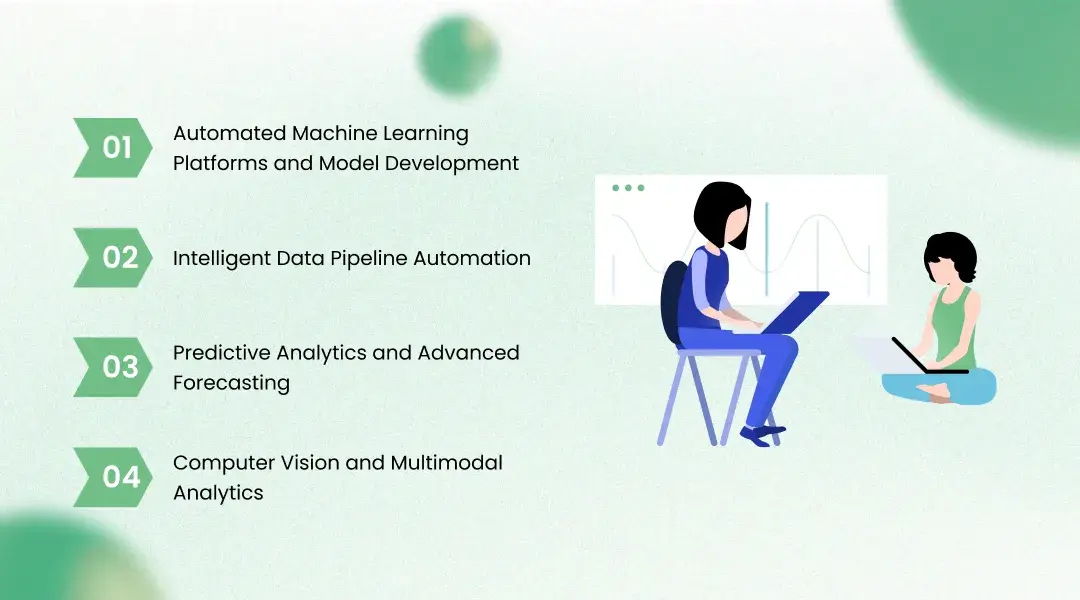
The application of AI within data science services is not a single technology replacement. It is a layered transformation that touches every phase of the analytics lifecycle. From data ingestion to model deployment and monitoring, AI technologies are automating, accelerating, and improving each step.
Automated machine learning platforms, commonly referred to as AutoML, represent the most visible AI driven change in data science services. These platforms automate the traditionally manual processes of feature engineering, algorithm selection, hyperparameter tuning, and model validation. Tools such as Google Cloud AutoML, H2O.ai, and DataRobot allow teams to evaluate hundreds of model configurations in hours rather than weeks.
The impact on service delivery is substantial. A consulting engagement that previously required a senior data scientist to spend three weeks testing algorithms can now generate optimized models in a single afternoon. This does not eliminate the need for human expertise, as interpreting results and ensuring ethical model behavior still require skilled practitioners. However, it shifts the role from manual computation to strategic oversight, increasing the value delivered per billable hour.
KriraAI has integrated automated machine learning platforms into its service delivery framework, enabling client teams to reach production ready models 40% faster than traditional approaches. By combining AutoML with domain specific feature libraries, KriraAI ensures that automation does not sacrifice contextual accuracy for speed.
Before any model can be built, data must be collected, cleaned, transformed, and loaded into analytical environments. Intelligent data pipeline automation uses AI to streamline this entire process. Machine learning algorithms can now detect schema changes in source systems, identify and correct data quality issues automatically, and optimize transformation logic based on downstream requirements.
Natural language processing plays a critical role in unstructured data processing within these pipelines. Service providers working with clients in legal, healthcare, or media industries can now use NLP models for entity extraction, sentiment analysis, and document classification at scale, replacing manual annotation processes with automated pipeline stages. AI driven pipelines also learn from previous runs and adapt to new data patterns, reducing the marginal cost of each subsequent engagement.
Predictive analytics has always been central to data science services, but AI is expanding both the accuracy and the scope of what can be predicted. Deep learning models can now process multivariate time series data with hundreds of input features, capturing nonlinear relationships that traditional statistical models miss entirely. Reinforcement learning algorithms are being applied to dynamic optimization problems such as supply chain routing, pricing strategy, and resource allocation.
For data science service providers, these capabilities open new revenue streams. Clients that previously engaged for descriptive reporting are now requesting real time prediction systems, anomaly detection engines, and prescriptive analytics platforms that recommend specific actions.
AI driven analytics solutions are no longer limited to tabular and text data. Computer vision models enable data science service providers to offer image and video analytics across industries. Manufacturing clients use visual inspection models to detect product defects. Retail clients deploy shelf monitoring systems that track inventory through store cameras. Agricultural clients leverage satellite imagery analysis for crop health assessment.
The convergence of multiple data modalities is creating demand for multimodal analytics capabilities that few traditional data science teams possess. Service providers that invest in these capabilities are positioning themselves to capture higher value engagements.
The business case for integrating AI into data science services is built on quantifiable outcomes. Organizations that have made this transition report measurable improvements across four critical dimensions.
AI driven data science workflows reduce time from data acquisition to actionable insight by 50% to 70% on average. A financial services firm that previously required six weeks to build a credit risk model can now complete the process in under two weeks using automated machine learning platforms combined with intelligent data pipeline automation.
Operational cost reductions of 30% to 45% are consistently reported by data science service providers that have adopted AI across delivery workflows. These savings come from reduced labor hours through automation, lower error rates that eliminate rework, and improved resource utilization through AI driven task allocation. A mid sized analytics consulting firm with 50 data scientists can effectively deliver the output of a 75 person team by integrating AI tools.
Automated model selection and ensemble techniques enabled by AI consistently produce models with 10% to 25% higher predictive accuracy compared to manually tuned alternatives. This improvement stems from AI's ability to evaluate a much larger search space of algorithms and hyperparameters than any human team could explore. Higher accuracy translates directly into better business decisions across demand forecasting, churn prediction, and fraud detection.
Data science service providers that deliver faster and more accurate results retain clients at significantly higher rates. Industry data suggests that AI adopting firms experience client retention rates above 85%, compared to an industry average closer to 65%. Faster delivery enables providers to take on more engagements per quarter, driving revenue growth of 20% to 35% annually. Scalable AI consulting models, where reusable components are deployed across multiple clients, further amplify this effect.
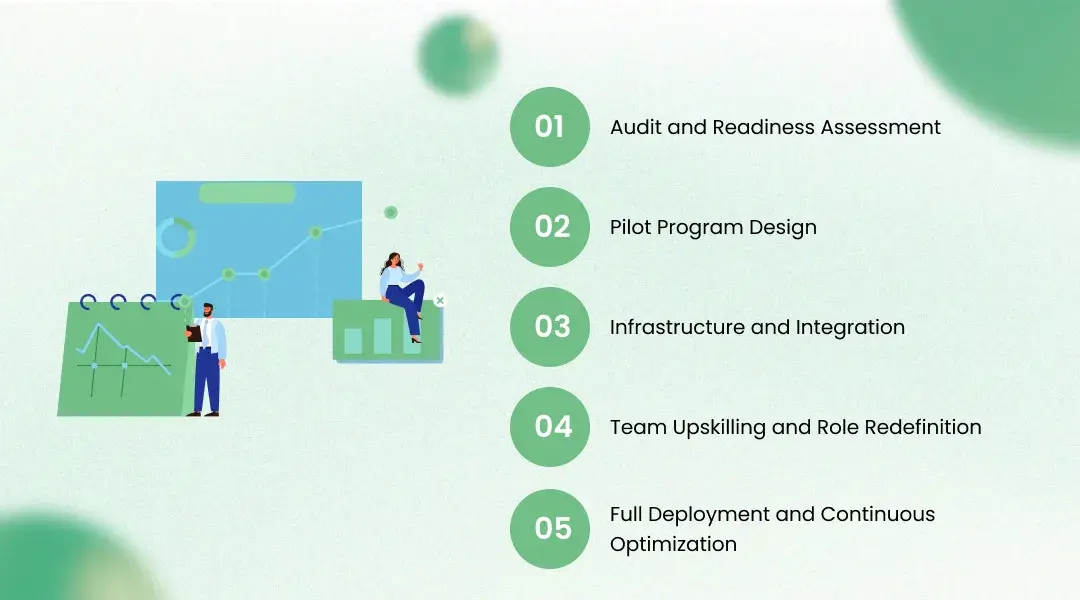
Adopting AI within a data science services organization is not a single purchase decision. It is a phased transformation that requires careful planning, investment, and change management. The following roadmap outlines the practical steps from initial assessment through full scale deployment.
The first step is an honest evaluation of your current capabilities and organizational readiness. This assessment should cover:
Data infrastructure maturity, including quality, accessibility, and governance of existing data assets.
Team skill profiles mapped against competencies required for AI augmented workflows.
Technology stack evaluation to identify integration compatibility with AI platforms.
Client engagement analysis to identify workflows with the highest automation potential.
Regulatory and compliance review to ensure alignment with data protection requirements.
Organizations that skip this step consistently underestimate the effort required and overcommit to timelines that erode team confidence when delays occur.
Select two to three internal projects or client engagements as pilot programs. These pilots should be complex enough to demonstrate AI's value but bounded enough to complete within six to eight weeks. Effective pilot candidates include:
A recurring analytics engagement where data preparation consumes more than 50% of project time.
A predictive modeling project where multiple algorithms are manually tested each cycle.
A client reporting workflow where insights are delivered as static documents rather than dynamic dashboards.
Track quantitative metrics including time savings, accuracy improvements, and cost reductions against traditional methods. Qualitative feedback from data scientists and stakeholders is equally important, as resistance to new tools often emerges during hands-on usage.
Based on pilot results, invest in infrastructure to support AI at scale. This includes cloud computing resources for model training, MLOps platforms for model versioning and deployment, and integration layers connecting AI tools with existing project management workflows.
KriraAI recommends a modular infrastructure approach where AI components are deployed as independent microservices that can be activated or replaced without disrupting the broader delivery pipeline. This architecture provides flexibility to adopt new capabilities as they mature.
AI adoption changes what data scientists do, not whether they are needed. Invest in structured training programs that help your team transition from manual model builders to AI augmented analysts. Critical skills to develop include prompt engineering for generative AI tools, MLOps and model lifecycle management, AI ethics and bias detection, and strategic interpretation of automated model outputs.
Role definitions should evolve accordingly. Junior data scientists may focus on data quality assurance and pipeline monitoring. Senior team members may shift toward solution architecture and client advisory roles. This redefinition prevents the perception that AI is replacing jobs, which is the single most common source of internal resistance.
Scale AI integration across all eligible engagements, establishing standardized workflows that combine automated and human driven steps. Implement continuous monitoring dashboards that track AI performance metrics alongside traditional project KPIs. Establish feedback loops where data scientists can flag AI outputs that require refinement, ensuring that automated systems improve over time rather than degrading as data patterns shift.
Organizations frequently stumble during AI adoption by making predictable errors. Awareness of these pitfalls significantly improves the probability of success.
Automating without understanding the process first leads to faster execution of flawed workflows rather than genuine improvement.
Choosing tools based on marketing claims rather than integration compatibility creates expensive shelfware that no one uses.
Failing to establish clear success metrics before launching pilots makes it impossible to objectively evaluate whether AI delivered value.
Underinvesting in change management leads to passive resistance from teams who view AI as a threat rather than an enabler.
Treating AI adoption as a one time project rather than an ongoing capability building effort results in initial gains that plateau within 12 months.
Data quality remains the most fundamental challenge. AI systems are only as effective as the data they process. Organizations with inconsistent data definitions or undocumented data lineage will find that AI amplifies existing problems rather than solving them. A model trained on biased data will produce biased predictions at scale.
The talent gap has shifted rather than closed. While AI reduces the need for manual model building, it increases demand for professionals who understand how to govern AI systems. MLOps engineers and solution architects with AI fluency are now in short supply.
Regulatory uncertainty creates hesitation, particularly in highly regulated industries such as financial services and healthcare. The European Union's AI Act and evolving U.S. federal guidelines impose requirements on model explainability, data usage, and algorithmic accountability that many AI tools are not yet designed to meet.
Integration complexity is frequently underestimated. Enterprise technology environments are rarely clean or standardized. Connecting AI platforms with legacy systems, proprietary databases, and diverse cloud environments requires significant engineering effort. KriraAI addresses this challenge by providing integration architecture consulting alongside its AI solutions, ensuring that new AI capabilities connect seamlessly with existing enterprise infrastructure.
Change management is the silent killer of AI initiatives. Even technically successful deployments fail when end users do not trust or adopt the new tools. Resistance from experienced data scientists who feel their expertise is being devalued is particularly common and damaging.
The next three to five years will bring changes to data science services that are more profound than anything the industry has experienced in the past decade. Several converging trends will reshape the competitive landscape in ways that reward early adopters and penalize hesitation.
Generative AI will evolve from content creation into analytical reasoning. Large language models are already applied to code generation and data summarization, but the next wave will see these models performing autonomous data exploration, hypothesis generation, and insight synthesis. Service providers will deploy AI agents that receive a business question in natural language and return a complete analytical report with minimal human intervention.
The democratization of analytics will accelerate. AI driven analytics solutions will make sophisticated capabilities accessible to business users without data science training. Natural language interfaces to data warehouses and self service predictive modeling tools will reduce dependency on specialized teams. Service providers that fail to evolve beyond what self service tools accomplish will face commoditization pressure.
Real time and streaming analytics will become the default. The traditional batch processing model will give way to continuous intelligence systems that process and act on data as it arrives. Data science services will focus on designing and maintaining these always on analytical systems rather than delivering periodic analyses.
Edge AI and federated learning will enable analytics in environments where centralized data processing is impractical or prohibited. Healthcare networks will train diagnostic models across hospitals without sharing patient data. Manufacturing operations will deploy inspection models directly on factory floor devices.
Companies that delay AI adoption will find the gap increasingly difficult to close. As competitors accumulate proprietary training data and refine automated workflows, the cost of catching up will grow exponentially. The window for entering the AI augmented data science market as a fast follower is narrowing rapidly.
The adoption of AI in data science services is not a speculative future trend. It is a structural shift already separating high performing organizations from those struggling to keep pace. Three core insights emerge from this analysis. First, AI technologies such as automated machine learning platforms and intelligent data pipeline automation are delivering measurable improvements in speed, cost, and accuracy. Second, successful implementation requires a disciplined, phased approach that balances technology investment with team development. Third, the competitive window for adopting scalable AI consulting practices is narrowing.
KriraAI helps data science service providers and enterprise analytics teams navigate this transition with practical, measurable AI solutions. Rather than offering generic platforms, KriraAI works as an implementation partner that combines automated machine learning, intelligent pipeline design, and strategic consulting to deliver results aligned with real business objectives.
If your organization is ready to modernize its data science capabilities, explore how KriraAI can help you design and execute the right adoption roadmap for your specific needs.
AI plays a transformative role in modern data science services by automating repetitive tasks that previously required extensive manual effort from skilled practitioners. Today, AI capabilities such as automated machine learning, intelligent data pipeline automation, and natural language processing are embedded across the analytics lifecycle, from data ingestion through model deployment and monitoring. Rather than replacing data scientists, AI augments their capabilities by handling routine tasks like feature engineering and algorithm selection at machine speed. This allows human practitioners to focus on higher value activities including strategic problem framing, model interpretation, and client advisory. Organizations that integrate AI into their data science workflows consistently report faster time to insight and higher model accuracy.
Automated machine learning platforms improve analytics outcomes by systematically evaluating a vastly larger space of modeling options than any human team could explore within practical constraints. These platforms automatically generate and test hundreds of feature combinations, apply dozens of algorithms with varied hyperparameter settings, and produce ranked model recommendations based on performance criteria. The result is a more rigorous model selection process that consistently identifies higher performing configurations. For data science service providers, this translates into faster project delivery without sacrificing quality, enabling teams to complete modeling phases in days rather than weeks. The platforms also improve reproducibility by documenting every decision in the pipeline.
The most significant challenges fall into five categories. First, data quality and infrastructure readiness present foundational barriers, as AI systems require clean, well governed data that many organizations lack. Second, talent demand is shifting toward MLOps engineers and AI ethicists who understand both AI capabilities and business context. Third, regulatory frameworks around AI are evolving rapidly, creating compliance uncertainty. Fourth, integration complexity is routinely underestimated, as connecting AI tools with legacy systems demands substantial engineering effort. Fifth, organizational change management often determines whether technically successful implementations achieve real world adoption, with resistance from experienced practitioners being common.
A realistic implementation timeline spans approximately 20 to 30 weeks from initial assessment to full deployment, though this varies based on organizational size and infrastructure maturity. The process typically begins with a four week audit, followed by a six week pilot program testing AI tools on representative projects. Infrastructure buildout requires an additional eight weeks, and team upskilling runs concurrently during weeks 12 through 20. Full deployment begins around week 20 and transitions into ongoing optimization. Organizations that skip the assessment or pilot phases consistently experience higher failure rates. A phased approach with clear success metrics at each stage produces more sustainable results.
AI will not replace data scientists in consulting and service firms, but it will fundamentally redefine their roles and responsibilities. The tasks most likely to be automated are repetitive and computation intensive, including data cleaning, feature engineering, algorithm testing, and report generation. These activities consume 60% to 80% of a data scientist's time yet represent the lowest value portion of their contribution. As AI absorbs these tasks, practitioners will shift toward strategic activities requiring human judgment, including problem formulation, model governance, and translating findings into business decisions. Firms that redesign their team structures around this division of labor will deliver more value per engagement at lower cost.
Founder & CEO
Divyang Mandani is the CEO of KriraAI, driving innovative AI and IT solutions with a focus on transformative technology, ethical AI, and impactful digital strategies for businesses worldwide.