For a field built on turning information into value, data science hides an uncomfortable truth. Industry surveys have repeatedly found that most machine learning models never reach production. Some estimates place that failure rate as high as 85 percent. The teams behind these models are rarely short on talent. They are simply buried under data cleaning, pipeline upkeep, and slow manual experimentation. This is exactly the gap that AI in data science is now closing.
The irony is sharp. The discipline that builds artificial intelligence is now being reshaped by it. Routine work that once consumed days is shrinking into minutes. Tasks that demanded a specialist can now be triggered by a plain sentence. For some teams this feels like a threat. For the sharpest teams it is the single biggest productivity unlock in a decade.
This blog breaks down what is actually happening, not the hype. We will cover the current state of data work and the specific technologies in play. We will examine the measurable business impact behind the adoption. We will then walk through a realistic roadmap, the honest limitations, and where this field is heading over the next five years.
Long before generative tools arrived, data science was already under strain. The demand for insight had exploded across every department. Marketing wanted attribution, finance wanted forecasts, and operations wanted optimization. Yet the supply of skilled data professionals could not keep pace. This imbalance created a permanent backlog that most organizations still recognize today.
The cost pressure sits underneath all of this. A senior data scientist is an expensive hire in any market. When that person spends most of the week wrangling messy spreadsheets, the economics break down. Studies have long shown that data professionals spend roughly 70 to 80 percent of their time preparing and cleaning data. Only a small slice of their effort goes to actual modeling and analysis.
Competitive dynamics make the squeeze worse. Companies now compete on how quickly they can turn raw data into a decision. A retailer that reprices daily beats one that reprices monthly. A lender that scores risk in seconds beats one that takes days. Speed of insight has quietly become a moat, and slow data teams erode it.
Here is the paradox at the center of the problem. Organizations have never collected more data, yet decision quality has not improved at the same rate. More dashboards do not mean more clarity. Many teams drown in reports while still guessing on the questions that matter most.
The bottleneck is rarely the data itself. It is the human time required to shape, query, and interpret that data. Every new data source adds maintenance burden rather than instant value. Without a way to compress that effort, hiring more analysts only scales the cost, not the output.
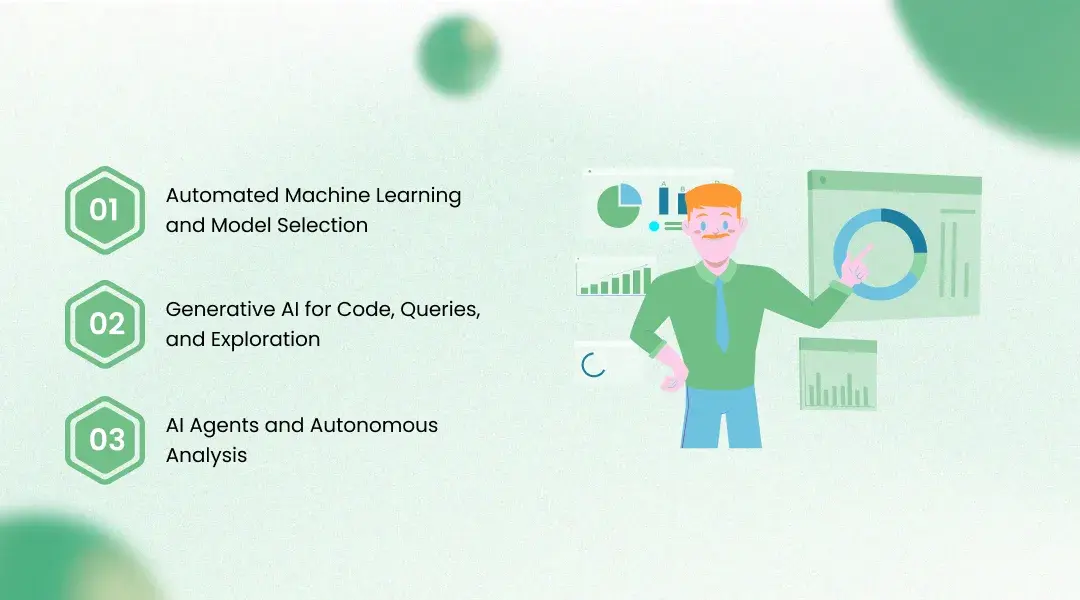
AI in data science is not a single tool. It is a stack of technologies, each attacking a specific bottleneck in the workflow. The real value comes from mapping the right technique to the right problem. Used carelessly, these tools add noise. Used well, they compress weeks of effort into hours.
Natural language processing now powers the conversational layer of analytics. Computer vision unlocks insight from images, documents, and scanned forms that once sat unused. Below are the technologies doing the heaviest lifting today. Each one is matched to the exact pain point it removes.
Automated machine learning, often called AutoML, attacks the slowest part of modeling. Selecting algorithms and tuning parameters once took weeks of trial and error. Automated machine learning now searches that space in hours. It tests dozens of model families, tunes them, and ranks the results. In typical projects it can cut initial model development time by 40 to 70 percent.
The practical applications are concrete and easy to name. AutoML handles churn prediction, credit scoring, demand forecasting, and lead ranking with minimal manual setup. It does not remove the expert. It removes the repetitive grind that kept the expert from higher value work.
Generative AI for data analysis has changed the daily texture of the job. A data scientist can now describe an analysis in plain English. The model writes the SQL, the Python, or the transformation logic in seconds. Controlled studies of AI coding assistants have shown task completion speeds improving by more than 50 percent. This matters most for the boilerplate that fills the average workday.
The applications go beyond code generation. Generative AI for data analysis can summarize a dataset, suggest features, and explain anomalies in readable language. It can translate a business question into a query without a single line written by hand. This is what brings nontechnical colleagues directly into the analysis.
The newest shift is the rise of autonomous AI agents. These systems do not just answer one prompt. They plan a multi step analysis, run it, check the result, and revise. An agent can profile a dataset, build a baseline model, and flag data quality issues without constant supervision. This is data science automation moving from single tasks to entire workflows.
Predictive use cases are where agents prove their worth. AI predictive analytics pipelines can now be assembled, monitored, and retrained with far less manual intervention. The agent watches for model drift and triggers a refresh when accuracy slips. Teams like KriraAI build exactly these kinds of agentic systems, designing them so that human review stays at the critical decision points rather than every step.
The business case for AI in data science is measured in time, money, and decisions. The gains are not abstract. They show up in cycle times, headcount efficiency, and revenue captured from faster insight. Here are the impact patterns that appear most consistently across adoption.
Model development cycles compress sharply. Tasks that took weeks of manual tuning often finish in days once automated machine learning enters the workflow.
Data preparation time drops. Teams that automate cleaning and feature work reclaim a large share of the 70 to 80 percent once lost to prep.
Insight reaches the business faster. Plain language querying lets managers answer questions in minutes instead of waiting in an analyst queue.
Forecast accuracy improves. AI predictive analytics models that retrain automatically catch shifts that static models miss.
Analyst capacity multiplies. One data scientist supported by AI tooling can cover the workload that previously needed two or three.
Errors and rework decline. Automated validation catches data quality problems before they corrupt a downstream decision.
The financial translation is where leaders pay attention. When data science automation reclaims even half of the time lost to preparation, the effective output of a team can nearly double. For a five person team, that is the equivalent of several new hires without the cost. This is why budget owners increasingly treat AI tooling as leverage rather than expense.
Revenue impact is equally direct in the right use cases. A pricing model that updates daily rather than monthly can lift margin by several percentage points. A churn model that flags at risk customers early can save a meaningful share of accounts. These are not theoretical numbers. They are the recurring outcomes that justify continued investment.
The talent equation reinforces the case. The United States Bureau of Labor Statistics projects data scientist employment to grow about 36 percent between 2023 and 2033. That is far faster than the average occupation. With demand outpacing supply, AI tooling becomes the only realistic way to scale output without an impossible hiring spree.
Adopting AI in data science fails most often when it skips the basics. The path that works is sequential, not a single leap. It moves from honest assessment, through a contained pilot, to scaled deployment. Each stage exists to reduce risk before the next.
Run a readiness audit. Map where your team spends time, where data quality is weak, and which decisions are slowest today.
Fix the data foundation. Reliable pipelines and clean sources matter more than any model you will build on top of them.
Choose one high value pilot. Pick a use case with a clear metric, an owner, and data that already exists.
Run the pilot against a baseline. Measure the before state honestly so the improvement is provable, not anecdotal.
Build the deployment path early. Decide how the model will be served, monitored, and retrained before you celebrate accuracy.
Scale to adjacent use cases. Reuse the pipeline, the monitoring, and the lessons rather than starting fresh each time.
Each stage protects the next from predictable failure. The audit prevents teams from automating a process that should be redesigned first. The pilot prevents a costly platform commitment before value is proven. The deployment focus prevents the classic trap of a brilliant model that never ships.
A trusted implementation partner can compress this timeline significantly. KriraAI works with enterprises to run this exact sequence, building practical AI systems that move from pilot to production rather than stalling in the lab. The emphasis stays on measurable outcomes and systems built to scale, not proof of concept demos that quietly die. This is where most internal efforts lose momentum without outside structure.
The most expensive mistakes in AI adoption are predictable. They repeat across industries and across team sizes. Knowing them in advance is the cheapest insurance available.
Chasing accuracy over deployment. A model that scores well in a notebook but never reaches users delivers zero value.
Skipping the data audit. Automating a broken process simply produces broken results at a faster pace.
Ignoring monitoring. Models decay as the world changes, and an unwatched model silently loses accuracy over months.
Over hiring before tooling. Adding headcount to a manual workflow scales cost instead of fixing the underlying bottleneck.
Treating AI as a one time project. Sustainable value comes from a repeatable system, not a single heroic build.
Avoiding these traps is less about technology and more about sequence. The teams that succeed treat AI adoption as an operating change, not a software purchase. They invest in the boring layers of data quality and monitoring first. They let those foundations carry the flashier models that follow.
AI in data science is powerful, but it is not magic. The honest view includes real friction that adoption guides often skip. Ignoring these limits is how promising projects collapse. Here is what actually goes wrong.
Data quality remains the single largest constraint. Automated tools amplify whatever they are fed, including the errors. A model trained on inconsistent or biased data will produce inconsistent or biased decisions, only faster. No amount of automation fixes a foundation that was never solid.
Talent gaps create a second hurdle. Using AI tools well still requires people who understand statistics, bias, and business context. The tools lower the floor, but they do not remove the need for judgment. A plausible looking output can still be dangerously wrong without an expert to catch it.
Regulatory and governance constraints add weight, especially in regulated sectors. Finance, healthcare, and lending face strict rules on explainability and fairness. A model that cannot justify its decisions may be unusable regardless of accuracy. Compliance is not an afterthought in these settings, it is a gate.
Integration complexity is the quiet killer of timelines. Connecting AI tools to legacy systems, messy databases, and existing dashboards is rarely smooth. Change management is harder still, because people resist tools they do not trust. Adoption stalls when teams are handed automation without training or context.
Cost and vendor lock in deserve attention too. Powerful tooling can carry recurring fees that grow with usage. Teams should weigh build against buy and keep an exit path open. Locking a core capability behind one vendor is a strategic risk, not just a budget line.
Within three to five years, the data scientist role will look meaningfully different. The shift is from builder to director. Less time will go to writing code and tuning models by hand. More time will go to framing problems, judging tradeoffs, and governing automated systems. The job becomes more strategic, not less important.
Autonomous agents will own larger stretches of the workflow. Today an agent assists with a task. Soon a fleet of agents will run routine analysis, monitor models, and surface findings for human review. Data science automation will extend from single steps to continuous, self managing pipelines. The human role shifts toward setting goals and validating the hard calls.
Augmented analytics will push insight to the edge of the organization. Business users will query data in plain language and trust the answer. The wall between analyst and decision maker will keep thinning. This widens who can participate in data work, rather than narrowing it to specialists.
The competitive split will be stark. Companies that treat AI as leverage will compound their advantage every quarter. Their decision speed and forecast accuracy will pull steadily ahead. Companies that resist, fearing job loss or clinging to manual habits, will fall behind quietly at first and then suddenly.
The teams left behind will not be the ones without data scientists. They will be the ones whose data scientists were never freed from manual work. The losers in this shift are defined by workflow, not headcount. AI predictive analytics will also grow more proactive, recommending the action to take rather than only forecasting what will happen. That step, from prediction to prescription, is the next real frontier.
The story of AI in data science is not about replacement. It is about leverage, and three points carry the whole argument. First, the real bottleneck was never data, it was the human time spent preparing and querying it. Second, the technologies that remove that bottleneck, from automated machine learning to autonomous agents, are already delivering measurable gains. Third, the teams that fall behind will be those whose talent stays trapped in manual work, not those without talent.
The practical challenge is moving from interest to a working system. That is the gap where most efforts stall, somewhere between a promising pilot and reliable production. KriraAI exists to close exactly that gap, building practical AI solutions for enterprises that are measurable, durable, and designed to scale. The focus stays on outcomes a business can see in its cycle times and its margins, not on demos that impress and then fade.
If your data team is spending more time maintaining than deciding, that is the signal to act. Treating AI as leverage rather than threat is the clearest competitive choice available this decade. You can explore how KriraAI helps companies turn data science from a cost center into a speed advantage, and start with a single high value use case rather than a sweeping overhaul.
AI will not replace data scientists, but it will reshape what they do every day. The repetitive parts of the job, such as data cleaning, code writing, and model tuning, are increasingly automated. What remains is the work that needs human judgment, including framing the right question, checking for bias, and connecting analysis to business strategy. The role shifts from manual builder to strategic director of automated systems. Demand for these skills is still rising sharply, with employment projected to grow about 36 percent over the decade. The professionals at risk are those who refuse to adopt AI tools, not the role itself.
AI in data science is applied to automate and accelerate nearly every stage of the analytical workflow. Automated machine learning selects and tunes models that once took weeks of manual effort. Generative AI for data analysis writes code, builds queries, and explains datasets in plain language. Natural language processing lets nontechnical users ask questions of data directly. AI predictive analytics builds forecasting systems that retrain themselves as conditions change. Autonomous agents now chain these steps together, running whole analyses with limited supervision. The common thread is removing repetitive manual work so that human experts can focus on judgment, strategy, and validation.
Automated machine learning, commonly shortened to AutoML, is the practice of automating the most repetitive parts of building a model. Instead of a data scientist manually testing algorithms and tuning parameters, the system searches that space automatically. It tests many model families, optimizes their settings, and ranks the results by performance. This can reduce initial model development time by roughly 40 to 70 percent in typical projects. AutoML is widely used for churn prediction, credit scoring, demand forecasting, and similar structured problems. It does not remove the need for an expert. It removes the slow, manual grind so the expert can focus on framing and validation.
AI can perform large portions of data analysis on its own, but full autonomy without human oversight remains risky. Modern AI agents can profile a dataset, build a baseline model, detect anomalies, and write a summary without step by step instructions. This is what data science automation looks like in practice today. However, these systems can still misread context, amplify bias in the data, or produce confident but wrong conclusions. For low risk, routine analysis, autonomous operation is increasingly reliable. For high stakes decisions in finance, healthcare, or compliance, a human expert must review the output before it is trusted.
In the age of AI, data scientists need a blend of technical depth and strategic judgment rather than coding alone. Strong foundations in statistics, experimental design, and bias detection matter more than ever, because automated outputs still need scrutiny. The ability to frame a business problem clearly is now a core skill, since AI handles much of the execution. Familiarity with AI tools, prompting, and machine learning operations is becoming standard rather than optional. Communication also rises in value, as analysts increasingly translate automated insight for decision makers. The most valuable professionals direct AI systems toward business outcomes rather than competing with them.
Founder & CEO
Divyang Mandani is the CEO of KriraAI, driving innovative AI and IT solutions with a focus on transformative technology, ethical AI, and impactful digital strategies for businesses worldwide.