A 2025 industry survey by Grand View Research found that 68 percent of chatbot development companies with fewer than 50 employees still rely on manual conversation design workflows, spending an average of 34 hours per project on tasks that AI could reduce to under 8 hours. For a firm with 15 to 40 developers, designers, and project managers, those lost hours translate directly into fewer projects delivered per quarter and a widening gap between your firm and the larger agencies that have already integrated AI into their operations. If you run or manage a chatbot development firm with 10 to 50 employees, this blog was written specifically for you.
The chatbot development industry sits in a unique position. You build AI products for your clients, yet the internal operations of your own firm may still run on spreadsheets, manual QA reviews, and hand crafted conversation flows. Companies of your size occupy a difficult middle ground where you are too large to operate on founder hustle alone but too small to afford the dedicated AI infrastructure teams that agencies with 200 or more employees maintain. This guide walks you through exactly how AI for small chatbot development firms works in practice, what it costs, what it returns, and how to implement it without disrupting the client work that keeps revenue flowing.
Understanding your operational constraints is the first step toward smart AI investments. A chatbot development firm with 10 to 50 employees typically operates with a lean structure where most team members wear multiple hats. Your senior developers are also your architects. Your project managers double as client success leads. Your QA process probably involves the same people who wrote the conversation flows reviewing their own work, creating blind spots that cost you in client satisfaction.
Budget ranges for firms of this size in the chatbot space typically fall between $800,000 and $5 million in annual revenue. Technology spending usually accounts for 12 to 18 percent of that revenue, which means your total tooling budget sits somewhere between $96,000 and $900,000 per year, and most of that is already allocated to existing platforms, cloud hosting, and development environments. The budget available for new AI tooling is often a fraction of that, perhaps $15,000 to $80,000 annually, which rules out enterprise AI platforms that start at six figures.
Your technology stack is likely built around one or two chatbot platforms such as Dialogflow, Rasa, or Microsoft Bot Framework, supplemented by custom NLP work and integrations with client systems. Decision making tends to be fast compared to enterprises, with the founder or CTO able to approve a new tool purchase within days rather than months. That speed is an advantage you should exploit. The pressure you face that larger firms do not is the constant tension between project delivery and internal improvement. Every hour spent on internal tooling is an hour not billed to a client.
The AI advice that dominates industry publications is written for two audiences: solo developers experimenting with APIs, or Fortune 500 companies deploying AI across thousands of employees. Neither model works for a chatbot firm with 10 to 50 people, and following either path will waste your limited resources. AI implementation for small dev teams requires a fundamentally different approach.
A solo developer can experiment freely because the cost of failure is just their own time. A Fortune 500 company can run 18 month pilots because a failed experiment barely registers on their balance sheet. Your firm sits between these extremes. A bad AI investment that costs $30,000 and consumes 200 engineering hours can meaningfully damage your quarterly performance. You need AI tools that deliver value within 30 to 60 days.
Enterprise AI vendors like IBM Watson and Salesforce Einstein price their solutions for companies spending $500,000 or more annually on AI infrastructure. Those vendors will not serve your firm, and their solutions require dedicated teams to manage. On the other end, free tier API access and open source tools require significant engineering time to customize and maintain, a hidden cost that small teams underestimate. The sweet spot for firms of your size is the growing category of mid market AI tools that offer pre built integrations and usage based pricing. Companies like KriraAI specialize in building practical AI solutions for exactly this segment, understanding that a 30 person chatbot firm needs something between a raw API and an enterprise platform.
The internal skill requirements also differ sharply. You do not need to hire a machine learning engineer. What you need is one or two senior developers who understand prompt engineering, API integration patterns, and how to evaluate AI model outputs. These skills can be developed internally within four to six weeks, which is far more practical than a $150,000 ML engineer hire.
The timeline to see returns is compressed at your scale, which is actually an advantage. While enterprises take 12 to 24 months to see ROI from AI investments due to organizational complexity and approval cycles, a firm with 10 to 50 employees can implement an AI tool, train the team, and measure impact within 45 to 90 days. KriraAI has observed that small chatbot firms that follow a structured 60 day implementation plan recover their AI investment costs within the first quarter of deployment.
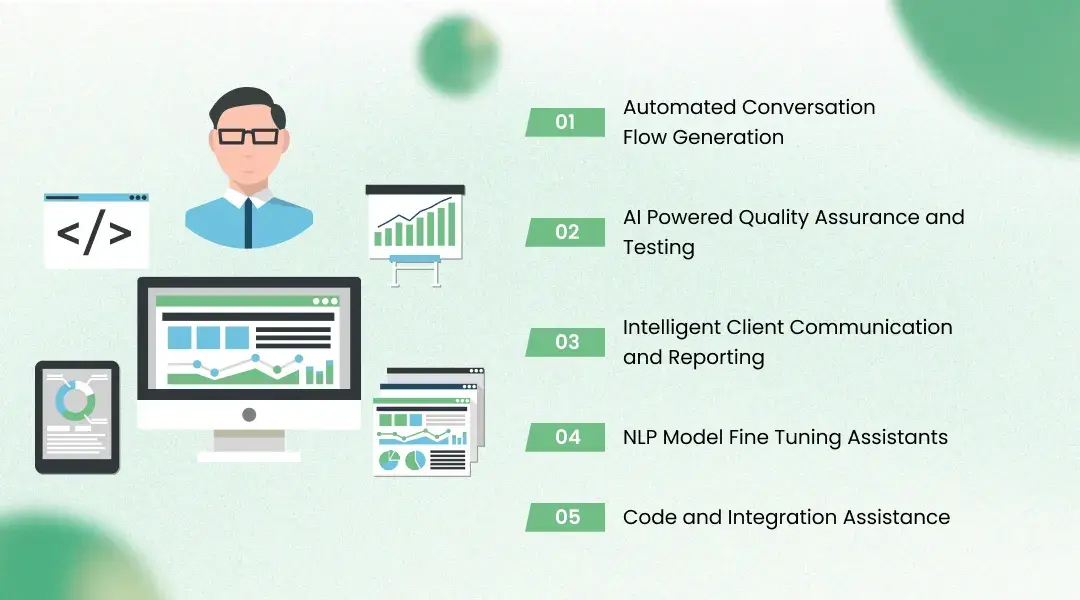
Not every AI application deserves your attention. The cost of AI tools for chatbot companies at your scale needs to justify itself against very specific operational needs. Here are the applications that deliver the highest return for firms of your size in this industry.
Modern AI tools can generate initial conversation flow drafts from a client brief, producing 60 to 80 percent of a workable flow in minutes instead of the 6 to 10 hours a designer typically spends. The output still requires human review, but the time savings per project are substantial. Tools in this category cost between $200 and $800 per month. For a firm handling 8 to 15 projects per quarter, this single application can save 120 to 200 hours of designer time quarterly.
Manual chatbot QA is one of the most tedious and error prone tasks in your workflow. AI testing tools can simulate thousands of user conversations, identify dead ends, detect sentiment mismatches, and flag intent recognition failures at a speed no human team can match. For a 10 to 50 person firm, the typical cost is $300 to $1,200 per month. The practical result is a 40 to 60 percent reduction in post launch bug reports from clients, which directly improves retention rates and reduces unpaid rework.
AI tools that auto generate client status reports, summarize project progress from ticketing systems, and draft client communications save project managers 5 to 8 hours per week. At your scale, where one project manager typically handles 4 to 6 active clients, this time savings is the difference between responsive service and the delayed communications that lead to churn. These tools generally cost $50 to $200 per user per month.
For firms building chatbots on custom NLP models, AI assisted fine tuning tools can reduce the iteration cycle from days to hours. These tools suggest data augmentation strategies, identify training set gaps, and automate hyperparameter optimization. The cost of AI tools for chatbot companies in this category ranges from $500 to $2,000 per month, but the acceleration in model quality improvement can reduce client time to deployment by 30 to 50 percent.
AI coding assistants tuned for chatbot frameworks can accelerate integration development and generate boilerplate connector code specific to conversation AI architectures. For a team of 10 to 50, licensing typically costs $20 to $40 per developer per month, making this one of the lowest barrier, highest return AI investments available.
The chatbot business ROI from AI becomes concrete when you map efficiency gains to the financial reality of a 10 to 50 person firm. Consider a firm with 25 employees generating $2.5 million in annual revenue.
Automated conversation flow generation saves an average of 160 hours per quarter across the design team. At a blended cost of $65 per hour for a mid level conversation designer, that represents $41,600 in annual capacity freed up. AI powered QA reduces post launch defect resolution time by 45 percent, saving approximately 320 hours annually in rework, which adds another $20,800 in recovered capacity. Intelligent reporting tools save each project manager 6 hours per week, totaling roughly 1,250 hours annually across a three person PM team, worth $56,250 in time value.
The combined annual value of these three applications alone exceeds $118,000 in recovered capacity and efficiency gains. The total cost of the AI tooling to achieve this sits between $18,000 and $36,000 per year, yielding a return on investment ratio between 3.3 to 1 and 6.5 to 1. It represents a 4.7 percent effective revenue increase through capacity gains alone, before accounting for the additional projects that freed up capacity enables you to take on.
Beyond efficiency, firms that integrate AI automation in chatbot development report a 25 percent improvement in client satisfaction scores within six months. For a firm where losing a single $150,000 annual client represents a 6 percent revenue hit, even a modest improvement in retention has outsized financial impact.
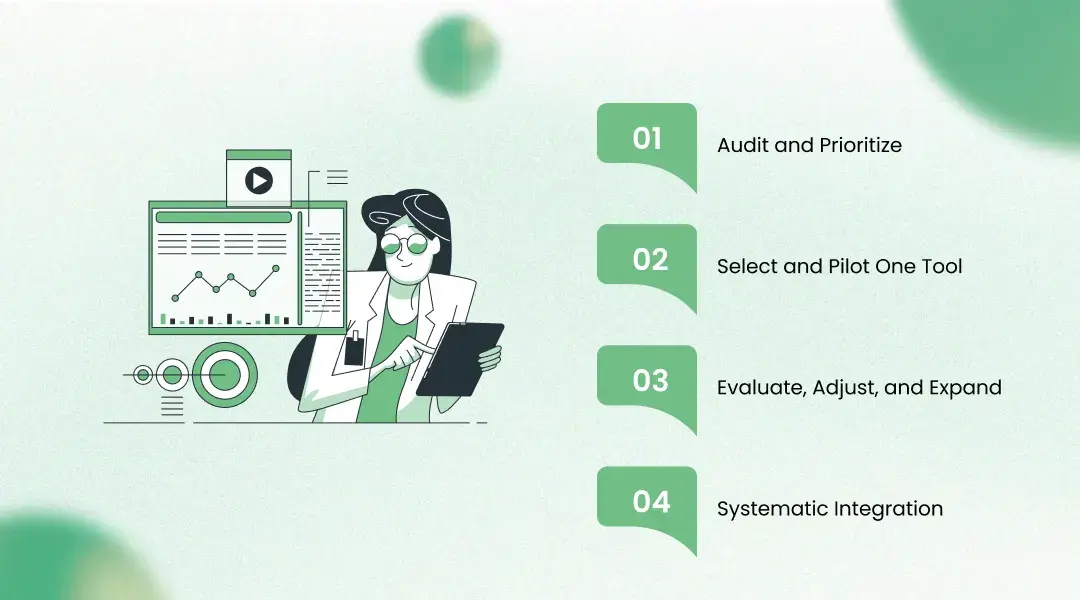
AI implementation for small dev teams succeeds or fails based on sequencing. You cannot adopt everything at once, and you should not try. Here is the realistic timeline for a chatbot firm with 10 to 50 employees.
Map every repeatable workflow in your firm. Document time spent on conversation design, QA testing, client communication, code development, and project management. Identify the three workflows where time consumption is highest relative to value delivered. Survey your team to understand which tasks they find most tedious and where they believe errors are most likely. This audit does not require external help and should involve your project managers and team leads over two to three focused sessions.
Choose a single AI tool addressing your highest priority workflow. Do not select multiple tools simultaneously. Run a controlled pilot on two to three active projects, with clear metrics defined before the pilot begins.
Track these metrics during the pilot:
Time spent on the target workflow before and after AI assistance.
Output quality as measured by client feedback or internal review scores.
Team adoption rate and any resistance points.
Actual cost versus projected cost at your usage volume.
Integration friction with your existing technology stack.
Analyze pilot results against your predefined metrics. If the tool delivered a positive return, roll it out to the full team and begin the selection process for the second tool. If results were negative, diagnose whether the issue was the tool itself, the implementation approach, or unrealistic expectations. Companies like KriraAI offer implementation consulting specifically for this evaluation phase, helping small firms interpret pilot data and make informed expansion decisions.
Over the following three months, add one new AI tool every four to six weeks. Each addition follows the same pilot, measure, and expand cycle. By the six month mark, you should have three to four AI tools integrated into your daily workflow, each delivering measurable value.
The first mistake is trying to build custom AI solutions instead of buying purpose built tools. Spending 400 hours building an internal AI testing tool when a $500 per month commercial solution exists is not a good use of resources. The opportunity cost of those engineering hours far exceeds several years of subscription costs.
The second mistake is selecting tools based on feature lists rather than integration simplicity. A tool with 50 features that requires a dedicated engineer to maintain is worse than a tool with 10 features that plugs into your existing workflow in under a day.
The third mistake is failing to designate an internal AI champion. You need one senior team member who spends 10 to 15 percent of their time evaluating tools, supporting team adoption, and tracking performance metrics. Without this person, AI tools get adopted enthusiastically for two weeks, then gradually abandoned as old habits return.
Small chatbot development firms face AI adoption challenges that neither solo operators nor large enterprises encounter. The most significant is the capacity paradox. Every hour your team spends learning and adapting to AI tools is an hour not spent on billable client work. Unlike an enterprise with dedicated R&D budgets, your implementation cost comes directly out of production capacity. Managing this requires allocating 10 percent of team capacity to internal tooling improvements on an ongoing basis rather than attempting intensive implementation sprints.
Data privacy presents another challenge specific to this segment. Your clients trust you with their customer conversation data, and many have contractual restrictions on how that data can be processed. Using AI tools that send conversation data to third party APIs may violate client agreements. You need to evaluate every AI tool's data handling practices carefully, and in some cases, you may need to choose self hosted solutions that cost more but preserve client trust.
Talent retention adds another layer of difficulty. Your best developers will expect access to modern AI tools, and the firms that offer those tools will attract stronger talent. At the same time, introducing AI tools sometimes creates anxiety among team members who fear their roles will be diminished. Transparent communication about AI as a productivity multiplier, combined with involving your team in tool selection decisions, mitigates this risk.
The chatbot development industry is heading toward a clear bifurcation over the next three to five years. Firms that integrate AI into their internal operations will deliver projects 40 to 60 percent faster at 20 to 30 percent lower cost. Firms that do not adopt AI internally will find themselves unable to compete on either speed or price.
For firms with 10 to 50 employees, the competitive dynamics are particularly acute. You are large enough that clients expect professional delivery timelines and quality guarantees, but small enough that efficiency improvements have an outsized impact on profitability. A firm that saves 15 hours per project through AI automation can either reduce pricing to win more contracts or maintain pricing and improve margins. Over 50 projects per year, that is 750 hours of competitive advantage.
By 2028, industry analysts project that 85 percent of successful chatbot development firms will use AI tools for at least three internal workflows. The firms that are implementing now will have 18 to 24 months of operational learning advantage over those that start later. That learning curve, the accumulated knowledge of which tools work, how to integrate them, and how to train teams effectively, is a durable competitive moat that cannot be replicated quickly.
Three insights should guide your AI strategy as a small chatbot development firm. First, AI adoption at your scale is a sequenced journey, not a wholesale transformation. Start with one high impact workflow, prove the value, and expand. Second, the financial case is compelling. A combined investment of $18,000 to $36,000 per year can unlock over $118,000 in annual capacity gains. Third, the competitive window is narrowing. Firms that begin now will accumulate 18 to 24 months of operational learning advantage that late movers will struggle to close.
KriraAI works with chatbot development firms of exactly this size, building practical AI solutions that fit the budget, team structure, and growth trajectory of companies with 10 to 50 employees. Rather than offering scaled down enterprise platforms or startup tools stretched beyond their limits, KriraAI designs implementations that match the specific operational reality of small development firms. If your firm is ready to turn AI from a product you sell into an advantage you use, exploring what KriraAI can build for your team is a practical next step worth taking.
A chatbot development firm with 10 to 50 employees can begin meaningful AI adoption with a budget of $500 to $1,500 per month, which covers a single high impact tool such as an AI powered QA testing platform or a conversation flow generation assistant. This is not a large investment relative to the typical tooling budget of a firm this size, and it should be treated as a productivity investment rather than a technology experiment. The key is to select one tool that addresses your most time consuming workflow and measure the return before expanding. Most firms recover this initial cost within 60 to 90 days through direct time savings.
For a chatbot development firm with 10 to 50 employees following a structured implementation approach, measurable ROI typically appears within 45 to 90 days of deploying the first AI tool. This timeline is significantly shorter than what enterprises experience because small firms have faster decision cycles, less organizational inertia, and more immediate visibility into the impact of workflow changes. The initial returns usually manifest as time savings on specific tasks, such as QA testing taking 50 percent less time or conversation flow drafts being completed in hours instead of days. Financial ROI, measured as recovered billable capacity or additional projects delivered, becomes clear by the end of the first full quarter. Firms that work with implementation partners like KriraAI tend to reach this milestone 20 to 30 percent faster because they avoid the common trial and error period that comes with unguided adoption.
AI tools in the chatbot development industry are augmentation technologies, not replacement technologies, particularly at the 10 to 50 employee scale. These tools automate the repetitive, time consuming portions of workflows such as initial conversation flow drafting, regression testing, and boilerplate code generation while leaving the strategic, creative, and client facing work to your human team. A conversation designer who uses AI to generate initial flow drafts does not become unnecessary. They become more valuable because they can focus on the complex interaction patterns, edge cases, and user experience nuances that AI cannot handle effectively. Firms that adopt AI typically redeploy freed up capacity toward higher value activities like advanced NLP customization, client strategy consulting, and new service line development rather than reducing headcount.
The primary risk for firms with 10 to 50 employees is not the technology itself but rather poor implementation sequencing. Adopting too many tools simultaneously without proper evaluation leads to tool fatigue, wasted budget, and team frustration that creates lasting resistance to future AI initiatives. Data security is the second significant risk, as many AI tools require sending client conversation data to cloud APIs, which may violate your client contracts or industry regulations. The third risk is dependency on a single AI vendor without an exit strategy. Mitigating these risks requires phased adoption, careful vendor evaluation including data handling audits, and maintaining the ability to revert to manual processes for any AI augmented workflow.
For chatbot development firms with 10 to 50 employees, the answer is almost always to buy rather than build, at least initially. Building custom AI tools requires significant engineering time, ongoing maintenance, and expertise in machine learning operations that most firms this size do not have in house. A custom AI testing tool might take 400 to 600 engineering hours to build and another 100 to 200 hours annually to maintain, while a commercial solution costs $3,600 to $14,400 per year with maintenance handled by the vendor. The better approach is to integrate commercial AI APIs into a lightweight custom wrapper when your workflow is highly specialized, rather than building from scratch. Save your engineering capacity for client work and revenue generating innovation.
Founder & CEO
Divyang Mandani is the CEO of KriraAI, driving innovative AI and IT solutions with a focus on transformative technology, ethical AI, and impactful digital strategies for businesses worldwide.